
When a toddler inserts a card into a talking flash card machine, the audio that plays must be flawless. If the pronunciation is muffled, the accent is incorrect, or there is background static, the educational value of the toy is destroyed, and customer returns will skyrocket. For B2B buyers creating custom OEM/ODM talking flash cards, understanding the professional audio recording workflow is critical to ensuring a premium final product.
Why Does Audio Quality Matter So Much?
The primary function of a talking flash card is to model correct pronunciation for early language learners. Children in the critical period of language acquisition (ages 1-5) are highly sensitive to phonetics. The American Speech-Language-Hearing Association emphasizes that clear, accurate auditory input is essential for proper speech development, particularly for children utilizing these toys for speech therapy [1].
Poor audio quality—often characterized by low bitrates, robotic text-to-speech (TTS) voices, or heavy compression artifacts—not only frustrates parents but can actively hinder a child’s phonetic development. High-fidelity audio, recorded by professional voice actors, is a key differentiator between a cheap commodity toy and a premium educational brand.
What Are the Steps in the Audio Recording Workflow?
Creating the audio files for a custom talking flash card deck involves a rigorous, multi-step process. B2B buyers should expect their manufacturing partner to follow this workflow:
- Voice Talent Selection: The brand selects a voice actor based on target demographics. For the US market, a standard American English accent with a warm, enthusiastic, and articulate tone is preferred. For bilingual cards, native speakers of both languages must be utilized.
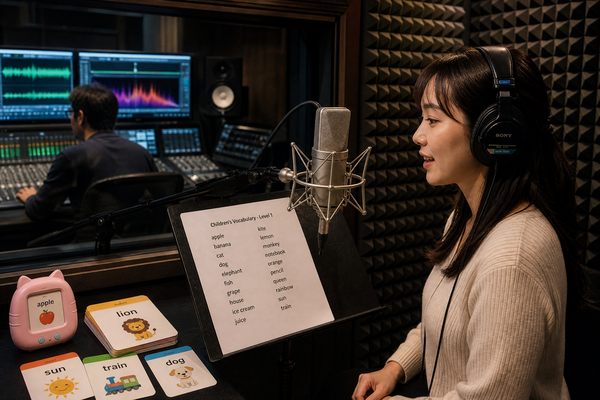
- Studio Recording: The script (the vocabulary list) is recorded in a professional, soundproof studio using high-end condenser microphones to eliminate all background noise and room echo.
- Audio Editing and Mastering: Audio engineers clean the recordings. They remove breaths, mouth clicks, and normalize the volume levels so that every word plays at the exact same loudness.
- Sound Effect Integration: For categories like Animals or Vehicles, authentic sound effects (e.g., a real dog barking, a real fire truck siren) are mixed with the voice recording.
- File Formatting and Compression: The final audio files are compressed to fit onto the toy’s internal memory chip (usually SPI Flash memory). The challenge is compressing the files to save memory costs without introducing audible distortion.
Audio Quality Comparison: Premium vs. Cheap
| Feature | Premium Audio (Toyvao Standard) | Cheap Commodity Audio |
|---|---|---|
| Voice Source | Professional Human Voice Actor | Robotic Text-to-Speech (TTS) |
| Recording Environment | Soundproof Studio | Uncontrolled Environment |
| Sound Effects | Authentic, High-Fidelity Samples | Low-Resolution, Generic Beeps |
| Volume Consistency | Normalized (All words equal volume) | Highly Variable |
How to Manage Bilingual and Multi-Language Audio?
The global market for bilingual educational toys is expanding rapidly. Grand View Research highlights the surging demand for English-Spanish and English-Mandarin learning tools [2].
When producing bilingual cards, the audio workflow becomes more complex. The device must seamlessly switch between audio tracks based on the optical code on the card. Furthermore, the translation must be culturally accurate, not just a literal machine translation. A professional factory partner will manage the complex mapping of optical codes to the correct language audio files, ensuring the device plays the correct language instantly.
How Toyvao Guarantees Crystal Clear Audio
At Toyvao, we treat audio engineering with the same rigor as our hardware engineering. We do not use cheap, robotic TTS voices.
We partner with professional voice studios to provide our B2B clients with crystal-clear, native-speaker recordings in over 15 languages. Our audio engineers meticulously master every sound file to ensure optimal playback through our custom-designed acoustic cavities and high-fidelity speakers. We balance compression algorithms perfectly, maximizing the number of words you can fit on a chip without ever sacrificing audio clarity. Partner with Toyvao to ensure your talking flash cards speak volumes about your brand’s quality.
References
[1] American Speech-Language-Hearing Association (ASHA). “Speech and Language Development.”
[2] Grand View Research. “Educational Toys Market Size, Share & Trends Analysis Report.”
[3] The Toy Association. “Trends in Educational and STEM/STEAM Toys.”
Demand crystal-clear audio for your educational toy brand? Contact Toyvao today!
Email: sales@toyvao.com | WhatsApp: https://wa.me/8618681064480
Related Articles
Useful Resources
