
The demand for educational toys is not limited to English-speaking countries. The global market for early childhood learning tools is expanding rapidly across Europe, Latin America, the Middle East, and Asia. However, B2B buyers cannot simply take an English talking flash card product, run the vocabulary list through Google Translate, and expect it to sell in Germany or Japan. To successfully penetrate international markets, brands must invest in deep localization and cultural adaptation.
What Is the Difference Between Translation and Localization?
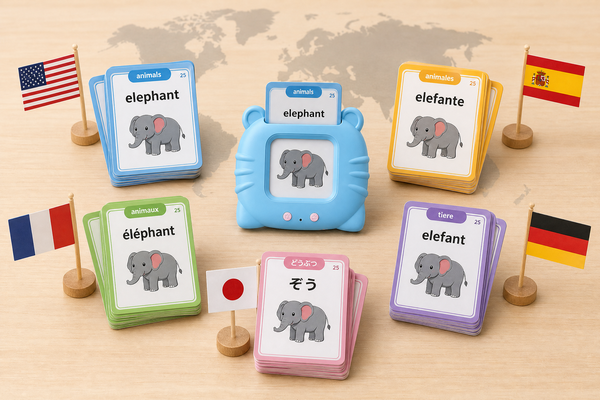
Translation is the simple conversion of text from one language to another. Localization is the adaptation of a product to meet the language, cultural, and educational expectations of a specific target market.
For talking flash cards, localization impacts both the physical cards and the audio files:
- Linguistic Accuracy: A direct translation often fails. For example, the English word “Owl” might translate to “Búho” in Spanish, but regional dialects matter. Is the target market Spain or Mexico? The pronunciation and even the vocabulary choices must match the specific locale.
- Cultural Relevance: The images on the flashcards must resonate with the local culture. A picture of a classic yellow American school bus might not be recognizable to a toddler in rural France. The foods, vehicles, and clothing depicted on the cards should reflect the child’s daily reality.
- Educational Standards: Different countries have different early childhood education frameworks. The categorization of words and the introduction of concepts (like phonics vs. whole-word recognition) must align with local pedagogical standards.
How to Execute a Multi-Language Audio Strategy?
When a B2B brand decides to launch a multi-language product (e.g., an English-French bilingual machine), the audio engineering becomes significantly more complex.
The device relies on an optical sensor reading a barcode printed on the card. For a bilingual machine, the factory must program the microcontroller (MCU) to recognize the code and then trigger two separate audio files in sequence (e.g., “Apple” [pause] “Pomme”). Alternatively, the device might feature a physical toggle switch allowing the user to select the active language.
The World Health Organization (WHO) notes that early exposure to multiple languages enhances cognitive flexibility in toddlers [1]. Marketing this cognitive benefit is highly effective, provided the audio execution is flawless. The audio must be recorded by native speakers; a slight foreign accent in an educational toy will immediately trigger negative reviews from native-speaking parents.
Localization Strategy Checklist
| Localization Element | Key Consideration | Impact on Market Success |
|---|---|---|
| Audio Voiceover | Must use native speakers of the specific regional dialect | Critical (Prevents negative reviews) |
| Card Imagery | Illustrations must be culturally recognizable | High (Ensures child engagement) |
| Vocabulary Selection | Avoid direct translations of idioms or culturally specific items | High (Maintains educational value) |
| Packaging & Manuals | Fully translated, complying with local safety warnings (e.g., CE mark for EU) | Critical (Legal compliance) |
How Does Factory Collaboration Enable Global Expansion?
Executing a global localization strategy requires a manufacturing partner with international experience. A factory that only produces for the domestic Chinese market will struggle to manage the complexities of multi-language audio mapping and international compliance.
A premium OEM/ODM factory provides the technical infrastructure for localization. They manage the complex optical code matrices required for bilingual cards. They ensure the memory chips have sufficient capacity to hold multiple high-fidelity audio tracks. Furthermore, experienced factories understand the specific safety testing and packaging requirements (like the WEEE directive or specific CE marking rules) required for different global regions [2].
How Toyvao Supports Your Global Brand Expansion
At Toyvao, we are experts in global educational toy manufacturing. We have successfully produced localized talking flash cards for markets across North America, Europe, Southeast Asia, and the Middle East.
We offer our B2B partners seamless multi-language support. Whether you need a Spanish-English bilingual deck for the US Hispanic market, or a fully localized German version for the EU, we handle the technical execution. We manage the complex audio programming, ensure pristine native-speaker audio quality, and guarantee that your packaging and product labeling meet all local regulatory requirements. Partner with Toyvao to take your educational toy brand global.
References
[1] World Health Organization (WHO). “Improving early childhood development.”
[2] U.S. Consumer Product Safety Commission (CPSC). “International Consumer Product Safety.”
[3] The Toy Association. “Global Toy Market Trends.”
Ready to launch your talking flash cards in international markets? Contact Toyvao today!
Email: sales@toyvao.com | WhatsApp: https://wa.me/8618681064480
