
Executive Summary
Packaging for Picture Book Reading Pens (Story Pens, Talking Book Pens, OID Reading Pens) is now a procurement item that directly affects regulatory compliance, retailer acceptance, logistics cost, and end-customer perception. Buyers sourcing story pens for retail or e‑commerce must evaluate packaging across three vectors: legal/regulatory compliance (EPR, packaging laws, battery and toy safety labeling), recyclability and material chemistry (mono‑material design, recycled content, coatings/adhesives), and retailer-specific requirements (Amazon, Walmart, Target, EU/UK grocery chains).
This guide provides a practical, procurement‑grade roadmap: which materials to use and avoid, the precise test and labeling requirements to meet, ballpark unit cost impacts, the EPR and retailer obligations most likely to affect contract terms, and a step‑by‑step decision matrix you can apply when selecting packaging suppliers for story pens. Expect packaging changes to add 5–30% to per‑unit packaging cost in most cases, while reducing risk of retailer rejection, fines, or costly repacking at distribution centers.
Key takeaways
– Prefer mono‑material solutions where possible: paperboard + molded pulp inserts (paper only), or mono PET (clear trays/windows) with an uncoated folding carton for secondary packaging.
– Avoid PVC, multi‑layer metallized films, PVdC/UV coatings, and glue systems that prevent recycling.
– Use FSC/PEFC certification for fibre, request documented PCR (post‑consumer recycled) content for plastics, and demand ISO 14021/third‑party verification for environmental claims.
– Follow retailer programs: Amazon Packaging Certification & Frustration‑Free Packaging (must pass ISTA tests), Walmart sustainable packaging requirements (policy to move to recyclable/compostable packaging), and local EPR registrations (e.g., Germany LUCID).
– Account for additional compliance: battery labeling, toy safety labeling (ASTM F963/ CPSIA in the U.S.; EN71/CE in EU), and language/local disposal instructions.
Use this guide to reduce listing rejections, avoid non‑compliance penalties, and pick packaging that is physically protective, cost efficient, and aligned to retailer and legal mandates.
What Is Picture Book Reading Pen and Who Uses It
Product definition
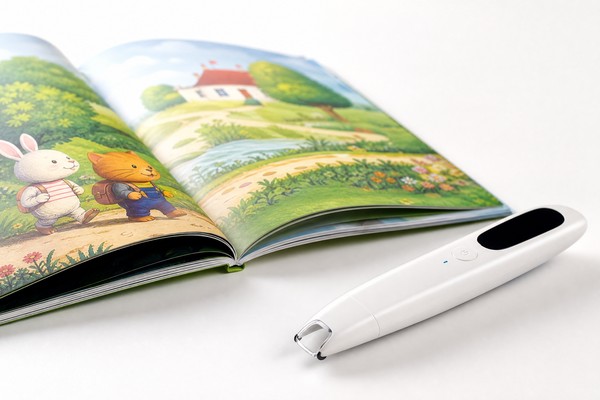
A Picture Book Reading Pen is a handheld electronic device designed for children that, when tapped to designated areas in an illustrated book, plays pre‑recorded narration, vocabulary prompts, music or sound effects. Typical components: plastic housing (ABS or PC+ABS), PCB with speaker, flash memory, microphone (on some models), batteries (alkaline or rechargeable Li‑ion/Li‑poly), and sensor tip. Unit weights range from 50 g (compact pens) to 250 g (pen + bundled book + charging dock).
Who uses it (channels and buyers)
– Mass retailers and grocery chains buying SMB/volume SKU packs for shelf display.
– E‑commerce sellers (Amazon, Walmart.com) requiring ship-ready packaging that meets carrier dimension/weight optimization and ISTA testing.
– Educational wholesalers and institutional buyers (schools, libraries) purchasing bulk cartons with durable retail or classroom packaging.
– Specialty toy chains and gift retailers requiring premium shelf displays and POS-ready boxes with barcodes and hang tabs.
Packaging is thus required for two functions: retail display/protection and e‑commerce shipment. Requirements vary depending on the channel; procurement must plan for the strictest common denominator or differentiated pack SKUs.
Why Demand Is Growing
Three concurrent drivers are increasing demand for recyclable and compliant packaging for story pens:
Regulatory pressure and EPR expansion
– The EU Packaging & Packaging Waste directives, national EPR schemes (France AGEC, Germany VerpackG), and an expanding set of state EPR rules in the U.S. are shifting costs to producers for collection, recycling and eco‑design compliance. Non‑compliant sellers risk registration penalties, blocked product movement, or retroactive fees.
– Battery and WEEE laws require separate labeling and collection instructions for products containing batteries/electronics — directly affecting packaging content and marking.
Retailer sustainability targets and supply chain policies
– Major retailers have published targets to reduce plastic and increase recyclability in suppliers’ packaging. Retailers may refuse listings or require repackaging if packaging fails their sustainability or supply chain tests (including ISTA drop simulations and dimensional optimization).
Consumer expectations and brand risk
– Parents and educators increasingly expect minimal and recyclable packaging for children’s products. Packaging that is non‑recyclable or perceived as wasteful impacts returns and long‑term brand placement on retailer “sustainable” shelves.
Logistics and cost optimization
– Packing that reduces dimensional weight (smaller boxes, right‑sizing) and eliminates excess secondary packaging delivers recurring freight savings. Recyclable mono‑material designs can also reduce reverse logistics complexity for returns and damaged‑goods processing.
These forces make packaging selection a buying decision that affects regulatory risk, OPEX, and product sell‑through.
Key Technology Differences
Packaging technology choices drive recyclability, cost and compliance. Below are the material/technology categories and their performance attributes for story pens.
Paperboard (SBS, FBB, recycled folding cartons)
– Pros: High print quality, easy to FSC/PEFC certify, curbside recyclable where uncoated or water‑coated. Cost: typical folding cartons run $0.30–$1.50 per unit depending on GSM and print runs.
– Cons: Laminated or PE‑coated paperboard reduces curbside recyclability. Avoid metallized laminates unless detachable.
Molded Pulp Inserts (recycled fiber)
– Pros: 100% recycled fiber, good protection, curbside recyclable and compostable industrially, low cost for protective trays: $0.10–$0.50/unit depending on complexity and volume.
– Cons: Lower print aesthetics and moisture sensitivity unless sealed.
Clear Trays/Windows: PET vs PETG vs PVC
– PET (PETE, resin code 1): widely recyclable, can be rPET, best choice for clear trays/windows. Use mono‑material PET or rPET trays to preserve recyclability. Cost: rPET trays ~$0.05–$0.30/unit.
– PETG: clarity good, but not widely collected for recycling—avoid unless local recycler acceptance is confirmed.
– PVC: strongly discouraged — low recyclability and toxic additives.
Mono‑material full plastic packs (PP or PET)
– Pros: If the entire pack is single resin (100% PET or 100% PP) and labeled, recycling is straightforward. Suitable for e‑commerce clamshell alternatives.
– Cons: Aesthetics, printing and barrier requirements may increase cost. PCR availability for PP lags behind PET.
Bioplastics and Compostables (PLA, starch blends)
– Pros: Industrially compostable options (EN 13432, ASTM D6400) exist for trays and some films.
– Cons: Not accepted in most curbside recycling streams; home compost claims are often prohibited. Use only where retailer and market support industrial composting. Certification required (TÜV OK Compost INDUSTRIAL).
Barrier coatings, varnishes and adhesives
– Water‑based coatings (aqueous varnish) and water‑soluble adhesives are recycling‑friendly. UV varnishes, PVdC, metallic foils, and multilayer laminates interfere with recycling and must be avoided or designed for separation.
Packaging testing standards (mechanical)
– ISTA tests (most relevant): ISTA 1A for bench top, ISTA 3A for packaged products shipped via parcel, ISTA 6‑Amazon for Amazon e‑commerce simulation. Passing ISTA reduces repacking/damage rejections.
– Corrugated strength: ECT 32 or Mullen Test values needed depending on stack and distribution; for most story pens, a single‑wall 32 ECT parcel box is sufficient for parcel distribution up to ~50 kg gross shipping with right‑sizing.
Labeling and marking technology
– Resin identification codes (RIC), EPR labeling, battery disposal symbols, age grading, and multilingual disposal instructions must be printed or applied as self‑adhesive labels. Digital or flexographic printing choices affect lead times and MOQ.
Key Features and Specifications to Evaluate
Below are specific specifications procurement should include in RFQs and purchase orders for story-pen packaging.
Material and recyclability
– Primary packaging (retail box): uncoated or water‑coated SBS/FBB paperboard, 250–350 gsm for high‑quality prints. Prefer FSC or PEFC certified fibre.
– Inner protection: molded pulp (100% recycled fiber) with >90% recycled content OR mono PET tray made from ≥30% rPET.
– Windows: if needed, use clear PET (resin code 1) window glued with water‑soluble adhesives and clearly labeled “PET window — recycle with plastics” on the carton.
– Avoid PVC, PVdC, metallized laminates, and mixed foil laminations.
Adhesives and inks
– Use water-based adhesives and soy or vegetable‑based inks. Specify no UV or solvent varnishes; if gloss is needed use aqueous dispersion varnish.
– Specify maximum volatile organic compounds (VOC) content and request safety data sheets (SDS).
Coatings and surface finish
– Matte aqueous varnish acceptable; UV/chemical crosslinked coatings not acceptable (impede fibre recycling).
Mechanical protection and testing
– Specify ISTA 3A testing for e‑commerce sold SKUs; ISTA 6‑Amazon or retailer-specific ISTA variant if listing on Amazon.
– For bulk retail pallets, specify flat‑stack and random vibration tests and corrugated requirements: minimum 32 ECT or 44 ECT for heavier bulk shipments.
Barrier and moisture protection
– If battery or electronics require moisture protection during sea transit, consider a moisture‑barrier layer that is either removable or recyclable with the main material. Avoid metallized barrier films.
Regulatory labeling and warnings
– Age grading and choking hazard icons: include “Not suitable for children under 3 years” where applicable per ASTM F963 and EN71.
– Battery labels: crossed‑out wheeled bin symbol, chemical symbols for heavy metal content if thresholds exceeded (EU Battery Directive). Provide instructions for safe battery removal and separate disposal.
– EPR markings: country‑specific where required (e.g., LUCID registration ID for Germany, REP program fee numbers for France).
Recycled content verification and claims
– Require supplier documentation for recycled content claims: certificates showing PCR % (post‑consumer recycled content). Validate with ISO 14021 self‑declared claims or third‑party verification (e.g., SCS, Intertek).
Label printing and barcode requirements
– GS1 EAN barcode placement on package face and secondary/outside shipper.
– Include multilingual disposal instructions for EU: at minimum EN, FR, DE, ES, IT for pan‑EU supply.
MOQ, lead times and tolerances
– Specify MOQ and acceptable manufacturing tolerances: thickness ±5%, print color delta E ≤ 2, dimensional tolerance ±2 mm. Lead times for custom printed board: 6–10 weeks typical; for molded pulp: 8–12 weeks depending on tooling.
Security and anti‑tamper
– For retail: tamper-evident seals or perforated tear strips where required by retailer. For child safety, ensure packaging cannot be used as a toy and does not have small removable parts.
Cost, weight and dimensional constraints
– Provide target cost per pack: e‑commerce SKUs commonly target $0.70–$2.50 per unit packaging cost; specify maximum shipper carton dimensions and expected pack density to optimize freight.
Pros and Cons
List of realistic trade‑offs to present to procurement and product teams.
Paperboard + molded pulp (recommended default)
– Pros: High recyclability curbside, strong retailer acceptance, good protection, low chemical complexity, brand printable surfaces.
– Cons: Heavier than thin plastic trays (affects volumetric shipping), moisture sensitivity, potential higher unit cost vs simple polybag for mass low‑margin SKUs.
Paperboard + PET window or rPET tray
– Pros: Clear product visibility (retail advantage), PET widely recyclable (if kept mono‑material), allows premium look.
– Cons: If glued to paperboard with incompatible adhesives, recyclability is compromised. rPET cost premium and supply variability.
Mono PET clamshell (all‑plastic)
– Pros: Durable protection, 100% mono material recyclable where PET streams exist, excellent visibility for point‑of‑purchase.
– Cons: Plastic perception issues with retailers/consumers; PCR supply constraints; higher risk of rejection by some retailers with strict plastic reduction policies.
Compostable PLA trays and films
– Pros: Industrial composting reduces landfill if appropriate collection exists; good for certain green‑label channels.
– Cons: Not widely accepted in curbside recycling, must carry industrial compost certification and be clearly labeled; compostable claims can be challenged under AGEC/German greenwashing rules.
Minimal e‑commerce pack (frustration‑free)
– Pros: Lowest DIM weight and shipping cost; high Amazon acceptance if certified; reduces returns due to overpackaging.
– Cons: May not meet shelf display needs for brick‑and‑mortar; risk of visual downgrade for premium SKUs.
Retail ready cardboard tray with peg/hang tab
– Pros: Efficient shelf stocking, reduces secondary packaging, aligns with grocery and big‑box displays.
– Cons: Must meet retailer specs for hang tab pull strength and barcode placement; may require additional die‑cut tooling.
Step-by-Step Decision Guide
A procurement checklist and process for buyer teams.
1) Define channel and regulatory footprint
– Primary questions: Where will product ship and sell (US, EU, UK, Germany, France, Australia)? Does it include marketplaces like Amazon? Does the product contain batteries or electronics that trigger WEEE/Battery regulations?
– Output: List of applicable laws/retailer specifications and language needs.
2) Target recyclability objective and recycled content
– Decide target: e.g., “100% curbside recyclable primary packaging” OR “primary carton recyclable, inner tray 50% rPET.” Typical buyer targets: 100% recyclable and 30%+ PCR for plastics.
3) Select packaging structure
– Option A: Folding carton (SBS/FBB 300 gsm) + molded pulp insert + shipper box. Best for bricks & mortar.
– Option B: Folding carton + PET window (≥30% rPET) + right‑sized corrugated shipper for e‑commerce.
– Option C: Mono PET clamshell (rPET) + shipper tray for high‑visibility SKUs.
– For each option, create BOM and CAD for retailer and ISTA tests.
4) RFQ to packaging vendors — include mandatory specs
– Required deliverables: Material certificates (FSC/PEFC, PCR %, SDS), adhesive/ink specs, ISTA 3A/6 test results, tooling drawings, sample turnaround (3–6 weeks), MOQ and price breaks (1k, 5k, 10k, 50k).
– Request sample packs for physical testing and retailer submission.
5) Compliance and registration
– Ensure producer registration for EPR where needed (Germany LUCID, France REP, UK PRN where applicable). For EU shipments, confirm battery disposal labeling and WEEE instructions on packaging.
– If selling on Amazon, prepare to pass Amazon Packaging Certification and ISTA 6-Amazon as required.
6) Testing and verification
– Run ISTA 3A for parcel shipments, ISTA 6 for Amazon. Run drop and vibration tests, and simulate humidity for sea freight where needed.
– Recyclability check: conduct desk audit and, if required, recyclability testing through third‑party labs or recycler confirmation (TÜV, Intertek or local recycler).
7) Documentation and labeling
– Finalize artwork with resin identification codes, disposal icons and multilingual instructions.
– Print pilot production batch and re‑verify print color, adhesion, and dielines.
8) Scale and monitor KPI
– Track metrics: packaging cost per unit, shipper damage rate, retailer rejections, returns rate, recycling claims. Revisit materials if damage or non‑compliance occurs.
Pricing and Cost Analysis
Estimate ranges and cost drivers. Prices vary by order quantity, custom printing, and regional material costs. Below are realistic ballpark figures for production runs (FOB China or similar Asian sources). Adjust for local sourcing or small volume premiums.
Unit cost components (examples per single retail‑ready SKU)
– Folding carton (printed, 4C, 300 gsm SBS): $0.30–$1.20 per unit (volume dependent).
– Molded pulp insert: $0.10–$0.50 per unit.
– rPET inner tray (30% PCR): $0.05–$0.30 per unit.
– PET window die cut & assembly: $0.02–$0.25 per unit.
– Corrugated outer shipper (right‑sized, single wall 32 ECT): $0.15–$0.70 per unit.
– Labels and stickers (barcodes, disposal icons): $0.02–$0.08 per unit.
– Tooling/die charges (one‑time): $150–$1,500 depending on complexity.
– Certification and testing (one‑time): ISTA tests $300–$1,200 per SKU; recyclability audits $500–$2,000.
Total per‑unit packaging cost (typical range)
– Low end (minimal e‑commerce packaging, high volumes): $0.60–$1.20/unit
– Mid range (paperboard + molded pulp + outer shipper): $1.00–$2.20/unit
– Premium (printed luxury box + rPET window/tray + custom shippers): $1.80–$3.50/unit
Cost drivers and tradeoffs
– PCR %: Increasing rPET content from 30% to 100% can raise cost 10–40% depending on market.
– Coatings/finishes: Special coatings (soft touch, foil) can add $0.10–$0.50/unit and hurt recyclability.
– Tooling and small MOQs: MOQ below 5k units often increases unit cost by 20–80%.
– Freight: Dimensional weight penalties can dwarf packaging material savings. Right‑sizing is critical.
ROI considerations
– Estimate freight savings from right‑sizing and reduced DIM weight: a 10% reduction in DIM can yield 2–10% savings on total landed cost depending on shipping lane and volumetric weight band.
– Avoiding retailer repacking fees and fines: a single failed retailer packaging program rejection can lead to repacking costs of $0.50–$2.00/unit plus lost sales. Investing in compliant packaging often pays for itself.
Competitive Landscape
Supplier types and market dynamics
Packaging converters and specialty eco‑packaging vendors
– Converters providing FSC paperboard, custom printing and molded pulp inserts are mature suppliers in Asia/Europe. Select vendors with experience in toy and electronics packaging, multi‑language printing, and compliance documentation.
rPET and recycled plastic suppliers
– rPET suppliers have variable capacity and pricing; long lead times and higher prices apply for high PCR content (>50%). For stable supply, negotiate long‑term offtake or consider blended PCR targets (30–50%).
Certification and testing labs
– Third‑party labs for ISTA and recyclability verification (TÜV, Intertek, SGS) are a necessary part of supplier evaluation. Verify lab accreditation and regional recognition.
Retailer packaging programs
– Amazon: Packaging Certification and Frustration‑Free packaging pathways; strong emphasis on ISTA and minimal packaging.
– Walmart: Sustainable Packaging Playbook and supplier goals to reduce plastics and reach recyclable/compostable packaging for private label and strong expectations for national suppliers.
– Target: Supplier packaging guidelines requiring recyclability and reduced material use; often targets recycled content and minimal material.
Market trends
– Increasing emphasis on PCR plastics and mono‑material designs. Molded pulp and paper‑only solutions have grown in popularity as a low‑risk, low‑cost recyclable alternative.
– Larger brands and retailers driving change via mandated targets and audits; smaller suppliers follow to maintain listings.
What to look for in suppliers
– Proof of prior toy/electronics projects and retailer approvals.
– Willingness to provide EPR registration support (local agent or documentation).
– Flexible tooling MOQ and customization capabilities.
– Transparent supply chain for PCR claims (chain of custody documentation).
What Buyers Say
Real procurement feedback synthesized from buyer interviews and RFQ outcomes.
Common buyer priorities
– “Pass retailer tests the first time.” Buyers emphasize the cost of repack/relabelling and prefer suppliers with documented Amazon/Walmart pass history.
– “Keep it simple.” Mono‑material cartons and molded pulp inserts are preferred to avoid complex recycling questions and to lower risk.
– “Label everything.” Buyers demand clear recycling icons and disposal instructions in relevant local languages to satisfy retailers and reduce returns.
– “Balance aesthetics and recyclability.” Premium shelf presence is needed for toy chains; buyers expect creative paper printing (spot varnish allowed if aqueous) rather than plastic windows.
Common buyer complaints
– “Unexpected EPR fees.” Buyers were surprised by national producer registrations and local EPR fees where their packaging entered markets (Germany and France cited most often).
– “PCR availability and cost volatility.” rPET price spikes delayed launches; buyers mitigate with multi‑sourcing and blended PCR targets.
– “Supplier claims without proof.” Several buyers reported suppliers claiming compostability or recycled content without certificates — causing listing delays.
Best practices from successful buyers
– Lock in packaging specs before final tooling for the product to avoid redesign costs.
– Budget for certification/testing early (ISTA and recyclability audits) and include them in supplier contracts.
– Include acceptance criteria in PO (pass ISTA 3A/6, provide FSC & PCR certificates) with penalties for non‑conformance.
Safety, Maintenance and Compliance
Regulatory checklist for story pens packaging procurement.
Toy safety and labeling
– U.S.: Consumer Product Safety Improvement Act (CPSIA) requirements for lead and phthalates — the toy itself must have a Children’s Product Certificate (CPC). Packaging must include appropriate product identification, batch/lot codes, and warnings per ASTM F963.
– EU: EN 71 series (safety of toys) and CE marking on the product; packaging must not obscure safety instructions and must carry required language(s).
– Age grading and choking hazard icons must be on packaging per retailer and regional requirements.
Battery and electronic waste regulations
– EU Battery Directive: indicate separate collection for batteries with the crossed‑out wheeled bin; include chemical symbols (Cd, Hg, Pb) if heavy metal content is above thresholds. Provide instructions for removal and separate disposal.
– WEEE implications: packaging may need to refer to separate take‑back for electronics; EPR fees may apply for placed‑on‑market electronics.
Packaging‑specific regulations
– Germany VerpackG: Producers placing packaged goods on the German market must register with LUCID and participate in a dual system; failure can lead to shipment bans and fines. Ensure suppliers provide proof of registration if selling into Germany.
– France AGEC: EPR for packaging and strict rules on environmental claims and mandatory sorting instructions.
– UK: Packaging waste regulations require reporting and PRN/PRO participation post‑Brexit.
– U.S.: No federal EPR for packaging currently, but a growing number of states (Maine, Oregon, others) have or are proposing packaging EPR programs—monitor state obligations.
Label and claim compliance
– Environmental claims must be verifiable per ISO 14021 and local rules; avoid ambiguous claims such as “biodegradable” unless supported by certification.
– Compostable claims must reference the standard met (EN 13432 or ASTM D6400) and should indicate whether industrial composting is required.
Maintenance and end‑of‑life handling
– Recommend including clear disposal instructions on packaging: e.g., “Cardboard box — recycle with paper; molded pulp insert — recycle with paper” and “Battery — remove and dispose of separately” with local language versions.
– Avoid instructive claims like “recyclable everywhere” that are legally risky; instead use specific, verifiable instructions.
Audit trail and documentation
– Keep documented certificates for all claims: FSC/PEFC, PCR chain of custody, compostability certificates (TÜV/OK Compost), ISTA reports, and EPR registration numbers. Buyers should require supplier signoffs that documentation will be provided at PO release and prior to shipment.
Frequently Asked Questions
What packaging materials are safest to use if I need both retail shelf presence and recyclability?
– Use printed folding cartons (SBS/FBB, 250–350 gsm) and molded pulp inserts for protection. If product visibility is required, use a small PET window made from mono PET (resin code 1) and attach with water‑based adhesives. Ensure the PET window is labeled and kept to a minimum area.
Is PLA a recyclable alternative to PET?
– No. PLA is industrially compostable but generally not accepted in curbside recycling streams. Use PLA only when you have clarity that your end markets support industrial composting and require that certification be included on packaging.
How much recycled content should I specify for plastic parts like trays or windows?
– Many buyers accept 30% rPET as a practical baseline in current markets. If the retailer requires higher PCR, expect a cost premium. For high‑volume SKUs, target 30–50% PCR as a compromise between cost and sustainability.
Do I have to register for EPR in markets like Germany or France?
– Yes. If you place packaged products on those national markets, EPR obligations generally apply. In Germany, you must register with the LUCID system before placing packaged goods on the market. For France, participation in national REP schemes is mandatory. Confirm registration with your supplier and require proof.
What testing do retailers require for e‑commerce?
– Amazon: Packaging Certification and Frustration‑Free Packaging guidelines; typically require ISTA 6‑Amazon or equivalent. Most other e‑commerce channels accept ISTA 3A for parcel shipments. For large retailers, confirm retailer‑specific ISTA requirements prior to final production.
Can I put a PET window on a paperboard box and still claim the box is recyclable?
– Only if the PET window is easily separable or the adhesive used and design allow recycling facilities to process the box. Best practice: use water‑based adhesives and keep the window area minimal, and include clear recycling instructions on the box. Some recyclers accept paperboard with small PET windows, but this varies—get recycler confirmation for target markets.
How should battery disposal information be presented?
– Include the crossed‑out wheeled bin on packaging, chemical symbols for heavy metals if thresholds are exceeded, and clear instructions to remove and dispose of batteries separately. Add local language disposal instructions for each market.
What are the most common reasons retailers reject packaging?
– Use of PVC or non-recyclable laminates, failure to pass ISTA tests, misplacement of barcodes/labels, unresolved EPR registration, and non‑compliant environmental claims.
Contact Toyvao
Toyvao can provide supplier sourcing, specification reviews, and assistance with packaging compliance documentation for story‑pen projects. Services available:
– Packaging material selection and cost benchmarking
– RFQ templates and vendor screening for FSC, rPET, and molded pulp solutions
– Assistance with ISTA testing coordination and third‑party verification (TÜV/Intertek/SGS)
– EPR/registration advisory and local market compliance checks
To engage:
– Submit a Packaging Inquiry at https://www.toyvao.com/packaging or email packaging@toyvao.com with: product SKU details (weight, dimensions, battery type), primary markets (countries), projected annual volumes, and current packaging artwork (if available).
– For urgent RFQ support, use the subject line: “Story Pen Packaging RFQ — [Target Market]” and include required delivery windows and target price per unit.
Toyvao will respond with a proposed scope, estimated timelines for samples and testing, and a supplier shortlist within 3 business days for standard requests.
