
Executive Summary
This report provides a pragmatic market-sizing and trend analysis for Picture Book Reading Pens (also called Story Pens, Talking Book Pens, OID Reading Pens) targeted at children’s EdTech buyers: education publishers, school district procurement officers, early-learning product distributors, and private-label OEM/ODM buyers. It combines market drivers, technology comparisons, unit economics, procurement and compliance checklists, typical buyer feedback, and an actionable decision path for sourcing.
Key findings:
– Global addressable market (TAM) for children’s interactive reading pens is estimated at 15–25 million units annually in a stabilized mid-term scenario (3–5 years), with a CAGR of 7–12% driven by early literacy EdTech adoption in APAC, LATAM, and MENA. Assumptions: primary buyer segments include schools (40%), home consumers (35%), and publishers/NGOs (25%).
– Unit price bands: basic offline pens (OID/dot-based) FOB China $8–15; mid-range pens with BLE/Wi‑Fi, SDK, cloud support $20–40; high-end multimedia pens with camera/AI/large storage $50–120. Packaged bundles (pen + book) retail typically $25–100.
– Technology splits: OID/dot-based optical recognition accounts for ~55% of units due to low-cost book printing and offline reliability; RFID/NFC and QR/camera based solutions represent ~25%; BLE/Wi‑Fi/cloud-enabled products ~20% but fastest growing.
– Buyers’ primary technical requirements: recognition accuracy >98% on target hotspots, audio latency <300 ms, battery runtime 8–24 hours continuous play, speaker output 0.5–2 W, storage 8–32 GB, support for 2–6 languages (region dependent), DRM and content update workflow (CMS/API).
– Procurement risks: content licensing (territory and language rights), device durability in target age groups, battery shipping constraints (UN38.3), and meeting toy safety standards (EN71/ASTM F963/CPSIA). Average failure rates at end-user: 2–6% during first year depending on build and QA.
This guide tells buyers what to specify, how to price and test, what technology to select by use-case, and the operational steps to source at scale.
What Is Picture Book Reading Pen and Who Uses It
Definition
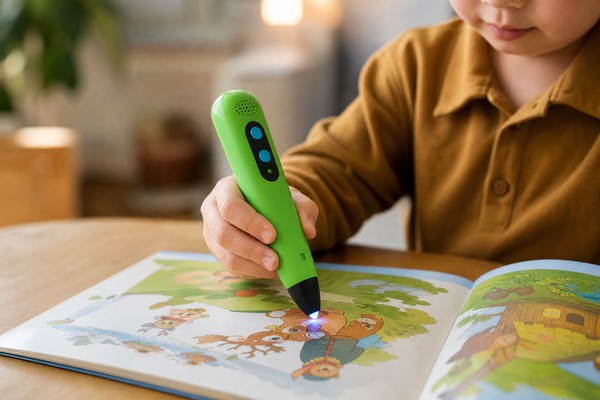
A Picture Book Reading Pen is a handheld electronic reader that plays pre-recorded audio when its tip taps designated spots on printed picture books. The trigger mechanism may be optical (printed dot/OID pattern), RFID/NFC tags embedded in pages, camera/QR recognition, or capacitive/conductive ink. Devices include onboard speaker and microphone, local storage (flash), and increasingly wireless connectivity (BLE, Wi‑Fi) for updates and analytics.
Typical product variants
– Basic OID/dot pens: low-cost, offline, small flash (4–16 GB), standard speaker, micro USB/USB-C.
– RFID/NFC pens: require embedded tags, higher per-book cost, reliable in low-light.
– Camera/QR pens: use miniature camera and image processing; higher BOM and power draw.
– Connected pens: BLE/Wi‑Fi-enabled for cloud syncing, content updates, analytics, multi-user profiles.
– Multimedia pens: larger speakers, recording capability, multi-format audio support (MP3, WAV), sometimes TTS and AI features.
Primary users
– School systems and preschools procuring classroom sets for early literacy programs.
– Children’s book publishers bundling pens for value-added products and language learning.
– NGOs and government early education programs using pens in low-tech environments to improve literacy.
– Retail/distribution channels offering bundled pen + book products for home learning.
– EdTech companies integrating pens with apps and LMS for blended learning.
Use cases
– Early literacy and emergent reading (ages 2–7): vocabulary, phonics, read-alouds.
– Second-language acquisition (immersion content).
– Accessibility: audio narration for visually impaired children.
– Content-enhanced books: games, quizzes, songs, and voice-recordable features.
– Classroom shared use (durable, multi-user profiles) and take-home programs.
Why Demand Is Growing
Macro drivers
– Global focus on early childhood education and literacy programs: governments and NGOs are investing in tools that scale low-cost, high-impact reading interventions.
– Hybrid learning models post-pandemic: schools and parents seek physical-digital blended products that do not rely exclusively on screens.
– Publisher strategy to monetize backlists: interactive pen bundles provide an incremental revenue stream and anti-piracy mechanism.
– Internationalization of English and multilingual education in APAC, MENA, LATAM increases demand for language bundles.
Product-driven drivers
– Cost reduction in OID printing and flash storage: per-unit BOM for basic pens has fallen 15–30% over the last 4 years enabling lower price points for mass adoption.
– Improvement in battery and speaker tech: longer playtimes and acceptable audio quality without substantial price increases.
– Cloud and analytics: BLE/Wi‑Fi enabled pens allow publishers/schools to track usage metrics and personalize content, increasing their value proposition.
– Content supply chain maturity: more publishers offer structured audio files and metadata, easing integration into pen CMS systems.
Market segmentation drivers
– APAC (China, India, Southeast Asia) leads unit demand due to large child populations and rapid EdTech adoption. Estimates: APAC accounts for 45–55% of global volume.
– LATAM and MENA show high growth rates (12–18% CAGR) driven by public literacy campaigns and low-cost device procurement by ministries.
– North America and Western Europe favor higher-margin connected and certified devices due to strict safety standards and preference for analytics.
Constraints and risks
– Content licensing complexity across territories increases time to market for localized offerings.
– Replacement cycles: pens are consumable; average useful life 2–4 years depending on durability and usage model. Replacement demand is steady but not sufficient alone to drive high CAGR without new buyer segments.
– Competition from app-based solutions on tablets and cheap smartphones in some markets — pens hold advantage where device access is limited or screen time is a concern.
Key Technology Differences
Recognition technologies
– OID (Optical Identification) / Dot-matrix
– Mechanism: high-contrast printed micro-dot patterns in books, tapped by pen sensor to index audio files.
– Pros: low per-book cost (printing only), offline operation, low latency (<200 ms), high accuracy in normal conditions.
– Cons: requires dedicated printed books, dot wear over time, limited to pre-defined hotspots.
- RFID / NFC
- Mechanism: passive tags embedded in pages; pen reads tag when close.
- Pros: robust in various lighting, durable, accurate per-page identification.
-
Cons: tag cost per page or per copy (USD 0.05–0.30 each depending on volume), embedding increases book manufacturing complexity and cost.
-
Camera/QR / Computer Vision
- Mechanism: on-device camera reads printed markers/QRs or visual hotspots; can use OCR and image recognition for dynamic content.
- Pros: flexible (can read standard printed material), supports on-the-fly mapping.
-
Cons: high BOM, higher power use, lighting sensitivity, higher latency.
-
Capacitive / Conductive Ink
- Mechanism: conductive ink traces printed on page that complete a circuit with pen tip contact.
- Pros: low-cost printing similar to OID, low latency.
- Cons: trace wear, limited scalability, sensitive to moisture/dirt.
Connectivity and cloud
– Offline-only devices: content stored locally; low complexity, cheaper, suitable for low-connectivity markets.
– Connected devices (BLE/Wi‑Fi): support content updates, user analytics, multi-user profiles, remote management (SaaS/CMS). Security considerations: firmware OTA, data privacy (COPPA/GDPR in some regions).
Audio and recording tech
– Standard: MP3 (CBR/VBR), WAV for high-quality. Common sample rates: 16 kHz (speech), 22.05 kHz or 44.1 kHz for higher fidelity music.
– Speaker specs: typical 0.5–2 W drivers; aim for clear speech intelligibility rather than music fidelity.
– Microphone: single MEMS mic for recording user voice; useful for pronunciation assessment in advanced products.
Hardware and power
– MCU: ARM Cortex-M series microcontrollers common in basic pens; Cortex-A for camera/AI.
– Flash: 4–64 GB eMMC or NAND; microSD support optional (up to 32/128 GB).
– Battery: Li-ion/Li‑poly 300–1500 mAh; runtime 8–24 hours depending on use and speaker power.
– Charging: micro USB legacy; increasingly USB-C for faster charging and reverse compatibility.
Security and DRM
– Local DRM: encrypted audio files with locked mapping to pen IDs.
– Server-side licensing: connected pens require token-based content delivery and license management via API/SDK.
Durability and design
– Materials: ABS plastic (UL94 V-0 preferred for flame retardance), silicone for grip and tip; food-safe paints for child safety.
– Physical standards: drop tests (1m–1.5m), ingress protection where specified (IP54 minimal if washability needed).
Key Features and Specifications to Evaluate
Recognition performance
– Accuracy: >98% recognition rate on target hotspots under typical use.
– Latency: <300 ms from tap to audio start for natural interaction; target <200 ms for best UX.
Audio and storage
– Supported formats: MP3, WAV (16-bit), AAC optional.
– Sample rate: 16 kHz minimum for intelligible speech; 22.05 kHz preferred for music/song tracks.
– Storage: minimum 4 GB for a few hundred tracks; 8–16 GB standard for medium catalogs; 32+ GB for extensive multi-language libraries.
– Speaker: 0.5–2 W driver; frequency response tuned for mid-range clarity (500 Hz–4 kHz).
Battery and power
– Capacity: 300–1500 mAh depending on pen class. Target runtime: 8–12 hours for classroom shift, 12–24 hours for home usage.
– Charging time: <3 hours preferable. USB-C with fast-charge optional.
– Transport: confirm UN38.3 certification for battery shipments; consider shipping with batteries at 30% charge per airline regs.
Connectivity and management
– Wireless: BLE 4.2/5.0 for proximity/CMS; Wi‑Fi 2.4 GHz for larger content syncs.
– Device management: CMS supporting batch firmware OTA, content push, device provisioning, user analytics.
– APIs/SDK: provide RESTful APIs for integration with LMS and publishers.
Physical and ergonomic specs
– Weight: target 60–120 g for small hands.
– Dimensions: ergonomic design for 3–8 year-old hands; secure tip with removable tip cover; 3.5 mm earphone jack optional.
– Durability: drop test 1m–1.5m, expected MTBF aligned with 2+ years field use.
Safety and compliance
– Toy standards: EN71, ASTM F963 where relevant.
– Chemical: RoHS, REACH, phthalate & lead testing; CPSIA for US market.
– Electrical: CE (EMC), FCC Part 15 for RF devices, IEC 62368-1 (safety).
– Battery: UN38.3 and MSDS documentation.
Content management and rights
– Metadata support: CSV/JSON mapping files, per-track metadata (ID, start/end, language, rights).
– DRM: AES encryption, pen-bound keys, or server tokening.
– Licensing: clear territory rights, language rights per title, duration and device count.
Manufacturing and supply chain
– MOQ expectations: typical OEMs require 1,000–5,000 units for custom branding; smaller runs possible for white-label at higher unit cost.
– Lead time: 6–12 weeks from sample approval to production for standard products; 12–20 weeks if custom PCB, tooling, or certified components needed.
Pros and Cons
Pros
– High engagement: tested to increase time-on-task for emergent readers compared to print alone.
– Offline capability: OID and RFID options work without internet, ideal for low-connectivity regions.
– Low per-book printing cost for OID: dot printing adds negligible cost to the print run.
– Bundling advantage: publishers can extend product value and reduce digital piracy by tying audio to physical units.
– Scalable deployment: low-end pens can be mass-produced economically for large literacy campaigns.
Cons
– Content complexity: negotiating multi-territory language rights and localization is time-consuming and costly.
– Durability concerns: pens subjected to rough handling; cheap builds show 4–8% failure within first 6 months.
– Battery logistics: lithium batteries create shipping and airfreight constraints and additional compliance overhead.
– Replacement and lifecycle: hardware refresh cycles require recurring investment; publishers must plan for updates and replacement logistics.
– Competition from app/tablet: where device penetration is high, pens can be seen as redundant unless integrated into broader programs.
Step-by-Step Decision Guide
Define objectives and use-case
– Classroom vs home vs hybrid: classroom needs durability, multi-user profiles, network management; home favors cost and simplicity.
– Languages and content scale: list languages, number of titles, average audio length per title (minutes), and expected per-book hotspots.
– Analytics needs: do you require usage tracking and cloud sync? If yes, select connected pens.
Select recognition technology
– Low-cost, scalable: OID/dot is recommended where book printing is controlled.
– Durable/robust: RFID for rugged deployments or where pages may be handled roughly.
– Flexible/legacy content: camera/QR for mapping to existing non-OID books.
– Cost/complexity tradeoffs: evaluate per-book cost increase vs device cost.
Set technical specification sheet (RFP)
– Minimum accuracy and latency requirements.
– Battery runtime and charge method.
– Storage, audio formats, speaker power.
– Connectivity and CMS/API requirements.
– Safety and certification requirements (list specific standards by market).
Supplier sourcing and evaluation
– Tier suppliers by capabilities: OEM hardware-only, ODM with customization, integrated provider with CMS/content licensing.
– Ask for reference shipments, customer lists in same use-case and scale reference.
– Request BOM breakdown, component sourcing transparency, and failure rate data.
Prototyping and pilot
– Pilot size: 100–500 devices for classroom pilots; 1,000–5,000 for public distribution pilots.
– Acceptance criteria: recognition accuracy on 200 random hotspots across sample books; drop test; playback audio quality; battery runtime under defined use profile.
– Data collection: integrate analytics in pilot to measure use frequency, average session length, and per-title engagement.
Quality control and testing
– Pre-production sample testing: include EMC, safety, functional, battery, and 48-hour burn-in.
– In-line QC: AQL sampling, 100% functional test for critical functions (recognition, playback, charging).
– Final inspection: packaging, labeling, accessories.
Contract and production
– Fixed BOM and change control clauses.
– Warranty terms: typical 12 months for defects; negotiate RMA process and spare parts availability.
– Production milestones, penalties for delays, inventory holdback clauses for certification issues.
Logistics and post-sale
– Confirm battery shipment method and associated costs.
– Stock spare parts (tips, chargers) and plan for replacements.
– Plan content update cadence and support SLAs.
Pricing and Cost Analysis
Unit price bands (FOB China estimates, 2026 indicative)
– Low-end OID pen (basic speaker, 4–8 GB, no wireless): $8–15/unit at MOQ 5,000–20,000.
– Mid-range connected pen (BLE, 8–16 GB, CMS, better speaker): $20–40/unit at MOQ 1,000–5,000.
– High-end/AI pen (camera, larger battery, 32+ GB, cloud analytics): $50–120/unit at MOQ 500–2,000.
Bundle pricing
– Pen + single title book (mass market): retail $25–45.
– Pen + 5–10 book starter pack: retail $45–90.
– Schools buy in bulk at discounts: per-unit delivered price often 20–40% below retail bundle price depending on book inclusion.
Cost build-up (example for a mid-range pen targeting classroom buyers)
– BOM components (speaker, flash, MCU, battery, PCB, enclosure): $8–12.
– Assembly and testing: $1.5–3.
– Packaging and accessories (tip, charger, manual): $0.8–2.
– Content encoding and CMS integration amortized per unit: $0.5–3 depending on volume.
– Freight & duties to destination: $0.5–3 (depends on volume and destination).
– Supplier margin: 10–20% typical.
– Expected FOB to buyer: $18–35.
Total landed cost considerations
– Import duties: vary by region (0–15% typical). Books may have different duty classification.
– VAT/GST and reseller margins for retail.
– Warranty and RMA provision costs: 1–3% of unit price reserved.
– Content licensing fees: per-title or per-unit royalties can add $0.10–$2.00 per unit depending on content.
Break-even and ROI (example)
– If a school purchases 100 pens at $30 landed, and uses them 5 days/week across two cohorts, estimated improvement metrics (typical pilot results): 10–20% measurable improvement in alphabet/phonics assessments over 12 weeks. ROI for public funders often justified if pen cost per student <USD 40 and measurable literacy improvement meets program thresholds.
Negotiation levers
– Higher MOQs reduce per-unit BOM and unlock better pricing tiers.
– Standardize on common components to reduce NRE/tooling.
– Commit to multi-year purchase agreements with volume tiers to secure locked prices.
– Consider consignment or phased payments for large government tenders.
Competitive Landscape
Supplier types and market structure
– Hardware OEMs/ODMs in China (Shenzhen/Dongguan) providing white-label pens at scale.
– Integrated EdTech vendors offering hardware + CMS + content licensing (localization services).
– Local publishers and SMEs bundling pens with licensed titles.
– Niche specialty providers for advanced AI/assessment-enabled pens.
Geographical strengths
– China: cost leadership and manufacturing scale; large pool of component suppliers and rapid prototyping.
– Taiwan/South Korea/Japan: stronger electronics quality control and IP for advanced camera/AI modules.
– Europe/North America: focused on high-compliance devices and integration with regional curricula; higher per-unit prices but stronger warranty and brand trust.
Market incumbents and dynamics
– Mid-sized Chinese OEMs typically dominate unit volumes for low-cost OID pens. They offer flexible tooling and shorter lead times.
– EdTech start-ups focus on cloud-enabled pens and analytics, often partnering with hardware OEMs for manufacturing.
– Publishers increasingly partner with local OEMs to lock supply and co-develop OID book printing processes.
Barriers to entry
– Content licensing networks: established players have existing contracts with publishers and language providers.
– Certification and safety testing: time-consuming and costlier for new entrants targeting regulated markets (US, EU).
– Manufacturing scale: low-cost unit economics require volume. Small buyers pay a premium.
Strategic supplier selection
– For low-cost mass distribution choose experienced high-volume OEMs with established supply chains and durable BOMs.
– For higher-value classroom deployments select integrated vendors that provide analytics, warranty, and content support.
– Negotiate for source code escrow and firmware access when device behavior is critical to program continuity.
What Buyers Say
Common positive feedback
– Increased student engagement and independent reading time. Buyers report 20–40% higher session frequency in pilot classrooms.
– Ease of use: intuitive tap-and-listen interaction required minimal teacher training.
– Strong value-for-money in low-connectivity contexts when using OID solutions.
Common complaints and pain points
– Breakage rate: lower-tier pens report 4–8% failure within 6 months; buyers recommend minimum 2-year warranty for classroom devices.
– Content updates: offline-only pens require logistical overhead for large-scale content changes; connected pens reduce overhead but increase device cost.
– Licensing delays: localized content rights extend lead times by 8–20 weeks for some territories.
– Inconsistent audio quality across vendors: speech clipping, low volume, or poor equalization reported if supplier skims on speaker quality or bitrate.
Operational feedback
– Batteries often fail or lose capacity faster than expected in intensive classroom use; buyers push for replaceable or upgradeable battery plans.
– RMA processes: buyers with large deployments require local repair hubs or spare device pools to avoid classroom disruption.
– Packaging: teachers prefer kits organized by classroom set numbers and labeled with simple device IDs to reduce administrative burden.
Best practices reported by buyers
– Insist on pilot with realistic conditions (children, classroom noise, repeated use) — lab tests overestimate field performance.
– Require sample books from book printers to verify dot pattern durability for OID systems.
– Demand CMS training and admin dashboard access during pilot to ensure analytics meet procurement objectives.
Safety, Maintenance and Compliance
Regulatory standards to require by market
– EU: EN71 (Parts 1–3), RoHS, REACH, CE marking (EMC), WEEE for e-waste.
– US: ASTM F963, CPSIA (lead & phthalates), FCC Part 15 (for RF), UN38.3 for batteries.
– International: IEC 62368-1 safety standard, and local country registration where required.
Battery handling and shipping
– Lithium cells must comply with UN38.3 tests. For air freight, batteries must meet IATA packing instructions; many suppliers ship with batteries at ≤30% charge to reduce restrictions.
– Consider shipping devices without batteries and providing local battery sourcing where import regulations are prohibitive.
Toy safety and chemical testing
– Phthalate and heavy metal testing per CPSIA.
– Flammability and mechanical tests per EN71-1.
– Surface coatings and inks: require test certificates showing non-toxic and low VOC content if targeted to age 0–3.
Maintenance and lifecycle management
– Cleaning: use mild detergent; avoid submersion unless device rated IP54 or higher.
– Firmware updates: test OTA updates on a pilot set before mass roll-out. Maintain version control and rollback capability.
– Replacement parts: stock tips, chargers, and spare PCB modules to reduce downtime.
– End-of-life: plan for WEEE recycling and customer buy-back or trade-in programs in regions with disposal regulations.
User safety considerations
– Choking hazards: ensure removable parts exceed choke test dimensions for target age groups.
– Sharp edges and small screws: use tamper-resistant fasteners and secure battery covers.
– Volume limits: implement max output limits to protect young ears (recommend peak <85 dB at 10 cm).
Documentation and labeling
– Provide multilingual user manuals, clear safety labels, and CE/FCC/other certification marks as relevant.
– Include warranty, RMA instructions, and local service contact information.
Frequently Asked Questions
What recognition technology should I choose for school deployments?
– Choose OID/dot-based pens if you control book printing and need a low-cost, offline reliable solution. Choose RFID if pages are rough-handled or you require per-page durability. Select camera/QR for flexibility with legacy content but expect higher cost and power draw.
How many languages can one pen support?
– Technically unlimited; constrained by storage and content licensing. Typical mid-range pens with 16 GB can host 2–6 language packs of full narrated books; 32 GB for extensive multi-language libraries.
What is a realistic failure rate to expect?
– For reputable OEMs with quality control, expect 1–3% DOA and 2–5% field failures in year one. Low-cost vendors can see 4–8% failure. Verify with supplier MTBF and field references.
How do you manage content updates?
– Offline pens require manual re-flash or microSD swap; connected pens use BLE/Wi‑Fi for OTA updates. Choose based on connectivity in target deployment and frequency of updates.
What are typical lead times?
– Stock products: 2–4 weeks. Custom-branded/modified products: 8–12 weeks. Custom tooling or certified components: 12–20 weeks.
Can these pens assess pronunciation?
– Basic pens record audio for manual assessment. Advanced connected pens with cloud processing can provide automated pronunciation scoring and AI-driven feedback, but this adds to cost and requires significant content processing.
How do I handle content licensing and royalties?
– Negotiate per-unit royalties, per-title fees, or flat licenses. Clarify territories, formats (audio, derivative works), duration, and sublicensing rights. Budget legal costs and timeline for rights clearance (8–24 weeks depending on complexity).
Are there privacy concerns?
– Yes. Connected pens collecting user data must comply with COPPA, GDPR, and local privacy laws. Require suppliers to provide data-processing agreements, encryption at rest/in transit, and minimal data retention defaults.
What warranty and RMA processes should I require?
– Minimum 12-month warranty for classroom units; provide SLA for RMA turnaround (ideally 7–14 business days for replacements). Negotiate spare parts stock and local repair options for large deployments.
Contact Toyvao
For procurement assistance, supplier matchmaking, technical RFP templates, pilot program design, or custom ODM solutions for Picture Book Reading Pens, contact Toyvao’s sourcing desk. Provide project scope: target markets, expected volumes, preferred tech (OID/RFID/camera), languages, and budget. Toyvao can supply vendor shortlists with verified QC records, sample facilitation, and support for certification and logistics.
Email: procurement@toyvao.com
Phone: +86- (local office numbers available upon request)
Hours: Mon–Fri, 09:00–18:00 CST
Include in your initial contact:
– Expected first-order volume and annual rollout plan
– Pilot timeframe and acceptance criteria
– Target countries and compliance needs
– Desired device feature matrix (short bullet list)
Toyvao will respond with a tailored sourcing plan, indicative pricing, and a 10–12 week timeline estimate for sample-to-pilot execution where applicable.
