
Executive Summary
This guide provides a technical, procurement-focused examination of OEM custom voice and branding options for Picture Book Reading Pens (also called Talking Book Pens, Story Pens, OID Reading Pens). It addresses the full buyer lifecycle: what custom voice and branding options exist, the technology differences that affect cost and quality, production steps, pricing mechanics, compliance, and decision criteria for selecting an OEM partner. Content is focused on specifications, measurable metrics, realistic lead times, MOQ expectations, and unit-cost drivers so sourcing managers can make informed, low-risk purchasing choices.
Key takeaways:
– Custom audio approaches: human-recorded audio (studio or remote), synthetic TTS, and hybrids (TTS for non-critical content + human for key phrases). Typical tradeoffs: human voice quality and brand differentiation vs. recurring cost and longer lead times; TTS reduces cost and enables rapid localization.
– File formats and storage: MP3 (CBR/VBR at 16–128 kbps), WAV (PCM 16-bit 8–44.1 kHz), and Opus. For voice-only narration 16 kHz mono at 32–48 kbps MP3 or Opus is adequate; plan raw storage ~0.24–0.45 MB per minute (32–64 kbps). Use 16–64 MB flash per pen depending on catalogue size.
– Branding options: pad printing, UV/silk printing, laser engraving, laser color fill, embossing, hot-stamp, shrink sleeves, and full-color 3D UV — typical per-unit imprint cost ranges $0.05–$1.50 depending on method, colors, and MOQ.
– BOM cost drivers: MCU/SoC, flash memory, speaker, battery, audio codec, assembly, and branding. Example per-unit material + assembly baseline for mid-tier pens: $4.50–$9.50; with custom audio production and advanced branding, landed unit cost commonly ranges $6.50–$14.00 for MOQs of 1,000–5,000.
– Lead times: audio production 3–15 business days (simple TTS to full multi-language studio); product tooling and mold 10–20 days (if new); sampling 7–14 days; mass production 20–45 days post-sample approval.
This guide provides specific evaluation criteria, step-by-step decision flow, compliance checkpoints (EN71, EN62115, CPSIA, FCC, CE), and cost models to help procurement teams specify and compare quotes.
What Is Picture Book Reading Pen and Who Uses It
Product definition:
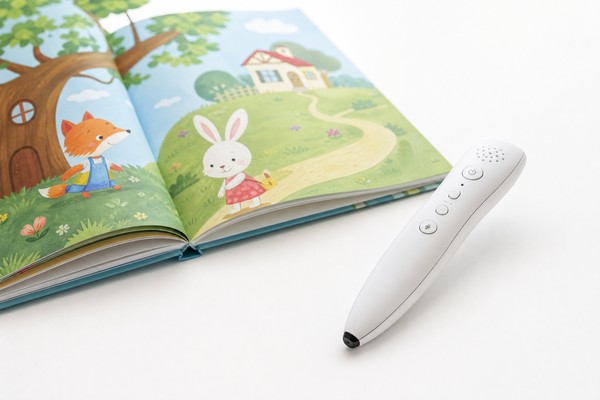
A Picture Book Reading Pen is a handheld electronic device that plays audio content when its tip is tapped on printed targets in illustrated books. The device typically contains:
– A recognition sensor (Optical Identification — OID, IR, RFID, or capacitive touch tied to printed IDs)
– Audio storage (NAND/serial flash or removable TF card)
– Decoder/DAC and amplifier
– Speaker and 3.5 mm headphone jack (optional)
– Microcontroller or SoC (may include Bluetooth for app connectivity)
– Rechargeable battery (Li-ion/LiPo) or replaceable alkaline cells
Primary users and use cases:
– B2C education and children’s publishing houses creating interactive storybooks
– Educational product distributors and retailers seeking branded merchandise
– NGOs and literacy programs sourcing low-cost audio-enabled books for early-childhood literacy
– Private-label toy brands adding audio narration and interactive features to licensed properties
Buyer roles:
– Product managers and sourcing managers at publishers and toy brands define content, language requirements, and branding.
– Localization teams specify translations and voice direction.
– Procurement and QA handle supplier selection, sampling, testing, and compliance.
Why Demand Is Growing
Market drivers:
– Early literacy emphasis: interactive audio supports phonics, vocabulary, and listening comprehension. Studies and curriculum trends favor multimodal learning for ages 0–8.
– Globalization of children’s content: brands want rapid, affordable localization (multiple languages/accents) with consistent quality.
– Decline in print-only engagement: tactile books plus audio increase perceived value and reduce returns.
– Declining cost of electronics: NAND flash, SoCs, and low-power audio decoders have fallen in price, enabling richer content per pen without high unit costs.
– Licensing and IP monetization: publishers and IP owners see pens as a way to extend franchises (audio-embedded collectibles, branded merchandise).
Procurement implications:
– Buyers demand turnkey solutions: content production + hardware + firmware with a single vendor to reduce integration risk.
– Faster time-to-market and low MOQs are increasingly requested — suppliers offering integrated cloud content management, remote updates, and flexible memory configurations are more competitive.
Key Technology Differences
Recognition method (how the pen knows where to play audio)
– OID (Optical Identification): Uses microdot or printed pattern encoding directly on the page; common in premium pens. Advantages: fine-grained mapping, no embedded chips in the book. Considerations: requires pen optical sensor and printed pattern process; print registration tolerance ±0.3 mm; susceptible to extreme low-light/reflective inks.
– RFID/NFC: Tags embedded or attached to pages — reliable detection and low latency. Cons: added cost per book, durability concerns, and minimal resolution unless many small tags are used.
– Barcode/QR: Low cost but requires camera or scanner and visible codes which affect layout and aesthetics.
– Capacitive touch or conductive inks: limited to defined hotspots.
Audio storage and format
– Flash memory: serial SPI NOR/NAND flash (8 MB–128+ MB). Typical capacities for a full-length children’s book with multiple languages: 32–64 MB. Price ranges: 8 MB ~$0.40, 16 MB ~$0.65, 32 MB ~$1.20, 64 MB ~$2.00 (volume-dependent).
– Removable storage: microSD/TF card for large libraries and in-field content swaps. Adds BOM cost and mechanical complexity.
– File formats: MP3 (most common), WAV PCM (uncompressed), Opus (better compression for voice), AAC. MP3 CBR 32–64 kbps mono typically acceptable for narration with low storage footprint.
Audio playback electronics
– Dedicated MP3/Opus decoder ICs (low-cost) vs. SoC with integrated decoder and BT. Decoders like VS1053 (legacy) or SoCs from Realtek/Actions/Nordic provide differing power profiles and capabilities.
– DAC performance: SNR target ≥ 80 dB for clean voice; many low-cost solutions achieve ~70–85 dB.
– Amplifier and speaker: amplifier class D or AB with output 0.5 W–2.5 W RMS; speaker 0.8″–1.5″ 8 Ω commonly used. For clear narration, aim for 0.8–1.5 W RMS with frequency response 300 Hz–8 kHz.
Connectivity and firmware
– USB (micro or Type-C) for charging/data, Bluetooth audio (A2DP) or BLE for app integration and OTA updates.
– Firmware: customer-specific voice mapping tables, multi-language toggle, sleep timers, and parental control. OTA DFU (via BLE) is recommended for long-term content management.
Battery and power
– Typical: 3.7 V Li-ion 300–1200 mAh. Expect 6–30 hours of playback depending on capacity, amplifier efficiency, and duty cycle.
– Charging: standard micro-USB or USB-C 5V/500 mA–1 A; include charging IC with battery protection and fuel gauge if needed.
Durability and child-readiness
– Housing materials: ABS, PC or TPE for grip. Impact resistance: drop-tested 1 m–1.5 m onto concrete as part of QA.
– Ingress: most pens are not IP-rated; if washability is required, design for IPX4+ with sealed switches and speaker membranes.
Key Features and Specifications to Evaluate
Recognition and mapping
– Detection latency: ≤ 200 ms is preferred for seamless UX.
– Hit accuracy: ≥ 98% in standard lighting; test under +/-20% ambient lighting and for glossy paper finishes.
– Mapping granularity: per-word, per-sentence, or per-illustration — depends on OID density and memory mapping.
Audio quality
– Preferred sampling: 16 kHz mono for speech; 44.1 kHz for music segments. Use 16-bit PCM for WAV masters; distribute compressed MP3/Opus.
– Bitrate guidelines for MP3/Opus:
– High-quality voice: 64 kbps CBR MP3 ≈ 0.47 MB/min; Opus at 32–40 kbps gives similar or better subjective quality at lower size.
– Good-quality voice: 32 kbps MP3 ≈ 0.24 MB/min (acceptable for narration with light noise reduction).
– Music or high-fidelity segments: 128 kbps MP3 or higher.
– Speaker output: 0.8–1.2 W RMS, frequency response 300 Hz–12 kHz; impedance 8 Ω typical.
Storage and content capacity
– Estimate storage requirement: minutes_of_audio × bitrate_in_kbps / 8 / 60 = MB required.
– Example: 30 minutes @ 32 kbps => 30×32/8/60 ≈ 2 MB (approx 2.0 MB).
– Add 10–20% headroom for file system overhead and metadata.
– Recommended minimum flash: 16 MB for single small book; 32–64 MB for multi-book or multi-language.
Battery/runtime and charging
– Typical targets: 10–20 hours playback on 800 mAh; lower-capacity options reduce unit cost but may impact satisfaction.
– Charging time: 2–4 hours at 500 mA; include battery protection IC and overcharge/discharge safeguards.
User interface and ergonomics
– Tip sensor sensitivity and tip durability (replaceable tips if stylus-based).
– Button layout: play/pause, volume up/down, language switch, sleep timer.
– Weight: 40–120 g depending on battery; design for comfortable grip for ages 2–8.
Firmware and content management
– Content upload mechanisms: USB mass storage, firmware tool, or cloud CMS with batch upload support.
– Rights management: support for encrypted files or DRM if required by licensor.
– Update paths: USB firmware update, Bluetooth DFU, or SD card swap.
Branding and cosmetic options
– Logo printing techniques: pad/screen/UV printing, laser engraving, laser color fill, hot-stamp. Color tolerance and registration specs: ±0.5 mm for pad printing; ±0.2 mm for laser.
– Label substrates and adhesives for stickers (avoid phthalates and restricted substances).
– Packaging customization: printed boxes, blister packs, multilingual manuals; unit box dimensions and custom inserts.
QA and testability
– Functional tests: playback, recognition accuracy, battery charge/discharge, speaker distortion (THD ≤ 3% targeted), button cycles (>100k cycles), drop tests (1.2 m), thermal tests (-10°C to 50°C).
– EMI/EMC: must pass local regulations (FCC Part 15, CE).
Pros and Cons
Pros of custom voice + branding
– Brand differentiation: unique voices and custom logos increase product perceived value.
– Localization: accurate accents and dialects for target markets increase adoption.
– Licensing alignment: brand-appropriate voice actors support IP integrity and audience expectations.
– Enhanced learning outcomes: carefully produced scripted audio can support pedagogical goals.
Cons and risks
– Cost: human voice recording and professional editing add $10–$100+ per finished minute depending on talent and language complexity.
– Lead time: studio scheduling, localization cycles, and approvals add 1–4 weeks.
– Memory and firmware complexity: multi-language content or long audio libraries require larger flash and more complex firmware.
– IP and rights: voice talent and licensor contracts must clearly assign or license audio rights for product lifecycle and geographic scope.
– MOQ constraints: some advanced branding methods increase per-color tooling and MOQ requirements; small runs cost disproportionately more.
Step-by-Step Decision Guide
Define content scope and quality
– Decide between human-recorded narration, synthetic TTS, or hybrid:
– If brand voice is critical, choose professional studio recording.
– If budget/turnaround is primary, choose TTS with high-quality voice models (neural TTS).
– Specify languages, dialects, and voice gender/age. Quantify audio minutes per language.
Estimate storage and BOM
– Compute required memory: total_audio_minutes × bitrate_kbps / 8 / 60, add 20% overhead.
– Select flash capacity with 2× headroom for updates (e.g., required 20 MB => choose 64 MB or microSD).
Select recognition technology
– For printed storybooks with no embedded electronics: choose OID.
– For premium durable products or where books cannot be printed with OID ink: consider RFID/NFC.
Define hardware spec sheet
– MCU/SoC class (Cortex-M0 vs higher with BT), DAC SNR ≥ 80 dB, speaker 0.8–1.5 W, battery capacity target.
– Connectivity: USB-C recommended for future-proofing; include Bluetooth if app sync or OTA is needed.
Branding specification
– Surface material (ABS/PC), area available for printing, required Pantone colors, text and logo dimensions.
– Choose printing process based on color count, durability, and budget:
– Pad printing: best for low-cost single/multi-color logos, MOQ typically 500–1,000.
– UV full-color printing: for photographic branding; MOQ typically 1,000+ and higher per-unit cost.
Partner selection
– Require vendor to provide:
– In-house audio studio or verified audio production partners.
– Sample turnaround time guarantees (7–14 days for functional sample with custom content).
– Compliance documentation (EN71, EN62115, CE, FCC, CPSIA).
– Clear IP assignment: voice master files, usage rights, and transfer of masters if needed.
– Prefer suppliers offering integrated content management tools for batch uploads and version control.
Agree pricing and MOQs
– Specify unit price tiers at defined MOQs (e.g., 500, 1,000, 5,000).
– Clarify per-language and per-minute audio costs, memory upgrades, and branding setup fees.
Prototype and validate
– Approve prototype for:
– Recognition accuracy across multiple printed book copies and lighting.
– Audio quality in actual kids’ environments (noisy classrooms).
– Drop and battery tests.
– Conduct acceptance tests and pre-shipment inspection (AQL sampling).
Plan for after-sales
– Warranty terms (typical 12 months).
– Spare parts availability (tips, speakers, batteries).
– Firmware support/OTA policies.
Pricing and Cost Analysis
Typical BOM breakdown (mid-tier Talking Book Pen, per unit estimate at MOQ 1k–5k):
– MCU/SoC + decoder: $1.20–$3.50
– Flash memory: $0.50–$2.00 (8–64 MB range)
– Speaker: $0.15–$0.90
– Amplifier IC: $0.10–$0.50
– Battery (Li-ion 500–800 mAh): $0.60–$1.80
– Housing (injection molded ABS, single-color): $0.40–$1.20
– Buttons, tip sensor, electronic components: $0.40–$1.10
– Assembly and test: $0.50–$1.20
– Packaging and manual: $0.30–$1.50
– Branding print/logo: $0.05–$1.50 (depends on method)
Estimated FOB unit material+assembly: $4.20–$13.00
Audio production costs (approximate)
– Studio rate with professional voice actor: $50–$500 per finished minute depending on talent and market. Typical rates for standard children’s narration: $70–$200/min.
– Remote voice platform or mid-tier voice talent: $20–$80/min.
– TTS neural voices: $0.01–$1.00 per finished minute (platform dependent).
– Post-production (editing, EQ, compression): $5–$20 per finished minute.
– Example per-book audio budget:
– 10 minutes human-recorded voice in 1 language: $700–$2,500 total.
– 10 minutes TTS with editing: $10–$200 total.
Memory and unit cost impact example
– Scenario: 3 books × 10 minutes each = 30 minutes audio. Use MP3 32 kbps => storage ≈ 30×32/8/60 ≈ 2 MB. Add other assets and overhead => 8 MB sufficient. But planners typically choose 16–32 MB flash for future updates.
– Price difference between 8 MB and 32 MB flash may be $0.60–$1.00 per unit. For 5,000 units, memory upgrade adds $3,000–$5,000 total.
Branding and tooling costs
– Pad printing setup: $30–$150 per color plate; per-unit cost $0.05–$0.30 depending on colors and runs.
– Laser engraving: higher one-time tooling cost negligible; per-unit $0.08–$0.50 depending on fill.
– Full-color UV printing (wrap/skin): setup $150–$500; per-unit $0.30–$1.50.
– MOQ implications: smaller MOQs raise per-unit imprint cost; expect premium of 10–30% for <1,000 units.
Shipping and compliance costs
– Batteries classified as dangerous goods: air shipment surcharges apply (UN38.3 compliance and special labeling). For Li-ion, prefer sea freight for large volumes to reduce surcharges; account for $0.10–$0.50 per unit extra for handling/shipping documentation on typical shipments.
– Lab testing costs: EMC/Toxic (RoHS/REACH), EN71/62115, CPSIA — expect $3,000–$8,000 per model per region for full test sets. Allocate one-time testing per SKU.
Price negotiation levers
– Increase MOQ for lower unit cost.
– Standardize on single language configuration for initial run.
– Use internal voice talent for costs savings and only use professional studio for brand-critical assets.
– Choose pad printing vs full-color printing for significant savings.
Competitive Landscape
Supplier types
– Full-service OEMs: provide hardware, audio production, printing, packaging, and compliance documentation. Advantage: single-point responsibility. Risk: higher unit prices but lower integration effort.
– EMS/Component assemblers: lower hardware cost but require buyers to manage audio production and firmware.
– Specialist audio/firmware vendors: provide recognition engine and content CMS; often partner with local assemblers.
– Platform providers: cloud CMS + marketplace for voice talent and TTS; useful for dynamic content and remote updates.
Geographic centers
– China (Guangdong, Zhejiang, Jiangsu) remains the dominant manufacturing hub for cost-to-quality balance. Advantages: integrated supply chain, short lead times, experience with toys and child-focused electronics.
– Vietnam and India are emerging low-cost assembly centers but may have longer ramp-up for electronics sourcing.
– Europe and North America: preferred for higher-end OEMs with strict IP and compliance oversight at higher price points.
Relevant component vendors (categories)
– Flash memory: Winbond, Macronix, GigaDevice.
– MCU/SoC and Bluetooth: Nordic Semiconductor (nRF52), Realtek, Actions, Telink.
– Audio codec/decoder: legacy devices like VS1053, and integrated decoders in SoCs.
– Speaker manufacturers and electro-acoustic specialists are regional.
Selecting a competitive supplier
– Verify end-to-end capability if you require short time-to-market: audio studio + printing + injection molding + compliance lab relationships.
– Evaluate supplier references and ask for sample packs with: custom-voiced sample, language toggles, branded prototypes, BOM list, and compliance certificates.
– Insist on source-code escrow for firmware if critical or if custom firmware is being developed.
What Buyers Say
Common buyer requirements and pain points (synthesized from procurement best practices):
– “We need fast sample cycles.” Buyers expect functional samples with custom audio within 7–14 calendar days. Delays commonly result from voice scheduling and print plate creation.
– “We need clear ownership of audio masters.” Buyers insist on written IP transfer or perpetual licenses for recorded audio. Ambiguity leads to future legal costs.
– “Memory capacity surprises us.” Buyers are surprised when initial flash is insufficient for added languages or songs — select 2× estimated capacity.
– “MOQ vs branding tradeoffs are not transparent.” Buyers want clear breakdowns of imprint setup fees, per-color costs, and the effect of order quantity on pricing tiers.
– “We need robust QA.” Buyers expect tests for recognition accuracy across multiple print runs and lighting conditions. They value suppliers who offer sample validation against their own printed proofs.
– “Battery logistics are tricky.” Buyers highlight extra freight, labeling, and insurance costs for Li-ion batteries. Some prefer supplier-handled shipment consolidation and documentation.
Best-practice buyer requests:
– Request an OEM sample pack: a functional pen with custom audio, print, packaging, and test reports.
– Require a full BOM and sourcing list for transparency on material origins and pricing.
– Ask for a content-management demo showing how to update/replace audio in production units.
Safety, Maintenance and Compliance
Essential safety standards and certifications
– EN71 Parts 1–3 (mechanical/physical, flammability, and migration of certain elements) — required in EU for toys.
– EN62115 / IEC 62115 — safety of electric toys.
– CPSIA (US) — lead content and phthalate testing for children’s products; mandatory for toys sold in the US.
– FCC Part 15 (USA) — for devices with radio emissions, including Bluetooth; CE for EU market.
– RoHS and REACH compliance for restricted chemicals.
– UN38.3 for Li-ion batteries shipment; MSDS documentation required.
– GDPR/COPPA considerations if the pen collects usage data or connects to a cloud app; children’s data regulations require parental consent and privacy measures.
Design for safety and durability
– Avoid small detachable parts for children under 3 — ensure compliance with choking hazard tests for intended ages.
– Battery compartment designs should prevent child access unless battery is intended to be user-replaceable.
– Use flame-retardant housing materials where required.
– Provide clear labeling of age grading and safety notices in local languages.
Maintenance and serviceability
– Provide user-replaceable or supplier-replaceable batteries and spare tips when applicable.
– Recommend simple cleaning instructions (wipe with damp cloth; no submersion unless IP-rated).
– Offer firmware recovery modes to prevent bricked devices after OTA updates.
Documentation and traceability
– Keep sample and batch-level production records for traceability in case of safety incidents.
– Maintain signed voice talent contracts and usage licenses in procurement files.
– Keep all testing certificates and lab reports centrally accessible for customs and retailers.
Frequently Asked Questions
What audio format should we supply?
– Supply masters as 16-bit WAV at 16 kHz for narrated voice; vendors can compress to MP3/Opus. For music or mixed media, supply 44.1 kHz WAV. Always provide masters and compressed assets.
How much storage do we need per book?
– Rough guideline: MP3 32 kbps ≈ 0.24 MB/min of audio. For a 10-min book per language, allocate ≈ 2.4 MB + 20% overhead. For 3 books × 3 languages, pick 16–32 MB.
What is the typical MOQ?
– OEM pen MOQs vary by customization: plain white stock pens can be 500–1,000 units; pens with significant molding color changes, full-color printing, or new molds commonly require 1,000–5,000 units.
Do we need a separate voice actor for each language?
– Yes. For authentic localization, native speakers are recommended. For consistent brand voice across languages, consider voice direction briefs and parallel casting to match tone.
Who owns the recorded voice files?
– Ownership depends on contract. Ensure the SOW includes perpetual, worldwide usage rights and assignment of masters if you want full control. Negotiate usage terms during contracting.
Can audio be updated after manufacturing?
– Options:
– Removable microSD/TF card: user/supplier can swap content.
– USB mass-storage devices: firmware/tools to upload new files during service.
– OTA via Bluetooth (if SoC supports DFU) — requires secure firmware update and app integration.
– Encrypted replacement files via service depot.
How long does setup and production take?
– Audio production (per language): 3–15 business days depending on quality.
– Printing setup: 3–7 business days for print plates.
– Sampling (with custom audio and print): 7–14 calendar days.
– Mass production: 20–45 days after sample approval.
Are neural TTS voices acceptable for story narration?
– High-quality neural TTS can be acceptable for low-cost or rapid localization. For branded IP or premium products, human voice is still preferred for expressiveness. Hybrid models (human for key parts, TTS for repetitive content) can reduce cost.
What compliance testing is required?
– At minimum, run EMC/Radio (FCC/CE) and toy safety tests (EN71/IEC62115) for target markets. Battery transport testing (UN38.3) if using Li-ion is mandatory for air shipments.
Contact Toyvao
For OEM inquiries, specification templates, sample requests, and price quotations, contact Toyvao:
– Website: https://www.toyvao.com
– Email: sales@toyvao.com
– Request: Provide your desired audio minutes per language, number of languages, required branding method (pad/UV/laser), target MOQ, and target delivery region for a detailed quote and lead-time estimate.
