
Executive Summary
This guide explains material choices and durability considerations for Picture Book Reading Pens (also called Story Pens, Talking Book Pens, OID Reading Pens). The primary materials evaluated are ABS, TPE, and Silicone (LSR/MVQ), plus child-safe surface coatings and finishing systems. The objective is to help B2B buyers (product managers, sourcing managers, OEM/ODM engineers) make defensible material and process decisions that meet target durability, cost, safety and manufacturability requirements.
Key conclusions:
– A hybrid approach (rigid ABS or PC/PC+ABS for internal structure + overmolded TPE or silicone for grips/seals) delivers the best balance of impact resistance, user comfort and assembly practicality for children’s reading pens.
– ABS is the lowest-cost, readily injection-moldable structural material; however, it needs UV stabilizers and possibly flame-retardant grades if required by product standards.
– TPE (thermoplastic elastomer) is the cost-effective choice for soft-touch zones and overmolding; TPE grades offer Shore A hardness 30–90 and are easily integrated into two-shot or overmolding processes.
– Liquid Silicone Rubber (LSR or VMQ) provides superior long-term softness, chemical and temperature resistance, and better resistance to sanitizers, but costs 2–5× more in material and tooling complexity.
– Child-safe coatings (waterborne polyurethane, medical-grade silicone coatings, or tested epoxy paints) must be evaluated for abrasion resistance, migration of restricted substances, adhesion, and resistance to disinfectants (isopropyl alcohol 70% commonly used in schools).
– Specify clear test requirements in RFQs: tensile/impact (ASTM D638 / ASTM D256), hardness (ASTM D2240), abrasion (ASTM D4060 Taber), salt spray (ASTM B117) for metal parts, EN71-1/2/3 and ASTM F963/CPSIA compliance for toy use, and ingress protection (IPX4 or IP67) depending on target environment.
This guide provides technical property ranges, testing protocols, cost implications, manufacturing recommendations, and a step-by-step decision process to select materials and coatings for reliable, compliant reading pens.
What Is Picture Book Reading Pen and Who Uses It
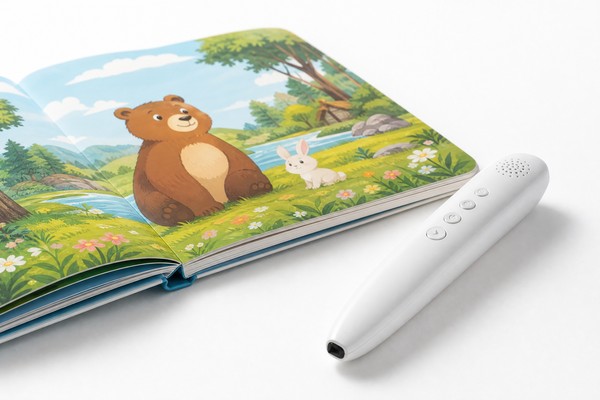
A Picture Book Reading Pen is a consumer electronic educational device designed for children (typically ages 2–10) that plays recorded audio when the pen tip taps specific spots in printed picture books. The pen integrates mechanical, electrical and acoustic subsystems: a printed circuit board (MCU + audio codec), micro speaker, microphone (optional), flash memory or SD card, battery (rechargeable Li-ion or replaceable alkaline/NiMH), buttons, LEDs, and a pen tip or stylus sensor. Typical physical dimensions and weights:
– Length: 120–190 mm; diameter (body): 18–30 mm
– Weight: 40–120 g (dependent on battery and speakers)
– Battery: 200–1000 mAh for rechargeable variants; AA/AAA for replaceable-cell designs
Primary end users and environments:
– Children in home settings (drops, spills, sticky hands, crayons)
– Early learning centers and preschools (higher handling frequency, sanitization)
– Schools and libraries (shared use, higher durability requirements)
– Export markets with varying climate and regulatory constraints
Key user interaction points that determine material and coating requirements:
– Grip zones and buttons (comfort, non-slip)
– Pen tip/stylus (tactile feedback and wear resistance)
– Battery compartment (tamper-resistance)
– Seams and joints (ingress protection and mechanical integrity)
– Decorative surfaces (printed icons, colors, paints must resist abrasion and migration)
Why Demand Is Growing
Market drivers for reading pens and the resulting material expectations:
– Increased emphasis on early literacy and interactive educational products drives adoption in both consumer and institutional channels.
– Shared devices in schools and libraries require higher durability and sanitization capability versus single-family consumer use.
– Buyers now expect lower failure rates, predictable maintenance costs, and regulatory compliance (EN71/ISO 8124, ASTM F963, CE, FCC/IC, RoHS/REACH).
– Global distribution places demands on colorfastness (UV exposure), cold-chain handling (storage/transport extremes), and supply chain traceability for restricted substances.
Material trends influenced by demand:
– Consumers and institutions prefer soft-touch grips for ergonomics — TPE and silicone overmolds are increasingly required.
– Sanitization protocols (70% isopropyl alcohol wipes, bleach solutions in institutional settings) create a preference for materials and coatings resistant to chemical degradation.
– Longer warranty expectations (1–3 years) and lower return rates push buyers toward materials with higher impact and abrasion resistance.
Key Technology Differences
This section compares the mechanical, chemical and manufacturing properties relevant to reading pens across ABS, TPE, and Silicone, plus coatings.
ABS (Acrylonitrile Butadiene Styrene) — typical role: structural shells, internal frames
– Mechanical: Tensile strength ~30–50 MPa; flexural strength ~60–90 MPa (grade dependent). Izod impact strength typically 15–100 kJ/m² for general-purpose ABS; higher for impact-modified grades.
– Thermal: Glass transition ~100°C; service temperature typically -20°C to +70°C without additives.
– Processing: Standard injection molding, cycle times 15–40 s for typical part sizes; low tooling cost compared to LSR.
– Properties: Good dimensional stability, easy to paint/print, economical. Susceptible to UV yellowing unless UV-stabilized. Poor chemical resistance to strong solvents (acetone).
– Typical issues: brittle fractures at stress concentrators; seam weakness when ultrasonic welding is not properly controlled.
TPE (Thermoplastic Elastomer) — typical role: overmolded grips, button caps
– Mechanical: Shore A hardness 20–90 depending on grade. Tensile strength typically 6–30 MPa. Elongation at break 200–600% for many grades.
– Processing: Overmolding or two-shot injection molding directly onto ABS/PC substrates. Cycle times slightly longer; good recyclability.
– Properties: Good soft feel, non-slip, better abrasion resistance than some rubbers. Can be selected for resistance to oils and sanitizers (select grades).
– Typical issues: Some low-cost TPEs are prone to cold flow (surface creeping), staining, and migration of plasticizers — test for phthalate content and oozing.
Silicone (LSR – Liquid Silicone Rubber or VMQ – Vulcanized Silicone) — typical role: seals, stylus tips, outer skins
– Mechanical: Shore A 10–70; elongation at break commonly 200–800%; tensile strength 4–12 MPa for typical LSR grades (lower tensile than many TPEs but much higher elongation).
– Thermal/Chemical: Excellent temperature range (-60°C to +200°C), outstanding resistance to UV and ozone; superior resistance to many sanitizers (alcohols, dilute bleach) and plasticizers.
– Processing: LSR requires specialized injection molding equipment; two-shot for overmolding onto rigid substrates is possible but tooling and cycle management are more complex. Typical molding cycle times 30–90 s depending on part geometry.
– Properties: Long-term softness retention, tactile feel preferred, superior longevity in harsh environments. More expensive material (~$5–15/kg) and higher tooling costs.
– Typical issues: Adhesion to rigid substrates may require surface treatments or mechanical interlocks if not chemically bonded; higher unit cost.
Coatings and Surface Finishes — typical role: decorative finishes, abrasion resistance, antimicrobial and chemical resistance
– Types: Water-based polyurethane (WBPU), UV-curable coatings, thermoplastic coatings, silicone surface coatings, powder coating (for metal parts).
– Key properties: Taber abrasion resistance (ASTM D4060 cycles to failure), cross-hatch adhesion (ISO 2409), migration of restricted elements (EN71-3/ASTM F963), resistance to alcohol and detergent exposure.
– Considerations: Coatings must be tested for adhesion to plastics (ABS often needs primer or corona treatment). For children’s products, coatings must be validated against EN71-3 migration limits and be free of restricted phthalates and heavy metals.
Other technology considerations:
– PC vs PC+ABS blends: Polycarbonate (PC) offers higher impact resistance and better heat resistance (useful if better flame rating or transparency is needed). PC+ABS blends offer a practical compromise with improved impact and dimensional stability but slightly higher cost.
– Flame retardancy: For certain markets and product categories, UL94 V-0 grades are used for enclosures around PCBs; ABS can be supplied in V-0 grades with brominated or phosphorus-based retardants (specify RoHS-compatible formulations).
– Sealing and ingress protection: Achievable via overmolding, LSR gaskets, or O-rings; target IPX4 for splash resistance or IP67 for full waterproofing. Battery compartment sealing and user access must comply with toy battery safety regulations.
Key Features and Specifications to Evaluate
Technical specifications to include in RFQs and supplier contracts. Use measurable values and acceptance criteria.
Mechanical and material specifications
– Base material: ABS (grade name/resin code), PC or PC/ABS blend where needed. Request Material Test Certificate (MTC) with density, MFI (melt flow index), and supplier batch number.
– Overmold material: TPE grade and Shore A hardness. Specify Shore A tolerance ±5. If LSR is used, specify LSR grade, viscosity, cure system, and post-cure requirements.
– Wall thickness: Target 1.8–2.5 mm for ABS structural shells; thinner zones 1.4 mm allowed for small parts. For LSR overmolds, maintain minimum bead widths per tooling specs (typically ≥1.2 mm).
– Reinforcement ribs: Minimum rib thickness 0.5 × nominal wall thickness to avoid sink marks and warpage.
– Dimensional tolerances: ±0.2 mm for critical features (button cutouts, PCB mounts), ±0.3–0.5 mm for cosmetic regions depending on size.
Durability and performance tests
– Drop test: Minimum 1.0 m drop onto concrete or steel plate, 6 orientations × 10 cycles. Acceptance: no life-safety failures (sharp edges, battery compartment opening), full functionality retained (audio, buttons), cosmetic hairline cracks acceptable only if not leading to functional failure.
– Impact resistance: Izod or Charpy per ASTM D256; specify minimum impact energy or resistance per part weight/geometry.
– Abrasion resistance: Taber abrasion ASTM D4060; specify cycles to failure for painted/coated surfaces (e.g., ≥1,000 cycles at H-22 wheel).
– Hardness: ASTM D2240 Shore A (TPE/silicone) and Shore D (ABS/PC).
– Chemical resistance: Exposure to 70% isopropyl alcohol, 0.1% sodium hypochlorite (bleach), and common household detergents with post-exposure functionality and cosmetic acceptance criteria.
– UV resistance: Xenon arc 500–1,000 hours per ISO 105-B02; maximum ΔE color change allowed (specify numeric limit, e.g., ΔE ≤3).
– Ingress protection: IPX4 minimum for consumer products; IP67 if marketed as submersible. Specify testing per IEC 60529.
Safety, migration and flammability
– EN71-1 (mechanical/physical), EN71-2 (flammability), EN71-3 (migration of heavy metals) and ISO 8124 family for target export markets. Obtain third-party lab reports showing compliance.
– Phthalate limits: Compliance with RoHS 3 / REACH Annex XVII where applicable (DEHP, DBP, BBP, DINP, DIDP, DnOP) — require test reports.
– Lead and heavy metals: Limits per EN71-3 (e.g., lead limit 160 mg/kg in dry, brittle, powder-like or pliable materials — check current standard for exact limit).
– Electrical safety: IEC 62115 / EN 62115 for toys (electrical shock, temperature rise, battery safety). EMC: FCC Part 15 / CE EMC standards.
Coating-specific specifications
– Adhesion test: Cross-hatch (ISO 2409) rating of 0–1 required.
– Abrasion: Taber cycles to failure; specify wheel and load (e.g., H-22 wheel, 1 kg load).
– Migration: EN71-3 migration limits for elements and test for solvent extraction to check for harmful residues.
– Antimicrobial claims: Require ISO 22196 or equivalent testing and exact performance thresholds; most buyers prefer supplier-provided certified test reports rather than marketing claims.
Manufacturing and assembly specifications
– Join methods: Ultrasonic weld strength (specify pull-off force for snaps), screw torque on battery hatch (tamper-proof screws recommended with minimum torque settings), snap-fit retention forces (specify insertion/removal forces for child safety).
– Surface finish: Specify Ra for polished surfaces if tactile or optical clarity is required; specify preferred texture (e.g., 60–120 µm) for matte grip zones.
– Labeling: In-mold labeling (IML) or pad printing durability (adhesion, abrasion) and chemical resistance; specify 500 cycles minimum on Taber abrasion for printed areas.
Quality documentation to request from suppliers
– Material Test Certificates (MTC)
– RoHS/REACH statements and test reports
– EN71/ASTM F963/IEC 62115 test reports from accredited labs
– Process FMEA and PFMEA for molded parts
– First Article Inspection (FAI) report with DIMENSIONAL, mechanical and functional test results
Pros and Cons
ABS
– Pros: Low material cost (typical resin costs $1.5–4.0/kg depending on volume and grade), easy tooling and short cycle times, good dimensional stability, widely available.
– Cons: Susceptible to UV yellowing, moderate chemical resistance, may require flame retardants for electronic housings, lower tactile quality compared to TPE/silicone.
TPE
– Pros: Soft-touch feel, lower cost than silicone, straightforward overmolding/two-shot processes, recyclable in some grades, good initial abrasion resistance.
– Cons: Variable long-term resistance to sanitizers and oils depending on grade, potential plasticizer migration in low-grade products, Shore hardness drift over time under some conditions.
Silicone (LSR)
– Pros: Superior thermal stability, excellent UV/ozone resistance, excellent chemical resistance and tactile longevity, superior performance in harsh cleaning regimens, good low-temperature flexibility.
– Cons: Higher material cost (~$5–15/kg), requires special LSR molding equipment and expertise, potential adhesion challenges to rigid substrates unless chemically bonded or mechanically locked.
Child-safe coatings
– Pros: Improve abrasion resistance, colorfastness, and chemical resistance; can add antimicrobial properties if required and certified.
– Cons: Add additional processing steps and costs; coatings can delaminate if surface prep (plasma/corona) is not consistent; must be validated for migration and abrasion.
Manufacturing process choices (impact on pros/cons)
– Ultrasonic welding: Fast and tamper-resistant seams; irreversible assembly can complicate repairs/recycling.
– Screws for battery compartments: Easier servicing but increases parts count, assembly time, and per-unit cost; tamper-proof screws add cost but are required by many toy safety standards.
– Overmolding: Improves ergonomics and ingress protection but increases cycle times and tooling complexity.
Step-by-Step Decision Guide
This practical roadmap helps you select materials and processes for a Picture Book Reading Pen.
Define your target use case and performance targets
– Consumer single-user home device: target IPX4, 1.0 m drop test, soft-touch grip preferred but not mandatory, budget-sensitive.
– Institutional device (schools/libraries): target IP67 or IPX5–6, 1.5 m drop test, sanitizable with 70% isopropyl alcohol, durable over 2–3 years of repeated handling.
– Battery type: Rechargeable Li-ion for premium models; replaceable alkaline (AA/AAA) for low-cost and user-serviceable models (consider more robust battery hatch design).
Select base material and shell construction
– Low cost, consumer: ABS structural shell + TPE overmold grip areas. Specify impact-modified ABS grade; supply MTC.
– Mid-range, higher durability: PC/PC+ABS structural shell for better impact/heat resistance + TPE overmold.
– High-end, sanitizable, or waterproof: PC structural components + LSR overmold for seals and full outer skin if targeted for frequent cleaning and harsher environments.
Decide on coating/finish strategy
– No coating for colored ABS if pigments are stable and surface finish is acceptable; use UV-stabilized grades.
– Use waterborne polyurethane (WBPU) or UV-curable coating if printed icons or brighter colors are required and high abrasion resistance is needed.
– For metal parts (clips or stylus ring), specify passivation/powder coating or nickel-free plating with salt-spray resistance per ASTM B117.
Address ingress protection and battery compartment
– IPX4 (splash): Use rubberized TPE overmolds around seams and a well-designed battery hatch with gasket or silicone lead-in. Tamper-proof screw to secure hatch.
– IP67 (submersible): Full LSR overmold with bonded seals and potting of sensitive electronics; use LSR-compatible screw bosses or ultrasonic weldless assembly. Expect higher cost and lower repairability.
Prototype and test
– Produce first 5–10 pre-production units for functional testing, and 50–100 units for accelerated life testing.
– Run the full test matrix: drop tests, Taber abrasion, chemical exposure, UV aging, ingress protection tests, battery safety tests.
– If any coating delaminates or TPE oozes, iterate material grade or surface treatment (plasma/corona) and tooling design (mechanical interlocks).
Specify acceptance criteria in contract
– Define pass/fail criteria for each test (e.g., functional after 10 drop cycles from 1.2 m; no parts larger than 3 mm detached; printed icons must pass 1,000 Taber cycles).
– Include defect rates (e.g., maximum 0.5% critical defects, 2% major defects) and remedies: rework, replacement, or price deductions.
Scale and monitor
– Require supplier to provide Incoming Quality Control (IQC) and First Article Inspection (FAI) reports per batch.
– Implement periodic audits and third-party lab testing on batches (e.g., every 6 months or for each 2,500 units).
– Maintain material certificates and traceability for each production lot.
Pricing and Cost Analysis
Material cost breakdown and manufacturing cost drivers relevant to housings and coatings. Values are indicative ranges for planning and negotiating; exact prices depend on order volume, region, supplier, and market fluctuations.
Raw material pricing (indicative, per kg)
– ABS resin: $1.5–4.0/kg
– PC resin: $2.5–5.0/kg
– TPE: $2.0–6.0/kg (functional grade and softness affect price)
– LSR silicone: $5.0–15.0/kg (medical/food-grade at higher end)
Example material volume per unit (typical reading pen, 60–80 g gross shell weight)
– ABS shell: 30–60 g → material cost: $0.05–$0.24 per unit (based on $2–4/kg)
– TPE overmold: 5–15 g → material cost: $0.01–$0.09 per unit (based on $2–6/kg)
– LSR overmold: 10–25 g → material cost: $0.05–$0.38 per unit (based on $5–15/kg)
Processing and tooling costs
– Metal tooling (single-cavity) for ABS: $3,000–$15,000 for simple pen shells; multi-cavity and complex geometries $10,000–$60,000. Lead time 3–8 weeks depending on complexity and factory backlog.
– LSR tooling: Typically more expensive — $8,000–$50,000 per cavity; tooling must be corrosion-resistant and temperature-controlled; lead time 6–12 weeks.
– Overmolding tooling (two-shot): +20–50% over single-shot tooling costs due to secondary tooling and machine time.
Per-unit manufacturing cost drivers
– Injection molding cycle time and complexity (part geometry): $0.05–$0.50 per unit in machine time for basic parts; higher for LSR or two-shot.
– Secondary processes: painting, pad printing, ultrasonic welding, assembly, QA/testing: $0.50–$3.00 per unit depending on complexity and quantities.
– Electronics (PCB, battery, speaker): Often the largest single cost — typical consumer-grade audio PCB including battery and speaker: $2.50–$12.00 per unit depending on memory, MCU, components, and volumes.
Total BOM cost ranges (indicative FOB China pricing)
– Low-cost consumer pen: $6.00–$12.00 per unit (basic ABS shell, printed graphics, replaceable alkaline battery, minimal overmold)
– Mid-range: $12.00–$22.00 per unit (PC/ABS shell, TPE overmold, rechargeable battery, better speaker, printed and coated finish)
– High-end ruggedized/sanitizable pen: $22.00–$45.00+ per unit (full LSR overmold, IP67 sealing, rechargeable battery, premium components, certified coatings)
Cost tradeoffs to consider
– Upfront tooling for LSR and two-shot overmolding is higher but acceptable with volumes ≥ 10,000 units; for smaller runs, consider TPE overmold sleeves or secondary assembly.
– Coatings add per-unit processing cost ($0.10–$1.00 per unit depending on method — spray/curing vs UV) and require curing/handling space.
– Design for manufacturability (DFM) reduces scrap; minimizing thin walls and abrupt thickness changes reduces sink and warpage and lowers rejection rates.
Competitive Landscape
How manufacturers typically position themselves by material choice and feature sets.
Low-cost manufacturers (focused on minimal BOM and price)
– Common materials: ABS shell, basic printed decoration, sometimes low-grade TPE button caps.
– Typical weaknesses: poor adhesion of prints, low resistance to alcohol cleaning, brittle battery hatches, higher return rates in institutional use.
– Target customers: low-cost retail channels and single-family consumer products.
Mid-tier manufacturers (balance cost and durability)
– Common materials: PC/ABS blends for structural parts, TPE overmolds for grip areas, waterborne coatings, rechargeable variants with basic ingress protection (IPX4–5).
– Typical strengths: better printing and finish, improved drop resistance, more reliable battery hatches with tamper-proof screws.
– Target customers: retailers with slightly higher price points, educational product lines.
Premium/industrial manufacturers (durability and compliance)
– Common materials: PC or ABS with LSR overmolds for seals and external skin, medical-grade silicone tips, full sealing to IP67 in some product lines.
– Typical strengths: robust in institutional environments, tested sanitization resistance, full compliance documentation (EN71/ASTM/IEC reports), longer warranties.
– Typical clients: institutions, licensed OEMs, premium consumer lines.
Supplier selection criteria
– Manufacturing capability: injection molding capacity, overmolding experience, LSR equipment, clean-room for assembly if needed.
– QC and testing capability: in-house labs or partnerships with accredited test houses for EN71, IEC 62115, RoHS/REACH.
– Traceability and documentation: ability to supply MTCs, RoHS/REACH statements, batch traceability, and routine audit access.
– Price vs lifecycle value: choose suppliers that can demonstrate lower total cost of ownership via reduced returns and warranty claims rather than lowest unit price only.
What Buyers Say
Synthesis of common buyer feedback and lessons learned from sourcing reading pens.
Common quality issues reported by buyers
– Battery hatch failures: child-accessible battery compartments opening after repeated drops; solved by better tamper-proof screw design and improved boss geometry.
– Button wear and functionality loss: soft TPE buttons detaching or losing actuation feel due to poor overmolding or low-quality TPE grades.
– Discoloration and yellowing: ABS shells losing color under sunlight; solved by UV stabilizers or pigment selection and coatings.
– Print/coating delamination: pad-printed icons wearing off in months, especially on high-contact areas; solved by using IML, laser etching, or tougher coatings.
– Water ingress: insufficient sealing around seams and speaker ports when marketed as splash resistant; resolved by better gasket design or LSR sealing.
Operational feedback
– Institutional buyers prioritize sanitizability and serviceability (replaceable batteries, robust hatches) over premium finishes.
– Home buyers prioritize ergonomic feel and appearance; they accept lower ingress protection but expect low return rates.
– Buyers want clear documentation and batch traceability — absence of lab reports is the quickest deal-breaker when selling into regulated markets.
Procurement tips from experienced buyers
– Insist on drop-test videos and third-party lab reports during sampling stage.
– Include a small production-run pilot order (1–2K units) with full test modules before large-scale tooling and production.
– Specify acceptance criteria in the PO; link payment milestones to passing predefined tests.
Safety, Maintenance and Compliance
Standards to require, maintenance recommendations, and failure modes to monitor.
Standards and tests to request
– Mechanical and physical: EN71-1 / ISO 8124-1; ASTM F963 (where applicable).
– Chemical migration: EN71-3 (heavy metals) and specific phthalate tests per RoHS 3 and REACH Annex XVII.
– Flammability: EN71-2 and UL94 for internal structural parts around electronics (UL94 V-0 desirable for PC housings).
– Electrical safety: IEC 62115 / EN 62115 if the product is a “toy” with electrical circuit; for general consumer electronics, compliance with IEC 62368-1 and local regulations is required.
– EMC: CE/EMC for EU, FCC for USA (if wireless or significant EMI).
– Batteries: UN38.3 for air transport of lithium batteries; IEC 62133 for battery safety and cell-level testing.
Maintenance and cleaning guidelines to provide end users
– Recommended cleaners: 70% isopropyl alcohol wipes or mild detergent; avoid acetone, strong solvents, and abrasive cleaners. If a product will be cleaned with stronger disinfectants, specify and test materials/coatings against those chemicals.
– Drying: After cleaning, air dry; avoid placing pens on radiators or in high-heat drying equipment.
– Battery care: For rechargeable models, provide charging cut-off, recommend not exposing to temperatures above 60°C, and supply clear instructions on disposal or return programs.
Design mitigations for common safety concerns
– Battery compartment: Use tamper-proof screws and recessed hatch design. For products intended for very young children, make battery removal require a tool and design to prevent small part detachment per toy standards.
– Sharp edges: Specify maximum permissible gage for any broken or fractured edge in failure mode (e.g., no sharp edges exceeding certain radius after a 1.2 m drop).
– Small parts: Verify that any components likely to detach under test are larger than choking hazard limits (EN71/ASTM define thresholds).
End-of-life and recycling
– Provide material declarations to support recycling (e.g., ABS, PC, TPE, silicone separation).
– Consider design for disassembly: captive screws for battery compartment and PCB connectors that allow component-level recycling and repair.
– For LSR overmolded parts, recycling is complicated; provide clear EOL instructions and consider takeback arrangements for high-volume institutional customers.
Frequently Asked Questions
What material should I choose for a reading pen used in preschools?
– Recommended: PC/PC+ABS structural parts with LSR overmold for seals/grip or TPE overmold with validated sanitizer resistance. Target IPX5+ and specify 1.2–1.5 m drop resistance.
Is silicone (LSR) always better than TPE?
– Not always. LSR offers superior long-term performance, sanitizer resistance, and temperature performance, but costs and tooling are higher. For volumes below 5–10k/year or tight cost constraints, TPE overmold is often the pragmatic choice if you choose the correct grade and test it against intended cleaning agents.
How do I prevent prints and icons from wearing off?
– Use durable marking methods: in-mold labeling (IML), laser etching, or high-performance UV-cured coatings followed by abrasion testing. Specify Taber abrasion cycles and require adhesion cross-hatch results in RFQs.
What ingress protection do I need?
– For consumer home use, IPX4 (splash) is generally sufficient. For school/institution use where devices are frequently exposed to cleaning and handling, IPX5–IPX6 or IP67 (if immersion is expected) are recommended. Higher IP ratings increase cost and repair complexity.
How do coatings affect safety compliance?
– All coatings must be included in EN71/REACH/RoHS testing. Request migration and heavy metal tests for any coatings in contact or likely to be mouthed by children.
What are realistic durability targets to set in contracts?
– Functional after 10 drops from 1.2 m; Taber abrasion resistance ≥1,000 cycles on printed areas; operation temperature range -10°C to +50°C; sanitizer exposure without cosmetic or functional degradation after 100 wipe cycles with 70% isopropyl alcohol (specify concentration and contact time).
How often should I re-test production batches?
– At minimum, require full compliance testing for each new tooling batch and then periodic testing (every 6 months or per 5,000–10,000 units). For high-risk items or major material change, test each production run.
Contact Toyvao
To request sourcing support, material verification, or a supplier shortlist for Picture Book Reading Pens:
– Visit Toyvao.com and use the “Sourcing & Manufacturing” contact form to upload RFQs, part drawings (STEP/IGES), BOM, target volumes and required certifications.
– Provide the following with your inquiry for fastest response: target annual volume, target price per unit, required certifications (EN71/IEC 62115/UL94), preferred battery type, target IP rating, and any mandatory chemical limitations (phthalates, heavy metals).
– Expect an initial supplier shortlist and costing estimate within 3–5 business days for common configurations (ABS+TPE); LSR/overmolded solutions require supplier confirmation and tooling lead-time assessment.
Toyvao will assess material suitability against your use-case, produce a comparative material-cost matrix, and coordinate sample runs and third-party testing if requested.
