
Executive Summary
This guide explains battery and power management choices for Picture Book Reading Pens (also called Story Pens, Talking Book Pens, OID Reading Pens). It focuses on the trade-offs between rechargeable and replaceable batteries and on charging standards and best practices that affect product safety, cost of goods sold (COGS), user experience, compliance, and field servicing.
Key takeaways:
– Rechargeable lithium-ion (Li-ion / Li-Polymer) single‑cell packs (3.7–3.8 V nominal) are the most common choice for modern talking pens due to size, energy density, and user convenience. Typical capacities: 300–1,200 mAh.
– Replaceable cells (AA alkaline or NiMH) lower initial unit cost and simplify field replacement, but increase size, weight, and recurring ownership cost for end users.
– Charging must implement a proper CC/CV (constant current / constant voltage) Li‑ion charge profile and include protection (BMS or PMIC) to meet IEC 62133 / UN38.3 requirements and to avoid thermal/runaway risks.
– USB-C is the recommended physical interface for durability and futureproofing. Simple 5 V charging without PD negotiation is acceptable if charger and device are designed to 5 V USB BC 1.2 or USB-C default mode; avoid relying on fast‑charge PD/QC for small single-cell packs unless specified and tested.
– Design choices should be driven by target market (classroom vs consumer), regulatory environment (air shipping, EU Battery Directive), expected daily usage (playtime and duty cycle), and service model (in-warranty returns vs user-replaceable).
This guide provides technical detail and purchase/engineering checklists to support OEMs, product managers, and sourcing teams in specifying battery and charging subsystems for talking book pens.
What Is Picture Book Reading Pen and Who Uses It
Product definition
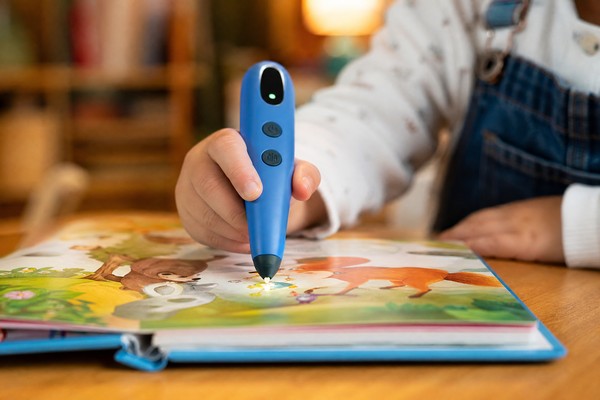
– A Picture Book Reading Pen is a handheld, reader-friendly device that identifies hotspots printed on picture books and plays pre-recorded audio (narration, sound effects, language lessons). They typically combine: an optical sensor or OID (Optical Identity) reader, microcontroller (MCU), audio codec/DAC, small speaker (8–16 Ω, 0.5–2 W), memory (Flash), simple UI (buttons/LED), and a power source (battery or cells).
– Typical dimensions: pen length 120–180 mm, diameter 16–28 mm, weight 50–180 g depending on power source and speaker.
– Power demands: intermittent bursts for audio playback, idle/standby for sensor detection, short wake-ups for touch events.
Primary users and use cases
– Children aged 2–8 learning reading, vocabulary, and languages; devices used at home, kindergarten, and schools.
– Publishers bundling interactive books as product addons; educational distributors.
– OEMs and ODMs producing low-to-mid volume educational electronics.
Operational expectations
– Daily usage: average session 5–20 minutes; heavy use 1–2 hours/day in classroom settings.
– Durability: 2–4 years product lifetime expected; battery replacement or service model must match that lifetime.
– Safety: child-safe design, tamper resistance, compliance with toy safety and battery transport regulations.
Why Demand Is Growing
Market drivers
– Increased spend on early childhood education tools and interactive content.
– Multi-lingual/STEAM curricula encourage audio-supported learning; interactive pens provide low-cost, accessible delivery.
– Consumer preference for convenience: rechargeable devices reduce friction and perceived ongoing cost.
Technology enablers
– Smaller, higher-energy-density Li‑Polymer cells allow slim pen designs with longer runtime.
– Efficient MCUs and audio codecs reduce active power consumption and improve standby life.
– Standardized charging interfaces (USB-C) and widely available chargers make recharging seamless.
Regulatory and environmental pressure
– EU Battery Directive (2006/66/EC) and national disposal laws increase pressure to minimize primary battery use and to design for recycling.
– Air transport and lithium battery shipping rules create logistical constraints that influence whether manufacturers ship with batteries preinstalled or ship devices with batteries removed and include separate battery handling procedures.
Operational & business drivers
– Education buyers prefer replaceable batteries in some contexts (classroom management, rapid turnaround) while consumer buyers prefer rechargeable units for convenience. This segmentation drives product variants and stocking strategies.
Key Technology Differences
Battery chemistry and form factors
– Primary alkaline (AA, AAA)
– Voltage: 1.5 V nominal (fresh), depleted ~1.2–1.0 V
– Capacity: AA 1,700–2,800 mAh, AAA 800–1,100 mAh (varies by load)
– Advantages: low cost, easy user replacement, no charging circuitry
– Disadvantages: lower energy density by volume/weight, inconsistent voltage under load, environmental disposal concerns
– Rechargeable NiMH (AA, AAA)
– Voltage: 1.2 V nominal
– Capacity: AA 1,700–2,500 mAh (low self-discharge NiMH available)
– Charging: requires NiMH charger; allow for peak detection (∆V), timer, or dT/dt algorithms
– Pros: established technology for replaceable cell designs with better cycle life than alkalines for high drain; cons: lower voltage per cell than alkalines, memory effect largely mitigated in modern cells
– Lithium-ion / Lithium-polymer (single cell)
– Voltage: 3.6–3.7 V nominal, 4.2 V fully charged (typical); cutoff ~3.0–3.2 V recommended
– Capacity: small pouch/cylindrical 300–2,000 mAh for pens; 300–1,200 mAh common in compact designs
– Charging profile: CC/CV with termination current around 0.05–0.1C; protection required
– Advantages: highest energy density, compact form factor, consistent voltage, low self-discharge
– Disadvantages: requires charging IC/BMS, subject to transport and storage regulation, higher COGS for cells and safety testing
Electrical architecture options
– Single-cell Li-ion with onboard PMIC/BMS and USB charging port.
– Typical architecture: battery -> protection IC -> fuel gauge -> battery charger IC -> MCU and audio power stage.
– Use of PMIC simplifies charging and protects against over‑charge/over‑discharge.
– Replaceable cells (AA or AAA) without charging
– Simple battery holder, mechanical retention, polarity protection (diode or MOSFET).
– Simpler BOM and lower regulatory burden for shipping, but larger size and mass.
– Hybrid: replaceable NiMH cells with optional external charger
– For markets where users prefer replaceability with rechargeable convenience; requires charger compatibility and labeling.
Power management hardware blocks
– Charge controller (for Li-ion): supports CC/CV, termination, temperature monitoring, safety timers.
– Battery protection: overvoltage, undervoltage, overcurrent, short-circuit protection, and cell balancing (if multi-cell, rarely used in pens).
– Fuel gauge: coulomb counting or impedance-based to report battery state to MCU; useful for user-facing battery indicators.
– DC-DC regulators or LDOs: maintain stable logic rails (e.g., buck converter from 3.7 V down to 1.8/3.3 V) and efficient audio amplifier supply.
– Wake/sleep power domains: sensor and MCU low-power modes to reduce standby drain.
Charging interface and protocol differences
– Micro-USB / USB-A (legacy): device expects 5 V supply; chargers detect using D+/D- resistors (USB BC 1.2) to indicate dedicated charging port.
– USB-C (recommended): reversible connector, higher mechanical durability, better futureproofing; power role negotiation possible but not necessary for simple 5 V charging if CC line is pulled appropriately or a dedicated sink-only port is used.
– Fast charging protocols (USB PD, Qualcomm QC): unnecessary for single-cell pens unless explicitly supporting higher currents; adding PD negotiation increases BOM and software complexity and raises thermal concerns.
– Wireless charging (Qi): niche; adds 25–50% cost and additional space/thermal considerations; generally not recommended for low-cost pens.
Key Features and Specifications to Evaluate
Battery specifications to specify in an RFP or BOM
– Chemistry: Li‑ion pouch, cylindrical Li‑ion, NiMH, or alkaline
– Nominal voltage: 3.7 V for single-cell Li‑ion; 1.2 V per cell for NiMH; 1.5 V per cell for alkalines
– Rated capacity (mAh) at expected discharge current (specify test conditions, e.g., 200 mA discharge to 3.0 V)
– Internal resistance (mΩ at 1 kHz) — affects peak current delivery and heat
– Dimensions and weight: specify length/width/height or AA/AAA form factor
– Cycle life: number of full cycles to 80% capacity (e.g., 300 cycles at 0.5C)
– Operating temperature range: charge and discharge limits (e.g., charge 0–45 °C, discharge −20–60 °C)
– Self-discharge rate: % per month
– Safety certifications: IEC 62133, UL 1642 (cells), UN38.3 for transport
– Warranty term and expected EoL handling/recycling
Charger and charging subsystem specifications
– Charge algorithm: CC/CV with termination current threshold (e.g., 0.05C) and safety timer
– Input voltage range: 5 V ±5% for USB, or broader if designed for PD
– Maximum charge current: recommended ≤0.5C for consumer devices; 0.2–0.5C trade-off for runtime vs longevity
– Thermal monitoring: thermistor (NTC) on battery or temperature sensor in pack
– Protection features: overcharge cutoff, discharge cutoff, short-circuit protection, overcurrent limit
– Connector standard: USB-C receptacle with defined CC resistors to force 5 V default if PD not implemented
– Indicators: charge status LED or multicolor indicator, battery level reporting via UI
Device power consumption profiling
– Active playback current (speaker driven at moderate volume): typical 150–400 mA at 3.7 V; peak 500–700 mA for large volume transients
– MCU active: 5–40 mA depending on MCU and peripherals
– Standby / deep sleep: target <50 µA to achieve long shelf life and avoid deep discharge
– Wake-up sensor draw: optical OID sensor bursts—specify average and peak currents
– Approximate run time examples:
– 400 mAh Li‑ion pouch + average playback draw 250 mA => ~1.5 hours playback (400 mAh / 250 mA ≈ 1.6 h)
– 800 mAh pouch + same draw => ~3.2 hours
– AA NiMH x2 (1.2 V x2 = 2.4 V) with boost converter raises complexity; runtime depends on converter efficiency (70–90%)
Mechanical and user-safety features to require
– Battery compartment: child-resistant fastener (e.g., Phillips screw captive, tamper-evident), rounded edges, secure retention to prevent easy access
– Venting and pressure relief in Li‑ion packs not typically feasible in consumer pens; require protective enclosure and BMS
– Conformal coating and potting for splash resistance if specified; ensure charger port waterproofing standards (IP54–IP67 depending on use case)
Documentation and labeling
– Battery labeling as per IEC and regional regulations (chemistry, voltage, capacity, disposal symbol)
– User manual: charging instructions, storage guidelines (store at 40% SOC for long-term), disposal/recycling information, warnings about temperature and not exposing to fire
Pros and Cons
Rechargeable Li‑ion/Li‑Polymer (internal)
Pros
– High energy density: smaller, lighter pens with longer runtime
– Better user experience: no ongoing battery purchases, consistent voltage under load
– Slim, integrated industrial design is possible; fewer moving parts (no battery door)
– Lower environmental impact over lifetime if used frequently
Cons
– Higher COGS: cell single cost $1.5–$4.0 (varies by capacity and supplier), PMIC/charger adds $0.3–$2.0
– Requires charging circuit, safety testing (IEC 62133), and more complex compliance & shipping
– Serviceability: replacement often requires factory/authorized repair
– Battery capacity degrades over time; lifecycle replacement strategy needed (warranty and EoL plan required)
Replaceable AA/AAA (alkaline or NiMH)
Pros
– Lower unit cost for the pen BOM (no charger, no BMS)
– Easy field servicing: end users replace cells without return logistics
– Lower regulatory complexity for shipping and global compliance (alkaline are not restricted like Li‑ion)
– Durable and predictable for classroom settings where spare cells are supplied
Cons
– Larger/heavier form factor; less ergonomic for small hands
– Ongoing ownership cost for parents and institutions; inconsistent performance as cells discharge
– Risk of damage from incorrect insertion, mixing old/new cells, or battery leakage
– For rechargeable NiMH, a separate charger is required — either included or sold separately.
Hybrid options
– Replaceable rechargeable NiMH with charger: offers middle ground but increases logistics complexity and charger compatibility challenges.
– Removable Li‑ion pack for serviceable replacement: combines Li‑ion benefits with replaceability but increases design complexity and safety requirements for removable packs.
Step-by-Step Decision Guide
Decision Step: Define target user and use case
– Consumer home use, light: rechargeable Li‑ion favored for convenience.
– Classroom / library use, heavy duty: consider replaceable NiMH/AA for ease of service and rapid turnaround.
– Remote markets with poor electricity access: replaceable alkaline may be preferred.
Decision Step: Set runtime and duty-cycle targets
– Calculate required playback hours per day and expected number of charge cycles.
– Estimate required capacity: Required mAh = (average playback current mA × hours per day) / depth of discharge.
– Example: target 1.5 hours/day; average playback current 250 mA; desired 80% DoD ⇒ mAh = (250 × 1.5) / 0.8 ≈ 469 mAh → select 500–800 mAh cell.
Decision Step: Determine form factor and weight constraints
– Pen diameter and balance are affected by cell size; pouch cells are slim, cylindrical cells increase diameter.
– For a 16–20 mm barrel, 300–600 mAh pouch or button-style cells are preferable.
Decision Step: Choose chemistry and charging approach
– If choosing Li‑ion:
– Specify single-cell 3.7 V with onboard charger and protection IC.
– Charge current: conservative 0.2–0.5C recommended for safety and cycle life.
– Include temperature monitoring and fuel gauge for accurate battery indicators.
– If choosing replaceable cells:
– For AA form factor, decide alkaline vs NiMH. For sustainability and repeated use, specify NiMH low self-discharge cells.
– Design child-resistant battery compartment and include polarity protection.
Decision Step: Specify charging interface
– Prefer USB-C receptacle with the device configured as a 5 V sink using CC resistor method if not implementing USB PD. This provides mechanical durability and user convenience.
– Avoid PD negotiation complexity unless offering fast charge that must be extensively safety-tested.
Decision Step: Safety, testing and compliance plan
– Require IEC 62133 certification for Li‑ion packs; require UN38.3 for air transport when shipping devices with batteries.
– Budget for compliance testing: cell-level and pack-level safety testing can cost from $5k to $25k depending on test scope and labs.
– Include toy safety testing (EN 71-1/EN 71-2/EN 71-3, ISO 8124 or ASTM F963 depending on market) and EMC/RED for wireless features.
Decision Step: Service, warranty and EoL policy
– Define battery warranty and replacement policy.
– For non-serviceable Li‑ion designs, plan for authorized service channels and end-of-life recycling paths.
– For replaceable designs, define recommended replacement cycles and disposal guidance, and include a warning label for battery insertion.
Decision Step: Procurement and supplier selection
– Require suppliers to provide ROHS, material safety datasheets (MSDS), IEC 62133/UN38.3 certificates, and batch traceability.
– Factory audits: evaluate lithium handling, cell aging procedures, and quality control (IR, capacity testing, visual inspection).
Decision Step: Pilot production and field validation
– Build 100–1,000 pilot units covering worst-case thermal and charge scenarios; measure runtime under standardized load profiles (continuous playback, intermittent use).
– Validate charging behavior across multiple charger brands/power banks to ensure compatibility.
Pricing and Cost Analysis
Component cost ranges (indicative, spot market variances apply)
– Small Li‑Polymer cell (300–600 mAh): $1.20–$2.50 per cell (single-unit pricing in OEM volumes; volumes change price dramatically).
– Larger pouch cell (800–1,200 mAh): $2.50–$5.00 per cell.
– NiMH AA cell (1,900–2,400 mAh): $0.40–$1.00 per cell.
– Alkaline AA single: $0.20–$0.60 per cell.
– PMIC / charger IC: $0.30–$1.50 depending on complexity (USB-C CC support increases cost).
– Fuel gauge IC: $0.20–$1.00.
– Protection MOSFETs and discrete components: $0.10–$0.50.
– Connector (USB-C): $0.40–$1.20 depending on mounting/reinforcement.
– Mechanical battery holder and screws (for replaceable design): $0.10–$0.50.
– Assembly and test overhead per unit: $0.50–$1.50 for battery integration, testing, and BOM traceability.
Total BOM impact examples (approximate)
– Compact rechargeable pen (500 mAh pouch + PMIC + USB-C): incremental cost above non-battery pen ~$3.00–$7.00 per unit depending on volumes and cell choice.
– Replaceable AA pen (no charger): incremental cost ~+$0.20–$1.50 for battery holder and mechanical changes, but recurring cost to end user for cells.
– Replaceable NiMH with included charger: additional charger cost $1.50–$4.00 (bulk), increases distribution complexity.
Lifecycle cost comparison (example over 3 years; assume daily use)
– Scenario A: Rechargeable 800 mAh Li‑polypen, average 2 hours/day, charged daily, cell cycle life 300 cycles to 80% capacity. Replacement cost: require replacement after ~10 months if charged daily. Replacement cell cost plus service ~$3–$6. Total direct battery cost across 3 years: $6–$18.
– Scenario B: Replaceable AA alkaline 2× AA, end-user replaces every 2 weeks with daily use (depending on duty): 26 replacements/year × 3 years × $0.50 per pair ≈ $39.
– Conclusion: For moderate-to-high daily use, rechargeable options reduce total cost of ownership for users; for infrequent use, replaceables may be cheaper.
Compliance and testing costs
– Cell certification (supplier-provided) vs internal pack-level testing: expect to pay $5k–$25k across required safety tests, with time for scheduling and corrective actions.
– Shipping and logistics overhead: shipping devices with Li‑ion requires special paperwork and packaging (UN classification), may increase freight cost by 2–15% and limit air transport options.
Warranty and RMA costs
– Higher incidence of battery faults can drive RMA costs disproportionately because returns are typically complete-device returns. Design for modularity or a field-replaceable battery module reduces RMA logistics cost but increases unit BOM.
Competitive Landscape
Industry product choices
– Low-cost consumer pens: many vendors choose internal Li‑poly packs to achieve compact design and acceptable runtime. Vendors often trade off serviceability for slim form factor.
– Classroom-grade devices: mainstream education device makers and institutions often choose replaceable AA or robust NiMH designs to facilitate rapid replacement and to avoid downtime.
– Premium interactive readers: may include higher capacity cells (1,000+ mAh), USB-C charging, and fuel gauge reporting for better UX.
Supply chain segmentation
– Cell suppliers: large brand cells from Samsung SDI, LG, Panasonic, and ATL serve tier-one clients; OEMs can also source from qualified Chinese cell manufacturers for cost optimization but must verify traceability and test data.
– Charger IC suppliers: Texas Instruments, Microchip, STMicroelectronics, and smaller PMIC vendors provide integrated charging and protection ICs with variant support for USB-C and fuel-gauge features.
– ODM suppliers: multiple hardware factories in Shenzhen/Guangdong and Zhejiang provide turnkey pen designs; differentiation is often in housing quality, speaker hardware, and battery integration.
Market differentiators
– Battery life and charging time: units advertising 3–6 hours continuous playback and fast charging can command higher price points subject to validated testing.
– Safety and compliance: units with certified cells and visible conformity marks (CE, FCC, IEC 62133) instill buyer confidence for institutional purchases.
– Serviceability and spare parts: vendors offering replaceable battery modules or swap programs reduce total cost of ownership for institutions.
Trends and future directions
– Increased migration to USB-C for charging and data.
– Growth of smart pens with Bluetooth connectivity and over-the-air updates—requiring more sophisticated power budgets and battery management.
– Greater pressure to reduce use of disposable cells in consumer segments due to environmental regulation and parental preference.
What Buyers Say
Consolidated buyer feedback collected from procurement and field reports (aggregate view)
– Parents / consumer buyers:
– Favor rechargeable pens for convenience and single-charge runtime of at least 2 hours.
– Frequent complaints: inability to replace battery once capacity degrades; long charge times; device unavailable during charging.
– Institutional buyers (schools, kindergartens):
– Prefer replaceable AA/NiMH due to ease of swapping and minimal device downtime.
– Concerned with sustained high-use conditions and cost of providing replacement batteries.
– Retailers and distributors:
– Demand clear labeling and compliance documentation; devices with accessible batteries incur fewer logistics constraints.
– Recommends offering a replaceable-battery variant in markets with strict lithium handling rules or where consumer education is a barrier.
– Product teams and engineers:
– Emphasize the need for lab-validated runtime figures rather than manufacturer claims.
– Recommend implementing a low-battery alert and automatic safe shutdown to avoid data corruption or sudden device failure.
Operational lessons from field
– Devices with shallow standby strategies suffer from faster-than-expected battery drain in real-world mixed use; specifying <50 µA deep-sleep current is critical.
– Using a robust, hardware-based battery protection circuit reduces field incidents; software-only protection is insufficient.
– Provide clear charging guidance: avoid using chargers rated >1A unless the device is designed/tested for that current.
Safety, Maintenance and Compliance
Safety requirements and best practices
– Cell-level safety: require IEC 62133 certification for cells and packs used in devices sold to consumers. This covers abuse tests (overcharge, short circuit, thermal, mechanical).
– Transport and shipping: UN38.3 testing required for air transport. For bulk shipments of devices with lithium batteries, ensure proper documentation, package labeling, and carrier-compliant packaging.
– Toy and child-safety standards:
– Europe: EN 71 (mechanical/physical and flammability parts), and applicable national toy safety laws.
– USA: ASTM F963 safety standards for toys; battery-specific guidance and labels recommended.
– Battery labeling: include battery chemistry, nominal voltage, capacity, disposal symbol, and recycling information as required by local law (e.g., EU Battery Directive).
– Charging safety: implement over-voltage, over-current, over-temperature, and timer-based charge termination; include thermistor (NTC) on the battery pack for temperature qualifications.
Design-for-maintenance considerations
– Make battery compartments child-resistant: screw-fastened battery doors or tamper-evident seals when replaceable cells are used.
– For internal Li‑ion packs, include an accessible service port for authorized replacement or design a user-replaceable module employing safe mechanical interlocks.
– Document replacement procedures for authorized service centers; include battery sourcing info to avoid counterfeit or unsafe replacements.
Compliance testing and sample plan
– Pre-production: cell vendor certificate verification, sample batch destructive testing (IR, capacity).
– Production validation: incoming cell lot testing (sampled), pack assembly validation, charge/discharge cycle sample test.
– Certification: IEC 62133 (or local equivalent), UN38.3 for shipping, EMC testing (EN 55032/EN 55035 / FCC Part 15), and toy safety testing for target markets.
– Maintain test reports and traceability for at least the warranty period.
Maintenance and end-of-life
– Recommend storing Li‑ion devices at 30–50% SOC for long-term storage; avoid full discharges.
– Provide end-of-life and recycling instructions in manuals; in EU, comply with WEEE and battery collection obligations.
– Plan for battery replacement service or recycling take-back program to meet regulatory and reputational responsibilities.
Frequently Asked Questions
Q: Which battery type gives the best runtime-per-volume for a pen?
A: Li‑Polymer pouch cells provide the best energy density by volume and weight in the 300–1,200 mAh range, enabling slim pen profiles with 1.5–4 hours of typical playback depending on capacity and usage.
Q: Is USB-C required for safety?
A: No—USB-C is not required for safety but is recommended for durability and future compatibility. USB-C requires proper CC resistor implementation if PD negotiation is not used to ensure safe 5 V charging.
Q: What charge current should be specified for a 500 mAh cell?
A: A conservative charge current is 0.2C (100 mA), which balances charge time (~5–6 hours including CV taper) and cycle life. 0.5C (250 mA) reduces charge time to ~2–3 hours but increases thermal stress; ensure thermal management and testing if selecting >0.5C.
Q: Can the pen be charged via power banks and phone chargers?
A: Yes, if the charging circuit accepts 5 V and implements robust input filtering and CC resistor logic for USB-C. Device should tolerate rips and voltage variations and should not rely on PD negotiation unless implemented.
Q: How long will a rechargeable battery last before replacement?
A: Typical small Li‑poly cells are rated for 300–500 full cycles to 80% capacity under 0.5C charging. In daily usage scenarios, expect 9–18 months before noticeable capacity loss; warranty and replacement policy should account for this.
Q: Are there shipping restrictions if I ship pens with internal Li‑ion batteries?
A: Yes. Lithium batteries subject devices to UN38.3 and carrier-specific rules. Some carriers restrict air transport for large quantities or require special packaging and documentation. Consider shipping with batteries at 30% SOC or shipping batteries separately as needed.
Q: Should I include a fuel-gauge?
A: Fuel gauges improve UX but add cost and complexity. Use a fuel-gauge IC if offering precise battery percentage indicators or expecting variable duty cycles. Otherwise, a simple low-battery indicator can suffice.
Q: How to prevent children from tampering with batteries?
A: Use captive screws, concealed battery compartments, and child-resistant designs. Include warnings and do not make batteries easily accessible without tools.
Q: Can a single charger circuit support both Li‑ion and NiMH?
A: Not safely. Li‑ion requires CC/CV profile with 4.2 V endpoint, NiMH requires negative delta‑V or temperature-based termination. Use separate configurations or provide external chargers.
Q: What safety documentation should be required from cell suppliers?
A: IEC 62133 certificate, UN38.3 test reports, MSDS (Material Safety Data Sheet), lot traceability, and factory audit evidence of manufacturing controls.
Contact Toyvao
For sourcing, compliance support, technical specifications, and supplier qualification for Picture Book Reading Pens and battery systems, contact Toyvao:
- Website: https://www.toyvao.com
- Email: sourcing@toyvao.com
- Services available: supplier sourcing, BOM optimization, compliance/testing management, pilot production coordination, and product redesign for power management.
Provide your target market (regions), expected annual volumes, preferred battery chemistry, and desired runtime to receive a tailored supplier shortlist and cost estimate.
