
Executive Summary
Custom app and firmware development for OID (Optical Identification) reading pens is now a core differentiator for manufacturers selling interactive picture-book pens to education and consumer markets. Buyers must evaluate three intertwined areas: device firmware architecture, mobile/cloud API design, and secure OTA (over‑the‑air) update pipelines. Decisions at the chipset and firmware level (RTOS vs Linux, secure boot, crypto support, available flash/RAM) directly determine which API patterns, OTA mechanisms, and security controls are practical.
This guide defines the technical choices, presents concrete hardware and software specifications to evaluate, lists security best practices and compliance obligations, and delivers an actionable procurement and development checklist. Expect engineering development costs in a broad range: firmware engineering (initial port and core features) typically $40k–$150k; companion app development $30k–$120k; OTA/cloud infrastructure $3k–$30k initial (plus recurring). Component cost impacts per-unit BOM (nRF52840 module $3–$7; ESP32 $2–$6; 8–16 MB SPI NOR flash $0.5–$2). Plan for long‑term support (3–5 years), signed firmware, and test automation to avoid field recalls and data breaches.
What Is Picture Book Reading Pen and Who Uses It
Product definition
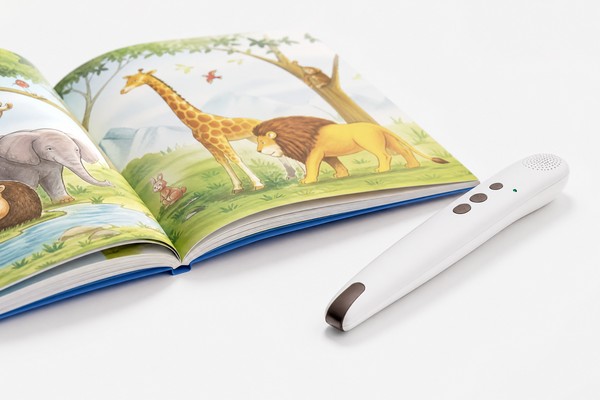
– OID Reading Pen (also called Picture Book Reading Pen, Story Pen, Talking Book Pen): a handheld device with an optical sensor that reads printed OID markers (dot codes, micro-patterns) embedded in illustrated pages and plays associated audio content when the pen tip contacts or points to a marker.
– Typical components: optical OID sensor (camera or IR sensor), microcontroller or SoC, flash storage for audio and firmware, DAC and amplifier for speaker output, MEMS microphone (for voice recording/feedback), battery, BLE and/or Wi‑Fi radio for connectivity.
Primary user segments
– Education publishers (K–6 activity books, bilingual learning).
– Toy manufacturers and licensing partners (character-based reading pens).
– Distributors/retailers and private-label brands.
– Parents/end users seeking screen-free interactive reading aids.
Primary buyer roles (B2B)
– Product managers and procurement leads evaluating OEM/ODM suppliers.
– Hardware and firmware engineering leads responsible for integration.
– Mobile app teams (in-house or agency) coordinating APIs and app UX.
– Compliance and safety officers ensuring regulatory conformance.
Why Demand Is Growing
Market drivers
– EdTech adoption: Schools and parents seek low-screen, tactile learning tools. Global edtech device adoption is rising; reading aids are a stable segment that supports language acquisition and phonics.
– Content monetization: Publishers want devices tied to digital content, subscriptions, analytics, enabling recurring revenue.
– Multi‑channel connectivity: BLE and Wi‑Fi enable content updates, analytics, and parental controls — features that demand custom firmware and secure OTA flows.
– Personalization and localization: Buyers require multi‑language audio, content mapping, and analytics that require custom APIs and secure cloud backends.
Quantitative indicators
– Average product lifecycle for consumer educational electronics: 3–5 years. Budget for at least 2 major OTA firmware revisions and frequent content updates.
– Typical audio storage per book: 5–20 MB for compressed MP3 at 32–64 kbps per 1 hour of narration; a single pen often needs 8–64 MB user-accessible storage depending on library size.
– Expected BLE throughput for firmware transfer: 100–800 kbps (practical); OTA via BLE for a 2–4 MB firmware image takes 30–120 minutes without optimization; via Wi‑Fi it drops to minutes.
Procurement implications
– Buyers prioritizing product longevity must insist on secure, field-proven OTA and a maintenance SLA. Lack of robust OTA capability is the biggest single technical cause of product obsolescence in shipped units.
Key Technology Differences
OID decoding approach
– Camera-based OID: small CMOS image sensor captures printed dot patterns; CPU performs decoding. Pros: flexible markers, robust mapping. Cons: higher CPU load, more power consumption, increased BOM cost.
– IR/reflectance OID: simpler photodiode/IR LED pairs detect high-contrast marks. Pros: lower cost, lower CPU. Cons: limited data density and resilience.
Processor and OS choices
– Cortex‑M class (e.g., STM32F4/M7, Nordic nRF5x): common for low-power, deterministic behavior. Use RTOS (FreeRTOS, Zephyr) or bare-metal. Best when memory < 256 KB–1 MB RAM and flash 1–8 MB.
– Cortex‑A or Linux-capable SoC (e.g., A7, A9, or ARM-based application processors): chosen when heavy audio processing, codec support, complex UI, or large local storage needed. Requires more BOM and power.
– Hybrid approach: small MCU handles OID decoding and low-level control; MCU delegates connectivity and heavy tasks to companion Wi‑Fi/BLE module (e.g., ESP32).
Wireless connectivity
– BLE (Bluetooth Low Energy): primary choice for companion apps. Use BLE 4.2/5.0 modules (nRF52832, nRF52840). Practical DFU over BLE is possible with Nordic DFU, requires fragmentation, typically 100–800 kbps peak.
– Wi‑Fi (802.11 b/g/n): required when faster OTA or large content sync is needed. ESP32 and similar provide low-cost Wi‑Fi + BLE.
– Hybrid (BLE for control, Wi‑Fi for bulk transfer): common architecture.
Storage and audio
– Storage options: SPI NOR flash (4–64 MB) for firmware and small audio; SPI NAND or eMMC for larger libraries (>64 MB). FAT32 or custom file system; consider wear leveling.
– Audio codecs: MP3 (baseline), AAC-LC (higher efficiency), Ogg Vorbis (open), PCM/WAV (higher quality, larger size). Typical deployment: 16-bit PCM at 22.05 kHz mono for intelligible narration (file size ~5 MB per 10 minutes at 64 kbps MP3).
Security and crypto capability
– Hardware crypto: SoCs with AES, SHA, RSA or ECC accelerators (e.g., nRF52840 supports AES-128, ECC P-256). For high security, require secure element (ATECC608A) or TrustZone support on Cortex‑M/‑A.
– Secure key storage: hardware-backed key storage recommended. Avoid storing private keys or symmetric keys in plain flash.
Power and audio output
– Battery: LiPo 3.7 V typical; capacity range 400–1200 mAh depending on target run-time and size. Target 6–18 hours playback per charge.
– Speaker: 8 Ω, 0.5–1.5 W. DAC resolution 12–16 bit.
Key Features and Specifications to Evaluate
API design (mobile and cloud)
– BLE GATT vs REST: BLE GATT for local control—characteristics for device status, OID mapping sync, DFU control. REST/HTTP(S) or MQTT for cloud interactions and analytics.
– Required API endpoints/features:
– Device identity and pairing: device UUID, firmware version, serial number.
– Content sync: manifest files (JSON) with content IDs, sizes, checksums (SHA-256), and version tags.
– Playback control and telemetry: play/pause, device events, usage metrics; batched telemetry to conserve power and bandwidth.
– OTA control: update available, version manifest, chunk URLs, signature, and rollback policy.
OTA update requirements
– Bootloader & A/B partitioning: use an A/B scheme to ensure atomic updates and safe fallback. MCUBoot and similar are industry standards for Cortex‑M.
– Signed firmware images: use ECDSA (P-256) or RSA-2048 signatures; manifest contains version, hash (SHA-256), signature, and vendor certificate chain.
– Delta updates: binary diffs (bsdiff, xdelta) reduce transfer size but increase CPU/memory during patching; recommended when BLE-only delivery and large images.
– Chunking and resume: support partial downloads, chunk acknowledgements, retry logic, and resume after interruption.
– Update verification: validate signature and checksum before switch; perform health checks on boot.
Security specifications
– Secure boot: verify bootloader integrity and chain of trust.
– Secure storage: encrypt user data and content at rest (AES-128/256), preferably via hardware crypto.
– Communication security: TLS 1.2/1.3 with certificate pinning for cloud; BLE pairing with LE Secure Connections (ECDH).
– Anti-rollback: monotonic counters or version enforcement in secure element.
– Debugging lockout: disable JTAG/SWD in production or require authenticated debug.
Performance and memory targets (baseline)
– RAM: 256–512 KB for simple RTOS + audio playback; 1–2 MB or more for complex image decoding and encryption.
– Flash: 8–32 MB SPI NOR recommended for firmware, audio cache, and mapping; larger libraries need SPI NAND or eMMC (128 MB+).
– CPU: Cortex‑M4 80–180 MHz adequate for OID decode plus audio; choose Cortex‑M7 or Cortex‑A for advanced features or ML inference.
– Audio playback: hardware DAC preferred; target 22.05–44.1 kHz at 16-bit for clarity.
Testing and QA capabilities
– DFU/OTA test harnesses: automated test rigs to validate interrupted updates, rollback, and signature checks.
– Integration tests: pairing flows, manifest tampering scenarios, corrupted-image behaviour.
– Field testing: deploy beta firmware to limited devices with remote logging and safe recovery paths.
Manufacturability and supply chain
– Module selection: prefer pre-certified radio modules (Bluetooth SIG certificates, FCC) to speed time to market and reduce compliance cost.
– BOM consistency: lock component sources for at least 12–18 months to reduce rework during firmware updates.
Pros and Cons
Pros of custom app and firmware
– Feature differentiation: custom audio mapping, analytics, parental controls, and localization create product value.
– Security control: ability to mandate secure boot, encryption, and signed OTA.
– Long-term maintainability: vendor-controlled update path for bug fixes and new content.
– Integration: tight integration between OID decoder, app UX, and cloud content management.
Cons and risks
– Development cost and time: expect 6–12+ months for robust firmware, app, and OTA infrastructure with a cross-functional team.
– Maintenance burden: ongoing OTA infrastructure, certificate rotation, and support for older devices.
– Complexity on low-end hardware: limited RAM/flash constrains OTA and cryptographic choices, increasing engineering effort or requiring hardware upgrades.
– Regulatory exposure: data collection brings GDPR/COPPA compliance responsibilities and potential legal risk if not handled correctly.
Step-by-Step Decision Guide
Define product requirements
– Content size and frequency of updates: small static libraries vs frequent streaming/large additions — determines Wi‑Fi requirement and storage size.
– Security posture: enterprise-grade (signed images, secure element) vs basic (signed images without hardware-backed keys). Choose hardware accordingly.
– Connectivity model: BLE-only for paired apps; BLE + Wi‑Fi for independent updates/downloads.
Choose the hardware baseline
– Minimum recommended platforms:
– BLE-only low-power pen: nRF52840 or STM32 + pre-certified BLE module; 16 MB flash; Cortex‑M4/7; A/B bootloader.
– Hybrid Wi‑Fi + BLE pen: ESP32-WROOM/ESP32-S3 or equivalent with 32–128 MB flash and at least 1 MB RAM.
– Include hardware crypto (ATECC608A or equivalent) or SoC with ECDSA/AES acceleration for secure boot and OTA.
Architect the firmware and app API
– Use modular firmware: separate OID decoding, audio playback, connectivity, and OTA modules. Use standard bootloader (MCUBoot) and consider Zephyr/FreeRTOS.
– Define BLE GATT profile with characteristics for:
– Device info (UUID, fw version).
– Control channel (playback commands).
– DFU control (start/stop, progress, manifest).
– Telemetry/diagnostics (bat level, error codes).
– Cloud API: REST endpoints for manifest retrieval, signed firmware hosting, and telemetry ingestion (JSON, HTTPS).
Design OTA pipeline
– Build a versioned manifest format (e.g., JSON) that includes:
– version
– target device model
– SHA-256 hash
– signature (ECDSA) over the manifest
– list of files and sizes (for multi-file updates)
– optional delta/patch map
– Host firmware on CDN with HTTPS and use signed manifests to prevent MITM.
– Implement server-side policy: staged rollouts (e.g., 1%, 10%, 100%), forced vs optional updates.
Security controls and lifecycle
– Provision keys at manufacture (or during first power-up) into secure element or TrustZone repository.
– Implement secure boot chain: boot ROM → bootloader → kernel/firmware.
– Use certificate pinning for critical endpoints and restrict debug access in production.
– Plan for key rotation: support server-side revocation and re-provisioning mechanisms.
Testing and QA checklist
– Unit tests for decoding, playback, and power modes.
– Integration tests for OTA with interrupted scenarios and forced rollback.
– Penetration testing for BLE, Wi‑Fi, and cloud APIs.
– Regulatory and safety tests (FCC, CE, RoHS, EN71, ASTM as applicable).
Procurement and SLAs
– Insist on supplier documentation: bootloader source, DFU protocols, manifest formats, key provisioning process, and supply-chain BOM traceability.
– Negotiate maintenance SLA: security patches within a specified window (e.g., critical patches within 30 days), firmware signing keys custody, and minimum support period (recommend 3+ years).
Pricing and Cost Analysis
Development cost ranges (approximate)
– Firmware development (initial): $40k–$150k depending on complexity (OID decoding, secure boot, OTA, multiple radios).
– Companion app (iOS + Android): $30k–$120k depending on features (analytics, parental controls, in-app purchases).
– Cloud/OTA infrastructure: one-time $3k–$30k for setup and integration; monthly hosting/monitoring $50–$2,000 depending on scale and CDN usage.
Per-unit BOM cost examples (estimates for mid-volume purchasing, 10k–50k units)
– BLE-only baseline:
– nRF52840-based module (pre-certified): $3.00–$7.00
– SPI NOR flash 16MB: $0.50–$1.50
– MEMS mic: $0.12–$0.40
– Speaker 8Ω 0.5W: $0.30–$0.80
– LiPo 600–1,200 mAh: $1.00–$3.00
– PCB, sensors, passive components, casing: $3.00–$7.00
– Assembly, test, packaging: $2.00–$5.00
– Typical total unit cost: $10–$25 (excluding shipping, duty, and margins)
– Wi‑Fi + BLE:
– ESP32 module: $2.00–$6.00
– Larger flash 64–128MB: $2.00–$4.00
– Additional power management and shielding: $1.00–$3.00
– Typical total unit cost: $15–$35
Certification and compliance costs
– Bluetooth SIG listing: module pre-certification reduces cost; expect $0–$5k for paperwork if module certified.
– FCC/CE/IC testing for final product: $8k–$25k depending on lab and retest cycles.
– Toy safety (EN71, ASTM F963): $2k–$10k depending on test scope and iterations.
– Battery (UN38.3 testing): $2k–$6k per battery chemistry and certificate.
Operational costs
– HSM or KMS for key management: cloud KMS usage may cost $10–$200/month depending on volume. Dedicated HSM appliances add capital expense.
– OTA CDN bandwidth: depends on update frequency; plan $50–$500 monthly for small deployments, scaling to $1k–$5k+ with large user bases and frequent updates.
Return on investment considerations
– A secure, maintainable OTA pipeline reduces field recall risk and supports content subscription business models.
– A higher BOM to support hardware-backed security and Wi‑Fi can be amortized via higher ASP and content-related recurring revenue.
Competitive Landscape
Module and SoC vendors
– Nordic Semiconductor (nRF52832/nRF52840): dominant for BLE-focused devices; strong DFU tools (MCUboot, Nordic DFU).
– Espressif (ESP32 series): low-cost Wi‑Fi + BLE combo for bulk content and faster OTA.
– STMicroelectronics (STM32 series): widely used for custom MCUs with rich peripheral options and ecosystem.
Security and crypto providers
– Microchip ATECC family (ATECC608A): low-cost secure element for key storage and ECDSA.
– Platform providers: ARM TrustZone on Cortex‑M/‑A and secure firmware stacks.
ODM/OEM suppliers
– China-based OEMs specialized in educational pens: many with existing OID decoding IP and reference applications. Supplier evaluation must include source control, OTA pipeline maturity, and long-term support capacity.
Software ecosystems and frameworks
– Zephyr OS: growing support for small devices with BLE, OTA, and secure boot options.
– FreeRTOS: mature, with community-portable libraries.
– MCUBoot: established bootloader for secure A/B updates.
– Nordic SDKs: integrated DFU tools and example GATT services.
Open-source projects and standards
– Nordic DFU, MCUBoot, and Zephyr boot frameworks are commonly used. Use of these reduces development time, but proprietary modules still necessary for device-specific features.
Selection criteria for buyers
– Prefer suppliers offering pre-integrated secure boot and OTA solutions with documented test suites.
– Insist on source code escrow or access to critical firmware components in case of supplier failure.
– Choose vendors with demonstrable experience on the chosen SoC and with toy/education device certifications.
What Buyers Say
Common buyer priorities (aggregated)
– Reliability of OTA: buyers insist on atomic updates, rollback, and staged rollouts. Failures in early shipments create high warranty and replacement costs.
– Security and privacy: buyers require signed firmware, secure boot, and explicit data collection policies. Compliance with COPPA/GDPR is non‑negotiable for North American and EU markets.
– Time-to-market vs features: many buyers accept higher BOM to gain faster development using pre-certified modules.
– Long-term support: typical buyer requirement is 3–5 years of firmware updates and security patches. Buyers budget for this lifecycle when evaluating suppliers.
– Documentation and test artifacts: full API docs, manifest schema, and automated DFU/rollback tests are frequently requested during procurement.
Operational feedback
– BLE-only solutions led to frequent customer support cases due to fragmented DFU experiences on Android. Buyers view hybrid BLE+Wi‑Fi OTA as a superior UX albeit with higher BOM.
– Lack of hardware-backed keys results in security audit failures. Buyers prefer suppliers that include secure elements or SoCs with TrustZone.
Safety, Maintenance and Compliance
Regulatory requirements
– Radio certifications: FCC (US), CE/RED (EU), ISED (Canada), MIC (Japan) — can often be streamlined if using pre-certified radio modules.
– Toy safety: EN71-1/2/3 (Europe), ASTM F963 (US), CPSIA compliance for heavy metals and phthalates. Battery-specific regulations (UN38.3) and label requirements apply.
– Electrical safety: IEC 62368‑1 (audio/consumer electronics) may apply.
– Environmental: RoHS, REACH.
– Data privacy: COPPA (US) when collecting data about children <13; GDPR for EU customers. Parental consent and minimal data retention policies required.
Maintenance best practices
– Update policy: define critical patch SLA (e.g., 30 days) and regular maintenance cadence (quarterly or as needed).
– Logging and diagnostics: keep limited device logs for 30–90 days; provide secure upload options for diagnostics with consent.
– Key management: maintain secure key rotation processes and backup keys in a KMS/HSM. Maintain a revocation/compromise plan.
– Firmware provenance: maintain cryptographic proof of origin (signature chain) and store signing keys offline except for controlled signing environments.
Safety features in firmware
– Battery safety: firmware monitoring for overcurrent/overvoltage, thermal limits, and charge cutoffs.
– Content access controls: parental PINs or app-based controls, content rating metadata.
– Fail-safe behaviour: ensure device boots to a minimal mode if app/firmware update fails (e.g., low-level audio playback for emergency diagnosis).
Frequently Asked Questions
Q: What is the recommended cryptography for signing firmware?
A: ECDSA with curve P-256 is the industry standard for embedded devices due to smaller key sizes and good security. Use SHA-256 hashes. For higher assurance, include an intermediate certificate and store only the root public key in secure storage.
Q: Should OTA use BLE or Wi‑Fi?
A: Use BLE for control and small updates; use Wi‑Fi for large firmware images or content libraries. For BLE-only devices, implement delta updates and compression and expect significantly longer DFU times.
Q: How big should firmware images be?
A: Keep core firmware <2–4 MB for BLE-based DFU. If larger, use Wi‑Fi or split the image and use delta updates. Reserve an A/B partition scheme with at least 1.5× image storage overhead.
Q: How to protect against rollback attacks?
A: Implement anti-rollback using monotonic counters in hardware or secure elements; enforce firmware version checks in the secure bootloader.
Q: How to manage keys for millions of devices?
A: Use per-device keys provisioned during manufacturing stored in secure elements, with centralized key management (KMS/HSM) for signing and certificate lifecycle. For smaller runs, a single vendor key may suffice but increases risk.
Q: What testing is essential before shipping?
A: OTA interruption/resume, corrupted image handling, signature verification, cold-boot behavior, battery safety under charging/discharging cycles, RF coexistence, and toy safety standards depending on market.
Contact Toyvao
For assistance sourcing OEM/ODM partners, evaluating firmware architectures, or setting up secure OTA pipelines, contact Toyvao through the company contact page at https://toyvao.com/contact. Provide the following when making an inquiry:
– Target device volumes (annual), preferred radio stack (BLE only / BLE + Wi‑Fi), and desired storage footprint (MB).
– Required security baseline (signed FW, secure element, COPPA/GDPR compliance).
– Expected timeline for prototype and mass production.
Toyvao provides supplier shortlists, technical evaluation checklists, and support in negotiating SLAs and IP escrow terms. Include any existing hardware or software constraints to receive a tailored supplier recommendation and cost estimate.
