
Introduction
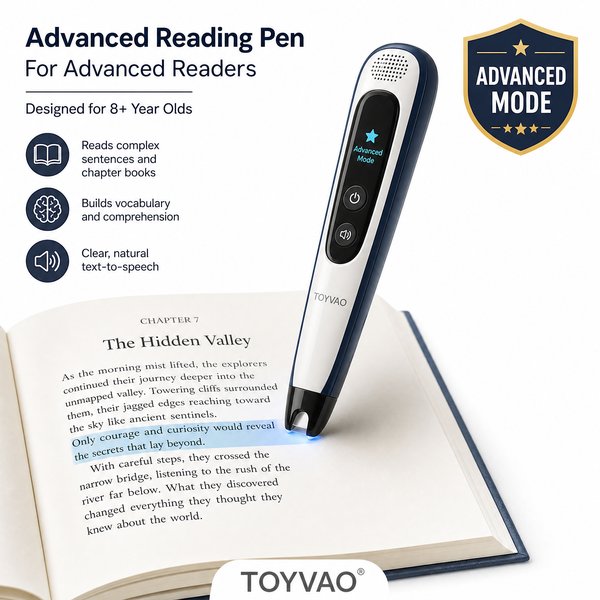
As an assistive learning tool, reading pens have attracted widespread attention in children’s education in recent years. By converting printed text into audible content, they aim to help children improve reading skills and foster learning interest. However, as children grow older, many parents may wonder: are reading pens too simple for an 8-year-old, or do they still offer unique educational value? This article explores the suitability of reading pens for 8-year-olds, the benefits they provide, potential considerations, and their ongoing educational value.
Benefits of Reading Pens for 8-Year-Olds
For 8-year-old children, reading pens can provide significant support in multiple areas, particularly in cultivating reading independence and improving learning efficiency.
First, reading pens can enhance reading independence. They allow children to explore text autonomously and, through immediate pronunciation and explanations, reduce reliance on adult assistance. This autonomous learning experience is crucial for building a child’s confidence and initiative. Second, reading pens help alleviate reading fatigue. For children who struggle with the decoding process, a reading pen can shift their attention from laborious word-decoding to deeper text comprehension, thereby increasing reading efficiency and enjoyment [2].
In addition, reading pens offer valuable support to children with reading difficulties, such as those with dyslexia or children for whom English is an additional language (EAL). They help these students access textual information more easily and overcome reading barriers, facilitating better inclusion in classroom learning [2]. With text-to-speech (TTS) functionality, reading pens can not only read words and sentences aloud but also provide built-in dictionary definitions, which significantly supports vocabulary and comprehension development. Research indicates that using TTS tools can increase student engagement, enable access to grade-appropriate materials, and improve vocabulary, comprehension, reading accuracy, and fluency [1].
Most importantly, reading pens can boost confidence and interest in learning. When children can independently resolve reading difficulties, they gain a sense of control that meaningfully enhances self-esteem and learning resilience [1]. These positive reading experiences help cultivate favorable attitudes toward reading and school, motivating continued learning.
Potential Drawbacks and Considerations
Although reading pens offer many benefits for 8-year-olds, there are considerations to keep in mind when using them.
First is the age-appropriateness consideration. While reading pens can be beneficial for 8-year-olds, their effectiveness should be evaluated based on the child’s individual abilities and learning needs. For children with strong reading skills, a reading pen may serve mainly as a supplementary tool, whereas for those with reading challenges, its impact can be more pronounced. Second, the cost factor is a practical concern. High-quality reading pens can be expensive, which may be a financial burden for some families. Parents should weigh the educational benefits against the economic investment before purchasing.
Additionally, there is a need to be aware of the risk of overreliance. If a child becomes excessively dependent on a reading pen to complete all reading tasks, this could diminish their ability to think independently, solve problems unaided, and infer word meanings from context. Therefore, parents and educators should guide children to use reading pens as an assistive tool rather than a substitute for active learning and critical thinking.
Ongoing Value of Reading Pens for 8-Year-Olds
Even at age eight, the educational value of reading pens should not be underestimated. They are not merely introductory devices for younger children but can be effective supports for older children as well.
Reading pens can function as supplemental learning tools, particularly for children who require additional support in reading. They help these learners process more complex texts effectively and keep pace with their peers’ academic progress. At the same time, reading pens play an important role in promoting autonomous learning. They empower children to independently tackle reading challenges and cultivate proactive learning habits. Through reading pens, children can expand their learning materials, access a broader range of reading content and more advanced knowledge, which positively contributes to their overall development.
Conclusion
In summary, reading pens are not too simple for 8-year-old children; rather, they are assistive tools with sustained educational value. They play important roles in enhancing reading independence, reducing reading fatigue, supporting children with reading difficulties, improving vocabulary and comprehension, and boosting confidence and interest in learning. Of course, when selecting and using reading pens, parents should consider the child’s individual needs, product cost, and the risk of overreliance. Ultimately, the value of a reading pen depends on how thoughtfully it is integrated into the child’s learning process to maximize educational benefits and help the child progress more confidently in their reading journey.
References
[1] C-Pen. (n.d.). Using a reader pen at different ages. Retrieved from [https://cpen.com/insights/using-a-reader-pen-at-different-ages](https://cpen.com/insights/using-a-reader-pen-at-different-ages)
[2] CALL Scotland. (2026, January 7). Reading pens. What are the benefits and what are the options? Retrieved from [https://www.callscotland.org.uk/blog/scanning-pens-what-are-the-benefits-and-what-are-the-options/](https://www.callscotland.org.uk/blog/scanning-pens-what-are-the-benefits-and-what-are-the-options/)
