
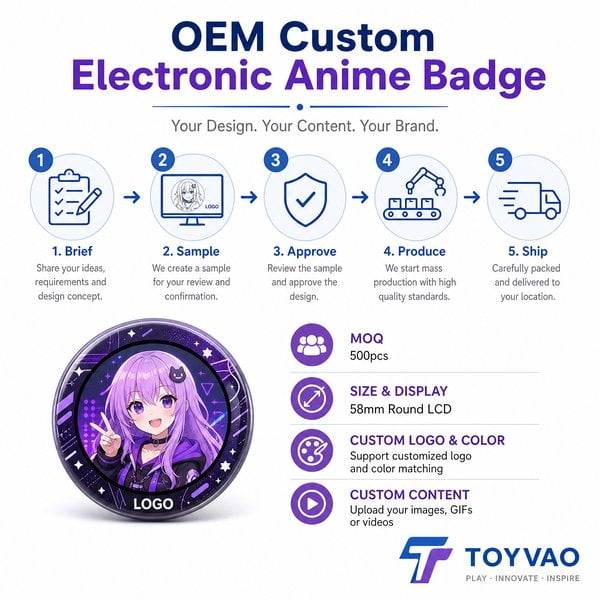
Introduction: Why OEM an Electronic Anime Badge?
Electronic anime badges (电子吧唧 / digital round badges) are compact, eye-catching promotional products that blend fandom, fashion, and tech. For anime licensors, merch brands, event organizers, and ecommerce retailers, OEM-customized electronic badges offer a high-margin, brandable item that drives engagement at conventions, retail stores, subscription boxes, and online drops. This guide walks procurement and product managers through the full sourcing lifecycle—from specification to shipment—using best practices from a Shenzhen OEM perspective.
Market Signals & Industry Data
Two data points to frame demand and opportunity:
- Wearable and small-form-factor electronics growth: Grand View Research projects continued strong expansion for wearable and compact electronic accessories as consumer adoption rises, with the smart wearable market growing at a high single-digit to mid-teens CAGR over the next several years (Grand View Research, market forecast context).
- fandom and licensed merchandise scale: The anime and related IP merchandise market has become a multi‑billion-dollar ecosystem in recent years—statistical analyses (e.g., Statista industry reports) show global anime-related revenues in the tens of billions, underlining steady demand for licensed physical goods such as badges, figures, and apparel.
These trends make electronic anime badges an attractive SKU for short-run drops and long-term catalog placement alike.
Key Buyer Concerns & How to Address Them
1. Design & IP Licensing
- Obtain clear licensing rights before production. Provide your OEM with signed license agreements when using protected characters or logos.
- Supply vector artwork (AI, EPS) and specify exact color profiles (Pantone/HEX). If you lack print-ready files, request pre-production artwork services and mockups from the factory.
2. Hardware & Functionality Choices
Decisions to make:
- Display: simple LED pattern vs. programmable RGB matrix (resolution and effects determine cost).
- Battery: replaceable coin cell (CR2032) vs. rechargeable Li‑ion with Type‑C. Rechargeable options increase unit cost and require additional safety testing.
- Controller & memory: MCU selection (8‑bit vs. 32‑bit) impacts effects complexity and firmware update capability.
- Attachment: pin-back, magnet, clip, or keychain conversion.
- Enclosure: metal vs. plastic housing, diameter (e.g., 37mm, 56mm), and lens (clear/acrylic).
3. Certifications & Safety
Common requirements for export and retail:
- CE (EMC/LVD) and ROHS for EU markets.
- FCC part 15 for US if RF or wireless interactions exist.
- UN38.3 and IATA compliance if shipping devices with lithium batteries by air.
4. Minimum Order Quantities (MOQ) & Lead Time
- Typical MOQs: 500–2,000 units for mass-produced PCBs and tooling. Higher MOQs may be required for custom molds or unique enclosures.
- Lead time: prototype (2–3 weeks), pre-production samples (2–4 weeks), mass production (4–8 weeks) depending on complexity and seasonal demand.
5. Cost Drivers
- PCB complexity, LED pixel density, battery type, custom molds, and packaging design are primary cost drivers.
- Tooling amortization: custom metal shells or molds add upfront cost but reduce per-unit price at higher volumes.
Production & Quality Checklist (Shenzhen OEM Best Practices)
- Prototype → Engineering Validation Test (EVT) → Design Validation Test (DVT) → Production Validation Test (PVT).
- Use inline testing: ICT (in-circuit test) for PCB, functional burn-in for firmware stability.
- Perform sampling inspections (AQL) and third-party lab testing for certifications.
- Track firmware version control and provide OTA/USB update plan if applicable.
Shipping, Packaging & Logistics
- Specify retail packaging vs. bulk poly bags. Custom retail boxes increase perceived value but add weight and cost.
- Declare HS codes correctly (commonly under electronic toys, promotional items, or battery-powered devices). Prefer DDP or DAP terms depending on buyer capability.
- Plan for lithium battery shipping constraints—consider shipping with batteries installed vs. separate according to destination regulations.
Specification Comparison Table
| Feature | Basic SKU | Standard SKU | Premium SKU |
|---|---|---|---|
| Diameter | 37 mm | 56 mm | 56 mm (metal) |
| Lighting | Single-color LED | RGB multi-segment | Full RGB matrix, animations |
| Battery | CR2032 (replaceable) | Rechargeable Li‑ion (USB-C) | Rechargeable Li‑ion, fast charge |
| Controller | Basic MCU | 32-bit MCU | 32-bit MCU + OTA support |
| Water Resistance | IP20 | IP54 | IP65 |
| MOQ | 500 pcs | 1,000 pcs | 2,000 pcs |
| Estimated Unit Cost (EXW) | $1.80–$2.50 | $3.50–$5.00 | $7.50–$12.00 |
Packaging & Branding Options
- Full-color retail boxes with blister insert for retail distribution.
- Collector packaging with numbered certificates for limited editions.
- Custom hang tags, instruction inserts in multiple languages, and tamper-proof seals.
Risk Management & IP Protection
- Register trademarks where you sell. Require NDA and IP clauses in your OEM contract.
- Insist on serial-numbered batches and secure storage if producing limited-edition items.
- Audit supplier compliance and conduct on-site inspections, especially for battery assembly.
Practical Steps to Start an OEM Order
- Brief: Provide target retail price, artwork, functionality list, and target markets.
- Quotation: Receive BOM-level quote and MOQ confirmation.
- Prototype: Approve electronic and cosmetic samples.
- Testing: Complete compliance testing and pre-shipment inspections.
- Mass Production: Confirm production schedule and logistics plan.
FAQ
Q: What is the typical MOQ for custom electronic badges?
A: MOQs vary by complexity—expect 500 units for basic LED badges, 1,000+ for rechargeable or custom-molded products.
Q: Can you produce badges with official anime licenses?
A: Yes. We can manufacture licensed products, but you must provide licensing documentation. We can assist with artwork cert checks and print-ready file preparation.
Q: What certifications will I need for EU/US sales?
A: CE (including RoHS/EMC) for EU, and FCC for the US if emissions apply. Batteries may require UN38.3 testing and specific transport paperwork.
Q: How long does prototyping and mass production take?
A: Prototyping typically takes 2–3 weeks; pre-production samples 2–4 weeks. Mass production ranges from 4–8 weeks depending on schedule and complexity.
Q: Can firmware be updated after shipping?
A: Yes—if the design includes USB or Bluetooth and the MCU/bootloader supports firmware updates. Discuss OTA requirements during design phase.
Next Steps / Contact Us
Ready to start an OEM project or request a BOM-level quote? Contact Toyvao’s sourcing team:
- Email: sales@toyvao.com
- WhatsApp: +86 186 8106 4480
We offer engineering support, rapid prototyping in Shenzhen, factory tours on request, and consolidated shipping solutions for global brands.
