
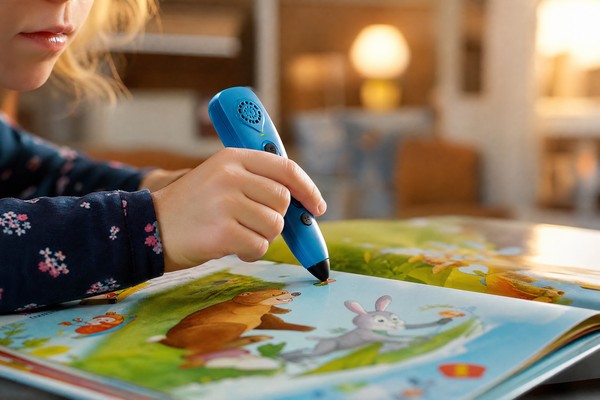
Executive Summary
This guide compares two implementation strategies for Picture Book Reading Pens (aka Story Pens, Talking Book Pens, OID Reading Pens): Pre‑Recorded Audio (recorded voice actors, edited and stored on the device or removable media) versus Voice Synthesis (text‑to‑speech, TTS). It evaluates cost (unit BOM, content production, and lifecycle updates), audio quality (naturalness, prosody, pronunciation control), and update flexibility (content distribution, localization, and feature updates). The analysis includes engineering constraints (storage, CPU, power), regulatory and safety implications for children’s products, and practical break‑even scenarios to help B2B buyers (publishers, OEMs, contract manufacturers, and distributors) select the optimal approach.
Bottom line recommendations:
– For premium single‑language catalogs with high production values and small title count: pre‑recorded audio remains the preferred choice for best naturalness and branding control.
– For large catalogs, frequent updates, multi‑language offerings, personalized content, or subscription models: TTS (cloud or embedded) is more cost‑effective and scalable.
– Hybrid models (primary TTS with selective pre‑recorded voice for brand/character lines) often deliver the best ROI and user experience.
This guide quantifies cost drivers, specifies technical requirements, and provides a step‑by‑step decision framework for procurement and engineering.
What Is Picture Book Reading Pen and Who Uses It
Product definition
– Picture Book Reading Pen: a handheld device for children that recognizes markers on printed picture books or uses optical identification (OID), NFC, or coordinate sensing to trigger audio playback (narration, sound effects, language switching).
– Typical hardware components: pen tip sensor, microcontroller or SoC (ARM Cortex‑M or ARM Cortex‑A), flash memory (embedded NOR/NAND or microSD), audio DAC and amplifier, 0.5–2 W speaker, battery (350–1200 mAh), buttons/LEDs, Bluetooth/Wi‑Fi module for updates (optional), and packaging meeting toy safety standards.
Primary users and buyers
– Publishers of children’s picture books and educational series seeking physical/digital hybrid products.
– OEMs and contract manufacturers producing story pens for retailers and e‑commerce.
– Educational institutions and early learning centers procuring multi‑language reading aids.
– EdTech companies integrating pens with subscription content and analytics.
Use cases that matter to procurement
– Fixed catalog with premium voice branding (a limited set of titles).
– Large, frequently updated catalogs (hundreds to thousands of titles and multiple languages).
– Personalization and dynamic content (child names inserted, adaptive reading level).
– Offline/low‑connectivity environments (schools or regions with limited network).
Why Demand Is Growing
Market drivers
– Increased demand for hybrid tactile/digital learning: parents and educators seek screen‑lean alternatives that still deliver adaptive or multimedia content.
– Globalization: publishers want efficient localization into multiple languages and accents.
– Subscription and digital extension models: vendors want to convert physical product buyers into recurring revenue customers with updates and new titles.
– Decreasing cost of compute and memory: enables advanced embedded features (embedded TTS, more storage) at consumer price points.
Quantitative signals (typical for 2023–2024)
– Memory density: consumer flash prices dropped ~20–40% over five years; 8–16 GB microSD cards are commodity priced <$5/unit at scale.
– SoC capability: entry ARM Cortex‑A class SoCs with integrated audio DSPs and low‑power modes are available in volume for $3–$8 per unit BOM.
– Licensing and cloud TTS pricing allow economically feasible per‑request synthesis (example cloud rates discussed below).
Customer requirements manifest as:
– Need for multi‑voice, multi‑language support without re‑recording.
– Faster time‑to‑market for seasonal or promotional titles.
– Lower content production cost per title for long tail catalogs.
These pressures make TTS attractive for scale and flexibility; however, quality expectations for children’s narration are high, so pre‑recorded audio still retains a role for flagship IP and character voices.
Key Technology Differences
Core architectural split
– Pre‑Recorded Audio: audio files (MP3/AAC/WAV) are produced, mastered, and stored. Playback requires only audio DAC, amplifier, and storage. No runtime text processing.
– Voice Synthesis (TTS): text or markup is converted to audio at runtime by software. Implementation options: cloud (remote API) or embedded (local TTS engine). Requires text content, TTS engine binary, runtime resources (CPU, RAM), and possibly model weights.
Latency and responsiveness
– Pre‑Recorded: near‑instant playback when the pen taps a point; latency typically <100 ms for local playback.
– Cloud TTS: network round‑trip plus synthesis time. Typical latency 200–1000+ ms depending on network and API. Not acceptable for ultra‑low latency interactions without caching.
– Embedded TTS: depends on model size and hardware. Lightweight concatenative/parametric TTS can synthesize in <100–300 ms on a moderate MCU; neural TTS requires a stronger SoC/NPU and can run in hundreds of ms to a few seconds depending on optimization.
Quality metrics
– Mean Opinion Score (MOS): human ratings where 5.0 = indistinguishable from natural. Modern neural cloud TTS scores often 4.2–4.7 for general voices; embedded TTS (small footprint) typically 3.2–4.0.
– Prosody and emotional expressiveness: pre‑recorded > cloud neural TTS > embedded concatenative TTS (in most cases).
– Pronunciation control and phonetic correction: pre‑recorded gives perfect control; TTS requires lexicon management (phoneme dictionaries, SSML, custom pronunciation mappings).
Footprint and hardware constraints
– Storage:
– Pre‑Recorded: audio size depends on encoding. Example: 64 kbps mono MP3 ≈ 0.47 MB per min; 128 kbps ≈ 0.94 MB per min; uncompressed 16‑bit 44.1 kHz mono WAV ≈ 5.17 MB per min. A typical 5‑minute book at 64 kbps ≈ 2.4 MB.
– TTS: needs engine binary and model weights. Lightweight engines can be 2–20 MB; neural models for high quality can be 50–500+ MB and require NPU/DSP acceleration.
– Compute:
– Pre‑Recorded: MCU class Cortex‑M4/M7 sufficient.
– Embedded TTS: Cortex‑A class or Cortex‑M with DSP; neural TTS often needs >0.5 GFLOPS and benefits from NPU.
– Power: runtime synthesis increases active CPU draw. Example: baseline audio playback 30–100 mA; adding synthesis might increase draw by 50–200 mA during synthesis.
Operational constraints
– Offline capability: pre‑recorded and embedded TTS work offline; cloud TTS needs network or caching.
– Update pathway: pre‑recorded content requires re‑flashing or delivering new SD cards; TTS can receive text updates and voice updates remotely if device supports OTA.
Key Features and Specifications to Evaluate
Design and procurement checklist for technical evaluation
Hardware and audio
– Speaker and SPL: speaker size and sensitivity matter. Typical speaker sizes 28–40 mm; SPL at 0.5 W measured at 0.5 m should be ≤85 dB for child safety but many products target 70–80 dB. Ask for frequency response (300 Hz–4 kHz is most critical for intelligibility).
– DAC/Amplifier: 16‑bit DAC and class‑D amplifier recommended; peak power up to 1–2 W.
– Battery: capacity 400–1000 mAh; estimate runtime. Example: typical pen with playback only can run 8–12 hours continuous on 600 mAh; synthesis reduces runtime.
– Storage: NAND/NOR and/or microSD. Minimum pre‑record support: 4–8 GB for catalogs with many titles. For embedded TTS models, plan for 32–512 MB model storage or higher.
– Connectivity: Bluetooth LE for app pairing and updates; optional Wi‑Fi for large content transfers or cloud TTS.
Software and content handling
– Audio formats: MP3 (mono) at 32–128 kbps common; AAC offers better quality at lower bitrates; ensure player supports your chosen format.
– TTS engine: confirm vendor, voice types (neural vs standard), supported languages, SSML support, and offline footprint.
– Pronunciation management: lexicon/phoneme editor for names and brand terms; for TTS, SSML support and custom lexicons are essential.
– Latency budget: define max acceptable delay from tap to audio (typical target ≤300 ms for good UX).
– Update mechanisms: OTA via Bluetooth/Wi‑Fi, microSD, or USB. Evaluate rollback and integrity verification (hashing, signed firmware).
Content production workflow
– Pre‑Recorded: studio time, voice director, editing, mastering, file format pipeline, and QA. Estimate turnaround per book (1–3 days for simple books; up to 2+ weeks for premium character recordings).
– TTS: text input pipeline, SSML tagging for prosody, QA pass for pronunciation/performance, and automated TTS generation. Turnaround can be minutes to hours per title once the pipeline is in place.
Regulatory and safety
– Toy safety standards: ISO 8124, EN 71, ASTM F963; battery standards: IEC 62133. Audio exposures: WHO guidance for safe listening levels — keep output levels configurable and cap max SPL.
– Data protection: for cloud TTS, confirm vendor’s compliance with GDPR and COPPA if targeting children in US/EU markets.
Business and licensing
– TTS licensing models: cloud per‑character or per‑minute pricing; embedded engines often have per‑device or per‑deployment license fees. Confirm commercial use and redistribution rights.
– Voice actor contracts: secure rights for use duration, languages, territories, and potential digital cloning if you plan to create synthetic variants.
Pros and Cons
Pre‑Recorded Audio
Pros
– Highest perceived naturalness and emotional nuance; unmatched for character voices.
– Complete control over pronunciation, emphasis, timing, and sound design (SFX, music bed).
– Very low runtime compute, low power consumption, predictable BOM.
– Very low latency on tap interactions.
Cons
– Higher upfront production cost per title (studio, talent, editing).
– Storage scales linearly with title count and languages.
– Low update flexibility: adding edits requires re‑flashing devices, issuing updates, or distributing new media.
– Scalability and localization expensive for catalogs with many titles or many languages.
Voice Synthesis (TTS)
Pros
– Virtually immediate content generation from text; low marginal cost per title when using cloud.
– Easy multi‑language support and fast localization; SSML enables basic prosody control.
– Dynamic and personalized content possible (name insertion, adaptive difficulty).
– Update elasticity: change text centrally and propagate quickly (cloud or push updates).
Cons
– Quality variability: cloud neural TTS closes the gap but may still lack expressive nuance for character IP.
– Latency concerns for cloud synth; embedded high‑quality TTS increases BOM (larger memory, stronger SoC/NPU).
– Licensing complexity and potentially non‑trivial per‑device fees for embedded TTS.
– Pronunciation edge cases require lexicon management and testing (especially for child names or invented words).
Hybrid Approach (Recommended in many scenarios)
– Use pre‑recorded audio for flagship characters and brand voice; use TTS for bulk catalog and language variants.
– Pros: balances quality and scalability; mitigates high production cost while maintaining flagship brand presence.
– Cons: adds complexity in content pipeline and device software to switch modes.
Step-by-Step Decision Guide
Step 1 — Define product and business priorities
– Prioritize quality vs. scale vs. update speed.
– If flagship brand/character voice is critical and titles <100: favor pre‑recorded.
– If titles >200 or multilingual >3 languages and frequent updates: favor TTS or hybrid.
Step 2 — Quantify catalog and languages
– Calculate average audio length per title (minutes), total titles, and languages.
– Example: 500 titles × 5 minutes × 3 languages = 7,500 minutes ≈ 125 hours of audio. Pre‑recording cost scales with hours; TTS cost scales negligibly.
Step 3 — Establish quality threshold and target MOS
– If target MOS >4.5 and emotional timing required → pre‑recorded for that voice.
– For MOS 3.5–4.5 acceptable with lexicon tuning → cloud neural TTS or high‑end embedded TTS.
Step 4 — Model the cost (see Pricing section for example calculations)
– Compute per‑title and per‑device costs for both approaches, including:
– Pre‑record: voice actor+studio+editing per title + incremental storage cost.
– TTS: cloud per‑character cost or embedded per‑device license and storage.
– Include support costs for updates and QA.
Step 5 — Assess hardware implications
– Pre‑recorded only: MCU class and minimal memory; choose storage to match catalog.
– Embedded TTS: ensure SoC, RAM, and storage meet engine requirements; budget for increased BOM ($1–$10+ per device).
– Cloud TTS: include connectivity hardware and UX for offline fallback (local cache).
Step 6 — Evaluate update and distribution path
– If OTA updates are required: include server costs, app development, and security signing for firmware/audio.
– For regions with limited connectivity, ensure offline capabilities: pre‑cached TTS or local audio.
Step 7 — Pilot and QA
– Run a pilot with representative titles. For TTS, include edge cases (names, invented words).
– Measure latency, battery impact, and MOS via user testing with target age group (parents and children).
Step 8 — Contractual and IP checks
– For pre‑recorded: secure voice talent rights for all intended use cases.
– For TTS: verify vendor license allows commercial redistribution if synthesizing characters; consider voice‑style licensing if using a proprietary “brand” voice.
Step 9 — Decide on hybrid thresholds
– Set rules (e.g., top 10% of titles and character lines pre‑recorded; rest TTS) and implement content pipeline automation to manage both.
Pricing and Cost Analysis
Assumptions and units
– Example title: 5 minutes of narration (typical picture book).
– Speech rate: ~150 words/min → 750 words → ~4,500 characters (varies by language).
– Production volumes: small = 1–100 units/titles, medium = 1,000–50,000, high = 50k+.
Pre‑Recorded Cost Components (per title)
– Voice talent: $100–$500 per finished hour (mid‑market). For a 5‑minute book: proportional share $8–$42. In practice, minimum sessions and editorial fees often push effective per‑book talent cost to $50–$250.
– Studio time and engineer: $50–$150 per hour; editing and mastering for a 5‑minute book often 1–3 hours → $50–$450.
– Post‑production (SFX/music licensing): $0–$200 depending on complexity.
– Total per title (professional): $100–$500 typical; premium character recording can be $500–$2,000+.
Storage cost per device
– 5 minutes at 64 kbps ≈ 2.4 MB. At scale, flash cost per GB is low. Example microSD 8 GB ~$3–$5 in volume.
– For 500 books: 500 × 2.4 MB ≈ 1.2 GB. 2 GB storage suffices.
TTS Cost Components
Cloud TTS (per title)
– Per‑character pricing varies. Typical 2023–24 public cloud examples:
– Standard neural rates: $4–$16 per 1 million characters (varies by voice quality). Using $10 per 1M characters as a midpoint.
– Example cost: 4,500 characters × $10/1,000,000 ≈ $0.045 per title. Even with higher rates ($20/1M) ≈ $0.09.
– Additional costs: API calls, network egress, and storage for cached audio.
Embedded TTS
– Upfront per‑device licensing: ranges widely; small footprint engines $0.50–$5 per unit; high‑quality neural engines $5–$25+ per device depending on voice pack and redistribution rights.
– Model licensing: some vendors require a one‑time engineering fee ($5k–$50k) to port or customize.
– Increased BOM: stronger SoC and extra storage may add $1–$8+ per unit in hardware costs.
Breakeven illustration (simplified example)
– Suppose pre‑recording a single language title costs $200 per title. For a catalog of N titles to be loaded on M devices:
– Total content cost = $200 × N.
– If using TTS cloud at $0.05 per title, content cost = $0.05 × N.
– For small N (e.g., N = 10), pre‑record content = $2,000; TTS content = $0.50 — pre‑record may be justifiable if quality imperative.
– For large N (e.g., N = 1,000), pre‑record = $200,000; TTS = $50 — TTS clearly dominates.
Device licensing breakeven
– If embedded TTS licensing adds $5 per device to BOM but eliminates per‑title recording costs for future titles, compute break‑even:
– If each device requires S titles to be stored pre‑recorded at $200/title amortized over M devices, and TTS per device cost is $5, then for large catalogs or frequent updates, TTS pays back quickly.
– Example: If a device distribution is 10,000 units, embedded TTS license at $5 adds $50k to BOM but avoids $200k–$1M of pre‑recording cost across catalog generation.
Operational pricing considerations
– Cloud TTS is appealing for publishers with central content management and a subscription model (pay per synthesis or cache).
– Embedded TTS economics improve with higher unit volumes where per‑device license is amortized over sales.
– Hybrid models should budget for both per‑title production and device licensing.
Competitive Landscape
Categories of suppliers
- Hardware OEMs and Module Suppliers
-
Offer complete pen platforms (sensor, SoC, audio, battery) that support pre‑recorded audio and, increasingly, embedded TTS. Prices vary with capability from $6–$25 BOM for simple pens to $25–$70+ for advanced SoC/NPU units.
-
TTS Vendors
- Cloud leaders: Amazon Polly, Google Cloud Text‑to‑Speech, Microsoft Azure TTS — provide high‑quality neural voices, per‑character pricing, and SSML.
- Embedded/local TTS vendors: Acapela, CereProc, Nuance (or similar), and specialist embedded TTS firms offering smaller footprints and commercial redistribution licenses.
-
Open‑source/edge models: e.g., TTS models that can be optimized for edge; these require licensing/engineering to meet commercial and child data rules.
-
Content Production Houses
-
Voice talent agencies, studios, and localization houses that package recording, editing, and mastering services. They frequently work on retainer for premium character voices.
-
System Integrators and Platforms
- Companies that provide backend content management, OTA distribution, serialization, and security (content signing). They are critical for large rollouts with regular updates.
How suppliers differentiate
– Voice naturalness and expressiveness for TTS.
– Low‑latency embedded synthesis and small model size.
– Robust content management and OTA update platforms.
– Children’s product certifications and experience in toy compliance.
Procurement tips
– Request reference units with identical SoC/engine and test with representative content.
– Ask for signed license terms clarifying commercial redistribution, voice cloning restrictions, and offline deployment rights.
– Evaluate supplier roadmaps for neural embedded TTS if planning longer product life cycles.
What Buyers Say
Common buyer feedback distilled from procurement and pilot programs
Pre‑Recorded buyers
– Positive: “Our brand voice is unmistakable and parents respond to the warmth of the actor.”
– Negative: “Localization costs ballooned as we expanded to 8 languages; it was slow and expensive.”
TTS buyers
– Positive: “We reduced time‑to‑market from weeks to hours and added dynamic content that boosts engagement.”
– Negative: “Kids noticed odd pronunciations and flat delivery for character lines; we had to invest in SSML tuning and hybrid voice recordings for flagship titles.”
Operational observations
– Hybrid approaches require more sophisticated content pipelines and QA, but they deliver measured improvements in engagement and cost control.
– Buyers emphasize the need for printable OID/pattern quality to avoid mis‑triggers regardless of audio backend.
– Security and robustness of OTA were common concerns: buyers demand signed audio and rollback capability to avoid corrupting devices in the field.
User testing
– User studies often show that children and caregivers rate high‑quality pre‑recorded voices slightly higher than even top neural TTS in expressive narration scenarios; difference is smaller for simple read‑aloud content.
Safety, Maintenance and Compliance
Safety requirements specific to children’s reading pens
Acoustic safety
– Aim to cap maximum sound level. WHO and various standards use 85 dB(A) as an exposure threshold. For toys, many vendors target 70–80 dB at typical listening distance (20–30 cm) and include volume limiting and parental lock features.
– Implement output attenuation circuits and measure SPL across production samples (test at 0.3 m and 1 m).
Electrical and battery safety
– Batteries must comply with IEC 62133 for lithium batteries. Consider NiMH as a lower‑cost, lower‑risk alternative for low‑current devices.
– Provide overcharge, over‑discharge, temperature protection, and overcurrent protection. Test for mechanical abuse (drop tests) and thermal runaway.
Toy standards and labeling
– EN 71 (Europe), ASTM F963 (US), ISO 8124 (international) apply to small parts, mechanical hazards, and flammability.
– RoHS and REACH compliance for materials and components.
– CE/FCC/IC certification for radio devices (if Bluetooth/Wi‑Fi included).
Data privacy and cloud TTS
– If sending text or audio to cloud TTS, ensure compliance with COPPA (US) for children under 13, GDPR (EU) and similar. Implement minimal data retention, parental consent flows, and encryption in transit.
– Store no more PII than necessary; anonymize or avoid sending identifiable data (children’s names) unless explicitly permitted and secured.
Maintenance and field support
– Plan for firmware and content rollback mechanisms in OTA. Signed packages and secure boot help prevent bricking or malicious updates.
– Include physical maintenance guidelines (cleaning tip, battery replacement) and field replacement policies.
Quality assurance
– Acoustic QA: random sample SPL, distortion, speaker fatigue.
– UX QA: latency under worst network conditions, tap accuracy, and fallbacks (e.g., local cache).
– Localization QA: phonetic tests across language variants, lexicon coverage for names and invented words.
Frequently Asked Questions
Q: Which option costs less per title in the long run?
A: For small catalogs, pre‑recording can be reasonable. For large catalogs or frequent updates, cloud TTS is orders of magnitude cheaper per title (fractions of a dollar per title). Embedded TTS has an up‑front device license cost that becomes cost‑effective as unit volume increases.
Q: Is TTS good enough for children’s story narration?
A: Cloud neural TTS is approaching parity for neutral narration but can still struggle with character acting, complex emotions, and nuanced timing. For flagship characters, pre‑recorded audio remains superior. A hybrid approach can capture both benefits.
Q: What are practical storage and memory requirements?
A: Pre‑recorded: ~0.5–1 MB per minute at 64–128 kbps MP3. Embedded TTS: engine and model storage typically 2–500 MB depending on quality. Plan device NAND/microSD capacity accordingly.
Q: Are there offline TTS options?
A: Yes — embedded TTS engines can run offline. High‑quality neural models offline require significant storage and compute (NPU or DSP acceleration), raising BOM and power consumption.
Q: How do we handle pronunciation for unusual names or invented words?
A: For pre‑recorded: record the exact pronunciation. For TTS: maintain a custom lexicon (phoneme map) and test via automated QA. SSML and phoneme tags are essential. Hybrid approach: record names for flagship characters and use TTS for generic text.
Q: What about latency for cloud TTS?
A: Typical round‑trip plus synthesis can be 200–1000+ ms. For tap interactions where instantaneous feedback is required, cloud TTS may feel laggy unless you implement local caching or short pre‑recorded prompts.
Q: Can we clone a voice to use in TTS?
A: Voice cloning and synthetic voice licensing is possible but legally and ethically sensitive. Ensure correct rights from original talent and confirm vendor policies. Embedding cloned voices may require additional licensing and ethical review for children’s products.
Contact Toyvao
For procurement assistance, technical integration guidance, product samples, and pilot program support for Picture Book Reading Pens and content pipelines (pre‑recorded, cloud TTS, embedded TTS, and hybrid implementations), contact Toyvao procurement and technical team.
Email: sales@toyvao.com
Business inquiries: procurement@toyvao.com
Technical support and integration: techsupport@toyvao.com
Provide your project brief with:
– Number of titles and average minutes per title
– Target languages and accent requirements
– Expected unit volumes and geography
– Required runtime (offline-only vs cloud-enabled)
– Quality targets (MOS or sample references)
– Any IP/voice branding constraints
Toyvao will provide a tailored cost model, BOM estimate, and pilot plan aligned to the requirements above.
