
Executive Summary
This guide explains how to evaluate speaker and sound quality in picture-book reading pens (story pens, talking book pens, OID reading pens) for use in children’s books. It focuses on measurable audio parameters—rated power (wattage), sensitivity, frequency response, sound pressure level (SPL)/volume, distortion, and related DSP and mechanical factors—translated into practical acceptance criteria, test methods, and procurement requirements for B2B buyers.
Key takeaways:
– For small handheld story pens, driver size and enclosure volume limit low-frequency output. Prioritize midrange clarity (300 Hz–6 kHz) and high sensitivity (≥85 dB SPL @1W/1m) rather than high wattage.
– Specify RMS (continuous) power and sensitivity rather than peak power. Typical target: 0.5–2.0 W RMS for low-cost models; 2–4 W RMS for premium models with larger drivers and better DSP.
– Measure frequency response with a calibrated microphone and report ±3 dB or ±6 dB tolerances. For speech-first devices, acceptable target: 300 Hz–6 kHz within ±6 dB, presence boost around 2–4 kHz.
– Safety: design for prolonged average playback ≤75 dB at typical holding distance (10–30 cm) and short-term peaks <85 dB to reduce hearing-risk; require regulatory compliance (toy safety, EMC, battery transport standards).
– Include DSP features—limiter, equalizer, de-esser, and low-latency decoding—on the procurement checklist. Require SNR ≥80 dB and THD ≤1% at nominal output for intelligible speech.
This guide provides concrete specification sheets to request from suppliers, pass/fail test procedures, and recommended acceptance criteria for three buyer tiers (budget, education-grade, premium).
What Is Picture Book Reading Pen and Who Uses It
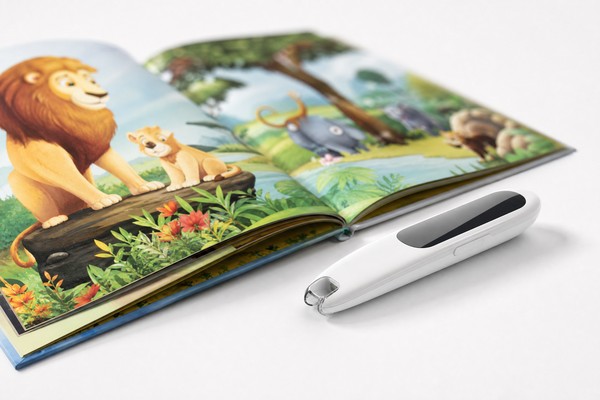
Picture-book reading pens are compact audio players that pair with printed picture books. The pen’s tip or sensor reads embedded codes (dots, OID, invisible ink) on pages and plays a prerecorded audio file—typically narration, sound effects, or music—through a miniature loudspeaker in the pen body. Primary users:
– Children aged 2–10 (end users)
– Preschool and primary schools (institutional buyers)
– Educational publishers producing interactive storybooks
– Retailers and distributors sourcing private-label educational toys
Buyer objectives vary:
– Publishers require consistent narration intelligibility and low-maintenance units for multiple uses.
– Schools prioritize durability, safe SPL limits, easy battery management, and batch uniformity.
– Retailers demand cost-effective BOM while maintaining acceptable audio clarity for customer satisfaction.
Sound quality directly affects comprehension (vocabulary, phonics), engagement, and perceived product value. B2B buyers must evaluate both acoustic hardware (speaker, enclosure) and software (codec, DSP, EQ) with objective metrics.
Why Demand Is Growing
Drivers of growth in the story-pen market:
– Rising adoption of interactive printed media in early education. Buyers shift from static books toward multimodal learning aids that combine visual, tactile, and auditory stimulation.
– Global literacy initiatives increasing demand for phonics-rich audio content.
– Cost compression in small loudspeaker and SoC components enables inclusion of better audio features at lower price points.
– Consumer preference and retail competition favor products with better voice clarity, longer battery life, and robust safety features.
For buyers this means higher expectations for speech intelligibility and battery/runtime balance. Suppliers who can demonstrate repeatable SPL, low distortion, and consistent voice reproduction across large batches gain competitive advantage.
Key Technology Differences
Understanding the core technology choices clarifies trade-offs in loudness, clarity, and cost.
Speaker drivers
– Size: Typical diaphragm diameters for pens range 10–40 mm. Larger diaphragms increase SPL potential and low-frequency response but require bigger enclosures. Typical tiers:
– Budget: 10–16 mm drivers (compact, low-cost)
– Mid-tier: 20–28 mm drivers (balanced)
– Premium: 30–40 mm drivers or two-way solutions (better mid-bass)
– Magnet: Ferrite (cheaper) vs neodymium (higher flux density—better sensitivity and smaller size).
– Diaphragm material: Mylar/PET (common), paper (warmer), metalized (for higher stiffness). PET is typical for rugged toys.
Amplifier and power
– Integrated class-D amps are standard for efficiency. Specify RMS output into the speaker impedance (e.g., 2.0 W RMS into 4 Ω).
– Rated power vs peak power: suppliers often quote peak numbers; insist on RMS power at a specified THD.
Acoustic enclosure and tuning
– Sealed enclosure vs ported: pens generally use sealed enclosures with internal damping due to form factor. Passive radiators can help low-frequency response without ports but add cost and assembly complexity.
– Baffle design and internal foam influence frequency response and resonance.
Digital audio and DSP
– Codecs: speech can be delivered at 32–128 kbps MP3 or AAC. For quality, 64–128 kbps MP3 or 48–96 kbps AAC at 22–44.1 kHz sampling is sufficient.
– DSP features: limiter/compressor, parametric EQ, de-esser (to control sibilance), loudness compensation. Proper DSP can substantially improve intelligibility even with small drivers.
Battery and electronics
– Battery capacity (mAh), discharge curve, and amplifier quiescent current drive runtime and maximum sustainable SPL. Buyers must trade off runtime vs maximum volume.
Mechanical and assembly quality
– Driver mounting, adhesive quality, solder joints, and PCB layout affect long-term reliability and acoustic performance.
Key Features and Specifications to Evaluate
Ask suppliers to provide the following measured parameters and test artifacts. Where possible, specify measurement conditions and acceptance thresholds.
Acoustic performance (measurements)
– Rated power (RMS): specify into speaker impedance (e.g., 2.0 W RMS @4 Ω).
– Impedance: 4 Ω/8 Ω rating and impedance vs frequency curve.
– Sensitivity: stated as dB SPL @1W/1m (or @0.2 m). Target: ≥85 dB @1W/1m for clear speech from a small enclosure; translate to typical holding distance—see SPL targets below.
– Frequency response: provide magnitude curve from 100 Hz to 16 kHz with ±3 dB or ±6 dB tolerances. For speech-first pens: acceptable target 300 Hz–6 kHz within ±6 dB; preferred further extension to 12 kHz.
– Total Harmonic Distortion (THD): measured at 1 kHz at 1/3 rated power and at rated power. Target: ≤1% THD at typical playback levels, ≤3% at maximum.
– Signal-to-noise ratio (SNR): measured with input at nominal level. Target: ≥80 dB.
– Maximum output (SPLmax): dB SPL at a specified distance (0.2 m / 0.5 m). Provide both continuous and short-term peak SPL.
– Frequency-dependent distortion (THD vs frequency): THD spikes at resonances are common; require graphs.
Electrical and digital
– DAC resolution and sampling: 16-bit/44.1 kHz or better standard for mixed music and speech; 16-bit/22.05 kHz acceptable for speech-only content with appropriate codecs.
– Supported codecs and bitrates; required content format for batch programming.
– DSP features: list functions (limiter threshold, compressor ratio, EQ bands, de-esser settings).
Mechanical, battery, and durability
– Driver size and magnet material.
– Enclosure materials and internal damping description.
– Battery: chemistry (NiMH vs Li-ion), capacity (mAh), nominal voltage, expected runtime at defined SPL.
– IP rating if applicable (IPX4 splash resistance preferred for kids).
– Drop test, vibration test, and operating temperature range.
Regulatory and safety
– Compliance certificates: CE, RoHS, FCC (for wireless), UN38.3 for lithium batteries, applicable toy safety standards for target markets (specify later under compliance).
– Material safety: BPA-free plastics, phthalate and heavy-metal testing.
Documentation and samples
– Provide frequency response curves, SPL vs input power graphs, THD graphs, and sample units for validation.
– Production test plan and AQL for batch acceptance.
Practical targets by buyer tier
– Budget (mass-market): Driver 12–20 mm; sensitivity 82–88 dB @1W/1m; RMS power 0.5–1.0 W; frequency response 350 Hz–10 kHz within ±8 dB; THD ≤3% at typical output.
– Education-grade: Driver 20–28 mm; sensitivity 85–90 dB; RMS power 1–2 W; response 300 Hz–12 kHz ±6 dB; THD ≤1.5%.
– Premium: Driver 28–40 mm or multi-driver; sensitivity ≥88 dB; RMS 2–4 W; response 200 Hz–14 kHz ±3–6 dB; THD ≤1%.
Pros and Cons
Pros of improving speaker/sound design in story pens
– Increased intelligibility improves learning outcomes.
– Better perceived product quality increases retail sell-through.
– Proper DSP and limiter reduce risk of harmful peaks and protect hardware.
– Higher sensitivity enables lower battery draw for the same perceived loudness.
Cons and trade-offs
– Cost: larger drivers, neodymium magnets, and DSP increase BOM and assembly complexity.
– Size/weight: larger acoustic components can conflict with pen ergonomics.
– Low-frequency limitations: small enclosures cannot produce deep bass, requiring DSP tailoring and content mixing.
– Battery trade-offs: higher sustained SPL reduces runtime; need to define priority (volume vs runtime).
– QA complexity: acoustic testing requires lab equipment or reliable third-party test results; suppliers may provide inconsistent measurement methods unless tightly specified.
Step-by-Step Decision Guide
- Define use-case and user interaction model
- Holding distance: Is the pen played pointing to a page (10–30 cm from ear) or placed on a table? Typical handheld use is 10–30 cm.
- Intended environment: Quiet home, noisy classroom, travel.
-
Content mix: Spoken-only, music plus speech, high-energy songs (affects bitrate and DSP).
-
Set target SPL and safety limits
- For handheld story pens, target continuous average playback of 65–75 dB SPL at 0.2–0.3 m in quiet environments.
-
Limit short-term peaks to ≤85 dB SPL at the same distance. Specify peak-limiter behavior in DSP.
-
Select target acoustic specs
- Choose frequency response target: speech-first: 300 Hz–6 kHz ±6 dB; music-inclusive: 200 Hz–12 kHz ±6 dB.
- Sensitivity: ≥85 dB SPL @1W/1m preferred.
-
THD: ≤1–1.5% at typical playback levels.
-
Request and evaluate sample data
- Require supplier-provided frequency response curves (sweep ±3/±6 dB), SPL vs input, THD vs SPL, and SNR measurements.
-
Request full manufacturing sample and run standard tests (see test methods below).
-
Perform acceptance tests
- Measurement setup: anechoic or semi-anechoic chamber, IEC 61672 Type 1/2 calibrated microphone placed at specified distance (0.2 m / 0.5 m / 1.0 m), log sweep and pink-noise measurements, recorded graphs.
- Listening tests: recorded speech (male/female), fast consonant-heavy sentences, standard children’s song, sibilance test tracks.
-
Run battery and thermal tests: runtime at defined SPL, temperature stability, distortion at end-of-life voltage.
-
Define pass/fail criteria and AQL
- Base acceptance on objective measurements (frequency response tolerances, sensitivity, THD) and listening test ratings.
-
Set AQL for production: example 2.5% for major defects, and specify in-line acoustic random checks for SPL and continuity on 1–5% of units.
-
Negotiate warranty and repair coverage
-
Specify minimum 12-month warranty for electronics and speakers; ask for accelerated failure data if available.
-
Roll out QC and post-market monitoring
- Include periodic lab checks on batches and capture customer feedback on audibility and battery life. Adjust EQ or firmware OTA (if supported) if systemic issues arise.
Pricing and Cost Analysis
Cost drivers
– Driver size and magnet: neodymium magnets increase cost 15–40% vs ferrite, but allow higher sensitivity and smaller drivers.
– DSP and SoC: adding parametric EQ, limiter, and better DAC adds $0.50–$3.00 per unit depending on volume and integration.
– Battery capacity and chemistry: Li-ion 500–1500 mAh adds cost and shipping paperwork (UN38.3) compared with NiMH but offers higher energy density.
– Enclosure complexity and assembly (internal damping, ports, passive radiators) increase BOM and manufacturing labor.
– Testing and certification: lab testing, compliance certificates, and QC processes add to up-front and per-unit costs.
Indicative cost bands (CIF unit cost estimates; final retail multipliers depend on branding and packaging)
– Budget consumer model: $3–6 per unit (10–16 mm driver, basic SoC, NiMH battery)
– Education-grade: $7–14 per unit (20–28 mm driver, DSP, Li-ion 700–1200 mAh)
– Premium: $15–30+ per unit (larger driver or dual-driver, premium magnets, DSP tuning, higher capacity battery, robust enclosure)
Price vs performance trade-offs
– Doubling driver size does not double perceived loudness in typical handheld use due to enclosure and battery constraints; invest in sensitivity and DSP tuning first.
– Adding a limiter and parametric EQ provides better perceived clarity than a modest increase in power.
Procurement tips
– Negotiate for sample lab reports and limit clauses for out-of-spec acoustic batches.
– Request BOM transparency for audio-critical components (driver spec, amp part number, DSP features).
– Consider volume-based roadmap: order a small certified batch, then scale once acoustic performance is validated.
Competitive Landscape
Supplier types
– Contract manufacturers in Shenzhen, Dongguan, and Ningbo with experience in educational audio devices dominate supply.
– Component-level suppliers for drivers and magnets are often in Zhejiang and Guangdong provinces.
– Specialized educational-tech OEMs provide integrated pen + content packaging (value-add for publishers).
Market segmentation
– OEM/ODM producers supplying white-label pens for publishers and retailers.
– Branded vendors offering complete solutions (pen, book content, cloud updates) often priced at a premium.
– Regional compliance specialists offering testing and certification services.
Key differentiators among suppliers
– Acoustic engineering capabilities: suppliers with in-house acoustic labs and DSP engineering produce more consistent voice clarity.
– Firmware flexibility: suppliers who provide adjustable DSP and OTA update paths reduce time-to-fix for content tuning.
– QA systems: those offering lab-grade measurements and batch-level documentation reduce downstream defects.
What to demand from bidders
– Measurement artifacts: raw measurement files, response and distortion graphs, datasheets tied to actual sample units (with serial numbers).
– Field performance evidence: case studies or references from schools/publishers with real-world runtime and durability data.
– Scalability: clear timeline for ramping production and maintaining audio spec consistency across large batches.
What Buyers Say
Common buyer priorities and feedback from institutional purchasers:
– “Clarity beats loudness”: Buyers consistently prefer clear midrange-focused audio over heavy bass. Small drivers cannot reproduce bass; EQ and midrange projection are more important.
– “Battery runtime surprises”: Buyers report real-world runtime often 30–40% lower than supplier claims when devices are used at higher volumes. Insist on measured runtime at specified SPL.
– “Inconsistent batches”: Acoustic variance between batches is a common complaint if suppliers do not use controlled driver suppliers or consistent enclosure assembly processes.
– “DSP saves money”: Buyers found that adding basic DSP (limiter + 2–3 band EQ) improved perceived quality more than marginally increasing driver power or size.
– “Safety and compliance are table stakes”: Buyers will not accept units lacking full toy-safety and battery transport certifications.
Lessons learned
– Require a standardized test protocol in the contract and include acoustic acceptance checkpoints before mass shipments.
– Include firmware access or an OTA path to adjust EQ efficiently post-deployment.
– Plan for spare parts (drivers, PCBs, batteries) and clear repair paths for institutional customers.
Safety, Maintenance and Compliance
Acoustic safety
– Design to minimize risk of hearing damage. For handheld devices, specify average playback around 65–75 dB at typical usage distance (0.2–0.3 m). Cap short-term peaks ≤85 dB.
– Implement a hard limiter in DSP to prevent clipping-related distortion and short high-energy bursts.
Regulatory compliance (common requirements)
– Toy safety: confirm applicable local/regional toy directives and standards for each target market (e.g., EU Toy Safety Directive, ASTM F963 for U.S.), and test accordingly.
– EMC/Radio: FCC Part 15 (U.S.), CE (EMC) for devices with wireless functions.
– Battery transport: UN38.3 for lithium batteries; shipping paperwork and testing are required for air transport.
– Chemical and material safety: RoHS, REACH, and phthalate/heavy-metal tests for plastics in contact with children.
Maintenance and wear
– Speaker life: small drivers in pens should be tested for endurance (e.g., 100–500 hours of continuous playback at nominal level) to detect voice coil and adhesive failures.
– Water resistance: supply IPX classification if moisture resistance is required. Splash resistance (IPX4) is a practical target.
– Cleaning: surfaces should tolerate mild detergents; provide cleaning instructions and recommended disinfectants.
Testing and labeling
– Insist on labels for battery type, charging instructions, maximum recommended volume levels, and CE/FCC marks where applicable.
– Provide an instruction sheet recommending listening distance and safe usage durations.
Frequently Asked Questions
What does “wattage” mean for a tiny story pen?
– Wattage refers to electrical power the amplifier can deliver to the speaker. For small pens, RMS power (continuous) is the useful metric (e.g., 1.0 W RMS). Higher RMS may increase maximum SPL but requires matching battery and amplifier. Sensitivity (dB SPL per 1W @1m) is often more predictive of real-world loudness than wattage alone.
What is the difference between sensitivity and SPL?
– Sensitivity is a normalized specification: dB SPL produced with 1W of input measured at 1 m. SPL is the absolute sound pressure at a given distance and input level. For hands-on products, convert sensitivity to expected SPL at typical holding distance (e.g., sensitivity 88 dB @1W/1m ≈ 100 dB @1W/0.1m, adjusting for actual power and distance).
Why is frequency response important for speech?
– Speech intelligibility depends on midrange and upper-midrange energy where consonants occur (~2–6 kHz). A response emphasizing clarity around 2–4 kHz and extending to 6–8 kHz helps consonant clarity and sibilance handling.
How to measure frequency response and SPL in simple terms?
– Use a calibrated microphone and play a swept sine or pink noise from the pen at a fixed distance in a quiet room or anechoic chamber. Capture the response curve and compare to target tolerances. For field checks, smartphone measurement apps can indicate relative differences but are not a substitute for lab-grade testing.
Are large drivers always better?
– Larger drivers can produce more low-frequency energy and higher SPL, but in a pen form factor they increase cost, weight, and power consumption. For speech-oriented applications, driver design, sensitivity, and DSP tuning are more efficient ways to improve perceived clarity.
How do codecs affect perceived quality?
– Speech can be encoded efficiently; 32–64 kbps AAC or 64 kbps MP3 at 22–44.1 kHz will be perceptually acceptable. Lower bitrates can introduce artifacts that reduce clarity, so require a minimum bitrate and test playback on the actual hardware.
What QA should I demand during production?
– Batch-level SPL tests on a statistical sample, continuity and polarity tests, impedance checks, and visual inspection for driver mounting and adhesive quality. Specify frequency-response spot checks and record results.
Contact Toyvao
For RFQs, sample requests, technical specification templates, and lab-test coordination, contact Toyvao procurement. Provide the following when requesting quotes:
– Target production volume per SKU (monthly/annual)
– Exact form factor constraints (max diameter, length)
– Required battery type and runtime target
– Target frequency response and SPL at a specified distance (e.g., 0.2 m)
– Pass/fail criteria for THD, SNR, sensitivity, and production AQL
– Required certifications and target markets
Toyvao will coordinate supplier short-listing, provide standardized audio test scripts, and assist with test-lab scheduling and acceptance procedures. Include your shipping destination and preferred lead time when you submit the RFQ.
