
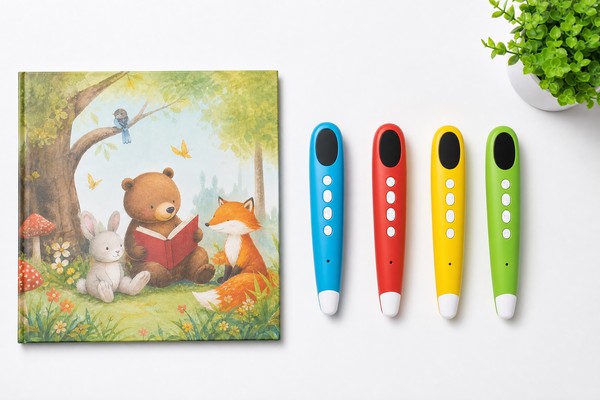
Executive Summary
This guide explains Minimum Order Quantity (MOQ), unit pricing, and cost drivers for OEM Picture Book Reading Pens (a.k.a. Story Pens, Talking Book Pens, OID Reading Pens). It is written for product managers, buyers, and sourcing teams considering an OEM supply relationship. The goal is to provide the data and negotiation tactics needed to estimate landed cost, evaluate supplier quotes, structure price breaks, and minimize risk.
Key takeaways:
– Typical MOQs: 500–5,000 units for basic models; 1,000–10,000 units for models requiring custom injection molds, bespoke PCB designs, or certified batteries.
– Target FOB factory prices (indicative, 2026 market): $6–$12 per unit for basic OID pens (simple MCU, 8–32 MB flash, mono speaker, no wireless); $12–$25 per unit for advanced pens (TTS, Wi‑Fi/Bluetooth, rechargeable Li‑ion, larger memory).
– One-time upfront costs (tooling, firmware development, certifications, content production) commonly add $5,000–$60,000 depending on complexity.
– Main cost drivers: injection tooling, PCB BOM (MCU + flash + audio codec), battery type, content licensing/recording, certification, and assembly/test labor.
– Negotiation levers: MOQ tiers, tooling amortization, component sourcing splits, milestone payments, specification relaxation, and bundled certification.
This guide breaks down the BOM, predictable cost items, supplier quote structure, negotiation checklists, practical MOQ strategies, and compliance points buyers must control to avoid unexpected expense.
What Is Picture Book Reading Pen and Who Uses It
Definition:
– A Picture Book Reading Pen is a handheld electronic pen that plays pre-recorded audio when its tip touches or taps printed pages encoded with optical identification (OID), NFC tags, or dot pattern printing. Alternatives use capacitive touch on conductive ink dots or an embedded ID system read by an optical sensor. Functionality ranges from simple playback to interactive learning platforms with TTS, multi-language audio, streaming via Wi‑Fi, and companion mobile apps.
Primary users and buyer profiles:
– Educational publishers creating interactive storybooks and learning materials.
– Toy distributors and children’s product retailers.
– Edtech startups delivering blended physical-digital literacy tools.
– Private-label brands and online sellers specifying OEM units under their brand.
– NGOs and institutions procuring low-cost literacy devices for programs.
Typical use cases:
– Ready-to-play narrated storybooks for 2–8 year olds.
– Language learning sets with phrase repetition and quizzes.
– Multi-book libraries where one pen reads multiple books via onboard or removable storage.
– App-connected pens that download updates, new books, and analytics.
Form factors and variants:
– Basic OID pen: simple MCU, fixed speaker, line-level audio, no wireless.
– Rechargeable pen: built-in Li‑ion battery, USB-C charging, charger IC.
– Smart pen: Wi‑Fi/Bluetooth, app connectivity, streaming, updateable firmware.
– Modular pen with replaceable cartridges or memory cards for region-specific content.
Why Demand Is Growing
Market drivers:
– Hybrid learning models and early literacy emphasis increase demand for tactile-digital reading aids.
– Content owners seek higher margins by differentiating print with interactive audio.
– Low-cost manufacturing improvements make tactile audio products commercially viable for mid-market brands.
– Globalization drives multi-language product versions and demand for turnkey OEM solutions.
Specific trends:
– Shift from fixed ROM to SD/flash-based storage allows scalable libraries; many buyers want 256 MB–8 GB storage options.
– Increased regulatory scrutiny in major markets (EU, US) has professionalized supply chains; buyers prefer suppliers who manage certification.
– Growth in low-latency text-to-speech (TTS) inference and on-device models supports advanced offline features without requiring high bandwidth.
Commercial implications:
– Buyers need to amortize higher one-time costs (tooling, content recording, certification) over larger runs or accept higher per-unit prices for small runs.
– Price sensitivity remains high at retail; typical retail price points for bundled pen + 1–3 books are $25–$60. For this to be profitable, unit COGS should generally be below 35–40% of retail including packaging and shipping.
Key Technology Differences
OID vs RFID/NFC vs Capacitive tagging:
– OID (Optical Identification Dot Pattern): Uses printed dot patterns and an optical sensor in the pen. Pros: low per-book cost; no tags to embed. Cons: needs high-precision print registration; sensor cost higher than simple contact sensors. Sensor cost variation: $0.50–$3 depending on supplier and volume.
– NFC/RFID-based systems: Pen detects embedded NFC tags. Pros: robust recognition, easy to update by swapping tags. Cons: per-book tag cost (NFC sticker $0.05–$0.30) and slower scanning for page-turn heavy content.
– Capacitive/conductive ink: Cheap per-page option for simple triggers but requires special print runs and may be less durable.
Processing and memory:
– MCU choices: low-end 32‑bit ARM Cortex-M0/M3 typical; cost $0.60–$2 in volume. Higher-performance MCUs for TTS/advanced audio: $3–$10.
– Flash memory: 8–32 MB for dozens of short tracks; 128 MB–8 GB for large libraries or high-quality audio/firmware. Flash cost: $0.30–$2 per 16–128 MB; $2–$8 for 1–8 GB (varies by type).
– Audio codec/DAC and power amplifier: integrated ICs $0.20–$1.0.
Power:
– Alkaline-powered pens cheaper (AA/AAA): no battery certifications needed for Li‑ion but higher field maintenance and lower user perception value.
– Rechargeable Li‑ion/Li‑Po: battery cost $0.6–$3 depending on capacity and protection. Requires battery safety certification (UN38.3) and IEC62133 compliance; increases tooling/packaging for charging port.
Connectivity:
– Bluetooth Low Energy (BLE) modules: $1.5–$4 in volume.
– Wi‑Fi modules (ESP32-class): $2–$6 depending on antenna, approval, and performance.
Audio performance:
– Speaker selection: 0.5–1.2W mini-speakers for voice: $0.15–$0.60. A better-quality speaker and enclosure raise cost and perceived value.
– Codecs: standard PCM or compressed formats (MP3/ADPCM). License costs for certain codecs may apply but are usually baked into SoC or handled by supplier.
Firmware and feature set:
– Basic firmware (play/pause, page detect, volume): $5k–$15k development.
– Advanced features (TTS, OTA updates, analytics, companion app): $15k–$100k depending on scope. Buyers must account for ongoing update and maintenance costs.
Key Features and Specifications to Evaluate
Hardware
– Detection method: OID sensor / NFC / conductive ink — specify accuracy and read speed (ms per tap).
– Memory: recommended 128 MB minimum for multi-book deployments; 512 MB–2 GB for extensive libraries. Confirm type (SPI NOR vs eMMC) and lifespan (P/E cycles).
– Audio: speaker impedance and SPL (dB) at 1W, sample rate (8kHz for voice minimum; 22–44.1kHz for music-quality).
– MCU: core type, clock speed, audio DSP support, power consumption.
– Power: alkaline cells vs integrated Li‑ion (mAh), battery life (hours continuous playback), standby current.
– Charging: USB-C recommended; include charge IC model and protection circuitry.
– Enclosure: ABS/PP material, IP rating if required (IP54 common for child products), weight (g), dimensions (mm).
– Input interface: replaceable tip, stylus hardness, tactile buttons, LED indicators.
– Expandability: microSD slot, firmware update port, OTA capability.
Software and Content
– File formats for audio; compression; localization strategy.
– Content management: how books map to file IDs, update mechanism, DRM or watermarking for rights management.
– Preloaded content licensing terms: one-time fee vs per-unit royalty vs ongoing licensing.
Manufacturing & Testing
– Production capacity and lead times for typical MOQs.
– AQL inspection levels; unit testing for audio playback, tap detection, battery charging cycles.
– Environmental tests: temperature/humidity storage and operating ranges.
Compliance & Certification
– Toy-specific safety: EN71 series (EU), ASTM F963 and CPSIA (US), REACH, RoHS.
– Radio: FCC (US), CE/RED (EU) for wireless models. Battery standards: UN38.3 for transport, IEC62133 safety.
– Chemical migration tests: EN71-3 (heavy metals) if paint or plastic in contact with mouth.
Packaging & Accessories
– Retail packaging vs bulk/kitting: specify unit packaging size, weight, polybag or box, instruction inserts, age warnings, barcode/UPC.
– Accessories: charging cable, lanyard, extra tips, starter book.
Pros and Cons
Advantages of OEM sourcing for Picture Book Reading Pens
– Cost control: lower per-unit cost at higher volumes; ability to specify materials and BOM.
– Customization: brand identity via housing, color, voice, UI, and preloaded content.
– Integration: opportunity to bundle books and pens for retail/education channels.
– Scalability: established manufacturers offer turnkey services (hardware + content + certification).
Disadvantages and risks
– High upfront fixed costs: tooling ($2k–$20k), firmware and content development, certification.
– Long lead times: 8–16 weeks typical before first shipment for custom parts; delays common for tooling and certification.
– MOQ constraints: lower price tiers require higher MOQs (commonly 1,000+), forcing larger inventory.
– Quality variance: inconsistent audio, sensor misreads, battery issues — requires stringent QC and supplier oversight.
– Content licensing complexity: negotiating rights and territories can add substantial time and legal cost.
Step-by-Step Decision Guide
Define product spec and target price
– Establish required features and target retail price. Aim for COGS <35% of retail for retail channels; for bulk educational procurement aim for COGS <50% of contract value.
– Example target: retail $39.99 for pen + 2 books => target COGS $8–$14 per unit.
Estimate volume and MOQ tolerance
– Conservative approach: if tooling >$5k, MOQ should be at least 1,000 units to amortize tooling to <$5/unit.
– Use the formula: Required MOQ = Tooling cost / acceptable tooling-per-unit + buffer for QA returns.
Request detailed quotes
– Ask suppliers for fully itemized quotes including BOM, labor, tooling, packaging, certification, testing, and sample fees.
– Insist on EXW and FOB pricing with detailed per-unit breakdown at 500/1,000/2,500/5,000/10,000 quantities.
Validate supplier capability
– Request factory photos, process flow, recent certifications, and references from other buyers for similar products.
– Verify presence of electronics assembly (SMT lines), injection molding, acoustic test capability, and battery assembly procedures.
Sample and pre-production testing
– Order engineering sample (charged fee $100–$500) and pre-production sample (PPS) before full run.
– Test functions: all tape tracks, error rates of page detection, battery life, charging robustness, firmware stability, and drop tests.
Negotiate terms
– Seek tooling amortization terms: supplier absorbs part of tooling against committed purchase orders, or reduced tooling fee spread across tiered payments.
– Negotiate price breaks at 1,000 / 2,500 / 5,000. Demand component-level transparency to identify where cost reductions are possible.
Quality control and acceptance criteria
– Define AQL levels (AQL 1.5 for critical, 2.5 for major, 4.0 for minor) and test plans.
– Require factory final inspection report and 3rd-party pre-shipment inspection (PSI) for initial orders.
Shipping and inventory planning
– Choose sea freight for full container loads to reduce per-unit shipping cost; air freight for urgent smaller runs.
– Plan replenishment lead time: production lead time + sea transit + customs clearance; typically 12–16 weeks for custom units.
Post-launch support
– Arrange warranty terms (12 months typical), spare parts supply (tips, charging cables, replacement batteries), and firmware maintenance contract.
Pricing and Cost Analysis
Indicative cost breakdown (basic OID pen, 10,000 units) — per-unit estimates (USD)
– PCB & SMT assembly (including MCU, passive components, speaker amp): $2.00–$4.00
– Flash memory (128–512 MB): $0.50–$1.50
– Speaker: $0.20–$0.60
– Optical sensor / ID reader: $0.50–$2.00
– Battery (if rechargeable 400–800 mAh) + protection: $0.80–$2.00 OR Alkaline holder + batteries: $0.20–$0.60
– Casing and injection molding (amortized tooling cost included separately): $0.80–$2.00
– Assembly & testing labor: $0.60–$1.50
– Packaging (retail box + manual): $0.40–$1.50
– Firmware & integration amortization (per unit): $0.50–$3.00 depending on initial dev cost and volumes
– QA, inspection, minor rework: $0.10–$0.30
– Logistics to port (local transport, palletization): $0.10–$0.40
Estimated per-unit manufacturing cost (10,000 units): $6.00–$16.00 excluding one-time tooling and certification.
One-time and recurring costs
– Injection mold tooling: $2,000–$20,000 per cavity (complex toys at higher end). Amortization per unit at 10,000 units: $0.20–$2.00.
– Firmware development: $5,000–$50,000 depending on features. Amortization per unit at 10,000 units: $0.50–$5.00.
– Certification (EN71 series, CE, FCC, UN38.3): $3,000–$12,000 per campaign. For wireless models additional $5k–$15k.
– Content production: voice actors $100–$500 per hour; studio and editing $50–$200 per hour. Per-book recording cost often $500–$3,000. For 10 books amortized across units: depends on run size—$0.05–$3.00 per unit.
Landed cost calculation example (FOB China to US)
– FOB price (manufacturer quote) for 2,500 units, pen w/rechargeable battery and 512 MB storage: $11.50/unit.
– Add sea freight + insurance + destination duties + inland trucking + customs clearance: ~$1.20–$2.50/unit for LCL; ~$0.30–$1.00 for full container loads depending on weight/volume.
– Tariffs: classify as “electrical toys” — current US HTS tariff rates vary; maintain tariff lookup. Tariff impact can be 0–4.5% or higher depending on HTS classification and any anti-dumping duties; check with customs broker.
– Landed unit cost example: FOB $11.50 + logistic $1.00 + tariff 2% ($0.23) = ~$12.73 per unit.
Pricing targets by product tier (per unit FOB, 10k quantities)
– Economy/basic (OID sensor, AA/AAA, 32 MB flash): $5.50–$8.50
– Standard (rechargeable, 128–512 MB, better speaker): $8.50–$14.00
– Advanced (Wi‑Fi/BLE, 1–8 GB, TTS, OTA): $15.00–$28.00
Expected MOQ impact on price:
– Typical price deltas between tiers: 500→1,000 units ~5–12% reduction; 1,000→2,500 units ~8–18%; 2,500→5,000 ~6–12%; >10,000 typically gives the best per-unit savings due to negotiation leverage on components and tooling.
Competitive Landscape
Sourcing regions
– China (Guangdong, Shenzhen, Dongguan, Zhongshan): largest OEM capacity, vertically integrated supply chains, faster prototyping, competitive pricing.
– Taiwan: strong electronics and design houses; higher engineering support; higher cost.
– Vietnam: rising assembly hub for simpler models with lower labor costs but more limited electronics sourcing; longer lead times for components.
– India: emerging for low-cost assembly for domestic market; component sourcing still maturing for mass-market electronics.
Supplier types
– Electronics OEMs: offer PCB design, injection molding, and assembly. Best for buyers who own content and want strict control.
– Turnkey ODMs: provide full service — hardware, content integration, packaging, certifications. Useful for buyers lacking technical resources but carry higher risk of IP and content control issues.
– White-label factories: supply generic designs with minimal customization and low MOQs, but limited differentiation and recurring costs for custom firmware.
Supplier selection criteria
– Manufacturing capacity for target MOQ.
– Track record with toy and battery certifications.
– Willingness to provide itemized BOM and support for third-party inspections.
– Intellectual property protections and NDAs for firmware and content.
– Financial stability and ability to manage payment terms.
Market concentration
– Many suppliers are small-to-medium enterprises; competition is high at low-tech tiers (basic pens). For complex, certified, connected products, fewer suppliers have the necessary engineering and regulatory expertise.
What Buyers Say
Common buyer complaints
– Hidden costs: buyers encounter unexpected fees for certification corrections, mold rework, or firmware fixes.
– Quality inconsistencies: variations across batches in sensor sensitivity, speaker volume, and battery capacity.
– Sample-to-mass variance: supplier samples are better than mass production units due to non-representative component sourcing or insufficient QC.
– Content integration complexity: audio file formatting, file ID mapping and on-device indexing problems are frequent and create costly rework.
Common buyer praises
– Suppliers that handle certification end-to-end reduce procurement burden and speed market entry.
– Factories offering shared tooling or amortized mold fees make small-volume pilots feasible.
– Transparent BOM suppliers who allow buyer-sourced critical components (e.g., flash memory or batteries) enable better price control.
Practical feedback from buyers
– Insist on a functional pre-production sample (PPS) that uses the exact production BOM and enclosure.
– Require supplier to provide test logs and raw data for first 200 units to confirm performance.
– Use conditional payment milestones tied to passing factory acceptance test (FAT) and third-party inspection.
Safety, Maintenance and Compliance
Required safety and compliance checklist by market
European Union
– CE marking including EN71-1 (mechanical), EN71-2 (flammability), EN71-3 (migration of certain elements).
– REACH compliance for chemical substances.
– Radio Equipment Directive (RED) and EMC if using wireless modules (BLE/Wi‑Fi).
– Battery safety: IEC62133 for Li‑ion/Li‑Po cells used in toys.
United States
– CPSIA compliance (lead and phthalates limits), third-party testing for children’s products.
– ASTM F963 toy safety specification.
– FCC Part 15 for any RF-capable device; supplier should provide FCC ID or Supplier’s Declaration of Conformity.
– Battery transport (UN38.3) and CPSC labeling requirements.
Transport & battery regulations
– UN38.3 certification required for lithium batteries for transport; carriers enforce packaging and documentation strictly.
– Airfreight restrictions and additional handling charges apply for lithium-ion batteries.
Maintenance and warranty considerations
– Warranty period: 12 months standard; define RMA process and spare-part availability.
– Spare parts: maintain a supply chain for tips, speakers, PCBs, and batteries. Plan for spare parts minimum 5% of annual production for first 12 months.
– Firmware updates and security: establish a secure OTA or USB update process; plan for at least one year of security support for connected pens.
Product labeling and documentation
– Age grading, choking hazard warnings, CE/FCC marks, battery hazard icons, manufacturer contact info, and country of origin must appear on packaging and/or product.
– Keep technical file (design dossier) and testing certificates accessible for customs and market surveillance authorities.
Frequently Asked Questions
What is a reasonable MOQ for a custom-branded reading pen?
– Expect 1,000 units as a practical minimum for a truly custom design (custom mold and firmware). Lower MOQs (500) are possible if using existing mold and BOM with limited branding.
Can I reduce MOQ by accepting existing designs?
– Yes. Using a supplier’s standard platform with branding-only changes can lower MOQ to 300–500 units, with higher per-unit cost and limited differentiation.
How much do molds cost and how do I amortize them?
– Single-cavity injection molds for a pen housing run $2,000–$12,000 depending on complexity and steel grade. Amortize over expected production volume; e.g., $10,000 mold / 5,000 units = $2 per unit tooling amortization.
What are typical lead times?
– Prototype and samples: 2–6 weeks. Tooling + production lead time for first production: 8–16 weeks. Repeat production (no new mold) typically 4–8 weeks.
How to manage firmware and content updates?
– Define responsibility in the contract: supplier provides firmware and content loading, or buyer supplies images. For connected pens, require OTA capabilities and define bandwidth and hosting responsibilities.
Can I source critical components myself?
– Yes; buyer-supplied components (flash memory, batteries) can reduce cost and improve quality control. Expect supplier charge for kitting and additional handling.
What about content licensing costs?
– Costs vary widely. Voice recording typically $500–$3,000 per book; rights for copyrighted books depend on publisher terms (flat fee vs per-unit royalty). Reserve legal budget for licensing contracts.
How do I minimize certification delays?
– Use suppliers experienced in toy certifications; include certification scope in the contract and have supplier provide test lab details. Start testing in parallel with PRT to identify hazards early.
What payment terms are normal?
– 30% deposit on PO, 40% before mass production, 30% on shipment is common. For established partners, 60/40 or net 30 may be negotiated.
How to ensure ongoing support and spare parts?
– Include clauses for minimum spare parts stocking (e.g., 12 months), lead time for replacements, and price lists for parts in the supplier agreement.
Contact Toyvao
For OEM sourcing support, BOM review, supplier matching, and negotiation assistance, contact Toyvao through the website at Toyvao.com. Services available:
– Pre-quote BOM cost modeling and MOQ optimization.
– Supplier vetting and sourcing in China and Southeast Asia.
– Contract templates covering tooling amortization, warranty, and certification scope.
– Third-party inspection coordination and logistics estimates.
Use the Toyvao contact form to request a free preliminary cost model—provide target features, expected MOQ, and required certifications to receive a tailored estimate and supplier shortlist.
