
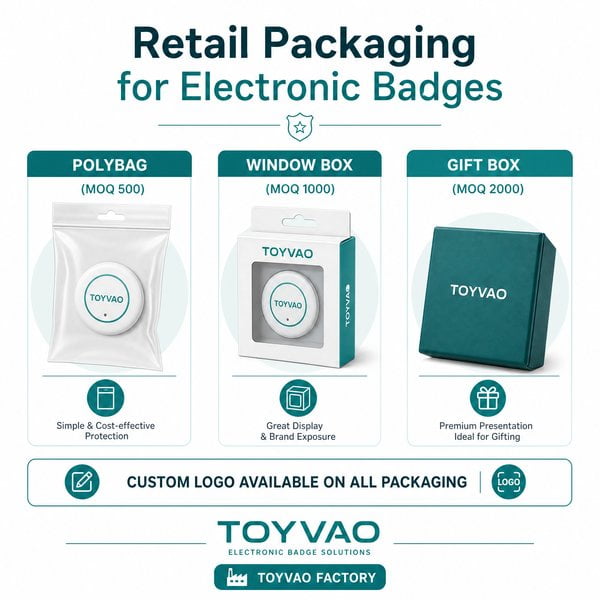
Overview: Retail packaging for electronic anime badges (电子吧唧)
Designing retail packaging for an Electronic Anime Badge / Digital Round Badge (电子吧唧) requires balancing protection for fragile electronics, strong shelf appeal for anime fans, cost-efficient sourcing, and compliance for global retail and e‑commerce channels. Toyvao (Shenzhen) recommends a packaging-first approach: specify product constraints, define the retail channel (brick-and-mortar, e‑commerce, or event merch tables), and then select materials, printing, and inserts that protect the PCB, LEDs, or battery while amplifying the brand story.
Key buyer concerns and how to address them
- Protection and transport: electronic badges contain PCBs, LEDs and often lithium coin cells. Use anti-static inner layers, foam or molded PET inserts, and secure the battery compartment to prevent movement. For air transport, follow UN 38.3 for lithium battery shipping.
- Unboxing & retail appeal: an anime badge competes on visual impact. Opt for a windowed paperboard box or a clear PET blister to show the artwork. Consider spot UV, metallic inks, and character art to increase shelf conversion.
- Sustainability & cost: global buyers increasingly demand recyclable options. Replace clamshells with FSC-certified folding cartons plus a small PET window, or biodegradable PLA for clear windows when feasible.
- Compliance & labeling: include CE/RoHS marking where required, battery warnings, disposal instructions, and supplier contact information. For EU/UK markets, ensure WEEE and battery labeling is visible.
- SKU variability & scalability: design modular packaging that accommodates multiple badge sizes/artworks with a single dieline and adjustable inserts to minimize tooling costs for small runs.
Authoritative market context (why packaging matters now)
Packaging investment is strategic. According to Grand View Research, the global smart packaging market has been growing in the high single digits CAGR as brands adopt more interactive and protective packaging for electronics — a trend that benefits vendors of small consumer electronics like digital badges. Statista also reports that global retail e‑commerce sales exceeded USD 5 trillion in the early 2020s, driving demand for packaging that protects during shipping while still offering visual impact when opened. These macro trends mean buyers should prioritize packaging that is both robust for logistics and designed to convert online shoppers.
Materials, structures and printing: selection guide
- Box types: folding carton with window (best balance of branding and cost); blister pack (high product visibility but higher plastic use); tin case (premium/collectible option).
- Base materials: 300–400gsm CCNB or SBS for printed outer boxes; PET or RPET for windows; EPE/PU foam or die-cut cardboard for internal cushioning.
- Anti-static & moisture protection: include a small ESD bag or anti-static inner pouch for badges with exposed electronics. Add a silica gel packet if humidity is a risk in storage/shipping.
- Printing techniques: CMYK + spot colors for character art, with optional spot varnish, holographic foil or embossed logos for higher-end SKUs.
Design checklist (artwork, dielines, specs)
- Confirm final product diameter/thickness and any protrusions (pins, clips).
- Provide high-resolution art (300–600 dpi) and dielines with bleed (3 mm standard) and safe zone (3–5 mm inside cut line).
- Specify window cutouts and PET thickness (0.2–0.4 mm common).
- Label requirements: barcode (EAN/UPC), batch/lot code, CE/RoHS symbols, battery type and disposal icon, supplier contact and country of origin (Made in China).
- Define insertion method (manual vs. automated), which affects inner insert tolerances and tooling.
Testing & quality control
- Perform drop and vibration tests on the final packaged SKU to simulate e‑commerce distribution.
- Inspect print color match via Pantone references and do pre-production press proofs.
- Check battery security and perform safety cycle testing (battery installation, retention under stress).
- Request sample packs from Toyvao Shenzhen for pre-shipment approval—include high-res photos and, if possible, a short unboxing video for ecommerce listings.
Sourcing and cost considerations (MOQ, tooling, lead time)
Toyvao recommends grouping SKUs to lower tooling costs. Typical tradeoffs:
- Folding carton with window: low tooling, MOQ 1,000–3,000 units, lead time 20–30 days.
- Blister packs: moderate tooling, MOQ 3,000–10,000, longer lead times due to thermoforming.
- Custom tins: higher tooling and mold costs, MOQ often 5,000+, lead time 35–60 days.
Data table: packaging option comparison
| Packaging Type | Protection | Branding Surface | Cost (per unit) | Best for |
|---|---|---|---|---|
| Folding carton with PET window | Medium – with die-cut insert | High (full 4C printing) | Low–Medium | E‑commerce & retail, mass SKUs |
| PET blister on printed card | High (visible, held in place) | Medium (card back printable) | Medium | Retail pegboard, impulse purchase |
| Collectible tin case | High (metal shell) | Medium–High (emboss/foil) | High | Premium limited editions |
| Minimal plastic sleeve | Low (simple protection) | Low | Lowest | Conventions, low-cost giveaways |
Sourcing tips specific to Shenzhen manufacturing
- Work with factories experienced in small electronics packaging—Shenzhen suppliers like Toyvao understand PCB/battery constraints and can advise on UN 38.3 and CE labeling.
- Request a packaging prototype before mass production; Shenzhen suppliers typically offer rapid prototyping within 7–14 days.
- Negotiate combined shipping (consolidation) to cut per-unit freight costs for small, heavy packaging like tins.
Next steps & decision framework
Decide which channel is primary (retail shelf vs. e‑commerce), list mandatory compliance elements for target markets, and choose a primary packaging type that meets protection, branding, sustainability and cost targets. Run a 100–500 unit pilot SKU to validate the design before scaling.
FAQ
Do I need a special container for battery-powered electronic badges?
Yes. For coin-cell or lithium batteries you should secure the battery (tamper-resistant compartment or taped cell), include appropriate hazard labels, and ensure packaging meets transport rules (UN 38.3 for lithium cells) and local battery disposal requirements.
What’s the most cost-effective packaging for a new anime badge line?
A folding carton with a small PET window and a die-cut cardboard insert balances cost, branding and protection. It provides a high-quality look with relatively low tooling expenses and is recyclable if materials are chosen carefully.
How should I label the packaging for EU distribution?
Include CE marking (if applicable), RoHS statement, WEEE/battery disposal symbols, battery type and capacity, the manufacturer’s contact, and the country of origin. Keep legally required text legible and near the barcode or on an inner leaflet if space is tight.
Can packaging be designed for both retail and e‑commerce?
Yes—design a retail-facing outer box that also fits into a protective mailer or shipper carton. Use inserts that prevent movement and consider a secondary corrugated outer shipper for high-volume e‑commerce fulfillment.
What lead times should I expect for custom packaging from Shenzhen?
Typical lead times: 20–30 days for folding cartons with windows, 25–45 days for blister packs, and 35–60 days for custom tins. Prototypes can often be produced in 7–14 days. Confirm current lead times with your supplier.
Contact Toyvao (Shenzhen) for packaging sourcing
If you’d like a packaging prototype, dieline templates, or a quotation for retail-ready packaging for your Electronic Anime Badge (电子吧唧), contact Toyvao:
- Email: sales@toyvao.com
- WhatsApp: +86 186 8106 4480
