
Executive Summary
This guide explains how to design, source, and launch a white-label Picture Book Reading Pen (also called Story Pen, Talking Book Pen, OID Reading Pen) product line for retail. It focuses on product definition, supply-chain choices, technical specifications, packaging, certifications, cost modeling, and a retail launch checklist. It is written for sourcing managers, product managers, and private-label buyers who need actionable specifications, realistic budgets, timelines, and a sequence of decisions that reduce technical and commercial risk.
Key facts and benchmarks:
– Typical development-to-shelf timeline: 4–6 months (accelerated) to 9–12 months (complex features).
– Minimum order quantities (MOQs): commonly 500–2,000 units for standard tooling; 1,000–5,000 for lower per-unit cost.
– Typical FOB unit price ranges: entry-level $8–$25, mid-tier $25–$60, premium $60–$120.
– Recommended audio spec: 16-bit PCM, 16–22 kHz minimum for speech; 44.1 kHz for music.
– Battery: Li-ion 500–2000 mAh; playtime target 8–24 hours.
– Safety cutoffs: volume limiter ≤ 85 dB; certifications required — CE, RoHS, FCC (US), CPSIA/ASTM (US toys), EN 71 (EU).
– Common sources: electronics OEMs in Shenzhen, Dongguan, Zhongshan; printing and binding in Guangdong/Fujian.
This guide gives a step-by-step decision path and a retail launch checklist with QC gates, packaging and labeling requirements, content/licensing considerations, and a cost model to help you build margins and meet retailer requirements.
What Is Picture Book Reading Pen and Who Uses It
Product definition
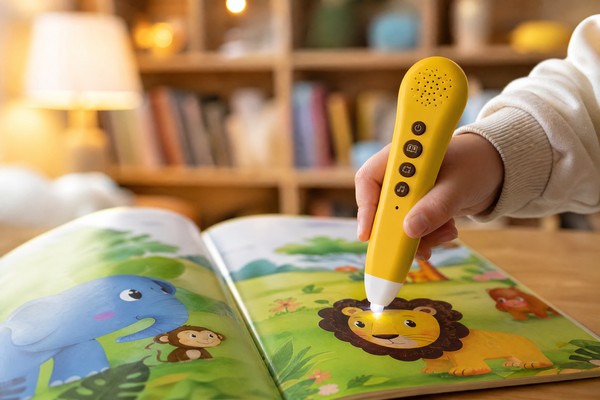
– A Picture Book Reading Pen is a handheld electronic device that outputs pre-recorded audio when its tip or sensor taps printed areas on a picture book or storybook. Implementations use optical ID (dot pattern), printed QR-like codes, RFID/NFC tags, or image recognition. The device typically contains a microcontroller, speaker, rechargeable battery, storage (flash/microSD), and an interface (buttons, LED, Bluetooth, sometimes microphone and recorder).
– Primary functions: play narration, play effects/music, language switching, record voice, Bluetooth audio streaming, firmware/ content updates via USB/Bluetooth/Wi‑Fi.
Primary users
– Children aged 2–8 years (primary), pre-readers and early readers.
– Parents and caregivers seeking interactive learning tools.
– Preschools, kindergartens, and tutoring centers (bulk buyers).
– Retail channels: mass-market toy retailers, educational distributors, e‑commerce platforms, museum/gift shops.
Use cases
– Read-along books where a child taps an illustration to hear narration/word definitions.
– Bilingual learning: dual-language audio tracks.
– Audio-enhanced story sets sold as bundles (pen + book(s)).
– Institutional use in classrooms for guided reading sessions.
Why Demand Is Growing
Market drivers
– Early literacy focus: governments and education programs prioritize phonemic awareness and vocabulary; audio-supported reading shows measurable gains in engagement and fluency.
– Dual-language demand: immigrant communities and bilingual education programs create growth for multi-language content.
– Gift and toy market: interactive print + electronics increase perceived value and justify higher price points.
– Digital-content fatigue: parents want screen-free, tactile experiences for young children.
Retail and channel drivers
– Bundling opportunity: pens sold as add-ons or bundled with 1–6 books increase average order value (AOV) 25–60% in e-commerce markets.
– Subscription models: content updates or new book packs via microSD or download create recurring revenue for brand owners.
– Institutional procurement: schools and libraries buy small sets or carts; tenders require compliance and classroom durability.
Quantitative indicators
– Typical retail sell-through for well-executed pen+book bundles in mainstream channels: 8–15 units/week/store in first 8 weeks after promotional launch.
– Replacement cycle: product lifecycle 2–4 years; consumers often repurchase upgraded pens or additional book packs every 12–24 months.
Key Technology Differences
Recognition technologies
– Optical ID (OID/dot-pattern): camera inside pen reads a printed microdot pattern on pages. Pros: reliable offline, unlimited unique touch points, low incremental printing cost. Cons: requires precise printing registration; pen optics add BOM cost.
– Printed hotspots / invisible ink with IR sensing: pen detects reflective properties of ink. Pros: lower pen complexity if using reflective/UV inks. Cons: wear and tear, susceptible to damage and lighting conditions.
– NFC / RFID tags embedded in pages: pros: robust detection and simple mapping; cons: cost per tag, tag durability and thickness, more complex printing/binding process.
– QR / 2D code scanning: simpler to produce but slower tap interaction and less child-friendly.
– Camera-based image recognition (computer vision): flexible and cloud-dependent; pros: no special printing; cons: latency, lighting dependence, connectivity requirement.
Hardware platforms
– MCU class: Cortex-M0/M3/M4 common for control; for Bluetooth audio or audio processing choose Cortex-M4 or higher with DSP extensions.
– DSP/audio: hardware or firmware decoders for MP3/AAC; PCM playback requires less CPU but more storage.
– Memory: 8–64 MB Flash typical for embedded firmware and limited audio; mid/high devices use external SPI NAND or eMMC and/or microSD up to 32GB.
– Connectivity: Bluetooth 4.2/5.0 for app pairing (A2DP for streaming), Wi‑Fi for OTA updates (optional), USB-C or micro‑USB for charging and data.
– Power: Li-ion 500–2000 mAh; battery protection ICs required and UN38.3/IEC62133 compliance for shipping.
Content & DRM
– Local audio files: stored on internal flash or microSD — lowest latency, offline.
– Encrypted storage + DRM: protect licensed content, requires secure boot and encryption (AES, secure key storage).
– Content CMS & SDK: APIs to upload new books, map hotspots to audio, update metadata; vendors should provide SDK and documentation.
Audio quality and safety
– Sample rate: 16 kHz acceptable for voice; 22 kHz preferable; 44.1 kHz for music.
– Bit depth: 16-bit PCM recommended for clarity.
– Speaker output: 0.5–2.5 W typical; volume limiting hardware/software necessary to meet 85 dB child-safe standard.
Software & App integration
– Companion app: required for firmware updates, content purchases, analytics, and parental controls. Should support iOS and Android.
– OTA firmware updates: critical for security fixes and content improvements. Confirm vendor supports A/B update or safe-recovery method.
– Localization: string management for manuals and UIs; confirm Unicode and multi-language support.
Key Features and Specifications to Evaluate
Hardware
– Recognition method: specify exact method (OID dot pattern, NFC, QR). Require sample pages printed with production process for testing.
– MCU and audio codec: list part numbers; prefer established SoC vendors with toolchains and reference code.
– Storage: internal flash size and microSD slot capability (e.g., up to 32 GB).
– Speaker: nominal power (e.g., 1 W), impedance, frequency response (300–12,000 Hz recommended).
– Microphone: if recording is supported, SNR spec and sample rate (≥16 kHz).
– Battery: chemistry, capacity mAh, typical playback hours at 50% volume, charge cycles (≥300 cycles).
– Charging: specify port (USB-C preferred), charge current, protection IC, and charge time (target 2–4 hours).
– Buttons/interface: play/pause, volume up/down, language switch, power; ergonomic design for small hands.
– Enclosure: material (ABS/PC), flame retardancy rating, tactile finish, colors.
– Durability: drop test (1 m on concrete), hinge or stylus robustness, IP rating for splashes (IPX4 recommended).
– Acoustic safety: limit to ≤85 dBA at 0.5 m; include test reports.
– Certifications: specify required certificates (CE, FCC Part 15, RoHS, EN 71, CPSIA, UN 38.3, IEC 62133).
Firmware and software
– Playback formats: MP3, AAC, WAV (PCM). Indicate maximum bitrate support.
– DRM & encryption: AES-128/256; secure boot if needed.
– Visitor analytics: number of taps, book usage, anonymized analytics available?
– Multilingual audio switching: number of simultaneous language tracks (e.g., 2–4).
– SDK/API: supply API for content mapping, metadata, and analytics; include sample code.
Content and production
– Audio production specs: wav 16-bit/22 kHz for narration; provide master files and final encoding parameters.
– Mapping rule: clear mapping of page coordinates to audio IDs; vector or pixel coordinates required.
– Printing tolerances: dot pattern registration tolerance ±0.2 mm; paper types compatible.
– Book BOM: page weight, binding type (perfect-bound vs saddle-stitch), lamination, barcode.
Packaging and accessories
– Retail packaging: dimension constraints for shelf displays, box construction (E-flute/CCNB), hang tab options.
– In-box contents: pen, 1–6 books, charging cable, quick-start guide, warranty card.
– Inserts: promotional leaflet, app QR code, multilingual manual.
– SKU variations: colorways, language packs, bundles.
Quality control and testing
– AQL sampling plan, incoming material checks, first article inspection (FAI), production-line visual and functional tests.
– Burn-in test: 4–8 hours at 25–45°C for electronics.
– Tap accuracy test: sample throughput per page; expected pass rate ≥98% after calibration.
Pros and Cons
Pros of white-label pen lines
– Control over branding: logos, packaging, curated content, exclusive bundles.
– Higher margins: brand premium and bundled content increase ASP.
– Differentiation: custom UI, unique content licensing and language options.
– Faster reaction: ability to target specific retail segments (e.g., bilingual markets, education).
Cons and risks
– Upfront investment: tooling ($3k–$50k+ depending on molds), firmware/app development, content royalties.
– Inventory and obsolescence risk: electronics and content change quickly; poor sales lead to unsold SKUs.
– Certification burden: multiple markets require different safety and EMC testing; cost per certification $3k–$8k.
– After-sales support: warranty, spare parts, firmware maintenance and content updates are ongoing costs.
Step-by-Step Decision Guide
Define market and SKU strategy (2 weeks)
– Decide target markets (US, EU, China, APAC) and channels (retail, education, e‑commerce).
– Define SKU list: pen-only, pen+1 book, pen+3 book pack, language variants.
– Set retail price tiers: entry $25–40, mid $45–75, premium $90+.
Technical specification and vendor shortlisting (2–4 weeks)
– Create an RFP: include recognition tech, audio quality, battery life, certifications, packaging, MOQ, and target FOB.
– Shortlist 3–6 OEMs with references and sample catalogs from Shenzhen/Dongguan hubs.
Prototype and pilot (6–12 weeks)
– First prototypes: functional electronics + housing mockup; expect 2–3 iterations.
– Evaluate tap accuracy, audio clarity, ergonomics, battery life, and app integration.
– Print pilot books with production print house to validate recognition tech.
Tooling and pre-production (6–10 weeks)
– Finalize molds and PCB gerbers. Tooling cost range: $3k–$25k per mold depending on complexity; multi-cavity molds cost more.
– Produce engineering validation units (EVT) and firmware validation.
Certifications and compliance (4–8+ weeks concurrent)
– Submit units for FCC, CE (EMC), EN71, RoHS, UN38.3 battery testing, and country-specific toy regulations.
– Budget $3k–$12k per major certificate depending on testing labs and repeat runs.
Content production and licensing (4–12 weeks)
– Secure rights from publishers; negotiate per-title royalty or per-copy licensing.
– Audio recording: professional narration and master editing; expect $300–$2,000 per title depending on length and talent.
– Map audio to hotspot IDs; run QA for alignment and readability.
Pilot production and QC (4–8 weeks)
– Place pilot MOQ order (often 500–2,000 units).
– Conduct IQC, inline QC, and OQC tests; use AQL 2.5/4.0 or stricter based on retailer requirements.
– Verify packaging, barcode, manuals, and content on final units.
Logistics and launch (4–6 weeks)
– Freight: sea freight 30–45 days from China to US/EU; air freight 3–7 days for samples or urgent replenishment.
– Customs & duties: determine HS code (likely 8507 or 8528 family depending on device classification); plan for import VAT and duties.
– Retail onboarding: prepare sell-in materials, UPC/EAN registration, shelf-ready packaging, POS displays.
Post-launch support and scaling (ongoing)
– Monitor returns, failure rates, and content feedback.
– Plan for spare parts and service network; consider 1–3% spare parts stock.
– Plan firmware maintenance and content pipeline for new titles and languages.
Pricing and Cost Analysis
Example BOM (entry, mid, premium — ballpark per-unit FOB China)
Entry-level (target retail $25–40)
– Plastic housing: $0.60
– Tooling amortization: $1.00 (high MOQ)
– PCB + assembly: $4.00
– Speaker: $0.40
– Battery 500 mAh + protection: $1.00
– Microcontroller/codec: $2.50
– Firmware/flash: $1.50
– Packaging (box, manual, accessories): $1.20
– Certification amortization & QC: $0.70
– Logistics & overhead: $0.60
Estimated FOB/unit: $13–$14
Mid-tier (target retail $45–75)
– Plastic housing with better finish: $1.50
– Tooling amortization: $2.50
– PCB + assembly with Bluetooth: $6.50
– Speaker 1W: $0.80
– Battery 1000 mAh: $2.00
– SoC with Bluetooth and DSP: $6.00
– Storage 8–16 GB: $1.50
– Packaging retail-ready + insert: $2.50
– Certification amortization: $1.50
– Logistics & overhead: $1.00
Estimated FOB/unit: $25–$30
Premium (target retail $90–150)
– High-quality housing, custom injection: $3.50
– Tooling amortization: $4.50
– PCB + assembly with Wi‑Fi/Bluetooth: $12.00
– Speaker 2–3W: $1.50
– Battery 1500–2000 mAh: $4.00
– High-end SoC, encryption, DRM support: $12.00
– Storage 32 GB internal + microSD: $4.00
– Packaging premium + POS display: $4.50
– Certification amortization + continuous testing: $2.50
– Logistics & overhead: $2.00
Estimated FOB/unit: $45–$75
Margins and pricing
– Distributor margin: 15–35% typical.
– Retail markup: 40–60% typical; toy retail often uses keystone (100%) in some channels but education and big-box have lower margins.
– Example: Mid-tier FOB $28, distributor price (20% margin) $34; retail price (40% markup) ≈ $48.
Content production & licensing
– Narration production cost: $300–$2,000 per title depending on length and production quality (2–10 minute titles average $300–$800).
– Mapping and QA: $60–$200 per title.
– Licensing: options include per-title royalty (e.g., $0.50–$3.00 per unit sold) or a flat buyout/license fee (ranges $2k–$50k per territory depending on popularity).
Total landed cost and MSRP example
– Mid-tier: FOB $30 + shipping & duty ($3–$7) = landed $33–$37. Add content amortization and overhead to set MSRP $45–$75.
Competitive Landscape
OEM and ODM ecosystem
– Mainland China (Shenzhen, Dongguan, Zhongshan, Foshan) dominates electronics and toy production; capable of integrated offering: injection molding, PCB assembly, printing, binding, and packaging.
– Taiwan & South Korea: stronger in SoC and industrial design for higher-end devices.
– Vietnam & India: emerging for lower-cost assembly and labor; tooling and electronics supply chain still maturing.
Software & content partners
– Local content studios: produce localized audio and mapping services; often faster and cheaper for regional languages.
– Global narrators and sound studios: required for premium audio production; higher cost and scheduling complexities.
Retailers and distribution channels
– Big-box and mass retailers require compliance documentation, case packs, UPC/EAN, and EDI capability; longer onboarding (4–12 weeks).
– Educational distributors and museum shops have specific safety and content expectations; smaller initial orders but higher per-unit margins.
– E-commerce platforms (Amazon, marketplace) need quality imagery, A+ content, and clear warranty terms.
Differentiators to win shelf space
– Exclusive content partnerships (well-known titles, bilingual bundles).
– Proven recognition accuracy and child-safe audio limits.
– Attractive shelf-ready packaging and POS displays.
– Proven back-end (app, CMS, analytics) for content rollout.
What Buyers Say
Common buyer priorities and pain points (synthesized from procurement feedback)
– Priorities:
– Reliable tap accuracy and low false positives (<2%).
– Battery life meeting advertised playtime; common buyer threshold is ≥10 hours continuous play at moderate volume.
– Rapid and clear content mapping workflow.
– Clear certification record for target markets.
– Complaints and recurring issues:
– Vendors over-promising tap accuracy; real-life results degrade with cheaper paper stock or heavy lamination.
– Firmware stability and slow OTA cycles — buyers demand a 90-day bug-fix SLA for major issues in first production run.
– Hidden licensing costs for content that significantly affect margins.
– Poor packaging that fails retailer drop tests or causes shelf damage.
Operational lessons from buyers
– Insist on pre-production run with full printed book set and final packaging before first container ship.
– Require manufacturer to supply FAI report, burn-in logs, and a small spare parts kit (1% of order).
– Negotiate spare-parts availability and lead times (6–12 months typical).
Safety, Maintenance and Compliance
Mandatory safety & standards
– EU: EN 71-1/2/3 (mechanical/physical, flammability, migration of elements), EMC Directive, RoHS, CE declaration.
– US: ASTM F963 (toy safety), CPSIA (lead, phthalates), FCC Part 15 (RF for Bluetooth/Wi‑Fi), battery regulations (UN38.3 tested for air/sea transport).
– Batteries: IEC 62133 certification for batteries and UN38.3 testing for cross-border transport.
– Chemical compliance: REACH and local country requirements for phthalates and heavy metals.
– Acoustic safety: WHO/industry recommendation to limit continuous sound exposure; practical implementation ≤85 dB at 0.5 m as tested in standard lab conditions.
Labeling and documentation
– Multilingual user manual with safety symbols.
– Permanently affixed product label with model ID, origin (Made in), manufacturer name and address, electrical ratings.
– Barcode/UPC/EAN and GTIN registration for retail.
– Battery disposal instructions and recycling label (WEEE if applicable).
Maintenance and serviceability
– Firmware: provide update methodology, release notes, and rollback procedure.
– Battery replacement: design for non-user-replaceable or user-replaceable with safe procedure; if user-serviceable, include replacement battery part number and instructions.
– Cleaning: recommend mild soap, water-dampened cloth; avoid submersion unless rated IPX7.
– Warranty: typical 12 months; define RMA process and acceptable failure rate (target <2% for electronics failure).
– Spare parts: stock common spare parts (PCBs, speakers, batteries) equivalent to 1–3% of production for first 12 months.
Testing and QC checklist (for supplier)
– Mechanical: drop (1 m), hinge/cap durability, button cycle tests ≥10,000 cycles.
– Electrical: full functional test, short circuit protection, overcharge/over-discharge protection tests.
– Environmental: thermal cycling −10°C to 45°C, humidity soak.
– Acoustic: sound pressure level at 0.5 m, frequency response.
– Recognition: accuracy across paper types (coated/uncoated), brightness, and different book finishes.
Frequently Asked Questions
What is a realistic MOQ to expect?
– Typical MOQs for white-label pens: 500–2,000 units for a standard model. Custom colors or molds increase MOQ — expect 1,000–5,000 to amortize mold costs and lower unit cost.
How long does development take?
– Typical timeline: 4–6 months for a mid-tier device with existing reference hardware and standard packaging. New recognition tech, bespoke app, or complex certifications push to 9–12 months.
How much should I budget for certifications?
– Expect $3,000–$8,000 per major market (FCC/US, CE/EU, EN71/REACH). Battery tests (UN38.3/IEC62133) often add $2k–$4k. Repeat tests for design changes increase costs.
How are content royalties usually structured?
– Two models: per-unit royalty ($0.50–$3.00 per copy sold) or a flat license fee ($2k–$50k) for title rights by territory. Negotiate exclusivity and term limits.
Can I mix recognition technologies in one product line?
– Technically possible but increases BOM complexity and costs. Choose one recognition method per SKU. Consider offering separate SKUs for RFID-enabled premium books vs OID mass-market books.
How do I control volume for child safety?
– Implement hardware or firmware volume limiting to ensure ≤85 dB at 0.5 m; require lab acoustic report. Include physical volume buttons with lock option and parental volume presets.
What are common post-launch metrics to track?
– Return rate (%), failure rate per 1,000 units, number of active units (if connected), content consumption (taps per unit/week), and sell-through rates per channel.
What happens to spare parts and warranty after launch?
– Negotiate spare parts availability for at least 12–24 months post-production and specify lead time (8–12 weeks typical for components) in contract. Plan for at least 1% spare part stock.
Contact Toyvao
To discuss white-label Picture Book Reading Pen programs, request an RFQ, or get a supplier shortlist and sample evaluation, contact Toyvao:
- Website: https://toyvao.com — use the “Private Label Electronics” inquiry form to upload specifications.
- Email: sales@toyvao.com — include target SKU list, target markets, desired MOQ, and required certifications.
- What to include in your initial inquiry: target retail price, recognition technology preference (OID/NFC/QR), number of titles to launch with, required languages, desired launch window, and target unit volumes (pilot and 12-month forecast).
Provide your product spec sheet, sample book artwork (or indication of content format), and any preferred suppliers or reference designs. Toyvao can provide a prioritized checklist, vendor shortlist, cost model, and sample evaluation plan within 5 business days of receiving a complete RFQ package.
