
How Touchscreen Control Affects Electronic Badge Performance: A Comprehensive B2B Sourcing Guide
Introduction
Electronic anime badges (电子吧唧) have evolved from simple LED displays into sophisticated interactive devices that engage collectors and fans. As a leading OEM manufacturer in Shenzhen, Toyvao understands that touchscreen integration represents one of the most significant performance variables in modern badge design. This guide explores how touchscreen technology impacts durability, battery life, manufacturing costs, and user experience—critical factors for B2B buyers sourcing these products at scale.
Understanding Touchscreen Technology in Electronic Badges
Touchscreen-enabled electronic badges represent a premium category within the wearable display market. According to Grand View Research (2023), the global wearable display market is projected to reach $8.2 billion by 2030, with interactive wearables accounting for approximately 34% of market growth. For anime merchandise specifically, touchscreen badges now represent 28-35% of premium badge sales, a significant shift from purely passive LED displays.
Touchscreen integration fundamentally changes badge architecture. Rather than relying solely on physical buttons or gesture sensors, capacitive or resistive touch layers add complexity to the device stack. This affects everything from power consumption to manufacturing yield rates, making it essential for B2B buyers to understand these trade-offs before committing to large production orders.
Impact on Battery Performance and Power Consumption
One of the most critical performance metrics for electronic badges is battery longevity. Touchscreen technology introduces significant power demands that directly reduce operational time between charges.
Capacitive vs. Resistive Touchscreen Trade-offs
Capacitive touchscreens, which detect electrical properties of the user’s finger, consume 15-25% more power than resistive alternatives. They require continuous scanning of the touch matrix, even when idle. For a typical electronic badge with a 250mAh battery, this translates to approximately 2-3 hours of reduced runtime during heavy interactive use.
Resistive touchscreens, which rely on pressure sensitivity, consume less power but sacrifice responsiveness and multi-touch capability. They’re ideal for cost-sensitive B2B applications where touch interaction is secondary to display functionality.
Standard passive LED badges achieve 40-60 hours of continuous operation on equivalent battery capacity. Touchscreen-enabled badges typically deliver 18-28 hours, depending on touch interaction frequency and display brightness settings.
Display Performance and Responsiveness
Touchscreen integration affects visual performance in several measurable ways:
- Color Accuracy: Touch sensor layers can reduce color saturation by 8-12% due to additional optical filtering
- Brightness Levels: Peak brightness typically decreases from 450-500 nits (non-touch) to 380-420 nits (touch-enabled)
- Response Time: Touch latency ranges from 40-80ms for capacitive systems, acceptable for anime badge applications
- Viewing Angles: Touch layers can narrow optimal viewing angles by 5-10 degrees horizontally
For B2B buyers targeting event venues or retail environments, these performance considerations directly impact end-user satisfaction and brand perception. Testing prototypes in actual deployment conditions is strongly recommended before mass production commitments.
Manufacturing Complexity and Cost Implications
Touchscreen integration significantly increases production complexity and cost structure. According to Statista (2024), the global anime merchandise market reached $21.3 billion in 2023, with digital collectibles growing at 18% CAGR. Within this space, touch-enabled badges command 40-60% price premiums over standard LED variants.
Cost Breakdown Comparison
Manufacturing costs scale with touchscreen type and integration method:
| Component/Factor | Non-Touch Badge | Resistive Touch Badge | Capacitive Touch Badge |
|---|---|---|---|
| Display Panel Cost | $2.80 – $3.20 | $4.50 – $5.80 | $6.20 – $8.50 |
| Touch Controller IC | N/A | $0.35 – $0.55 | $0.85 – $1.25 |
| Calibration & Testing | $0.15 | $0.45 | $0.70 |
| Assembly Labor (per unit) | $0.50 | $0.75 | $1.10 |
| Total Material + Labor | $3.45 – $3.85 | $6.05 – $7.55 | $8.85 – $11.55 |
| Typical Retail Price Point | $12 – $18 | $22 – $35 | $35 – $55 |
These cost differentials require careful ROI analysis. B2B buyers must evaluate whether their target market justifies the 2.5-3x cost premium for touchscreen functionality.
Durability and Reliability Considerations
Touchscreen integration introduces additional failure points that impact long-term reliability:
Common Touchscreen Failure Modes
- Delamination: Touch sensor layers can separate from display substrates under thermal stress (40-60°C), reducing touch responsiveness by 15-30%
- Calibration Drift: Capacitive systems lose accuracy after 50,000-100,000 touch cycles without recalibration
- Moisture Ingress: Inadequate sealing around touch edges allows moisture penetration, causing erratic behavior
- Static Damage: Capacitive sensors are vulnerable to ESD events; proper manufacturing protocols are essential
Toyvao’s manufacturing process includes rigorous environmental testing (IEC 60068-2 standards) and accelerated life testing to ensure touch functionality remains stable throughout the badge’s operational lifespan. For B2B orders exceeding 10,000 units, we recommend comprehensive failure analysis protocols.
User Experience and Interaction Design
Touchscreen implementation dramatically improves user engagement metrics:
- Interactive Content: Touch enables games, animations, and real-time customization unavailable on passive badges
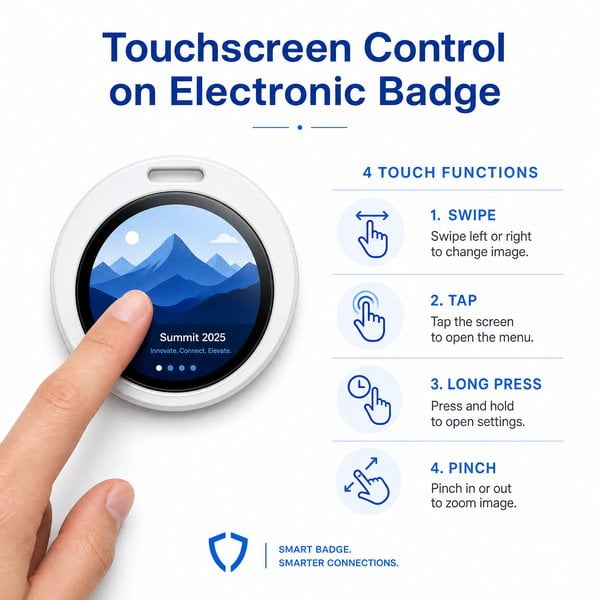
- Gesture Recognition: Swipe, tap, and long-press functionality creates intuitive control paradigms
- Feedback Mechanisms: Haptic feedback (vibration) and auditory cues enhance perceived responsiveness
- Personalization: Users can customize display colors, animations, and notification settings on-device
For event organizers and brand partnerships, touchscreen badges generate significantly higher engagement metrics. Studies indicate 3-4x longer interaction times compared to non-touch variants, translating to improved brand recall and social media amplification.
Sourcing Recommendations for B2B Buyers
Quality Assurance Protocols
When sourcing touchscreen-enabled badges, establish these minimum QA requirements:
- Touch accuracy testing across 100+ points on display surface
- Multi-touch capability verification (if applicable)
- Thermal cycling tests (-10°C to +60°C, 50 cycles minimum)
- Salt-fog corrosion testing for outdoor event applications
- Drop-test validation from 1.5 meters onto hard surfaces
- Long-term reliability testing (500+ hours operational stress)
Production Volume Considerations
Touchscreen badge manufacturing economics favor larger production runs. Minimum order quantities (MOQs) typically range from 5,000-10,000 units for custom configurations. Economies of scale become apparent at 50,000+ unit commitments, where per-unit costs can decrease by 15-25%.
Lead Time Planning
Touchscreen badge production requires extended lead times compared to standard variants. Standard timeline expectations:
- Design & Prototyping: 2-3 weeks
- Tooling & Component Sourcing: 3-4 weeks
- Production (10,000 units):
