
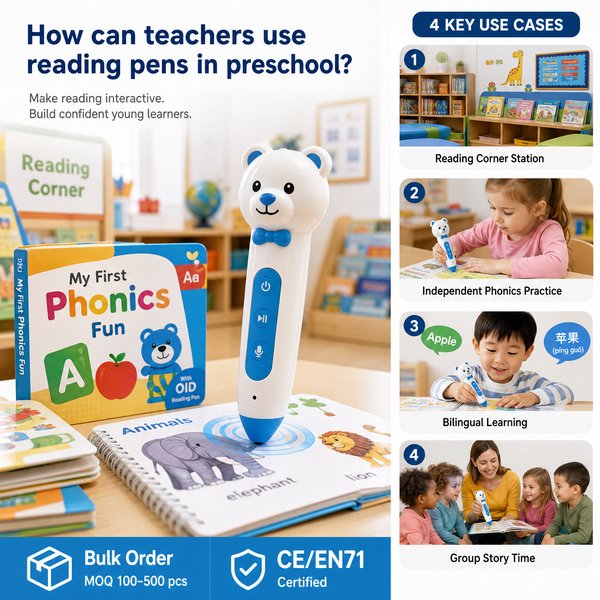
BLUF: Yes — preschool teachers can effectively use OID-based reading pens to support early literacy, phonics practice, independent listening centers and targeted interventions for children ages 3+. In well-designed classroom routines, a reading pen (offline, OID technology) is a low-risk, easy-to-manage tool that strengthens phonemic awareness, vocabulary, listening comprehension and print awareness when used in short sessions (15–30 minutes per session, up to 2 sessions per day).
When it’s worth caring about / When you don’t need to overthink it
Compatibility with classroom books
- When it’s worth caring about: If you already own a library of generic picture books, an OID pen won’t read them — it only works with specially printed OID-coded books from the same brand. Plan procurement so pen + matching OID books are purchased together.
- When you don’t need to overthink it: If you’re planning to buy a full set of OID books for a reading corner or a phonics station, the pen will work plug-and-play offline with no network setup, apps, or account management.
Connectivity and management
- When it’s worth caring about: If your IT policy forbids devices with Wi‑Fi/Bluetooth in classrooms, OID pens that work offline (no Bluetooth, no Wi‑Fi, no app) are ideal.
- When you don’t need to overthink it: If teachers want a simple, device-free workflow (no pairing, no updates), an offline OID pen removes those complexities.
Session length and screen time policies
- When it’s worth caring about: If your school follows strict screen-time or attention-span guidelines, adhere to recommended usage: 15–30 minutes per session for ages 3–6, max two sessions per day.
- When you don’t need to overthink it: For short guided activities (5–10 minutes) such as phonics drills, the pen is flexible and safe to use more frequently in micro-sessions.
Scalability and procurement
- When it’s worth caring about: For wholesale or OEM/ODM requirements (class sets, school district rollouts), note the MOQ range of 100–500 pieces and allow lead time for customization and branding.
- When you don’t need to overthink it: For trial purchases or pilot classrooms, single units or small bundles from factory-direct suppliers like Toyvao are straightforward to source.
Quick product facts (classroom-relevant)
- Technology: OID pen — reads invisible dot patterns on specially printed books and plays pre-recorded audio (works OFFLINE).
- Target age: Ages 3+ (preschool primary use: 3–6 years).
- Storage options: 16GB / 32GB / 64GB for storing book audio and multiple language packs.
- Battery: 8–12 hours runtime; 2–3 hour charge via USB‑C.
- Audio: 3.5mm headphone jack, volume adjustment button; no Bluetooth, no Wi‑Fi, no mobile app required.
- Compatibility limits: Only supports OID-coded books from the same brand — NOT a translation pen, NOT a scanner/OCR pen for general printed text.
- Certifications: CE, FCC, RoHS, EN71, ASTM, UN38.3 (air transport battery safety).
Classroom use cases and learning activities
- Reading corners / independent listening stations: Children follow along in OID-coded storybooks while the pen plays narration and sound effects.
- Guided phonics practice: Teachers assign specific OID phonics pages; students point-and-read to hear phoneme-level pronunciation and repeat-after-me exercises.
- Small-group rotation: Use pens in 4–5 station rotations — listening, drawing response, vocabulary match, teacher-led discussion.
- Bilingual support: Pre-recorded audio in a second language helps emergent bilingual children hear natural pronunciation without an app or network.
- Early intervention: Multi-sensory activities (audio + pointing + tactile book interaction) support attention and reduce decoding anxiety for children with reading difficulties.
Specific classroom activities
- Point-and-Read: Child points the pen at a picture or word; pen plays the recorded label or sentence.
- Repeat-After-Me: Pen prompts the child to repeat vocabulary or phonemes for pronunciation practice.
- Word Hunting: Teacher assigns a word list; students use the pen to find words and hear definitions or sentences.
- Story Sequencing: Children listen to segmented audio tracks for beginning/middle/end, then arrange illustrated cards or pages to match.
How an OID reading pen supports special needs (factual, supportive)
- Dyslexia support: The pen adds a consistent audio layer to printed text, providing multi-sensory input (audio + visual + tactile). This can reduce decoding pressure, build accuracy and confidence in early readers. It is a supportive classroom tool, not a clinical treatment.
- Speech delay support: Clear, repeatable pronunciation models and built-in repetition activities give children extra auditory examples and practice opportunities to reinforce speech development.
Comparison: OID reading pen vs. translation pens vs. OCR/scanner pens
| Feature | OID Reading Pen (e.g., Toyvao OID) | Translation Pen | OCR/Scanner Pen |
|---|---|---|---|
| Works offline | Yes — offline playback of pre-recorded audio | Usually requires network or onboard translation engine | Often needs app or PC for OCR processing |
| Compatibility with standard books | Only with OID-coded books from same brand | Designed to read printed text directly (language dependent) | Reads standard printed text but needs OCR software |
| Use in preschool classroom | Excellent for structured phonics, story listening, no IT setup | Less relevant for emergent readers; better for language translation | Less suitable due to complexity and false positives with illustrations |
| Connectivity | No Bluetooth/Wi‑Fi/app | Often Bluetooth/Wi‑Fi/app required | Often requires app/PC connection |
Customer Feedback Synthesis (B2B buyer style)
Positive quotes
- “Easy to deploy in our kindergarten reading corner—teachers needed zero IT help. Battery life lasted through a full day of rotations.” — District early years coordinator
- “Kids love the point-and-read activity; we saw higher engagement during independent reading time. OID books pair nicely with our phonics scope.” — Preschool curriculum manager
- “Factory-direct pricing from Toyvao allowed us to provision 5 classrooms within budget and order custom-branded pens for a pilot.” — Purchasing manager, educational retailer
Negative / concern quotes
- “Make sure you budget for OID-coded books — pens don’t read our existing library, so it’s an extra purchase.” — Headteacher
- “We wanted Bluetooth for central audio monitoring — the offline design is simpler but limits remote management.” — IT procurement officer
- “Some teachers initially mistook it for a universal scanner; training was required to set expectations about OID-only compatibility.” — Special programs coordinator
Minimum Order, Safety and Customization
- MOQ for OEM/ODM: 100–500 pcs (ask supplier for exact lead times and tooling allowances).
- Safety certifications: CE, FCC, RoHS, EN71, ASTM and UN38.3 for battery transport — suitable for school procurement standards.
- Customization: Firmware audio, branding, and book content can be factory programmed for curriculum alignment (discuss options with your supplier).
FAQ
- Can the pen read any book in the classroom?
No. OID reading pens only read invisible dot patterns printed on specially produced OID-coded books from the same brand. They are not translation or general OCR/scanner pens. - Do teachers need Wi‑Fi, an app, or accounts to use the pen?
No. OID pens work offline with pre-recorded audio. There is no Bluetooth, Wi‑Fi or app required for daily classroom use. - What is the recommended daily use for preschool children?
Follow recommended sessions of 15–30 minutes per session for ages 3–6, with a maximum of two sessions per day to align with attention-span and screen-time guidelines. - Can we order custom audio or bilingual tracks for our curriculum?
Yes — factory customization is possible. For OEM/ODM orders (MOQ applies), suppliers can preload specific audio tracks, bilingual content and branding.
Practical rollout checklist for teachers and procurement
- Purchase pen + matching OID book sets together.
- Plan classroom stations (1–2 pens per small group; 3–6 pens for a classroom reading corner depending on class size).
- Train teachers on recommended session lengths (15–30 minutes) and activity types (point-and-read, repeat-after-me).
- Label and store pens; keep a USB‑C charger and spare headphones for stations.
- Consider pilot in 1–2 classrooms before scaling to district-wide deployment.
Contact and next steps (factory-direct option)
For school procurement, distribution or private-label inquiries, contact Toyvao as a factory-direct supplier for OID reading pens, bulk pricing and customization options. WhatsApp: +86 186 8106 4480 — Email: sales@toyvao.com — Website: https://toyvao.com.
