
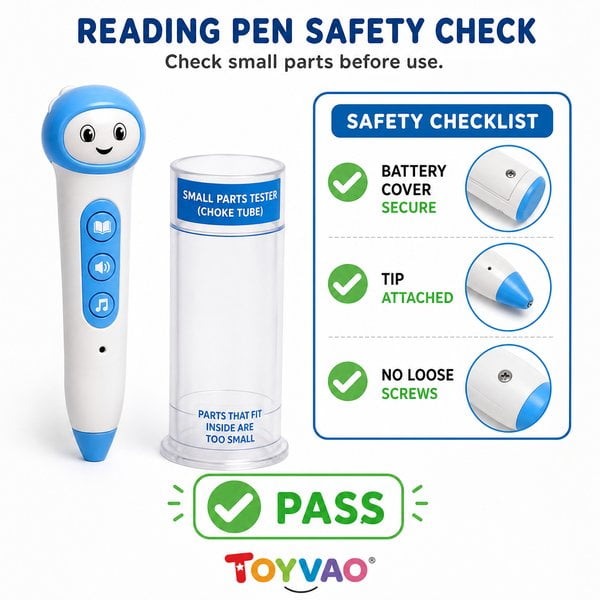
In the children’s educational toy market, reading pens are widely favored for their interactivity and learning efficiency. However, for B2B buyers, importers, and brand owners, ensuring product safety—especially the safety of small parts—is crucial. This article examines the safety inspection standards for reading-pen small parts, relevant industry regulations, and how Toyvao, as a leading manufacturer, ensures product compliance and superior quality.
Why Small-Part Safety Is Critical
Children, particularly those under 3 years old, tend to put small objects into their mouths. If a reading pen contains parts that can easily detach, these components may pose choking, inhalation, or ingestion hazards and present a serious risk to a child’s health. Therefore, rigorous small-part safety testing is not only a legal requirement but also a demonstration of a company’s responsibility to consumers.
International Small-Part Safety Regulations and Standards
Worldwide, there are stringent regulations governing the safety of small parts in children’s products. For example, the U.S. Consumer Product Safety Commission (CPSC) 16 CFR Part 1501 expressly prohibits small parts in products intended for children under 3 years old to prevent choking hazards [1]. The EU CE marking, China’s CCC, the U.S. ASTM F963 standard, and directives such as RoHS all set detailed requirements for the mechanical and physical properties, chemical composition, and electrical safety of children’s toys, with small-part testing as a core element.
Small-Part Testing Methods
Small-part testing typically uses a device called the Small Parts Test Fixture (SPTF), designed to simulate the fully expanded size of a toddler’s throat [2]. Any component that can fit entirely into this test cylinder is considered a small part; if the product is intended for children under 3 years old, such parts are not permitted. For products intended for children aged 3 and above, any small parts must be accompanied by clear warning labels.
How Toyvao Ensures Small-Part Safety of Reading Pens
With more than 15 years of OEM/ODM experience manufacturing children’s learning card devices, Toyvao understands the importance of product safety. We strictly follow international safety standards at every stage—from design and material selection to production—ensuring that every reading pen meets the highest safety requirements.
Toyvao Safety Measures
| Stage | Safety Measures | International Standards |
|---|---|---|
| Design | Adopt integrated, seamless designs to eliminate the risk of small parts detaching. | ASTM F963, EN71-1 |
| Material Selection | Use food-grade, non-toxic, environmentally friendly materials and subject them to rigorous chemical testing. | RoHS, REACH, CPSIA |
| Production Process | Implement automated production lines to reduce human error and ensure component integrity. | ISO 9001 |
| Quality Testing | Perform small-part tests, drop tests, pull tests, and other inspections on every batch. | 16 CFR Part 1501, EN71-1, GB 6675 |
| Certification & Compliance | Products certified to CE, FCC, RoHS, ASTM and other international standards. | CE, FCC, RoHS, ASTM, CCC |
Market Insights: Growth of the Educational Toy Market and Safety Demand
The global educational toy market is experiencing significant growth. According to Grand View Research, the global educational toy market reached $54.0 billion in 2023 and is projected to grow to $118.8 billion by 2030, with a compound annual growth rate (CAGR) of 12.0% [3]. This growth highlights a strong market demand for high-quality, safe educational products. For B2B buyers, in addition to cost and functionality, product safety has become a decisive factor when selecting suppliers.
OEM/ODM Customization and Safety
Toyvao provides comprehensive OEM/ODM customization services and understands the specific safety requirements of different markets and clients. Whether for industrial design, functional development, or material selection, we can meet customers’ customization needs while ensuring full compliance with the safety regulations of the target market. Our professional team collaborates closely with you from concept to finished product, managing quality and safety throughout the process.
Conclusion and Call to Action
Small-part safety for reading pens is a critical issue in the field of children’s educational toys. Choosing a partner with strict safety standards and extensive experience is fundamental to the success of B2B buyers. With outstanding manufacturing capabilities, rigorous quality control, and a commitment to international safety standards, Toyvao is your ideal partner.
Contact Toyvao now to learn more about our safe and reliable reading pen products and customization solutions, and let’s explore the broad opportunities in the educational toy market together!
- Email: sales@toyvao.com
- WhatsApp: +86 186 8106 4480
References
[1] U.S. Consumer Product Safety Commission. 16 CFR Part 1501 – Small Parts Ban and Choking Hazard Labeling. Available at: [https://www.cpsc.gov/Business–Manufacturing/Business-Education/Business-Guidance/Small-Parts-for-Toys-and-Childrens-Products](https://www.cpsc.gov/Business–Manufacturing/Business-Education/Business-Guidance/Small-Parts-for-Toys-and-Childrens-Products)
[2] Neofotistos, A. (2017). Choking Hazards: Are Current Product Testing Methods for … Available at: [https://pmc.ncbi.nlm.nih.gov/articles/PMC5467345/](https://pmc.ncbi.nlm.nih.gov/articles/PMC5467345/)
[3] Grand View Research. Educational Toys Market Size And Share Report, 2024-2030. Available at: [https://www.grandviewresearch.com/industry-analysis/educational-toys-market-report](https://www.grandviewresearch.com/industry-analysis/educational-toys-market-report)
