
Executive Summary
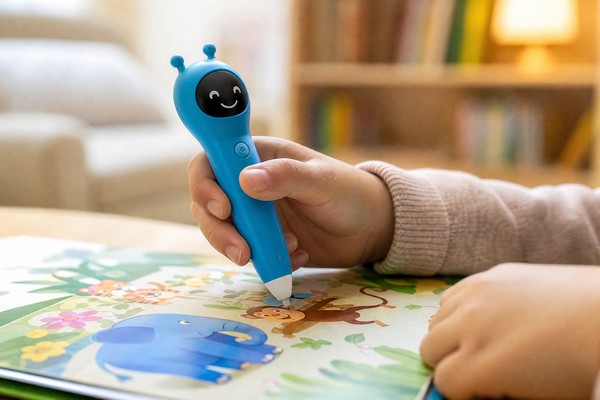
This guide sets out a factory inspection and quality control checklist specifically for Picture Book Reading Pens (also known as Story Pens, Talking Book Pens, or OID Reading Pens). It covers pre-production through pre-shipment controls, functional and safety tests, destructive and non‑destructive sampling strategies, sampling-plan principles, and cost implications. The objective is to provide a B2B buyer the actionable QC framework necessary to minimize field failures, ensure regulatory compliance for children’s products, and reduce financial and reputational risk before export.
Key recommendations:
– Use a three-stage inspection process: Pre‑Production Inspection (PPI), During Production Inspection (DUPRO), Final Random Inspection (FRI).
– Define AQLs explicitly in the purchase contract: Critical = 0, Major = 1.5 (or stricter for children’s products), Minor = 4.0.
– Require specific electrical, audio, mechanical and environmental tests with pass/fail criteria (see checklist).
– Include destructive testing (battery, ingress, flammability) on samples outside of the inspection lot using agreed sample sizes or percentages.
– Budget inspection and testing costs: third‑party inspection $200–$550 per visit; lab certification tests $300–$3,000 per test/sample depending on scope; expected product FOB ranges $4–$25 per unit depending on specifications.
This document assumes buyers will contract an independent inspection provider (SGS, Bureau Veritas, Intertek or specialist QA agencies) and a certified laboratory for regulatory testing. It details measurable criteria and sampling strategies that must be included in purchase orders and technical agreements.
What Is Picture Book Reading Pen and Who Uses It
Product definition:
– A handheld electronic reader — typically pen‑shaped — that uses an optical, electromagnetic, RFID/NFC or capacitive sensing method to detect “hotspots” on illustrated books and play pre‑recorded audio. Variants include: infrared/OID pens that scan printed dot patterns, NFC‑enabled pens that trigger audio from embedded tags, and capacitive pens that read printed conductive ink.
– Typical hardware: PCB with microcontroller or dedicated decoder, flash memory (SPI NOR or NAND/eMMC), DAC and amplifier, speaker (4–8 Ω), battery (Li‑ion/LI‑Po 200–1000 mAh or alkaline variants), charging circuitry (USB‑C or microUSB), LED indicators, optional microphone, and wireless (Bluetooth Low Energy or Wi‑Fi) modules for updates.
– Common software components: audio files (MP3/WAV), file index mapping (zone ID to file), firmware for decoding and playback, optional app for content updates.
Primary users:
– Educational publishers who pair physical picture books with audio (pre‑integration of dot or tag map).
– Toy / educational brands and distributors sourcing private‑label products.
– Schools and early childhood education centers that adopt multimedia reading aids.
– Exporters and retailers targeting children age 0–8, often with multilingual content.
Typical volumes, manufacturing locations and MOQs:
– Common MOQs: 1,000–5,000 units per SKU for custom branding; 500 units possible for stocked designs.
– Major production centers: Shenzhen, Dongguan, Zhongshan (China), Vietnam for assembly. Component suppliers for modules and batteries widely located in the Pearl River Delta.
Why Demand Is Growing
Market drivers:
– Rising demand for interactive learning tools: parents and educational institutions are buying early literacy tools with audio reinforcement.
– Hybrid product trends: publishers and educational brands prefer physical books with embedded digital interactivity to preserve tactile learning while adding audio/lingual support.
– Declining costs for components (flash memory, SoC for audio decoding, Bluetooth modules) make advanced features viable at lower price points.
– Regulatory push: manufacturers able to certify and document compliance to toy safety and electrical standards gain easier market access in EU and US.
Supply-side constraints:
– Battery and wireless certification create barriers to entry: UN38.3 for transport of lithium batteries, Bluetooth SIG and regional radio approvals are required for many models.
– Content localization and mapping accuracy are high‑cost steps: mismapped audio correlates to high return rates.
Quality risk profile (high to low):
– Safety and compliance risk (high): batteries, small parts, electromagnetic emissions, chemical migration (lead, phthalates).
– Functional risk (medium): audio mapping errors, touch detection accuracy, battery life shortfall.
– Cosmetic and packaging risk (low‑medium): print mismatch, box damage, accessory missing.
Key Technology Differences
Sensing technologies:
– Optical/OID (dot pattern recognition): Reader uses a camera/detector to detect coded dots printed in the book. Pros: high accuracy and fine-grained mapping. Cons: sensitive to print quality, requires precise alignment during manufacturing.
– RFID/NFC: Each hotspot uses an NFC tag. Pros: robust detection and easy to author content. Cons: higher per‑book cost, limited to tag density and range.
– Capacitive or conductive ink: Pen senses printed conductive traces. Pros: lower cost on printed materials. Cons: wear and environmental sensitivity.
– Infrared/LED sensing: Simpler but coarse detection; used for lower cost toys.
Audio decoding and storage:
– Simple systems: microcontroller with SPI NOR or serial flash (8–64 MB) storing compressed WAV/ADPCM/MP3; mapping tables for hotspots.
– Advanced systems: ARM Cortex‑M with eMMC or NAND for large libraries (hundreds of MB), Bluetooth/Wi‑Fi for streaming or updates.
Power and charging:
– Alkaline battery models: lower BOM cost, simple, but heavier and non‑rechargeable.
– Lithium Polymer (Li‑Po) rechargeable: common, compact and requires charging/protection circuit, UN38.3, and shipping documentation.
– Charging ports: micro‑USB, USB‑C (preferred), or proprietary connectors. Recommendation: include charge protection IC and input current limit (500 mA typical, fast charge options up to 1 A).
Audio performance:
– Typical speaker specs: 0.5–1.5 W output, 4–8 Ω, SPL 70–90 dB at 30 cm depending on driver and enclosure.
– Audio quality metrics: SNR >60 dB desirable; THD <1–2% at nominal volume for clear voice playback.
Wireless:
– BLE modules: used for app pairing and content updates. Must use pre‑certified modules to simplify compliance.
– Wi‑Fi: reserved for high‑end models that stream or download content.
Mechanical and enclosure:
– Material: ABS, PC‑ABS blends; must meet flammability and migration tests.
– IP rating: Generally not rated for immersion; ask for IP54 or IP65 if product is intended to be splash‑resistant.
Key Features and Specifications to Evaluate
Hardware specifications to require in the technical file:
– Sensing method: OID/RFID/Capacitive with detection accuracy tolerance (e.g., hotspot detection accuracy within ±3 mm).
– Memory capacity and format: e.g., 32 MB SPI NOR (low content), 256 MB eMMC (large libraries). List required audio capacity in minutes at chosen codec and bitrate (MP3 at 64 kbps ~ 8 KB/s).
– Audio codec and sample rate: MP3 or WAV with 16 kHz sample rate minimum for intelligible speech; 44.1 kHz for higher fidelity.
– Speaker and amplifier: driver impedance (4–8 Ω), rated power (0.5–2 W), SPL measurement method, and maximum SPL at device‑to‑ear distances.
– Battery: chemistry (Li‑Po preferred), capacity mAh, nominal voltage, expected playtime at 50% volume (e.g., 8 hours minimum), charge time, cycle life (≥300 cycles).
– Charging interface and protection: charger IC model, overcharge, overdischarge, short‑circuit protections.
– Latency: tap‑to‑audio latency ≤150 ms recommended for immediate feedback.
– Boot and resume time: ≤2 s audio ready; resume after deep sleep ≤1 s.
– Firmware update method: USB, BLE OTA; secure boot if needed.
– Wireless: Bluetooth version, module cert details (FCC ID, CE), transmit power (dBm).
– Mechanical tolerances: overall dimensions ±0.5 mm, housing gap ≤0.3 mm, button actuation force.
– Environmental ratings: operating temp 0–40 °C, storage temp −20–60 °C, humidity 10–90% non‑condensing.
– Safety limits: maximum SPL at user‑distance ≤85 dB (recommended for child safety), leakage current <0.25 mA (design target).
Documentation and deliverables required from supplier:
– Bill of Materials (BOM) with part numbers and sources for critical components (battery, MCUs, Bluetooth module).
– Factory test reports and calibration certificates for test equipment.
– Lab certificates for EN 71, EN 62115, RoHS, REACH, EMC/RED, FCC (as applicable).
– Firmware, audio content master files, and a mapping spreadsheet (hotspot ID → audio file ID).
– Battery transport papers (UN38.3) and MSDS.
Pros and Cons
Pros (for buyers using this checklist):
– Mitigates regulatory and field failure risks before shipment.
– Reduces returns, recalls and brand damage through rigorous pre‑shipment verification.
– Provides a clear contractual framework for acceptance/rejection, reducing disputes.
– Helps validate suppliers’ technical claims and capacity.
Cons / trade-offs:
– Increased up‑front cost from lab testing, destructive tests and multiple inspections.
– Longer lead times due to test scheduling, firmware/content validation, and corrective actions.
– Supplier resistance on sample destruction or stricter AQLs—may increase per unit pricing.
– Some tests (full EMC/RED certification) are per‑model and can be expensive if many SKUs are ordered.
Step-by-Step Decision Guide
Step 1 — Define product specification and tolerances
– Finalize hardware BOM, firmware baseline, audio content, and physical drawings with tolerances.
– Specify contractual metrics: AQLs (Critical 0, Major 1.5, Minor 4.0 recommended), sample-breaking rules, rework allowances, and penalties.
Step 2 — Require pre-production validation (First Article / PPI)
– Approve 1–5 production samples (First Article Inspection), including physical, functional, and firmware/content verification.
– Tests: Power on, hotspot mapping verification across 100% of hotspots on sample book(s), audio clarity check, charge and battery acceptance.
Step 3 — Implement in-line quality controls
– Supplier responsibilities: IQC for incoming components (battery batch certificates, Bluetooth module FCC IDs), in‑process solder joint checks, AOI for PCBA, functional test bench for each unit (100% if possible).
– Define hold points and defect reporting cadence.
Step 4 — Conduct During Production Inspection (DUPRO)
– Inspection when ~30–50% of order is complete; check workmanship, process control, and a small functional sample run.
– Ensure remediation prior to completing remainder.
Step 5 — Final Random Inspection (FRI) and pre-shipment testing
– Engage a 3rd‑party inspector to perform visual, functional, electrical, and packaging inspection on random samples per agreed sampling plan.
– Execute non‑destructive and destructive tests on designated samples; retain batch reference units for later failure reproduction.
Step 6 — Laboratory certification tests (as required)
– Chemical: EN 71‑3 migration of certain elements, phthalates (CPSC), REACH SVHC screening.
– Electrical/safety: EN 62115 (electric toys), IEC 62368‑1 as applicable.
– EMC/RED and radio approvals for wireless models: EN 300 328, EN 301 489 series, EN 55032/EN 55024 or FCC Part 15.
– Battery UN38.3 and transportation classification.
Step 7 — Acceptance, corrective actions and shipment
– Use inspection report and lab certificates to make acceptance decision.
– If failures occur, require corrective action plan, rework and re‑inspection, or reject shipment.
Step 8 — Post‑shipment stable production control
– Require supplier to maintain batch traceability, implement Statistical Process Control (SPC) and share monthly QC metrics.
Pricing and Cost Analysis
Unit manufacturing cost (approximate FOB ranges; refer to actual supplier quotes):
– Basic audio pen (single language, 32 MB flash, no wireless, alkaline power): $3.50–$7.00.
– Mid‑range pen (rechargeable Li‑Po 400–800 mAh, 128–256 MB flash, better speaker): $7.00–$15.00.
– High‑end pen (BLE/Wi‑Fi, 1 GB+ memory, high fidelity speaker, app integration): $15.00–$30.00.
Testing & inspection cost estimates (typical):
– Third‑party factory inspection (PPI/DUPRO/FRI): $200–$550 per inspection depending on scope and travel.
– Chem/EN71 testing: $300–$800 per test item or per sample series (EN 71‑3 elemental testing is typically $300–$600).
– EMC/RED testing: $1,200–$3,000 per sample; modules pre‑certified reduce cost significantly.
– Battery UN38.3 testing: $200–$700 per shipment or per battery type depending on test house and sample count.
– Acoustic testing (SPL, THD, SNR): $200–$400 per sample.
– Destructive mechanical tests (drop, torque, button cycle): $200–$600 per sample set.
– Firmware / content verification (functional acceptance tests by QA engineer): $150–$400 per test session depending on complexity.
Packaging and freight:
– Packaging testing (compression, vibration): $300–$800 per sample batch.
– Costs for rework per unit depend on defect; typical rework labor may be $0.5–$3 per unit.
Total QA budget planning:
– For an order of 5,000 units, allow a QA budget of 0.5–2.0% of product FOB for inspection and basic lab testing. For new SKUs requiring full certification, budget 2–6% of product FOB for one‑time certification costs.
Cost vs risk trade-offs:
– Skipping lab certification increases legal/regulatory risk and potential for shipment hold, fines or returns. Using pre‑certified modules and batteries reduces both cost and lead time.
Competitive Landscape
Global supplier segmentation:
– China (Shenzhen/Dongguan/Zhongshan): largest producers with vertical supply chain for PCBA, battery, enclosure and printing. Strength: cost and speed. Risk: quality variability—requires strict QC.
– Vietnam and SE Asia (assembly): often used for assembly with components sourced from China; useful for risk diversification.
– Taiwan / Korea / Japan: higher engineering capability for high‑end audio and wireless integration; unit cost premium.
Supplier capability tiers:
– Tier 1 (large OEMs): capable of full regulatory testing, firmware customization, and scale production at MOQs 10k+. Usually have in‑house labs; better traceability.
– Tier 2 (medium factories): lower MOQs (1–5k), competitive pricing, rely on external labs for certification.
– Tier 3 (trading factories / small shops): lower cost, higher risk; rely on buyer to oversee QA and testing.
Differentiating factors buyers should evaluate:
– Test equipment ownership and calibration (AOI, X‑ray, climate chambers).
– Battery assembly in‑house vs outsourced.
– Use of pre‑certified radio modules.
– Record of EN 71/EN 62115, FCC certifications for previous models.
– Content management capability and multilingual audio production.
Market tactics:
– Buyers seeking low cost may accept stricter PPI and larger sample sizes for acceptance risks.
– For brand products targeting EU/US, insist on documented compliance and stricter AQLs; sourcing to Tier 1/OEM suppliers reduces compliance friction.
What Buyers Say
Common buyer feedback and recurring defects:
– Audio mapping errors: mismatched or misindexed hotspots cause customer complaints and returns. Root cause: poor transfer of mapping tables or inconsistent printing alignment.
– Battery underperformance: rated capacity not met; short runtime and over‑estimation by supplier. Root cause: counterfeit or mismarked cells; insufficient charge algorithm.
– False triggers or missed taps: touch detection either too sensitive (false positives) or insensitive (misses). Often linked to calibration or inconsistent book printing.
– Inadequate packaging: pens arriving loose or with moisture ingress; packaging compression and drop failures reported.
– Firmware bugs and update failures: inconsistent OTA or USB update procedures lead to field bricked units.
– Non‑compliance surprises: lab reports show heavy metals or phthalates above limits leading to shipment stops.
Buyer remedies that work:
– Require submission of sample test reports and 3rd party lab certificates before mass shipment.
– Enforce a strict PPI and accept only after content and mapping validation on multiple books and print batches.
– Demand supplier provide a certificate of analysis (CoA) for batteries and a copy of UN38.3 test report.
– Insist on inclusion of spare parts and clear warranty process to reduce RMA cycles.
Safety, Maintenance and Compliance
Regulatory standards and tests to require:
– Toy safety: EN 71 series (EN 71‑1 mechanical/physical, EN 71‑2 flammability, EN 71‑3 migration of certain elements) for EU; ASTM F963 and CPSIA for US market.
– Electrical safety: EN 62115 (electric toys) or IEC 62368‑1 for audio/electronic systems where applicable.
– EMC and Radio: EN 55032/55035 for emissions/immunity; for BLE use EN 300 328/EN 301 489; FCC Part 15 for US.
– Chemical: RoHS (2011/65/EU), REACH SVHC screening, phthalates and lead limits per CPSC/EN standards.
– Batteries: UN38.3 for transport; IEC 62133 for cell safety (required for certain markets such as Japan); dispose/recycle labeling as per local regulation.
– Acoustic safety: while no single global mandatory limit, adopt WHO/child hearing recommendations: maximum continuous sound exposure target ≤85 dB at typical usage distance (specify measurement method in technical file).
Recommended maintenance and labeling:
– Include clear labeling for battery type, charging instructions, and disposal/recycling guidance.
– Provide user manual with warnings to avoid immersion unless IP rated; instructions for cleaning (damp cloth only) and recommended operating temperatures.
– Serviceability: indicate whether battery is replaceable and if so, by whom (service center or end user). Non‑removable batteries reduce choking hazards but complicate end‑of‑life recycling.
Factory safety and QA processes to require:
– Calibration certificates for key test instruments (SPL meter, multimeter, climate chamber) within last 12 months.
– Traceability records for battery batches, Bluetooth modules (FCC IDs), and speaker batch numbers.
– Evidence of employee training for battery handling and ESD controls in the assembly line.
Shipping constraints for batteries:
– For air freight, lithium batteries may need to be shipped under specific IATA packing instructions (PI 965–970 range) and require proper labeling and paperwork. For sea freight, IMDG rules apply. Verify whether batteries are shipped installed or separately; both have distinct documentation requirements.
Frequently Asked Questions
What sampling plan should I put in the contract?
– Include the AQLs (Critical 0, Major 1.5, Minor 4.0), and specify the sampling standard (ANSI/ASQ Z1.4 / ISO 2859‑1 Level II) as the method for sample-size determination. If you prefer a simpler approach, specify a sample percentage (e.g., 4% of the lot for lots between 1,000 and 5,000 units) and require a qualified inspector to choose samples randomly.
How many units should be functionally tested?
– Perform 100% functional tests on random units if the supplier is not trusted. Otherwise, perform 100% production line functional checks using automated test jigs and a statistically valid sample (4–5%) for full functional validation including battery, hotspot mapping, and audio play duration. Destructive tests (battery abuse, flammability) should be performed on a separate sample batch (1–2% or fixed number like 5–20 units depending on order size).
How strict should AQL be for children’s products?
– Stricter than general consumer electronics. Recommended AQL: Critical = 0 (no safety defects allowed), Major = 1.5 or less, Minor = 2.5–4.0. For new suppliers consider Major = 0.65 for critical functionality such as battery and detection malfunctions.
What are the must‑run pre‑shipment functional tests?
– Boot and playback of at least 10 audio files, tap latency test (<150 ms), hotspot mapping check across at least 20 representative pages or 100 hotspots, battery runtime (at least 4 hours at medium volume for rechargeable models), charge and protection circuit verification, speaker output and noise floor, and firmware stability burn‑in for 24–48 hours or 1,000 tapp cycles.
How many destructive tests should be done?
– For mechanical and battery destructive sequencing, allocate 5–20 units per lot for small lots (≤5,000), and increase for larger lots proportionally. Destructive tests include battery abuse (overcharge, short), flammability (if requested), and drop tests until failure to validate design. These are typically performed off‑line and documented.
Do I need lab certification for Bluetooth module?
– Use pre‑certified Bluetooth modules with module certificates (FCC ID, CE/RED) to reduce the scope and cost of full product radio testing. However, the final product must be tested for EMC and possibly for radiated spurious emissions; module pre‑certification reduces but does not eliminate testing.
What if inspection fails?
– Contract must include remedies: rework at supplier cost with re‑inspection, acceptance at agreed discount, or rejection and order cancellation with refund. Require a Corrective Action Plan (CAP) that includes root cause analysis and preventive measures.
Contact Toyvao
For sourcing support, inspection coordination, and custom QC checklist templates tailored to your specific Picture Book Reading Pen design and market, contact Toyvao’s B2B sourcing team:
- Email: info@toyvao.com
- Website: https://www.toyvao.com/contact
Provide the following when contacting:
– Product specification sheet (BOM and drawings).
– Expected order quantity and target markets.
– Required test/certification list (e.g., EN 71, FCC).
– Any known supplier proposals or existing test reports.
Toyvao can assist in supplier vetting, inspection coordination, and lab test procurement. Include SKU images and firmware/content mapping spreadsheets for faster turnaround.
