
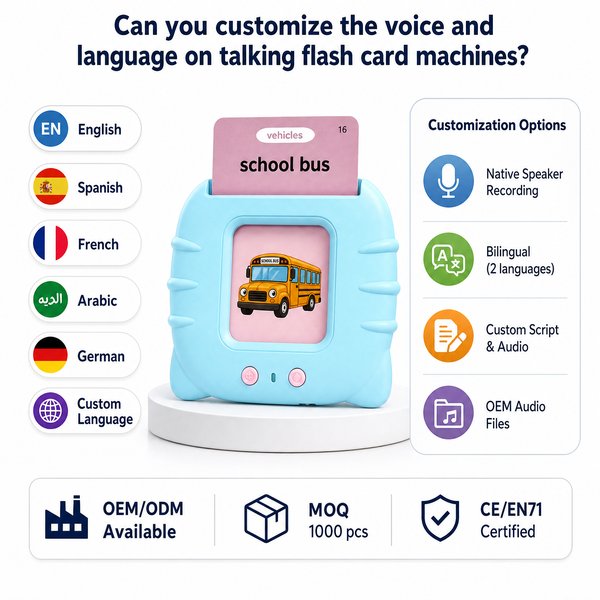
BLUF: Yes — talking flash card machines can be fully customized for voice and language. OEM/ODM factories (including factory-direct suppliers like Toyvao) will load custom recordings, support multiple languages, tune voice gender/age/style, and print bespoke card content and machine colors. Expect low-stock buys at small MOQ, but true OEM voice/language customization typically requires 1,000–3,000 pcs and additional lead time for voice recording and tooling.
Quick answer: what “customize voice and language” really means
- Custom voice: supplier records or uploads your supplied MP3/WAV files (male/female/child, regional accents).
- Custom language: add any language supported by your recordings — single-language, bilingual, or multi-language modes.
- Card content: print different vocabulary, phonics, numbers, or curriculum-aligned sets (e.g., 30 / 60 / 112 / 200 cards).
- Device changes: color, shape, logo, and packaging (window box, magnetic box, carrying case) are all doable under OEM/ODM.
When it’s worth caring about / When you don’t need to overthink it
Voice quality and accent
When it’s worth caring about: You are supplying devices for language-sensitive markets (ESL programs, bilingual schools, branded curriculum) and need a specific accent, pronunciation standard, or voice persona. Also critical for TTS-to-human-voice transition in early learners.
When you don’t need to overthink it: You need a low-cost vocabulary toy for general preschool use where neutral, clear speech is acceptable and off-the-shelf voices are fine.
MOQ and pricing
When it’s worth caring about: You want custom recorded voices, many printed card variations, or unique casing — these usually trigger custom tooling and higher setup costs. Expect custom OEM MOQ around 1,000–3,000 pcs depending on complexity.
When you don’t need to overthink it: You can buy standard stock models (factory stock or dropship) with low MOQ and existing languages/voices — good for test-market or small retail runs.
Durability and kindergarten sourcing
When it’s worth caring about: Purchasing for kindergartens or daycare centers where high daily usage requires reinforced cards, thicker plastic shells, louder/clearer audio (≥1W speaker preferred), and curriculum alignment.
When you don’t need to overthink it: Buying for gift items, seasonal retail, or limited-use classroom take-homes where heavy-duty industrial specs aren’t required.
Card Machine vs Reading Pen (short decision guide)
When it’s worth caring about: Choose a card machine if you need a cost-effective, rugged vocabulary builder (insert card → hear word). Choose a reading pen if you require interactive story reading, OID/RFID-enabled books, or sentence-level reading support.
When you don’t need to overthink it: For bulk kindergarten vocabulary practice, card machines are usually the simpler, cheaper, and lower-maintenance option.
Concrete specifications and factory capabilities (typical)
- Supported audio formats: MP3/WAV upload for custom voice files.
- Memory: typical devices use 8–32 MB flash (enough for several hundred short prompts); larger memory options available on request.
- Speaker: 0.5–2.0 W (ask for loud/clear option for classrooms).
- Power: 2×AA or rechargeable Li-ion options available.
- Card counts: standard sets available (30 / 60 / 112 / 200 cards) — custom counts supported.
- Certifications: CE, FCC, RoHS, EN71, ASTM (ask supplier for test reports).
- Packaging: window box, magnetic box, carrying case; gift-ready printing and inserts possible.
- MOQ: stock units — low MOQ; custom OEM typically 1,000–3,000 pcs depending on voice, printing, and tooling.
- Lead times: samples 7–14 days, production 25–45 days after sample approval (varies by order size & customizations).
Comparison: Card Machine vs Reading Pen
| Feature | Talking Flash Card Machine | Reading Pen |
|---|---|---|
| Primary use | Vocabulary and phonics via card insertion (insert card → play prerecorded word) | Interactive book reading and sentence-level playback (point-and-play) |
| Cost | Lower per unit; better for bulk classroom buying | Higher unit cost; needs OID-enabled books |
| Customization | Custom voice/language, card content, color/packaging (MOQ 1,000–3,000 for OEM) | Custom voice possible but higher MOQ/cost due to book encoding |
| Durability | Simple mechanics — generally robust for preschool use | More fragile electronics and pen tip — careful handling required |
| Best for | Kindergartens, bulk sourcing, vocabulary drills, gifts | Reading programs, story-based curriculum, higher price point retail |
Ordering checklist for customized voice/language
- Confirm target languages and dialects (e.g., US English, British English, Spanish-MX, Mandarin, Arabic).
- Decide voice persona (male/female/child, accent, speed).
- Prepare or request sample scripts (100–500 short prompts depending on card count).
- Submit audio files in MP3/WAV (factory can arrange professional voiceover at extra cost).
- Confirm card list/print artwork (CSV or Excel with front/back text mapping).
- Approve pre-production sample (7–14 days typical). Production lead time 25–45 days post-approval.
- Confirm certifications required (CE/FCC/EN71 etc.) and include testing time in schedule.
Customer feedback synthesis (B2B style)
- Positive: “Audio clarity was consistent across the classroom sets and volume was adequate — deliveries met our semester start date.” — Regional kindergarten chain buyer.
- Positive: “Toyvao handled custom Spanish/English bilingual audio and printed our curriculum lists exactly; MOQ was acceptable for our pilot.” — Educational product distributor.
- Positive: “Good price for 1,200-unit run and the magnetic gift box sold well in seasonal retail.” — Importer/retailer.
- Concern: “Lead time for bespoke voice recordings was longer than quoted; plan a buffer in your rollout schedule.” — School procurement officer.
- Concern: “Some cards showed edge wear after heavy use — ask for laminated or thicker stock for classroom sets.” — Preschool procurement manager.
- Concern: “Volume level was borderline in noisy rooms; order the louder speaker option for large classes.” — Education distributor.
FAQ
- Q: Can I supply my own voice recordings and have the factory load them?
- A: Yes. Most OEM/ODM factories accept MP3/WAV files and will load them into the device. Provide clearly labeled files and a script mapping to each card. Expect a sample fee and sample lead time (7–14 days).
- Q: Which languages and accents are available?
- A: Any language or accent can be supported as long as you can provide recordings or request factory-arranged voiceover. Common requests include English (US/UK), Spanish, Mandarin, Arabic, French, and bilingual sets.
- Q: What is the MOQ for custom voice and printed cards?
- A: Standard stock models have low MOQ for immediate purchase. Custom voice/language and printed card sets typically require a custom OEM MOQ of 1,000–3,000 units depending on the number of custom elements.
- Q: What certifications should I ask for?
- A: Request CE/EN71 for EU toy safety, FCC for US radio/emissions if applicable, RoHS for material compliance, and ASTM where required. Ask the supplier for up-to-date test reports before ordering.
How Toyvao can help
Toyvao offers factory-direct OEM/ODM services including custom voice/language recording, card content design, machine color/shape changes, and gift packaging options. They support small stock buys as well as custom runs (custom OEM MOQ typically 1,000–3,000 pcs) and can provide CE/FCC/RoHS/EN71/ASTM documentation on request.
Ready to get a quote or discuss custom voice/language options? Contact Toyvao (factory direct) via WhatsApp: +86 186 8106 4480, email: sales@toyvao.com, or visit https://toyvao.com for product specs and sample procedures.
