
For B2B buyers and educational toy distributors, international trade shows like the Canton Fair, Hong Kong Toys & Games Fair, and Nuremberg International Toy Fair remain the premier venues for sourcing new products. While digital sourcing platforms offer convenience, nothing replaces the tactile experience of testing a talking flash card machine and negotiating face-to-face with factory representatives. However, navigating a massive exhibition hall filled with hundreds of similar-looking booths can be overwhelming. This guide outlines how to effectively evaluate talking flash card manufacturers at international trade shows.
What Are the Key Indicators of a Direct Manufacturer vs. a Trading Company?
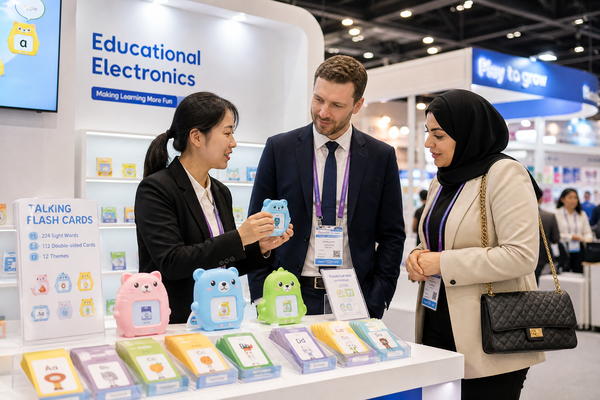
The most critical distinction a B2B buyer must make at a trade show is whether they are speaking to a direct factory (OEM/ODM manufacturer) or a trading company. While trading companies offer a wide variety of products, they add a markup and lack direct control over the production process, quality control, and customization timelines.
When visiting a booth displaying talking flash cards, look beyond the glossy marketing materials. Direct manufacturers usually exhibit a deep, narrow product line—focusing heavily on educational electronics, audio chips, and injection-molded plastics. If a booth displays talking flash cards alongside completely unrelated items like plush teddy bears or wooden blocks, it is almost certainly a trading company.
Ask technical questions about the product’s internal components. A factory engineer or direct sales representative should instantly know the battery capacity (e.g., 300mAh lithium-ion), the audio chip type, and the exact material of the flashcards (e.g., 300g coated paper). The Toy Association recommends asking to see the factory’s BSCI (Business Social Compliance Initiative) or ISO 9001 certificates on-site; direct manufacturers will have these readily available under their own company name [1].
How to Test Talking Flash Card Samples On-Site?
A trade show booth is the perfect environment to conduct preliminary quality control. When handed a sample talking flash card machine, B2B buyers should perform a series of rapid tests:
- Audio Clarity and Volume: The primary function of the device is auditory learning. Test the device in the noisy environment of the trade show floor. Is the pronunciation clear and accurate? Does the speaker crackle at maximum volume? The American Academy of Pediatrics (AAP) notes that poor audio fidelity in educational toys can hinder phonetic development rather than aid it [2].
- Card Recognition Speed: Insert a flashcard into the slot. The optical recognition sensor should read the barcode and play the audio almost instantaneously (under 0.5 seconds). Sluggish recognition indicates cheap, outdated sensor technology.
- Build Quality: Inspect the seams of the plastic casing. Are they smooth or sharp? Does the device feel substantial or hollow and fragile? Drop the device a few inches onto the table—a quality ABS plastic casing will withstand minor impacts without the battery cover popping off.
Trade Show Evaluation Checklist
| Evaluation Area | What to Look For | Red Flags |
|---|---|---|
| Company Type | Deep focus on electronic educational toys | Wide, unrelated product catalog (indicates trading company) |
| Technical Knowledge | Instant answers on battery specs, audio chips, and mold costs | Vague answers; “I need to ask the factory” |
| Sample Quality | Fast card recognition, clear audio, robust ABS plastic | Slow recognition, muffled audio, sharp plastic edges |
| Compliance Docs | Readily available ASTM, EN71, and BSCI certificates | Unwillingness to share certificates or mismatched company names |
Why Is Discussing OEM/ODM Capabilities Crucial at the Booth?
If you plan to build your own brand, the factory’s OEM (Original Equipment Manufacturer) and ODM (Original Design Manufacturer) capabilities are more important than the specific sample on display.
Use the trade show meeting to discuss customization. Ask the representative about the cost and lead time for programming a custom audio chip with your own voice recordings. Inquire about the Minimum Order Quantity (MOQ) for custom packaging and private-label printing on the flashcards. A highly capable factory will have clear, structured pricing tiers for these modifications. Grand View Research highlights that the ability to rapidly customize educational hardware is the primary driver of growth for successful B2B toy brands [3].
How Toyvao Stands Out at International Exhibitions
At Toyvao, we view international trade shows as an opportunity to demonstrate our manufacturing excellence and build long-term B2B partnerships. When you visit a Toyvao booth, you are speaking directly with the manufacturer.
We bring our latest talking flash card innovations, including our newest optical recognition sensors and premium audio chips. Our technical sales team is fully equipped to discuss complex OEM/ODM requirements, mold modifications, and custom audio programming on the spot. We proudly display our comprehensive safety certifications (ASTM, EN71, CE) and our factory’s BSCI audit reports. Partner with Toyvao to turn your trade show sourcing trip into a successful, long-term manufacturing relationship.
References
[1] The Toy Association. “Sourcing and Manufacturing Guide for Toy Professionals.”
[2] American Academy of Pediatrics (AAP). “Selecting Appropriate Toys for Young Children in the Digital Era.”
[3] Grand View Research. “Educational Toys Market Size, Share & Trends Analysis Report.”
Planning your next sourcing trip? Schedule a meeting with Toyvao to discuss your talking flash card manufacturing needs!
Email: sales@toyvao.com | WhatsApp: https://wa.me/8618681064480
Related Articles
Useful Resources
