
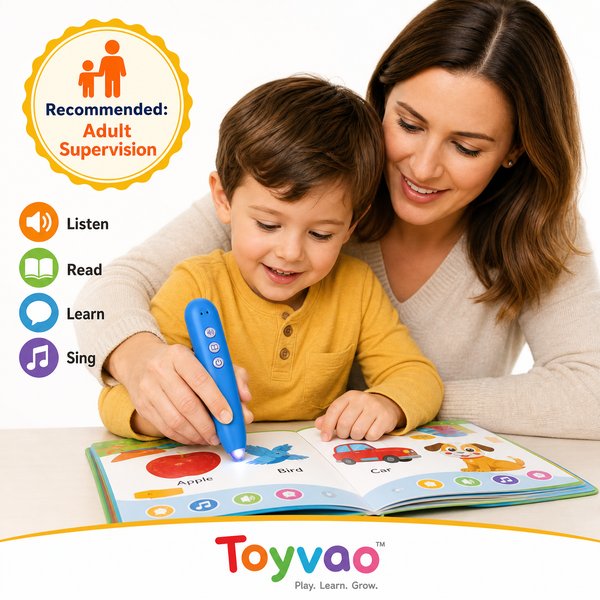
As an assistive learning tool, a reading pen is designed to enhance children’s reading independence and confidence, particularly for those with reading difficulties. While initial instruction and appropriate supervision can help children learn to use the device effectively in some cases, the core value of a reading pen lies in empowering children to learn autonomously, thereby reducing the need for continuous adult oversight.
Promoting Independent Learning and Building Confidence
One of the primary advantages of reading pens is their ability to significantly strengthen a child’s capacity for independent learning. Children with reading challenges often rely on adults to read or explain unfamiliar words, which can lead to frustration and diminished self-confidence. Reading pens provide instant text-to-speech (TTS) functions and built-in dictionaries that enable children to resolve reading difficulties on their own. When children can independently comprehend text, their sense of self-efficacy increases, boosting motivation and confidence in learning.
For example, products such as the C-Pen Reader 2 are designed as excellent learning tools for “children (6 years and up) and adults,” indicating that their design takes children’s independent use into account. The literature suggests that allowing children to use reading pens at home for study or homework enables them to solve problems largely on their own without constantly seeking help. This not only reduces parents’ burden but, more importantly, strengthens children’s confidence and resilience.
How Do Reading Pen Features Reduce the Need for Supervision?
Modern reading pens integrate multiple features that work together to enable more independent use by children:
- Text-to-speech (TTS): This core feature reads scanned text aloud, allowing children to understand words and sentences without adult assistance and focus on meaning rather than decoding.
- Built-in dictionary: When children encounter unfamiliar words, the pen’s dictionary provides definitions, and some models even read definitions aloud, further reducing the need for adult explanation.
- Multilingual translation: Some reading pens offer translation functions, which provide extra independent support for children learning a foreign language or working with multilingual texts.
- Exam mode: Certain reading pens include a restricted “exam mode” that limits functionality to reading text only, demonstrating that they can be used in controlled, unsupervised environments such as during tests.
Age and Initial Guidance Considerations
Although reading pens are intended to promote independence, a child’s age and maturity remain important factors in determining whether adult supervision is necessary. For younger children, especially when they first begin using the device, appropriate adult guidance is recommended to ensure they understand how to operate it correctly and make the most of its features. This guidance may include:
- Proper holding and scanning: Teaching children how to scan text smoothly to ensure accurate recognition.
- Feature orientation: Explaining how to use TTS, the dictionary, and other functions.
- Encouraging independent exploration: After initial instruction, encouraging children to explore the pen’s functions on their own to gradually build their independent use skills.
As children become more familiar with the reading pen and their reading skills improve, the need for adult supervision will diminish. Ultimately, the reading pen becomes a powerful tool in a child’s hands, enabling confident exploration of reading without continuous adult intervention.
Conclusion
In summary, reading pens are designed to grant children independence in reading and to boost their confidence. While moderate adult guidance is beneficial during initial use and for younger children, the features of reading pens are intended to minimize the need for ongoing supervision. By offering immediate support and fostering autonomous learning, reading pens help children become more independent readers and achieve greater success and satisfaction in their learning journey.
