
For international toy distributors, importers, and e-commerce brands, customs clearance and regulatory compliance are the ultimate gatekeepers of profitability. Electronic educational toys, such as talking flashcard readers, fall under a complex intersection of regulatory frameworks. They are classified simultaneously as children’s products (subject to strict chemical and mechanical safety standards) and electronic devices (subject to electromagnetic compatibility and battery safety regulations).
Failing to meet even a single compliance standard can result in devastating consequences: customs seizures at the port of entry, heavy financial penalties, Amazon listing suspensions, or complete product recalls. According to European Customs Union data [1], non-compliant toys account for over 30% of all product border rejections annually.
To protect your investment and ensure a seamless import process, you must partner with a manufacturer like Toyvao that operates an in-house compliance division and maintains full international certifications. Here is your essential guide to customs and compliance for North America and Europe.
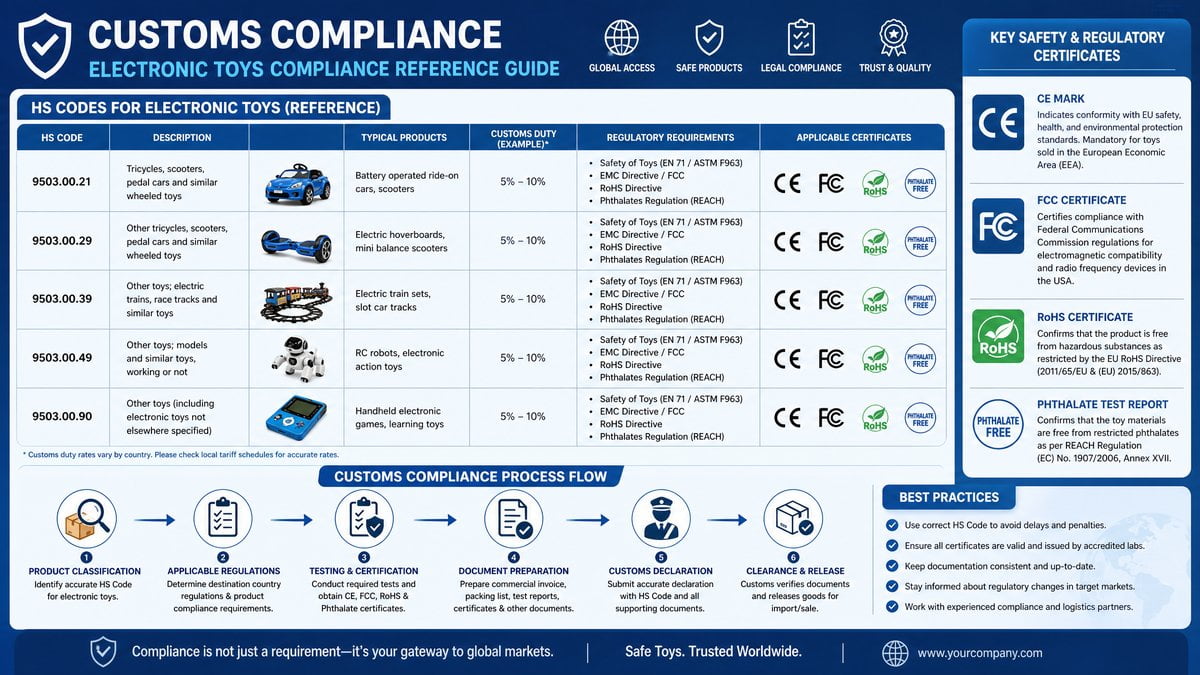
Harmonized System (HS) Codes for Electronic Toys
The first step in any import transaction is identifying the correct Harmonized System (HS) Code. The HS code determines the exact customs duty rate applied to your shipment and dictates which regulatory agencies will inspect the cargo.
Electronic educational toys with optical recognition (like talking flashcard readers) are classified under Chapter 95 of the Harmonized Tariff Schedule.
The standard international HS code for electronic educational toys is: 9503.00.90 (or regional variants like 9503.00.90.90).
– Chapter 95: Toys, games, and sports requisites; parts and accessories thereof.
– Heading 9503: Tricycles, scooters, pedal cars and similar wheeled toys; dolls’ carriages; dolls; other toys; reduced-size (“scale”) models and similar recreational models, working or not; puzzles of all kinds.
– Subheading 9503.00.90: Other toys (including electronic educational toys).
Regulatory Compliance Matrix: US vs. European Union
The table below outlines the mandatory safety certifications and chemical restrictions required to legally sell electronic learning toys in the United States and the European Union:
| Regulatory Jurisdiction | Mandatory Certification / Test | Governing Standard & Law | Critical Engineering Requirement |
|---|---|---|---|
| United States | CPC (Children’s Product Certificate) | CPSIA (Consumer Product Safety Improvement Act) | Requires testing by a CPSC-accepted third-party laboratory. |
| United States | ASTM F963-17 | US Toy Safety Standard | Mandates strict mechanical abuse, drop, and small parts testing. |
| United States | FCC Certification | FCC Part 15 Class B | Regulates electromagnetic emissions to prevent radio interference. |
| United States | Phthalate & Lead Limits | CPSIA Section 101 & 108 | Lead in substrate must be <100ppm; Phthalates must be <0.1% (1000ppm). |
| European Union | CE Mark & DoC | Toy Safety Directive 2009/48/EC | Declaration of Conformity (DoC) must be signed by the manufacturer. |
| European Union | EN71 (Parts 1, 2, 3) | European Toy Safety Standard | Part 1: Mechanical/Physical; Part 2: Flammability; Part 3: Heavy Metal Migration. |
| European Union | EN62115 & EMC | Electrical Toy Safety | Regulates voltage, heating, and electromagnetic compatibility. |
| European Union | RoHS & REACH | Chemical Safety Directives | Restricts hazardous substances (Lead, Mercury, Cadmium) in electronics. |
| European Union | WEEE Directive | Waste Electrical & Electronic Equipment | Requires the crossed-out wheelie bin symbol on packaging and product. |
Essential Customs Clearance Documentation
When your shipment of talking flashcard readers arrives at the port of entry, your customs broker must submit a complete import entry packet to US Customs and Border Protection (CBP) or European national customs authorities. This packet must include:
- Commercial Invoice & Packing List: Detailing precise unit counts, values, weights, and HS codes.
- Bill of Lading (B/L): Issued by the ocean or air freight carrier.
- Test Reports from Accredited Labs: Full test reports from globally recognized, accredited testing agencies (such as SGS, Intertek, or TÜV Rheinland) proving compliance with EN71, ASTM F963, FCC, and RoHS.
- Children’s Product Certificate (CPC) / EU Declaration of Conformity (DoC): These are legal documents signed by the importer (or manufacturer) certifying that the product complies with all applicable safety standards.
How Toyvao Guarantees Flawless Compliance
At Toyvao, we eliminate compliance anxiety for our B2B partners. We have integrated international safety standards into every stage of our manufacturing process:
1. Pre-Certified Materials
We only source raw materials (ABS plastics, paperboards, silicones, and inks) that have already passed preliminary chemical screenings for heavy metals and phthalates. This guarantees that the final finished product will pass laboratory testing with 100% certainty.
2. Partnership with Top-Tier Testing Labs
We maintain long-term partnerships with SGS and Intertek. When you place a custom OEM/ODM order, we manage the entire laboratory testing process on your behalf, delivering official, internationally recognized certificates registered under your brand name.
3. Compliant Packaging Design
Our graphic design team ensures that all mandatory regulatory markings (CE mark, FCC logo, WEEE symbol, age warning icons, batch/lot tracking numbers, and country of origin “Made in China” labels) are correctly sized and placed on your product and retail packaging.
Conclusion: Import with Confidence, Sell with Security
Navigating the complex world of customs and compliance may seem daunting, but it is a powerful barrier to entry that protects professional brands from low-quality, fly-by-night competitors. By partnering with Toyvao, you secure a manufacturer that treats compliance as a core engineering discipline, ensuring your shipments pass customs smoothly and your brand remains completely protected in the global marketplace.
Request Our Compliance Portfolio
Contact our import compliance specialists to receive copies of our current CE, FCC, CPC, and RoHS certificates.
- Email: sales@toyvao.com
- Engineering Support: engineering@toyvao.com
- WhatsApp/Business Line: +86 186 8106 4480
- Factory Address: Toyvao Manufacturing Park, Bao’an District, Shenzhen, Guangdong Province, China.
References
- [1] European Commission. (2025). Safety Gate: The EU Rapid Alert System for Dangerous Non-Food Products Annual Report. https://ec.europa.eu
- [2] U.S. Customs and Border Protection (CBP). (2024). Importing Children’s Toys and Electronic Products: Compliance and Duty Guidelines. https://www.cbp.gov
