
Executive Summary
This guide explains practical, scalable, and secure options for loading audio content and applying digital rights management (DRM) to OID Reading Pens (picture book reading pens, story pens, talking book pens). It is written for purchasing managers, product managers, and program leads who must choose between bulk pre-loading at manufacture, field updates via local transfer (USB/microSD), and cloud-based content delivery with secure audio streaming or offline licensing.
Key takeaways:
– Three deployment patterns dominate: factory bulk preload, local device-side update (USB/microSD), and cloud-managed delivery (OTA via Wi‑Fi/BLE gateway or mobile app). Each has different unit cost, update latency, and operational complexity.
– Security levels range from minimal (plain MP3 files on unencrypted flash) to high (per-device AES-256 encrypted audio with signed license tokens and server-side key management using an HSM). Choose security according to content value and geographic/regulatory risk.
– Practical DRM for offline embedded devices combines symmetric encryption (AES-128/256) with per-device keys, signed license files, integrity-checked firmware, and secure key injection at manufacturing or provisioning.
– Cloud Content Management Systems (CMS) are recommended for catalogs that require frequent updates, multi-language support, analytics, and remote license control. Expect recurring SaaS fees (typical range: $500–$5,000/month for mid-market solutions), plus per-device and bandwidth costs.
– For large runs, factory preload with secure key injection offers the lowest per-unit content delivery cost; for ongoing updates and localization, a cloud-based CMS with OTA/paired mobile app is more efficient.
This document explains technical options, features to evaluate, cost drivers, compliance and safety considerations, and a decision checklist to match content-loading and DRM choices to business requirements.
What Is Picture Book Reading Pen and Who Uses It
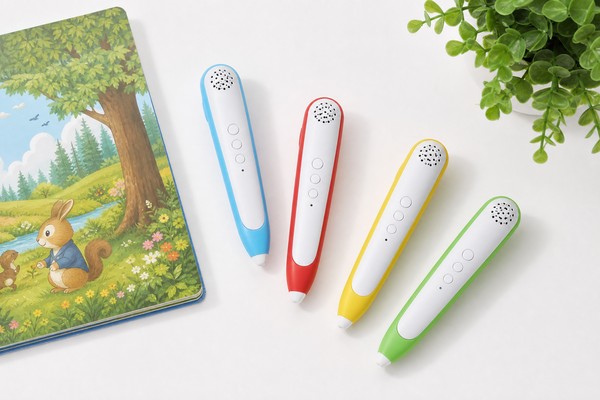
The OID Reading Pen is a handheld educational consumer device that detects printed optical identifiers (OID codes, ink patterns, barcodes, NFC tags) on picture books and plays associated audio (narration, sound effects, language instructions). Primary product components:
– OID optical reader and microcontroller (ARM Cortex-M or Cortex-A)
– Onboard audio DAC and speaker or headphone output
– Local storage (NAND, eMMC, or microSD)
– Connectivity options: Wi‑Fi (802.11b/g/n), BLE 4.2/5, micro-USB or USB-C, NFC (optional)
– Power: Li-ion or NiMH battery, typical capacity 500–2000 mAh
Primary users and buyers:
– Educational publishers bundling audio with printed books
– Toy manufacturers integrating smart audio features
– International distributors requiring localization
– Large institutions (schools, libraries) deploying managed sets
– Smaller publishers seeking turnkey audio distribution without print reprints
Purchasing decisions center on content operations (how to load, update, and protect audio files), device hardware capabilities (connectivity and storage), and regulatory requirements for children’s products.
Why Demand Is Growing
Several market forces are driving increased attention to content-loading and DRM for OID Reading Pens:
– Content breadth and multilingual editions: Publishers produce multiple audio tracks per book (narration in 5–10 languages, voice variants, interactive sound cues). This increases storage and management requirements — a 20-page book with 10-language narration at 64 kbps MP3 is ~9.6 MB; multiply by dozens of titles and devices quickly requires a CMS.
– Rapid update cycles: Iterative content improvements, corrected narrations, and rights-driven content retirements require remote update capability rather than re-manufacturing.
– Monetization models: Subscription and per-title purchases demand license-based access control rather than completely open audio files.
– Piracy and licensing compliance: High-value IP (popular franchises) demands stronger DRM than simple obfuscation.
– Enterprise deployments and analytics: Schools and distributors want usage metrics (listening time by page, attrition), requiring cloud integration.
From a procurement perspective, demand pushes buyers to evaluate secure update pathways, cloud management, and DRM that balance user experience, cost, and legal requirements.
Key Technology Differences
This section clarifies technical components that affect content loading and DRM choices.
Storage types and capacities:
– Embedded NAND/eMMC: 128 MB to 16 GB. eMMC preferred for reliability and write-cycle control in production. Typical mass-market pens use 128–512 MB; premium models use 1–4 GB.
– microSD: Low cost, removable, good for field updates. Security risk: removable media is easily duplicated.
– File systems: Lightweight FAT32 for microSD; partitioned flash with ext4 or custom file systems for embedded storage. Consider wear leveling and power-loss resilience.
Audio formats and quality:
– MP3 (CBR/VBR): Widely supported, low CPU decode cost; 32–128 kbps often adequate for narration. 64 kbps mono MP3 at 16 kHz sample rate is common for speech; results in ~7.5 KB/s.
– AAC-LC: Higher quality at lower bitrates; decoding requires license on some platforms.
– WAV (PCM): Uncompressed, high-quality but large (16-bit/16 kHz PCM = 32 KB/s).
– Opus: Efficient, modern codec for speech/music, but embedded decoder support varies.
Connectivity and update paths:
– Wired bulk loading via USB-C/USB 2.0: Fast and straightforward at factory or field kiosks; throughput up to 480 Mbps but practical rates 20–80 MB/s due to CPU/storage.
– microSD cloning: Quick at scale with duplicators; risk of physical theft/duplication.
– Wi‑Fi OTA: Requires module cost ($2–$6 BOM), more complex firmware and certificate management; supports large-scale remote updates.
– BLE + smartphone app: Low-power and low-bandwidth (typically <250 kbps); good for control/patching metadata and small files, not ideal for large audio sets unless incremental download from phone to pen.
Security primitives:
– Symmetric encryption: AES-128 or AES-256 in CBC/GCM modes for audio file encryption. GCM preferred for authenticated encryption.
– Key storage: Per-device keys stored in secure element (SE) or eMMC/SoC secure boot region. Without SE, keys are vulnerable.
– Authentication: TLS 1.2/1.3 for cloud communication; OAuth2/JWT for token-based APIs.
– DRM servers: License server issues short-lived keys or signed licenses bound to device IDs.
DRM approaches:
– Obfuscation: Filename and folder mangling — low cost, low security.
– Encrypted container with per-device key: Good tradeoff: AES-256 for file-level encryption + license file to unlock.
– Streaming license with online check: High security but needs persistent connectivity and latency management.
– Watermarking and forensic tracking: Post-distribution for piracy control.
Manufacturing provisioning:
– Preload audio and inject device-specific keys per unit at factory. Requires secure key injection process, HSM-backed key generation, and traceability.
Operational tooling:
– CMS with REST APIs, role-based access control (RBAC), bulk upload tools (CSV/XML mapping), and SDKs for device-side integration.
Key Features and Specifications to Evaluate
When comparing vendors and solutions, evaluate these technical and operational attributes. Specify minimum acceptable values based on your program size and risk profile.
Content ingestion and mapping
– Bulk upload support: CSV/JSON import, mapping columns for OID code <-> audio ID, batch metadata for language, title, rights expiry.
– Supported audio formats: MP3, WAV, AAC, Opus. Ensure CMS encodes/transcodes server-side or accepts your master assets.
– Max batch size: Support for >100 GB uploads; multipart/resumable upload (S3 multipart or chunked HTTP).
– Metadata: Schema for title, narrator, duration, language tag (ISO 639-1/2), rights info, expiry, and attribution.
Delivery and update options
– Factory preload: Capability to accept disk images or to remote load over secure FTP/SFTP. Turnaround time SLA (e.g., 2–5 business days).
– Local bulk update: Device-side tools and desktop app for mass USB loading, supporting 100–1000 units per hour depending on file sizes and duplication hardware.
– OTA updates: Support for Wi‑Fi firmware and content delivery with delta updates (patch size reduction of >=70% for small changes).
– Mobile sync: BLE pairing for authentication and content push via smartphone; support for Android and iOS companion apps.
Security and DRM
– Encryption: AES-128/256 with authenticated modes (GCM preferred). Vendor should support per-file encryption and container-level encryption.
– Key management: HSM-backed key storage recommended for key generation and signing. Per-device keys or per-batch keys depending on risk.
– License model: Time-limited license, per-title license, or subscription token. Support for revocation and remote disable.
– Secure storage: Support for secure element (ATECC family) or secure hardware-backed key store on SoC. Minimum: keys stored in protected area, not plaintext in firmware.
Device-side SDK and integration
– SDKs: C/C++ SDK for MCU-based devices, and Android/iOS SDK for companion apps. Provide sample code for decrypting and playing audio, license checks, and integrity verification.
– Resource footprint: RAM <= 256 KB for small MCU implementations; higher for Linux-based systems. Library CPU requirements stated (Cortex-M4 with FPU or Cortex-A profiles).
– Real-time audio playback latency: <50 ms start latency after tap.
Analytics and reporting
– Usage telemetry: Play count per OID code, session duration, language selected, device health metrics (battery cycles), and errors. Minimum retention: 12 months; export via API.
– Multi-tenant and RBAC: Roles for content manager, publisher, and distributor. Audit logs with immutable entries.
Compliance and certification
– Privacy: GDPR and COPPA compliance statements. Data minimization and option to anonymize PII.
– Security audits: Pen test report or SOC 2 Type II for cloud vendor. Firmware and device source-code review services.
– Standards: TLS 1.2/1.3, AES-256, signed firmware (RSA-2048 or ECDSA P-256).
Scalability and SLAs
– API rate limits: Baseline and burst allowances. Typical: 1000 requests/min for mid-market, scalable to 100k+/min enterprise.
– Uptime SLA: 99.9% for production cloud CMS; higher tiers may offer 99.95–99.99%.
– Support: 24×5 or 24×7 enterprise support options, escalation paths.
Pros and Cons
Compare the three main approaches: factory preload, local bulk load, and cloud-managed DRM/OTA.
Factory Preload (preprogrammed audio and keys at manufacturing)
Pros:
– Lowest per-unit delivery cost at scale. Example: preloading 256 MB into 100,000 units via assembly line may add <$0.20 per unit for programming labor and $0.05–$0.20 per GB in flashing services.
– No dependence on field connectivity; predictable user experience out-of-box.
– Secure key injection at factory can embed per-device keys into SE, allowing strong DRM for offline use.
Cons:
– Inflexible for updates: correcting audio or adding titles requires field update or return to factory.
– Inventory risk: content changes post-manufacture lead to obsolescence.
– Logistics overhead for batch tracking and ensuring correct image per SKU.
Local Bulk Update (USB/microSD loading via duplication stations or kiosk)
Pros:
– Faster field updating than returning to factory; suitable for mid-volume runs.
– Relatively low technical complexity and modest integration effort.
– Can support offline deployments without internet connectivity.
Cons:
– Physical media is a piracy vector; removable microSD is easy to duplicate.
– Operational labor cost: cloning 1 GB per unit over USB 2.0 at 20 MB/s is ~50 seconds per unit; overhead increases for verification and labeling.
– Hard to provide per-device DRM without secure key injection; often results in weak protection.
Cloud-Managed Delivery and DRM (CMS + license server + OTA)
Pros:
– Best for frequent updates, localization, and analytics. Enables subscription and per-title monetization models.
– Centralized revocation and licensing control; can remotely disable or update content.
– Supports per-device or per-user licenses, usage tracking, and fine-grained access control.
Cons:
– Higher recurring costs: cloud storage, bandwidth, license server operations, and SaaS fees. Bandwidth cost example: 1 TB/month egress ~ $90–$150 depending on provider and region.
– Requires device connectivity (Wi‑Fi or paired smartphone); offline UX must be designed.
– Increased complexity: key management, certificate provisioning, and maintenance.
Security tradeoffs
– Basic obfuscation reduces accidental leaks but offers minimal protection.
– AES-256 with per-device keys and HSM-backed key management significantly reduces piracy risk but increases integration complexity and cost (HSMs, certificate lifecycle management).
– DRM that requires periodic online license refresh increases protection but can disrupt user experience in low-connectivity regions.
Step-by-Step Decision Guide
This checklist-style guide helps match business requirements to a content-loading and DRM strategy.
- Define core constraints
- Volume: small (<5k devices), medium (5k–100k), large (>100k).
- Update frequency: static (rarely changes), periodic (quarterly), frequent (monthly/weekly).
- Connectivity profile: offline-first, smartphone-paired, always-online.
-
Content value: low (educational public domain), medium, high (licensed IP).
-
Map to recommended approach
- Small volume / static content / offline-first / low-value content:
- Approach: Factory preload or local USB load with minimal obfuscation.
- Specs: 128–512 MB storage, MP3 64 kbps, microSD optional.
- Medium volume / periodic updates / smartphone availability / medium-value content:
- Approach: Mobile app pairing (BLE) + CMS; minimal DRM with per-device signed license files and AES-128 container encryption.
- Specs: eMMC 512 MB–1 GB, BLE 4.2, companion app, CMS subscription.
- Large volume / frequent updates / always-online / high-value content:
- Approach: Cloud-managed DRM with per-device AES-256 keys, HSM-backed KMS, OTA via Wi‑Fi and signed firmware.
-
Specs: eMMC 1–4 GB, Wi‑Fi module (802.11n), SE for key storage, SOC supporting TLS 1.3.
-
Security checklist
- Determine acceptable level of leak risk and required cryptographic strength.
- If per-device DRM required:
- Use per-device keys injected at manufacturing or via secure provisioning flow.
- Use AES-GCM and signed license tokens (JWT with RSA/ECDSA).
- Implement key rotation and revocation capability.
-
Confirm vendor supports HSM-backed key storage and SOC 2/SOC 3 or equivalent.
-
Operational checklist
- Confirm CMS supports bulk mapping import (CSV) and content preview.
- Verify delta updates for OTA (reduce average patch size by >=60%).
- Verify device telemetry and analytics integration (event hooks, batch exports).
-
Evaluate service-level SLA and escalation process.
-
Cost and timeline estimation
- For each scenario, estimate:
- Per-device BOM for connectivity and secure element.
- Factory preload charge per unit ($0.05–$0.50 typical for programming depending on file size and volumes).
- SaaS CMS recurring fees, per-device license fees, and bandwidth forecasts.
-
Plan a pilot (1–2k units) to validate workflow and DRM before full deployment.
-
Procurement steps
- Issue technical requirements and an RFP to shortlisted vendors with defined evaluation criteria: DRM security evidence, CMS features, API documentation, pricing, and support SLOs.
- Require vendor-provided PoC demonstrating encrypted content delivery, license issuance, and device-side decryption on a sample device.
Pricing and Cost Analysis
Costs vary by approach and scale. Below are typical cost components with example ranges and calculations.
Hardware BOM impact (per-unit)
– Wi‑Fi module: $2.50–$6.00
– BLE module: $1.00–$3.00
– Secure Element (ATECC or similar): $0.50–$2.50
– eMMC 512 MB: $1.00–$1.80; 2 GB: $2.00–$4.00
– Additional BOM for DRM (secure crypto chip): $0.75–$3.00
Factory preload costs
– Flashing labor or programming service: $0.05–$0.50 per unit depending on volume and file size.
– Image creation & QA: One-time $1,000–$5,000 for tooling and test scripts.
– Example: 50,000 units, 256 MB files: flash cost ~$0.15/unit -> $7,500.
Local bulk update costs
– Duplication hardware: USB duplicators $500–$3,000; microSD duplicators $1,000–$10,000.
– Labor: $0.10–$1.00 per unit depending on manual handling and QA.
– Logistics for distribution and return: varies.
Cloud CMS and DRM costs
– CMS SaaS subscription: $500–$5,000/month for mid-market; enterprise tiers $5k–$25k/month depending on users and compliance features.
– Storage: S3-like storage ~$0.023/GB/month; storing 10,000 titles at 10 MB each = 100 GB -> $2.30/month.
– Bandwidth/eSgress: $0.09–$0.15/GB (varies by region and provider). Serving 100k downloads of 10 MB = 1,000 GB -> $90–$150.
– License server operations: if self-hosted, include VM costs ($50–$500/month) and engineering/time to maintain; if vendor-managed, often included in per-device or per-license fees ($0.02–$0.50 per license transaction).
– HSM: Cloud HSMs (AWS CloudHSM) cost ~$1,300–$3,500/month for production clusters; SaaS KMS with HSM-backed keys often available at higher per-operation cost.
Content production costs (non-hardware)
– Voice narration recording: $100–$400 per finished hour for professional narration studios; popular IP or celebrity voices much higher.
– Localization: Translation and re-recording per language. Expect $500–$2,000 per title per language for professional production (depends on length).
– TTS (cloud): $4–$20 per 1M characters or $0.01–$0.10 per minute depending on quality and vendor. Useful for prototypes.
Operational cost example (annual) for 50,000 devices, moderate usage:
– CMS subscription: $2,000/month -> $24,000/year
– Storage: 500 GB -> $11.50/month -> $138/year
– Bandwidth: 10 TB/year -> $1,000–$1,500/year
– License server SaaS: $0.05/license x 100k licenses/year -> $5,000/year
– HSM/KMS (shared): $1,500/month -> $18,000/year
Total annual: ~$48k–$49k plus initial integration.
Per-device effective annual cost (50k units): ~$1.00 per device/year (operational) excluding hardware amortization and content production.
Negotiation levers:
– Prepay storage/bandwidth for discounted rates.
– Bulk license bundles with DRM vendors.
– Leverage multi-year contracts for lower per-license pricing.
Competitive Landscape
The market splits into three supplier categories:
– Embedded hardware manufacturers (device OEMs): Provide pen hardware, secure element options, and factory preload services. They typically offer basic firmware tooling and may deliver custom bootloader/SDK integration for encryption.
– Content Management and DRM platforms: SaaS providers offering CMS, license servers, analytics, and SDKs. These vendors range from niche e-learning platforms to large cloud providers offering managed KMS and HSM services.
– Systems integrators and value-added resellers: Provide end-to-end integration, localization services, and operate licencing servers and key injection during manufacturing.
Key differentiation factors:
– Depth of device SDK and language support: Vendors with proven C SDKs for MCU-based devices reduce engineering time.
– Security capabilities: HSM-backed KMS, secure element support, code signing, and audit certifications (SOC 2).
– Scale and SLAs: Enterprise-grade SLAs, multi-region CDN support, and high API throughput for large deployments.
Selection practicalities:
– If you require per-device DRM, prioritize integrators who can manage key injection at the factory and operate HSM-backed KMS.
– For lighter-weight needs, CMS-only vendors with mobile SDKs and basic container encryption may suffice.
– Consider geographic coverage for cloud-CDN and compliance (GDPR jurisdictions, China hosting requirements).
What Buyers Say
Common buyer feedback distilled from procurement interviews and field pilots:
Positive points buyers emphasize:
– Cloud CMS greatly simplifies localization and updates; content managers appreciate drag-and-drop bulk uploads and CSV mapping.
– Per-device DRM with license revocation provides necessary legal cover for high-value IP owners.
– Preload at factory reduces field logistics and initial customer friction — out-of-the-box working set is crucial for retail returns.
Common pain points and requests:
– Complexity of provisioning per-device keys across multiple contract manufacturers. Buyers want standard operating procedures and audit trails.
– High HSM and license-server costs for pilots and low-volume projects. Buyers often request lower-cost pilot modes or escrowed key models.
– Fragmented device SDKs and inconsistent decoding performance on low-end MCUs cause integration delays.
– Need for offline-first UX and graceful degradation when connectivity is unavailable.
Feature requests frequently heard:
– Delta-OTA that minimizes downloaded data for incremental changes.
– Companion app with store purchase flow and background download to pen via BLE local transfer.
– Standardized analytics export (S3/csv/webhooks) for integration with LMS and ERP.
Safety, Maintenance and Compliance
Safety and regulatory compliance are especially important for children’s products and connected devices.
Electrical and mechanical safety
– Battery safety: Comply with IEC 62133 for Li-ion/IMR cells. Document overcharge, short-circuit, and drop test results.
– Toy safety: EN 71 series (EU) standards, ASTM F963 (US). Ensure materials and small-part tests are passed for intended age group.
– Electromagnetic compatibility: FCC Part 15 (US), CE EMC (EU). Test for conducted and radiated emissions.
Privacy and data protection
– GDPR: Minimize PII; obtain parental consent where required; provide data subject rights. Use data retention policies.
– COPPA (US): If collecting data from children under 13, comply with parental consent and data minimization.
– Secure telemetry: Encrypt telemetry in transit (TLS 1.2/1.3) and at rest. Mask or avoid storing unique identifiers unless necessary.
Software and firmware safety
– Signed firmware: Use code signing (RSA-2048 or ECDSA P-256) with bootloader verification to prevent unauthorized firmware.
– Secure boot and rollback protection to prevent older vulnerable firmware reinstallation.
– OTA integrity: Verify package signatures and use atomic updates to prevent bricking.
DRM and cryptography compliance
– Use approved cryptographic standards: AES-128/256, RSA-2048/3072, ECDSA P-256 for signatures. Avoid proprietary “homegrown” ciphers.
– KMS/HSM practice: Follow NIST key management guidelines. For high-value IP, use HSM-backed key storage and audited key handling procedures.
Maintenance and lifecycle
– Key rotation and revocation policy: Define procedures and frequency (e.g., rotate server keys annually; support immediate revocation of compromised keys).
– End-of-life: Plan content expiry, license migration, and secure data wiping. Provide a policy for when a device will no longer be supported (firmware updates, licenses).
– Field updates and recovery: Provide a USB recovery mode and documentation for RMA and repair workflows.
Regulatory documentation and evidence
– Request SOC 2, ISO 27001, or penetration test reports from your cloud/DRM vendor.
– Keep records of secure element part numbers, manufacturing injection logs, and chain-of-custody for key materials.
Frequently Asked Questions
What is the minimum encryption I should use?
– Use AES-128-CBC at a minimum; AES-256-GCM is recommended for authenticated encryption. Avoid just obfuscation or simple XOR.
Do I need an HSM?
– For high-value licensed IP and if you’re performing per-device encryption key generation and signing, yes. HSM reduces operational risk and helps meet enterprise security requirements. For low-value content, managed KMS or cloud KMS can suffice.
How do I prevent my audio from being copied from the device?
– Combine device binding (hardware ID) with encrypted audio files and signed license files. Store keys in a secure element or protected memory and avoid plaintext keys in firmware. No solution is absolute; tradeoffs depend on the attack model.
Can I offer pay-per-title or subscription models with offline pens?
– Yes. Implement license tokens that can be downloaded and stored on the pen: token grants the decryption key or unlocks local content. For subscription, require periodic license refresh to maintain access.
What’s the recommended storage size per title?
– Typical spoken-word narration at 64 kbps mono MP3 is ~0.48 MB/min. A 15-minute title = ~7.2 MB. Plan storage for multiple titles and audio variants. For 100 titles averaging 10 MB each, reserve at least 1 GB with overhead.
How long does a typical OTA update take?
– Depends on connectivity and delta size. Full 100 MB download on 802.11n at practical rates 5–10 MB/s takes 10–20 seconds. Real-world scenario includes retries and verification; plan for 1–3 minutes per large update. Delta updates shrink this significantly.
What are common integration pitfalls?
– Inconsistent OID mapping between printed assets and CMS metadata.
– Lack of content versioning and rollback plan.
– Ignoring firmware signing; leading to insecure update flows.
– Underestimating localization re-recording costs and timelines.
How to test DRM implementation?
– Perform white-box and black-box testing: verify encryption at rest, key extraction resistance, license revocation, and fallback scenarios. Engage third-party security audits for assurance.
Contact Toyvao
For procurement consultation, RFP templates, vendor shortlists, pilot program setup, or technical integration assistance for OID Reading Pen content loading and DRM, contact Toyvao. Provide project scope: expected units, update frequency, connectivity profile, and content rights level for a tailored recommendation and cost estimate.
