
Executive Summary
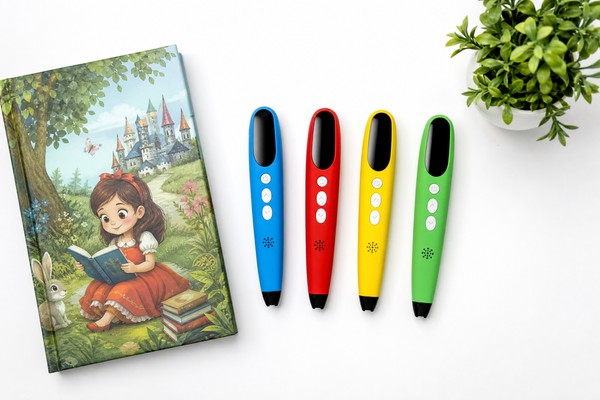
This guide compares Chinese OEM capabilities, minimum order quantity (MOQ) expectations, and lead time benchmarks for Picture Book Reading Pens (a.k.a. Story Pens, Talking Book Pens, OID Reading Pens). It is written for product managers, sourcing managers, and buyers evaluating Chinese OEM partners for private-label or white-label reading pens integrated with illustrated books.
Key takeaways
– Tier segmentation: Chinese OEMs generally fall into three tiers. Tier‑1 (large exporters) offer integrated R&D, in‑house IC firmware, large-scale molding and printing support, and higher regulatory compliance; Tier‑2 provide strong assembly and firmware customization but rely on third‑party IC suppliers; Tier‑3 are contract assemblers with short-run flexibility but limited IP and QA capabilities.
– MOQ benchmarks: stock models typically 200–1,000 units; custom molds and hardware 1,000–5,000 units; full custom platforms (SOC customization, bespoke OID printing) often require 3,000–10,000 units.
– Lead time benchmarks: sample 5–14 days; tooling (mold) 18–45 days; initial production run 20–60 days; content mapping and book printing add 2–8 weeks depending on coordination.
– Cost structure: BOM typically 35–60% of FOB unit price; assembly & test 10–20%; packaging & logistics 5–15%; tooling amortization and software integration vary materially depending on customization.
– Compliance: expect mandatory tests for toy safety (EN71/ASTM F963), chemical limits (CPSIA/REACH), battery (IEC 62133/UN38.3), and radio (FCC/CE) where applicable. Chinese CCC certification is product- and feature-dependent.
This guide provides actionable benchmarks, technical selection criteria, contract checkpoints, and an operational checklist for minimizing risk during supplier selection and onboarding.
What Is Picture Book Reading Pen and Who Uses It
Definition and function
– Picture Book Reading Pens are handheld electronic devices that play recorded audio when the pen’s tip touches images or designated locations on printed picture books. The interaction is typically point-and-play: the child taps a picture and hears narration, sound effects or music.
– Two common implementation patterns:
– OID (Optical Identification) pens: pen contains an optical sensor/camera and reads microdot or printed pattern data embedded in the page; audio files are stored on the pen or referenced by ID.
– RFID/contact solutions: books contain embedded tags; pen reads tag and plays corresponding audio. Less common for picture books due to increased book cost.
Primary users and commercial models
– End users: children aged 0–8 for early literacy, second-language learners, and special education.
– B2B buyers: educational publishers, toy brands, private-label retailers, government literacy programs.
– Commercial models:
– Co-branded / OEM: publishers license content and rebrand standard pen hardware.
– Fully custom: brands commission unique hardware, firmware, and integrated book printing with OID patterns.
– Platform licensing: buyers source a hardware platform and supply mapped audio content for firmware loading.
Key commercial considerations
– Content workflow: audio production, mapping (associating audio segments to coordinates/IDs), and book printing must be synchronized with the pen hardware and firmware.
– Scale: small pilots (hundreds) versus full retail runs (thousands to tens of thousands) change supplier selection and contract terms.
Why Demand Is Growing
Market drivers
– Early learning focus: governments and parents investing in early childhood literacy and bilingual products.
– Digital-physical convergence: demand for tactile, screen-free experiences that incorporate audio feedback.
– Localization and multilingual content: publishers want the ability to ship multi-language audio without changing printed books (audio selection via firmware or multiple audio banks).
– Cost pressure: buyers prefer lower per-unit costs by offshoring manufacturing to China while maintaining content IP locally.
Product innovation driving adoption
– Advances in optical recognition and miniaturized audio SoCs reduce BOM cost and improve reliability.
– Bluetooth and Wi‑Fi enable remote updates and streaming, allowing for larger audio libraries and post‑sale content expansion.
– Battery and materials improvements enable safer, longer-lasting devices that meet toy safety standards.
Commercial opportunities
– Bundling: pens sold as part of boxed sets or subscription models (pen plus replaceable book packs).
– Licensing: publishers create language packs, character voices, and themed series with repeat purchase potential.
– Aftermarket: audio/firmware updates and replaceable batteries create service and accessory revenue.
Key Technology Differences
Hardware and sensing technologies
– Optical Identification (OID)
– How it works: a low-resolution camera or optical sensor in the pen reads a printed microdot or pattern matrix on the page. The pattern encodes a unique ID and, in some systems, x/y coordinates for granular mapping.
– Typical sensor: CMOS camera or image sensor with resolution in the 200×200 to 640×480 range for reliable ID reads.
– Pros: no electronics in books, high mapping resolution, low per-book cost for mass print.
– Cons: requires precise printing process, pattern registration tolerance ±0.2–0.5 mm during production.
- RFID / NFC
- How it works: tags embedded into pages; pen contains RFID reader.
- Pros: robust tag read even under dirt, no line-of-sight.
-
Cons: high incremental cost per book; limited coordinate density; durability concerns for frequent handling.
-
Touch/contact and conductive inks
- Less common; uses printed conductive traces and stylus contact.
- Pros: low-cost; simple mapping.
- Cons: fragile and less durable; high production control required.
Processing platforms and SoCs
– Two common architectures:
– Embedded MCU-based SoC (ARM Cortex-M3/M4 variants or specialized audio MCUs from Actions/Realtek/AC chipset vendors): low cost, limited audio codec flexibility, appropriate for fixed audio playback and moderate mapping complexity.
– Application processor + Linux (e.g., small ARM A-class SOC): used in higher-end pens with Wi‑Fi streaming, Bluetooth audio, larger storage, and more complex UI (displays or voice recognition). Higher cost and longer development time.
Audio formats and storage
– Audio formats: MP3 (variable bitrate, broad compatibility), WAV/PCM/ADPCM (higher fidelity or lower CPU), AAC (better compression but higher licensing complexity).
– Typical sample rates and bit depths:
– Voice-only: 16 kHz, 16-bit, mono (sufficient for intelligible narration).
– Higher-fidelity music/effects: 22.05–44.1 kHz.
– Onboard storage:
– Basic: 8–32 MB (limited content, basic phrase-level audio).
– Typical: 64–512 MB (one or several books).
– High-capacity: 1–8 GB or microSD support for large libraries or multilingual banks.
Connectivity and peripherals
– USB (micro-B or USB‑C) for charging, firmware updates, and content loading (USB 2.0 full speed common).
– Bluetooth (BLE 4.x/5.x) for audio routing, app pairing, and OTA updates.
– Wi‑Fi (802.11 b/g/n) present in premium models for streaming and remote content delivery.
– Speaker: typical 8Ω, 0.5–2 W speaker; external stereo uncommon.
– Microphone: included for recording/playback or limited speech recognition in high-end models.
– Buttons and LEDs for control; limited displays on basic models; touch-sensitive tips in some variants.
Power and battery
– Cells: single-cell Li-ion/polymer 500–1500 mAh typical.
– Expected playback times: 6–18 hours depending on battery size, speaker volume, and duty cycle.
– Charging: USB charge with 5V/1A–2A; charging time 1.5–6 hours.
– Safety: cells must meet IEC 62133 and UN38.3 for transport.
Firmware and content mapping
– Mapping system: XML/JSON mapping tables that bind IDs or coordinates to audio file offsets. Suppliers typically deliver a mapping tool (desktop or cloud) to align timestamps with book coordinates.
– Required deliverables from OEM:
– Mapping file format specification.
– Player firmware versioning and a loader utility.
– Tools for bulk audio import and sync check.
– Intellectual property: control of mapping tools and firmware updates can be a negotiating point—request source-level license or escrow if critical.
Key Features and Specifications to Evaluate
Hardware specification checklist
– Sensing method: OID vs RFID vs contact. Confirm printing tolerances required and sample test prints before mass runs.
– SoC/processor: name and core (e.g., ARM Cortex-M4, Actions AC###). Ask for datasheets and longevity of supply.
– Memory:
– Flash: SPI NOR/NAND or eMMC; specify capacity (e.g., 128 MB).
– RAM: internal and external sizes for buffering audio.
– MicroSD support: yes/no and max card supported (e.g., up to 32 GB).
– Audio codec and playback:
– Supported formats (MP3, WAV, ADPCM, AAC).
– Playback quality (bitrate ranges recommended: voice 32–64 kbps, music 128–192 kbps).
– Speaker and power:
– Speaker impedance and power rating.
– Battery capacity (mAh), expected playback hours, charging current.
– I/O and connectivity:
– USB type, Bluetooth stack version, Wi‑Fi if needed.
– Headphone jack presence, microphone.
– Ergonomics:
– Tip design, tip longevity (number of actuations before replacement), pen weight and dimensions.
– Child-safe materials, non-removable battery (if required for safety).
Firmware and software checklist
– Mapping tool: format, license, ability to run locally (required for IP security).
– Firmware update method: USB/OTA/Bluetooth; rollback capability.
– Multi-audio bank support: ability to carry multiple languages and switch without reflashing.
– Content encryption: support for DRM or content encryption if required by licensor.
– Logging and analytics: support for usage logging and export for subscription or learning analytics.
Quality and manufacturing controls
– QA processes: IQC, IPQC, FQC, aging test durations (48–168 hours).
– Environmental testing: temperature, humidity, drop tests, and vibration.
– Yield and defect rate targets: acceptable first-pass yield typically >95% after initial PPAP.
– Packaging: inner/outer carton specs, certificate of conformity and labeling (country of manufacture, CE/FCC marks where applicable).
Service and IP controls
– Source code and IP: confirm ownership/licensing of firmware and mapping tools; request code escrow for long-term projects.
– Spare parts and replacement policies: availability windows (2–5 years typical), BOM freeze periods for warranty coverage.
– After-sales support: firmware maintenance SLA and update costs per incident.
Pros and Cons
Pros of sourcing from Chinese OEMs
– Cost efficiency: lower labor and production costs compared to Western manufacturers; BOM savings through local component sourcing.
– Vertical integration: many Tier‑1 suppliers have in-house molding, PCB assembly, audio SoC development, and printing partnerships, enabling faster iterations and bundled services (e.g., mapping + book printing).
– Scale and flexibility: high-volume capacity and ability to ramp to 100k+/month with proper contracts.
– Experienced supply chain: mature ecosystem for batteries, speakers, and plastic parts with established QC processes.
Cons and risks
– Communication and project management: time zone, language, and cultural gaps increase risk of misaligned requirements and rework.
– IP and firmware control: some suppliers retain firmware ownership; source code escrow often absent unless contractually mandated.
– Quality variance: significant variability among manufacturers; small suppliers may cut corners on battery safety or print registration.
– Hidden costs: tooling, mapping labor, book printing registration, testing, and compliance certification can add significant lead time and cost.
– Regulatory risk: toys and battery transport require thorough certification; noncompliance can lead to product seizures and recall costs.
Step-by-Step Decision Guide
Step 1 — Define product and content scope
– Confirm:
– Number of unique books per SKU.
– Average audio minutes per book and target audio quality (16 kHz vs 44.1 kHz).
– Desired features (Bluetooth, Wi‑Fi, multi-language banks, recording).
– Estimate storage need: e.g., 20 minutes of narration per book at 32 kbps ~ 4.5 MB per book; factor in music and effects.
Step 2 — Choose sensing and distribution model
– OID is usually the lowest total cost when book volumes are medium-to-high and printing quality can be controlled.
– RFID only if books must contain offline, independent hardware IDs (rare for picture books).
Step 3 — Establish technical must-haves and redlines
– Regulatory: EN71, ASTM F963, IEC 62133 for batteries, FCC/CE if radio components are present.
– Firmware ownership: request source code escrow or perpetual license for firmware and mapping tools.
– Security: content encryption requirements, data privacy, and analytics.
Step 4 — Supplier shortlist and RFQ
– Create an RFQ with:
– Detailed BOM and target specs.
– Desired unit pricing at multiple quantity bands (500 / 1,000 / 5,000 / 10,000).
– Sample requirements and evaluation criteria (functionality, reading accuracy, battery life, audio quality).
– Ask for:
– Factory photos, capacity numbers, sample lead times, past clients, production processes.
– Test reports and certifications.
Step 5 — Prototyping and sample validation
– Sample targets:
– Functional prototype with working sensor, audio, and mapping for a single book.
– Production-quality sample using final plastics, speaker, and battery.
– Testing checklist:
– OID reading accuracy (percentage of successful reads under normal play patterns).
– Battery life at 50% volume, charging time.
– Audio clarity and noise.
– Drop test (1.2–1.5 m), button endurance, tip wear.
Step 6 — Pilot run and full-supply coordination
– Pilot run: 200–1,000 units depending on risk tolerance; include full mapping and book print run.
– Synchronize supplier and printer: print registration test prints and QC approvals before mass print.
– QA: require 100% functional testing or statistically sampled AQL (usually 0.65 for critical defects).
Step 7 — Contract & logistics
– Contract must specify:
– MOQ tiers, unit pricing, tool costs and amortization schedule, payment terms (e.g., 30% deposit, 70% before shipment or L/C).
– Warranty period, RMA procedure, IP ownership clauses.
– Penalties for late delivery and quality failures.
– Logistics:
– Decide FOB (China port) vs DDP; account for battery shipment restrictions (class UN3480, need dangerous goods handling).
Step 8 — Production ramp and continuous improvement
– Plan staggered shipments: pilot, first bulk, replenishment.
– Set KPIs: defect rate, on-time delivery %, customer returns, read accuracy over time.
– Maintain spare parts and firmware update repository.
Pricing and Cost Analysis
Typical FOB unit price ranges (China) — indicative ranges depending on features and volumes
– Basic OID pen, no wireless, basic speaker, 64 MB flash: USD 6–12/unit at 1,000–5,000 MOQ.
– Mid-range pen with Bluetooth, 256 MB flash, 1,000 mAh battery: USD 18–40/unit at 1,000–10,000 MOQ.
– High-end pen with Wi‑Fi, app ecosystem, 1–4 GB storage, premium materials: USD 45–120/unit at 3,000+ MOQ.
BOM and cost structure example (mid-range pen at FOB $25)
– Components (SoC, flash, battery, speaker, sensor, PCB): 40% = $10
– Assembly, test, and labor: 15% = $3.75
– Housing and injection mold amortization: 8% = $2.00 (mold cost $8,000 amortized over run)
– Packaging and manuals: 6% = $1.50
– Firmware development, mapping setup (one-time amortized): 5% = $1.25
– Compliance testing and certifications amortization: 6% = $1.50
– Margin and overhead (factory): 20% = $5.00
Tooling and non-recurring engineering (NRE)
– Single-cavity plastic mold (pen body): USD 3,000–10,000 depending on complexity.
– Multi-cavity or metalizing: USD 8,000–25,000.
– Firmware development and mapping tool customization: USD 3,000–30,000 depending on SOC and features.
– Book printing prepress and OID pattern verification: USD 1,000–5,000 per title in initial setup.
Cost levers to negotiate
– Component substitution: choose slightly older SoC with same functionality for cost savings.
– Storage scaling: provision microSD slot rather than large internal memory to reduce cost or allow customer-upgrade.
– MOQ escalation discounts: 5–15% price decrease when moving from 1k to 5k and another 5–20% when moving to 10k+.
– Tooling contribution negotiation: supplier amortizes over larger run or buyer pays part of NRE upfront.
Freight and landed cost
– Batteries add dangerous-goods surcharges; air freight per carton increases 15–30% when including UN3480.
– For DDP shipments to EU/US, factor customs duties (HS code depends on product) and VAT/import taxes.
Competitive Landscape
Supplier tiers and capabilities
– Tier‑1 OEMs
– Characteristics: 200–1,000+ employees, in-house R&D, molding, PCB assembly, audio SoC partners, established export customers, comprehensive testing labs.
– Strengths: end-to-end project management, larger MOQs, better reliability for major retail clients.
– Typical customers: large publishers, toy brands, retailers.
- Tier‑2 OEMs
- Characteristics: 50–200 employees, strong assembly and firmware customization, rely on external mold shops or specialist IC vendors.
- Strengths: faster response for mid-volume runs, competitive pricing, some IP support.
-
Typical customers: mid-size brands, startups.
-
Tier‑3 OEMs / Contract manufacturers
- Characteristics: <50 employees, assembly-focused, higher flexibility for very small runs.
- Strengths: low MOQ and fast turnaround for prototypes and pilot batches.
- Risks: inconsistent QC, limited access to advanced SoCs, weaker warranty infrastructure.
Regional notes within China
– Guangdong/Guangzhou/Shenzhen: concentration of consumer electronics and mature supply chain for audio SoCs, battery suppliers, speakers, and injection molding.
– Zhejiang/Ningbo: strong small-electronics assembly, molding, and book printing partners.
– Jiangsu/Suzhou: mid-sized factories with strong QA processes for export.
Non-Chinese competitors
– Taiwan/South Korea/Japan manufacturers: higher costs but stronger IP protection and advanced SoC options.
– Vietnam: emerging assembly hub — lower labor costs for labor-intensive assembly, but less mature for advanced SoC and mapping integration.
Vertical integrators
– Some Chinese providers offer bundled book printing (OID registration), audio mapping services, and supply-chain coordination — consider these if you want single-vendor responsibility but validate anti‑monopoly and IP clauses.
What Buyers Say
Common buyer feedback themes (sourced from typical B2B experiences)
– Communication clarity matters more than factory size: buyers who provide precise technical documents, mapping CSVs, and clear acceptance criteria avoid rework.
– Mapping errors are the top operational failure: incorrect mapping, off-by-offset audio segments, and registration misalignment cause significant delays.
– Book printing coordination is underestimated: many buyers forget to pre-approve high-resolution registration proofs and color-accurate test prints for OID patterns; this causes reprints and delays.
– Firmware ownership is a recurring negotiation friction: buyers who require source escrow or perpetual firmware license improve long-term operational flexibility.
– MOQ surprises: many buyers assume lower MOQs than reality; negotiate sample runs of stock models to validate before committing to custom hardware.
– Warranty and spare parts: buyers report long-term pain when suppliers discontinue components; contract clauses for spare-part availability (2–5 years) reduce downstream risk.
Operational performance benchmarks buyers cite as critical
– Read accuracy target: >98% success rate for normal handling (benchmarked on validated sample books).
– Battery life: delivered within ±10% of promised playback hours.
– Delivery performance: on-time delivery rate >95% after pilot qualification.
Safety, Maintenance and Compliance
Mandatory standards and tests to require from supplier
– Toy safety:
– EN71 series (EU): mechanical/physical, flammability, and chemical requirements.
– ASTM F963 (US): toy safety standard for physical and chemical hazards.
– CPSIA (US): lead and phthalates limits and documentation (Children’s Product Certificate).
– Electrotechnical:
– IEC 62133: battery safety (widely required for Li-ion packs).
– UN38.3: transport testing for lithium batteries (air/sea).
– Radio and EMC:
– FCC Part 15 (US) and CE RED (EU) if device has Bluetooth/Wi‑Fi.
– Chemical restrictions:
– REACH (EU) and RoHS (lead, mercury, cadmium) where applicable.
– Packaging and labeling:
– Child-appropriate warnings, CE/FCC marks, battery disposal instructions, and country-of-origin labeling.
Maintenance and serviceability
– Recommended maintenance instructions in product manual:
– Battery handling and safe charging practices.
– Cleaning the optical tip and sensor window.
– Software update instruction and rollback procedure.
– Spare parts planning:
– Keep a 12–24 month spare parts inventory for critical components (sensors, speakers, batteries).
– Field returns and RMA:
– Define RMA SLAs (e.g., 7–14 business days for inspection, 30 business days for repair/replace).
– Statistical returns analysis (monthly) to identify systemic issues.
Testing labs and documentation
– Ask suppliers to provide:
– CNAS-accredited lab test reports (or equivalent) for EN71/ASTM tests.
– Battery manufacturer IEC 62133 and UN38.3 certificates.
– EMC/FCC/CE test reports for radio devices.
– Verify lab authenticity and retest using independent test houses in your target markets when necessary.
Contractual safety clauses
– Define recalls and defect liabilities explicitly.
– Mandate documentation transfer (test reports, BOM, source code escrow) upon specific triggers (e.g., bankruptcy, supplier takeover).
– Include insurance and product liability requirements (coverage amounts typical: USD 1–5 million depending on market).
Frequently Asked Questions
What MOQ should I expect for a new custom pen design?
– Expect 1,000–5,000 units minimum for custom molds and hardware. For full platform customization (SoC changes or new firmware stack) plan for 3,000–10,000 depending on supplier amortization needs.
How long does a full program (pen + book) take from project start to first shipment?
– Typical timeline:
– Concept & spec: 1–2 weeks.
– Prototype: 2–4 weeks.
– Tooling: 18–45 days.
– Book prepress and registration approval: 1–3 weeks (parallel).
– Pilot production and mapping: 2–6 weeks.
– Mass production: 20–60 days.
– Total: 10–20 weeks from kick-off to initial shipment, assuming no major redesign.
How many books can one pen store?
– Depends on audio fidelity and compression:
– Using MP3 at 32 kbps (voice): ~4.5 MB per 20-minute book. A 512 MB pen can store ~110 books of similar length.
– For mixed media (music, effects) increase bitrate to 128 kbps: storage per book quadruples.
What are common failure modes and how do I test them?
– Common failures: misreads (OID), battery degradation, speaker failure, firmware crashes.
– Tests to run: full-book automated read-throughs (1000 taps), battery cycle tests (charge/discharge 300 cycles), drop and tip endurance (10,000 actuations), and environmental stress (high/low temperature and humidity).
Should I insist on source code escrow for firmware?
– Yes, when firmware is critical to your product or you require long-term maintainability. Negotiate an escrow agreement with clear release conditions.
How do I manage IP for the audio content?
– Keep content transfer via secure channels, require supplier NDA, and request content deletion proof after production if you retain IP exclusively.
Contact Toyvao
For supplier matchmaking, RFQ preparation, factory audits, or technical consultation on Picture Book Reading Pen sourcing, contact Toyvao:
- Email: sales@toyvao.com
- Website: https://toyvao.com
- Services offered: supplier shortlisting, technical spec review, mapping tool audit, compliance checklists, and project management support for pilot-to-scale programs.
Provide project scope, desired features, estimated annual volumes, and target launch date when contacting. Toyvao will respond with a tailored sourcing plan and supplier shortlist based on current Chinese OEM performance and capacity.
