
BLUF (Bottom-Line-Up-Front)
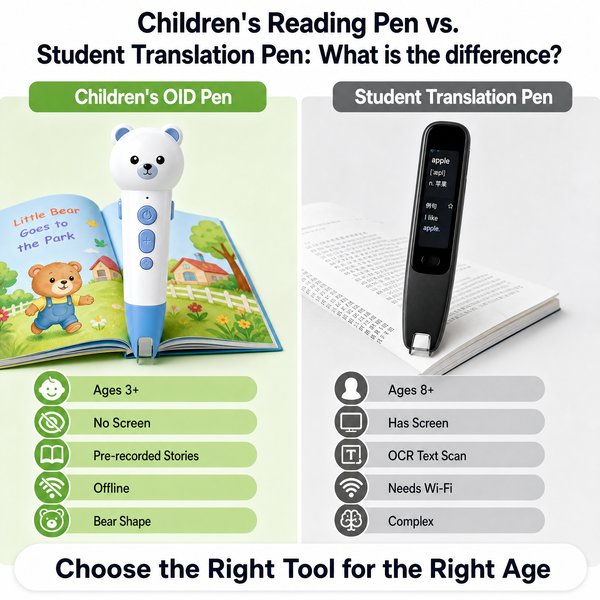
If you’re buying for toddlers (ages 3+) or early-years classrooms, choose a Children’s Reading Pen (OID). It’s a durable, screen‑free, offline toy that plays rich pre-recorded audio from specially coded books and meets early‑childhood safety needs (EN71/CE/ASTM). If you need a device to scan and translate arbitrary printed text for older students (8+), choose a Student Translation/Scanner Pen (OCR) — but don’t expect it to deliver the playful, sensory learning experience toddlers require.
Key decision points — When it’s worth caring about / When you don’t need to overthink it
-
Age & user maturity
When it’s worth caring about: Purchasing for ages 3–6 (toddlers, preschool) — choose an OID Children’s Reading Pen: screen‑free, simple, durable, and designed for small hands (example: bear-shaped).
When you don’t need to overthink it: Buying for 8+ students who must read, scan, or translate textbooks — choose an OCR Student Translation Pen. -
Learning goals & content type
When it’s worth caring about: You want multi‑sensory, scripted audio (character voices, songs, sound effects) tied to dedicated story/activity books — OID is purpose-built for this and works OFFLINE.
When you don’t need to overthink it: You need a tool to read or translate arbitrary printed text (dictionaries, foreign language study) — OCR is the appropriate tool. -
Safety & procurement standards
When it’s worth caring about: Procuring devices for young children in daycare or primary school — demand EN71/CE/ASTM, non‑toxic materials, secure battery compartments, no small detachable parts, and safe volume limits (use OID pens).
When you don’t need to overthink it: For adult learners or desktop reference use where small parts and screens are acceptable. -
Connectivity & IT policy
When it’s worth caring about: Your institution bans Wi‑Fi/Bluetooth or requires offline-only devices for privacy/security — OID pens are offline-only, no app, no cloud, no network required.
When you don’t need to overthink it: You have campus Wi‑Fi and need live translation or cloud features — OCR pens typically require connectivity. -
Durability & ease of use
When it’s worth caring about: Devices will be repeatedly handled by young children — choose rugged, easy-to-hold OID pens with long battery life and simple buttons.
When you don’t need to overthink it: Devices used by trained students who can handle screens, calibration, and software updates — OCR pens are acceptable.
Quick specs (example: Toyvao Children’s Reading Pen, OID)
- Age range: 3+
- Storage: 16GB / 32GB / 64GB options
- Battery life: 8–12 hours active use
- Charging: 2–3 hours via USB‑C
- Audio: 3.5mm headphone jack, volume adjustment button
- Connectivity: NO Bluetooth, NO Wi‑Fi, NO app required — works OFFLINE
- Compatibility: Only supports OID‑coded books (pre‑programmed content)
- Not a translator / not a scanner / not an OCR device
- Safety: Designed to meet EN71 / CE / ASTM standards (confirm certificates with supplier)
OID vs OCR — Feature comparison
| Feature | Children’s Reading Pen (OID) | Student Translation/Scanner Pen (OCR) |
|---|---|---|
| Primary purpose | Play pre‑recorded audio from OID‑coded books (stories, songs, effects) | Scan and recognize printed text; translate or read aloud arbitrary documents |
| Typical users | Toddlers & early learners (ages 3+), preschools | Older students and adults (8+ for effective use) |
| Screen | No screen (screen‑free, low distraction) | Usually includes a screen for text/menus |
| Connectivity | Offline only — NO Wi‑Fi/Bluetooth, no app required | Often requires Wi‑Fi or mobile data for translation/cloud features |
| Audio style | Rich, character voices, songs, sound effects — multi‑sensory | Robotic or synthesized voice reading recognized text |
| Content scope | Only OID‑coded books and resources | Any printed text (subject to OCR accuracy and language support) |
| Durability & design | Designed for small hands, fewer fragile parts | More complex mechanics and screens — less tolerant of rough handling |
| Safety / certification needs | Meets young‑child safety standards (EN71/CE/ASTM recommended) | Consumer electronics standards; not optimized for toddlers |
Customer feedback synthesis (B2B buyer style)
- “Positive: Easy to integrate into our kindergarten curriculum — kids loved the character voices and music, battery lasts the full school day.” — Early Years Procurement Manager
- “Positive: No Wi‑Fi requirement made it simple to approve through our IT policy; durable and drop‑resistant.” — School District IT & Purchasing
- “Positive: Factory direct pricing from the supplier simplified budgeting — good warranty and sample testing.” — Regional Distributor
- “Concern: Requires OID‑coded books only — we had to reprint a few storybooks to fit our program.” — Head of Curriculum Development
- “Concern: Some staff expected translation/scanning features; needed training to explain differences between OID and OCR devices.” — Procurement Officer, Primary Schools
- “Concern: Verify EN71/CE/ASTM certificates and volume‑limit specs before large orders — procurement requested paperwork.” — Large Retail Chain Buyer
FAQ
- Q: Can an OID Children’s Reading Pen read regular, non‑coded books?
- A: No. OID pens only play pre‑recorded audio linked to OID‑coded dots printed in companion books. They are not OCR devices and cannot read arbitrary text.
- Q: Are these pens safe for toddlers and certified?
- A: Children’s OID pens intended for ages 3+ should meet EN71, CE, and ASTM safety standards. Confirm certificates with the supplier and ensure the design has no small detachable parts and safe volume limits.
- Q: Does the pen require Wi‑Fi, Bluetooth, or an app?
- A: No. The Children’s Reading Pen described here is fully offline — no Wi‑Fi, no Bluetooth, and no companion app required. Content is stored on the pen (16/32/64GB) or read directly from OID books.
- Q: Can this pen translate text or perform OCR?
- A: No. It is not a translation or OCR/scanner pen. For translation/scan tasks, you must choose a Student Translation/Scanner Pen (OCR) designed for older learners.
Where Toyvao fits
Toyvao is a factory‑direct supplier of Children’s OID reading pens and companion books, offering bulk options (16/32/64GB), 8–12h battery life, USB‑C charging (2–3h), 3.5mm jack, and child‑safe designs. If you need a scalable children’s OID solution with safety certifications and classroom‑ready packaging, Toyvao can supply direct to distributors, retailers, and school procurement channels.
Next steps / Contact (strong CTA)
If you’re procuring for preschools, early learning centers, or retail channels and want factory pricing, samples, certification documents, or curriculum bundles, contact Toyvao today:
- WhatsApp: +86 186 8106 4480
- Email: sales@toyvao.com
- Website: https://toyvao.com
Request sample units (OID pen + companion book) and certification copies to validate safety and content before placing a bulk order.
