
Introduction
With advances in technology, a growing variety of children’s learning products has emerged. As an interactive tool that combines traditional reading with digital interaction, the talking pen has attracted significant attention from parents. However, for parents with infants at home, a central question remains: can babies safely use a talking pen? This article examines the potential risks and benefits of talking pens for infants and provides expert guidance to help parents and B2B buyers make informed decisions.
What Is a Talking Pen?
A talking pen is an intelligent learning device that uses optical recognition technology. When the pen tip touches text or images in a compatible book or card, it plays corresponding audio, such as word pronunciations, story narration, or music. It is designed to support language learning and early reading through auditory interaction.
Age Appropriateness and Safety Concerns
1. Choking Hazard
One of the primary concerns is the risk of choking. Most talking pens and their accompanying cards or small accessories are designed for children aged 3 years and older. According to Joybuy’s guidance, this is because talking pens may contain small parts that pose a choking risk to children under 3 years old [1]. Infants frequently put small objects in their mouths; components such as pen caps, battery covers, or parts that detach after damage can become potential choking hazards.
2. Material Safety
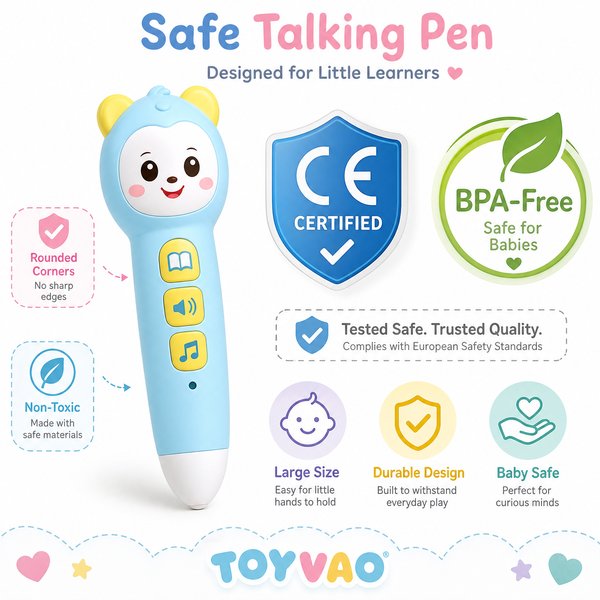
Products intended for infants must ensure that materials are non-toxic and safe. Buyers should choose talking pens made from durable, non-toxic, BPA-free materials. Ensure the product design is robust enough to withstand impacts typical of infant use and that there are no sharp edges or easily detachable small parts.
3. Hearing Concerns
If the audio output from a talking pen is too loud, it can potentially harm an infant’s sensitive hearing. Select products with adjustable volume controls and a capped maximum volume within safe limits, and monitor the volume level during use.
4. Screen Time and Interaction Quality
Although talking pens are marketed as a “screen-free” learning tool, excessive reliance on any electronic device can affect an infant’s interaction with the real world. Infants need to develop cognition and social skills through tactile exploration, grasping real objects, and face-to-face interaction with caregivers. A talking pen should be used as a supplementary tool, not as a substitute for parent–child interaction.
Potential Benefits (for Age-Appropriate Children)
For children who meet the recommended age range (typically 3 years and older), talking pens offer the following potential benefits:
- Promotes early literacy: Interactive pronunciation helps children link letter shapes with sounds and develop phonemic awareness.
- Vocabulary expansion: Introduces new words and concepts to enrich children’s expressive language.
- Interactive learning: Gamified learning methods can stimulate interest, increase engagement, and improve attention span.
- Screen-free alternative: Provides an interactive learning option distinct from tablets and smartphones, helping to reduce screen time.
Expert Recommendations
Pediatricians and child development specialists generally advise that a child’s age and developmental stage should be the primary consideration when selecting any learning tool. For infants (0–3 years), the following recommendations are especially important:
- Strictly follow age recommendations: Always adhere to the manufacturer’s recommended age range. If a product explicitly states it is intended for ages 3 and up, it should not be given to children under 3.
- Prioritize parent–child interaction: The most effective learning for infants comes from face-to-face communication, reading, and play with parents or caregivers. A talking pen cannot replace this high-quality interaction.
- Check product safety certifications: Before purchasing, verify whether the product has relevant safety certifications, such as CE, CCC, or equivalent.
- Inspect product condition regularly: Ensure the talking pen is not damaged, that the battery compartment is secure, and that no components are loose or missing.
- Limit usage: Even for age-appropriate children, limit usage time and encourage diverse learning and play activities.
Conclusion
While talking pens provide a novel avenue for children’s learning, the choking hazards and age-inappropriate design elements make them a significant concern for infants. In summary, most talking pens are not suitable for children under 3 years of age. Parents and purchasers should prioritize toys and learning methods that align with infant developmental needs and always place safety first. For age-appropriate children, talking pens can be a valuable supplementary tool when used under supervision and combined with other learning activities to support holistic development.
References
[1] Joybuy. (2026). Talking Pen for Toddlers: The Ultimate 2026 Guide. Retrieved from [https://www.joybuy.co.uk/blog/talking-pen-for-toddlers-guide/S4EcjQtN](https://www.joybuy.co.uk/blog/talking-pen-for-toddlers-guide/S4EcjQtN)
