
Executive Summary
This guide compares Bluetooth streaming and offline playback architectures for Picture Book Reading Pens (Story Pens / Talking Book Pens / OID Reading Pens) used by children to tap illustrated books and hear narration. It focuses on three buyer-critical dimensions: connectivity and user experience (latency, robustness), technical implementation (SoC, codecs, storage, power), and intellectual property/licensing implications for sellers and publishers.
Key takeaways:
– Offline playback (preloaded or local files on the pen) delivers deterministic, near-zero latency (<10 ms perceptual), is easier to certify for toy safety, and simplifies licensing if sellers obtain per-copy distribution rights. It requires local storage and stronger anti-piracy controls (encryption/secure provisioning).
– Bluetooth solutions (Classic A2DP or BLE LE Audio) enable streaming from a paired device or a hybrid workflow with content delivered via app. Bluetooth gives richer interactive features (multilingual streaming, large back catalogues) but introduces variable latency (typical 60–200 ms for Classic, 30–80 ms for modern LE Audio with LC3), dependency on smartphone/tablet hardware and OS, additional certification costs (Bluetooth SIG, FCC/CE radio), and more complex licensing (streaming rights, app-store constraints).
– For synchronized tap-to-sound interactions (tactile OID pens), offline playback is the most reliable choice unless the system design tolerates latencies up to ~100 ms or uses sync techniques (prebuffering, predictive caching).
– Cost trade-offs are material: adding a Bluetooth radio plus qualification typically increases BOM by $3–8 per unit and unit price by 15–50% depending on volumes. Licensing can change unit economics more dramatically — per-device preload royalties can range from $0.20 to $3.00+ per title; streaming agreements may be structured as per-stream fees, monthly subscriptions, or revenue share models.
– Sellers should evaluate use case, target markets, certification requirements, content licensing contracts, production volumes (MOQs), and after-sales support before choosing architecture. A hybrid model (offline core content + optional Bluetooth app for extended catalogues) is a common compromise.
This guide provides technical benchmarks, specs to evaluate, decision steps, pricing examples, compliance checklist, and recommended next steps for B2B buyers and sellers.
What Is Picture Book Reading Pen and Who Uses It
Product definition
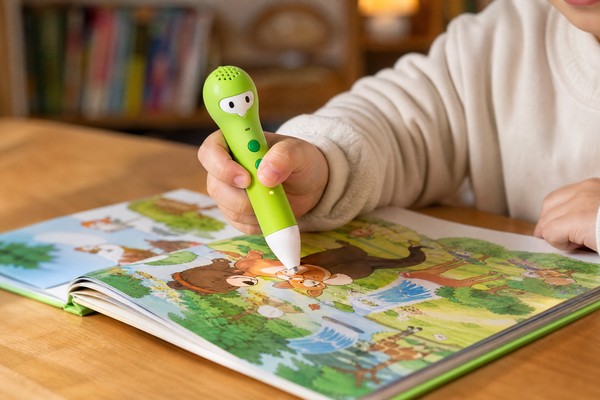
– A Picture Book Reading Pen is a handheld electronic device that reads audio content when the pen tip touches encoded locations on printed pages. Common names: Story Pen, Talking Book Pen, OID Reading Pen.
– Core components: optical sensor (for OID/dot-code or infrared grid recognition), microcontroller/SoC, audio DAC/AMP, speaker, microphone (optional), storage (NOR/NAND/SD), power (Li-ion or NiMH), and user controls (buttons, LED).
– Primary interaction models:
– Offline: audio files are stored on the pen (internal flash or removable SD) and played instantly when a code is touched.
– Bluetooth streaming: the pen acts as a Bluetooth endpoint controlled by a companion app that streams audio or commands the pen to play cached content.
Primary users and buyers
– End users: children aged 2–10 years for early literacy, bilingual learning, and interactive story experiences.
– B2B buyers:
– Publishers and educational content owners seeking to add audio capability to printed books.
– Toy and educational product distributors/resellers.
– OEM/ODM manufacturers sourcing modules or pen assemblies.
– Schools, libraries, learning centers procuring devices for classroom use.
– EdTech companies building app-integrated products.
Usage patterns
– Single-title kits: publishers bundle a specific book with a matching pen with a small number of audio tracks (2–30 tracks).
– Multi-title pens: pens with multi-GB storage that can host dozens to hundreds of titles for libraries or multi-language sets.
– App-enabled pens: pens that rely on an app for content download, user profiles, analytics, and remote management.
Why Demand Is Growing
Market drivers
– Early literacy emphasis: Governments and parents increasing investment in early childhood literacy and bilingual education, creating demand for tactile audio learning aids.
– Multimedia expectations: Consumers expect interactive digital experiences; pens bridge print and audio without requiring a full screen, which is attractive for young children.
– Declining cost of components: NAND/SPI flash, low-cost microcontrollers, and compact speakers make pens economically feasible at scale.
– Localization demand: Publishers seeking low-friction ways to offer multilingual narration for the same printed assets, especially in emerging markets.
Value propositions that drive adoption
– Offline pens: robust, simple to use, no dependency on smartphones, immediate response — ideal for preschools and markets with limited smartphone penetration.
– Bluetooth pens: deeper analytics (via companion apps), remote content updates, subscription/personalized content management, and integration with learning platforms.
Distribution channels
– Direct-to-schools and libraries (bulk procurement).
– Publisher bundles (book + pen sold together).
– Retail channels (brick-and-mortar toy retailers, online marketplaces).
– Licensing partnerships with content owners and language institutes.
Market segments
– Low-cost mass market: offline pens with 128–512 MB storage, single language, retail price $12–30.
– Mid-tier educational market: hybrid pens, 1–8 GB storage, Bluetooth optional, retail price $30–60.
– Premium EdTech/professional: full Bluetooth LE Audio, large storage, app integration, analytics, retail/education pricing $60–120+.
Key Technology Differences
Architecture overview
– Offline playback architecture:
– Pen contains audio files encoded as MP3/AAC/WAV stored in internal flash or SD card.
– Page taps trigger a mapping lookup in local OID table and immediate playback via on-board DAC and speaker.
– Typical SoC: ARM Cortex-M0/M3/M4 class microcontroller with integrated audio decoder or low-cost actions/RTL audio SoC.
– Bluetooth playback architecture:
– Pen pairs to smartphone/tablet via Bluetooth Classic (A2DP/AVRCP) or Bluetooth Low Energy (LE Audio).
– Audio may stream from app (real-time), or the pen uses Bluetooth merely as control channel while fetching audio from the cloud or local app cache.
– Typical SoC: Bluetooth combo SoC (e.g., nRF52840 or dedicated BT audio SoCs) with support for codecs and profiles.
Connectivity and latency
– Bluetooth Classic (A2DP):
– Latency: typical 100–220 ms depending on codec (SBC 120–200 ms, AAC 150–200 ms, aptX 60–100 ms).
– Bandwidth: sufficient for high-quality stereo (SBC up to 345 kbps nominal).
– Power: higher than BLE; affects battery life.
– Use case: good for music streaming and phones; suboptimal for immediate tap-to-sound sync.
– Bluetooth LE Audio (LC3 codec):
– Latency: modern implementations 30–80 ms in optimal conditions; depends on host/stack and buffer settings.
– Bandwidth/efficiency: lower power; supports multi-stream and broadcast audio.
– Adoption: introduced in 2020 but device support varies; iOS support limited in some versions.
– Use case: promising for low-latency audio in the future, but device ecosystem still catching up.
– Offline playback latency:
– Latency: typical detection-to-audio time <10 ms for optimized OID lookup and audio buffering; perceptually instantaneous.
– Determinism: highly predictable; crucial for tight OID mapping and lip-sync or sound effects.
Synchronization techniques
– Pre-buffering: app sends upcoming audio packets in advance, reducing perceived latency but requires local buffer and increased memory usage.
– Timestamped play commands: app and pen use clock sync to schedule playback, reducing perceived lag but adds complexity.
– Predictive caching: app downloads high-probability next segments to pen cache; hybrid approach for intermittent connectivity.
Codecs and audio quality
– Offline: any codec supported by the pen’s decoder; MP3 (CBR/VBR), AAC, WAV; sampling rates typically 22.05–44.1 kHz; bitrates 64–192 kbps for voice.
– Bluetooth:
– SBC: baseline; variable latency and quality.
– aptX/aptX LL: lower latency (aptX LL ~30–40 ms), licensing fees apply.
– AAC: common on iOS but higher latency on many Android devices.
– LC3 (LE Audio): designed for low latency and quality at low bitrates, requires host and device support.
Storage and memory
– Offline-only pens: internal SPI NOR (small OS + index) + SPI NAND/eMMC for audio. Typical storage ranges:
– Single title devices: 16–256 MB.
– Multi-title devices: 1–16 GB.
– Bluetooth-enabled pens: can use smaller storage for cached assets (128–512 MB) if reliant on streaming; still require firmware and OID maps.
Security and DRM
– Offline DRM: AES-128/AES-256 encrypted audio files, signed manifests, secure key provisioning during manufacturing or via secure server for activation. Hardware-based key storage (TPM/secure element) reduces risk of wholesale copying.
– Streaming DRM: server-side licensing, authentication via app credentials, token-based access, easier to control content access but requires backend and ongoing hosting costs.
Power and battery
– Bluetooth increases average power draw. Typical battery figures:
– Offline pen (no BT): 400–800 mAh Li-ion delivering 10–20 hours playback (voice, half volume).
– Bluetooth pen: 800–2000 mAh recommended for 8–15 hours depending on streaming duty cycle.
– Charging: USB-C increasingly standard; micro-USB still used in low-cost models.
Key Features and Specifications to Evaluate
Connectivity
– Bluetooth version/support: 4.2/5.0/5.2 with LE Audio support vs Classic A2DP. Verify supported profiles (A2DP, AVRCP, HFP, GATT).
– Pairing flow: simple single-button NFC pairing vs PIN pairing. Child-proof pairing and parental controls.
– Wi-Fi: rarely included; used only in premium products for direct cloud updates.
OID scanning and accuracy
– Optical recognition resolution: sensor resolution (e.g., 640×480 vs 1280×720) and read speed.
– Recognition latency: target <5 ms between touch and code decode.
– Tolerance to print/ink variation: ability to handle ±0.5 mm alignment error, smudges, and different paper stocks.
– Page mapping capacity: number of unique OID codes support (e.g., >65,000).
Audio and playback
– DAC resolution: 16-bit or 24-bit; sampling rates 22.05/44.1 kHz.
– Speaker output: RMS power (e.g., 1W–3W), peak SPL at 10 cm (target <85 dB to comply with recommended hearing safety).
– Output options: mono speaker vs stereo headphone jack or Bluetooth audio sink.
– File formats: MP3, AAC, WAV, OGG.
Storage and expansion
– Internal flash: size options (128 MB, 512 MB, 1 GB, 4 GB, 8 GB).
– Removable storage: microSD slot support (up to 32/128 GB).
– File system and index size: look for efficient OID-to-file mapping database.
Processor and memory
– MCU/SoC class: Cortex-M0/M3/M4 for offline; application-class SoC (Cortex-M33, nRF52/53, or dedicated audio SoC) for Bluetooth.
– RAM: 64 KB–256 KB for simple pens; 512 KB–4 MB for buffered audio and Bluetooth stacks.
Battery and power
– Battery type and capacity: Li-ion typical 400–2000 mAh; NiMH in low-cost designs.
– Charging: USB-C (5V/1A or 5V/2A) vs micro-USB.
– Playtime: specify at 50% volume; target ≥10 hours for classroom use.
– Standby time: weeks (offline), shorter if Bluetooth always-on.
Firmware and updates
– OTA capability: Bluetooth-based OTA or USB/SD update. Important for security patches and new content.
– Bootloader security: signed firmware images.
Certifications
– Toy safety: ASTM F963 (US), EN71 parts 1–3 (EU).
– Device/Radio: FCC part 15 (US), CE RED (EU), Bluetooth SIG qualification.
– Battery: IEC 62133, UN38.3 for shipping.
Manufacturing and supply chain
– MOQ for custom firmware and preloaded content: often 500–2,000 units.
– BOM sensitivity: Bluetooth module cost, flash size, and speaker choice affect unit price most.
– Expected production yield and burn-in requirements for audio components.
DRM and licensing features
– Content encryption method (AES-128/256).
– License provisioning (per-device keys, server activation).
– Support for per-title activation and revocation.
Analytics and telemetry
– For Bluetooth-enabled pens: app integration for usage analytics, content consumption metrics, and remote content management.
Pros and Cons
Offline Playback (Preloaded or Local Files)
Pros
– Deterministic, near-zero latency (<10 ms) — optimal for tap-to-sound experiences.
– No dependence on smartphone/tablet connectivity; works out-of-the-box.
– Simpler UX for caregivers and children; lower support overhead.
– Easier to deploy in low-connectivity markets and institutional settings (schools).
– Reduced runtime power consumption (no radio), enabling smaller batteries and longer playtime.
– Licensing model can be negotiated as a per-device distribution right, simplifying subscriber management.
Cons
– Limited onboard storage caps content library; increasing storage raises BOM cost (e.g., 2 GB vs 8 GB).
– Over-the-air content updates require infrastructure or physical updates via USB/SD.
– Higher risk of content piracy unless robust DRM and secure provisioning are implemented.
– Per-copy licensing royalties can increase cost, especially for bestselling titles.
Bluetooth Streaming (App-Connected)
Pros
– Virtually unlimited content catalog via app/cloud; easy to update and expand.
– Supports personalization, analytics, and subscription models.
– Simplifies per-stream licensing and content revocation.
– Enables multi-language, multi-user profiles without increasing physical storage.
– Potentially lower per-device storage cost if app caches aggressively.
Cons
– Latency variability: Classic Bluetooth often introduces 100–200 ms delay—can break tap-and-immediate sound experience.
– Reliance on user’s smartphone/tablet hardware and OS — fragmentation issues and extra support demands.
– Higher BOM and certification costs (Bluetooth module + RF testing + SIG listing).
– App dependency creates friction for users without phones or with restricted device ecosystems (school environments).
– Continuous connectivity and cloud dependencies raise ongoing infrastructure and operational costs.
Hybrid (Offline Core + Bluetooth Extension)
Pros
– Combines instant core experience with expandability via app.
– Lowers licensing exposure for core content while enabling subscription/access for extended catalog.
– Mitigates latency issues for core activities; non-critical content can stream.
Cons
– Increased complexity: dual firmware, content sync mechanisms, and DRM for both offline and streamed assets.
– Slightly higher BOM and development costs.
– Requires robust device management strategy to reconcile offline state and app state.
Step-by-Step Decision Guide
Define the use case
– Target user and environment:
– Home consumer market with smartphone penetration >70%: Bluetooth or hybrid possible.
– Institutional use (schools, libraries): prefer offline due to device management and network restrictions.
– Low-connectivity regions: offline strongly preferred.
– Content strategy:
– Few permanent titles bundled with books: offline.
– Large catalog, frequent updates, or subscription revenue: Bluetooth streaming or hybrid.
Set technical requirements
– Latency tolerance:
– Tight tap-to-sound sync (<50 ms): offline or LE Audio with rigorous testing.
– Delay acceptable up to ~150 ms: A2DP with optimization may be tolerable.
– Power & battery:
– Must support 8–12+ hours between charges? Avoid always-on Bluetooth streaming.
– Audio quality:
– Voice narration acceptable at 64–128 kbps; music or high-fidelity requires 192+ kbps and robust codecs.
Assess licensing and legal constraints
– Determine rights needed:
– Offline distribution requires mechanical/per-copy or per-device master license; check territory and duration.
– Streaming may require digital performance or streaming rights and agreements with publishers.
– Negotiate royalties and pricing:
– Request sample contracts, caps, and volume discounts.
– Consult IP counsel for terms around caching, user-side copying, and DRM requirements.
Evaluate BOM and unit economics
– Create baseline BOM for both architectures:
– Offline pen BOM example (mass production): MCU $1.5, 8 GB flash $2.0, speaker $0.6, battery $1.2, enclosure/assembly $3.0 → total Mw/Others ≈ $10–12.
– Bluetooth pen BOM example: add Bluetooth module $3–6, larger battery $1.0–2.0, and higher FW complexity → extra $4–8.
– Project margins at target retail or wholesale price. Include licensing per-unit royalties.
Prototype and pilot
– Build two prototypes: offline and Bluetooth/hybrid.
– Test metrics: latency (touch-to-audio), recognition accuracy under different lighting and paper stocks, battery life, OTA capability, and manufacturing variability.
– Run a pilot with representative users (n=50–200) in target markets; measure returns, fault rates, and support tickets.
Plan for certifications and supply chain
– Obtain toy safety and radio certifications in target markets before large production runs.
– Verify battery tests (UN38.3) and shipping restrictions.
– Decide manufacturing MOQ and lead times; plan buffer for firmware iterations.
Operationalize content management
– If offline: implement secure provisioning process at manufacturing (encrypted assets and per-device keys) and validate activation chain for warranty and licensing tracking.
– If Bluetooth/streaming: design backend (CDN, license server), app flows, token refresh, and analytics pipeline.
Scale and iterate
– Use pilot data to refine firmware, OID patterns, and manufacturing specs.
– Negotiate long-term licenses with content owners leveraging expected volumes and customer metrics from pilot.
Pricing and Cost Analysis
Component cost drivers (typical per-unit BOM in volume production, 5k–50k units)
– MCU/SoC:
– Basic MCU (no BT): $0.70–$3.00.
– Bluetooth combo SoC: $2.50–$6.00.
– Flash storage:
– 256 MB: $0.30–$0.60.
– 1 GB: $0.60–$1.20.
– 8 GB eMMC/SPI-NAND: $1.80–$4.00.
– Speaker and audio amplifier: $0.40–$1.50.
– Battery:
– 400–800 mAh Li-ion: $0.80–$1.80.
– 1000–2000 mAh Li-ion: $1.50–$3.50.
– Bluetooth module: $3.00–$8.00 (integrated modules reduce RF testing but have premium).
– Mechanical parts, buttons, assembly, QC: $3.00–$6.00.
Manufacturing cost comparison (example)
– Offline pen (8 GB): BOM ≈ $10–15; FOB unit cost with assembly, testing ≈ $12–20.
– Bluetooth pen (1–4 GB + BT): BOM ≈ $15–25; FOB ≈ $18–30.
Licensing cost scenarios (typical industry estimates — vary widely by publisher and market)
– Per-device preload royalty: $0.20–$3.00 per title per device. High-profile IP or localized narrators push higher.
– Per-stream or per-download licensing (for streaming): $0.01–$0.50 per stream per title or revenue-share models (30–50% of gross for some publishers/platforms).
– Subscription model: recurring revenue can offset higher platform costs but requires ongoing platform operations.
Price-to-market examples (retail guidance)
– Low-end offline pens: MSRP $12–30; wholesale (B2B) $6–15.
– Mid-tier hybrid pens: MSRP $30–60; wholesale $18–35.
– Premium bluetooth-enabled pens: MSRP $60–120; wholesale $35–70.
Break-even and margin considerations
– Consider total landed cost (production + certifications + licensing + shipping + returns).
– Example: Offline pen with FOB $15 sold wholesale at $30 yields gross margin before SG&A of ~50% but must cover licensing per copy (e.g., $1), marketing, and after-sales support.
– Bluetooth pen with FOB $25 sold wholesale at $45 has narrower margin; licensing via subscription may be needed to sustain platform costs.
Contractual levers to optimize cost
– Negotiate per-title volume discounts (e.g., $0.20 for 10k+ units).
– Use public domain or custom-produced narration for lower cost content.
– Offer publisher revenue-share for streaming to reduce upfront royalties.
Competitive Landscape
OEM/ODM ecosystem
– China-based OEMs dominate low-cost pen manufacturing; they offer turn-key solutions including OID printing services and provisioning at MOQs 500–2000 units.
– Specialized audio SoC vendors (e.g., Actions Semiconductor, Realtek, Qualcomm) supply Bluetooth and audio hardware solutions at different price points.
Publishers and platform providers
– Traditional publishers increasingly partner with device makers to offer bundled book+pen packages.
– EdTech platforms offer app-based subscription catalogues that can pair with pens for analytics and remote content provisioning.
Retail and distribution channels
– Mass retail and e-commerce handle low-cost offline pens.
– Educational distributors and institutional procurement handle multi-title pens and school deployments.
Geographic strengths
– China/HK: manufacturing capacity and cost advantage.
– Europe/US: premium content, stricter safety and radio certification, higher royalty rates.
– India/SE Asia/Latin America: high growth for offline, low-cost devices; multilingual demand.
Technology trends affecting competition
– Emerging LE Audio adoption will change the latency and power trade-offs, benefitting Bluetooth architectures in 2–4 years as device ecosystems catch up.
– Cloud-based content management, analytics, and subscription models will create platform defensibility for companies that can scale backend ops.
Barriers to entry
– Content licensing complexity and brand ties create high non-technical barriers.
– Certifications and safety testing add time and cost — not easily avoided.
– DRM and secure provisioning capability matter for publishers to trust device distribution.
What Buyers Say
Common buyer priorities
– Immediate, reliable tap-to-sound experience: buyers consistently rate latency and recognition accuracy as top concerns.
– Battery life: expectations vary by use-case; institutional buyers expect 8–12 hours continuous.
– Durability: drop testing results, child-safe design, and water resistance are commonly requested.
– Content: language options, narrator quality, and ability to add titles later.
– Support: firmware updates, replacement policies, and clear documentation.
Frequent complaints and failure modes
– Bluetooth pairing complexity and intermittent disconnects are the most cited issues in app-integrated products.
– Latency causing misalignment between page taps and narration frustrates users, particularly for phonics and language learning.
– Unreliable OID reading on glossy/satin paper or under poor lighting conditions.
– Insufficient parental controls or volume limits leading to complaints.
– Piracy concerns when content is preloaded without robust DRM.
Positive feedback trends
– Pens that work entirely offline and require no app receive high marks for simplicity and reliability in school deployments.
– Hybrid pens that provide offline core content and optional app features (analytics, extra titles) balance reliability and expandability, and receive favorable buyer sentiment.
Case lessons
– Pilot in the target environment (home vs school) — real-world usage reveals issues not caught in lab tests, particularly with lighting and staff training.
– Early investment in DRM and provisioning reduces later publisher friction and legal risk.
Safety, Maintenance and Compliance
Mandatory and recommended certifications
– Toy safety:
– US: ASTM F963 and CPSIA for lead/phthalate limits.
– EU: EN71 parts 1–3, REACH.
– Radio and electromagnetic:
– US: FCC part 15 for unlicensed transmitters.
– EU: CE Radio Equipment Directive (RED).
– Bluetooth SIG qualification listing required for devices using Bluetooth.
– Batteries:
– IEC 62133 safety testing.
– UN38.3 for air transport compliance.
– RoHS/REACH compliance for hazardous substance restrictions.
Child-safety engineering practices
– Choking hazard mitigation: pen and parts must pass small parts testing for targeted age groups.
– Rounded edges and impact testing for drop resilience (e.g., 1m drop onto concrete).
– Volume limiting: design peak SPL <85 dB at 10 cm and include default maximum volume lock; allow parental override where necessary.
– Non-toxic materials, flame retardant standards, and secure battery compartments.
Security and privacy
– Data protection: for pens that collect usage analytics, implement privacy-by-design and comply with GDPR, COPPA, or local equivalents when targeting minors. Minimize personally identifiable information collection; require parental consent for account creation.
– Secure firmware updates: signed updates, validated boot chain, and secure OTA to avoid remote compromise.
– DRM enforcement: hardware-backed keys or secure elements for offline preloads.
Maintenance and lifecycle
– Define support and RMA processes: expected failure rates, allowed latency for replacements.
– Spare parts logistics: speakers and batteries are common failure items; stocking spares reduces downtime.
– Firmware lifecycle: plan for security patches for the device’s operational life (typically 3–5 years for children’s toys).
Shipping and warehousing
– Batteries: comply with dangerous goods regulations; use approved packaging for air freight.
– Storage: maintain humidity and temperature controls to protect flash memory and batteries.
Frequently Asked Questions
Q: What is the critical latency threshold for a satisfying tap-to-sound experience?
A: Perceptual thresholds vary, but for tight tactile interaction with picture books, latency should be under ~50 ms to feel instantaneous. Offline playback typically achieves <10 ms. Bluetooth Classic often exceeds 100 ms unless low-latency codecs are used and device pairs support them.
Q: Can Bluetooth LE Audio solve the latency issue?
A: LE Audio (LC3) reduces latency and power compared with Classic profiles and can achieve 30–80 ms in optimal conditions. However, ecosystem support (smartphones, OS versions, stacks) is uneven; verify compatibility on target devices before committing.
Q: How large should internal storage be?
A: For single-title pens, 128–512 MB is often sufficient. For multi-title or library pens, 2–8 GB is a practical range: 1 hour of high-quality narration (128 kbps MP3) ≈ 56 MB; 8 GB can store ~140 hours of audio (voice). Factor in indexing and firmware space.
Q: What DRM approach is most practical for offline pens?
A: AES-128/AES-256 encryption of audio files with per-device keys provisioned during manufacturing plus signed manifests and a secure bootloader balance security and cost. Consider a secure element for high-value IP.
Q: How do licensing models differ between offline and streaming?
A: Offline distribution typically requires per-device or per-copy mechanical/distribution licenses; costs often charged as a flat royalty per unit or per title. Streaming models often use per-stream fees, subscription licenses, or revenue share arrangements. Each publisher negotiates differently; always secure written terms covering territory, duration, royalty, and caching.
Q: What are realistic BOM and retail price ranges?
A: Low-end offline pens FOB ≈ $10–15; retail $12–30. Bluetooth-enabled pens FOB ≈ $18–30; retail $30–120 depending on features. Licensing and certification can materially affect these numbers.
Q: Is a hybrid approach recommended?
A: For many sellers it is. Hybrid pens store essential content offline to ensure core functionality and use Bluetooth/app for extended catalogs, analytics, and monetization. This reduces the immediate need for large onboard storage and maintains a responsive primary experience.
Q: What approvals are necessary for Bluetooth devices?
A: Bluetooth SIG qualification, FCC (US) or RED/CE (EU) radio approvals, and local regulatory clearances where selling. Start the radio qualification process early — it can take 4–12 weeks including pre-compliance testing and documentation.
Contact Toyvao
For product inquiries, sourcing consultations, and to request BOM estimates, prototyping support, or licensing introductions, visit Toyvao’s sourcing portal at https://www.toyvao.com/contact. Toyvao offers vendor matching, technical validation checklists, and pilot program support for B2B buyers targeting educational and children’s audio products.
