
Executive Summary
This guide explains the battery safety and certification requirements most relevant to Picture Book Reading Pens (aka Talking Book Pens, Story Pens, OID Reading Pens) that use rechargeable lithium cells. It is written for product managers, sourcing managers, compliance officers and procurement teams who must specify, source, certify and ship battery-powered reading pens into global markets.
Key conclusions:
– For any lithium-based talking pen intended for commercial sale, you must have UN38.3 test results for the cell and/or pack, and IEC 62133 certification (or equivalent national safety test reports) for the assembled battery pack and device. These two are the baseline that buyers, retailers and carriers expect.
– Typical cell choice is a single-cell 3.7 V Li-ion/Li‑polymer pouch (300–1,200 mAh). Choose chemistry and pack arrangement to meet runtime and safety targets; LiFePO4 is safer but heavier and less common for pens.
– Transport controls (IATA/ICAO, IMDG, ADR, DOT) impose packaging, labelling, documentation and quantity limits. For passenger air carriage, spare Li-ion batteries are limited by Wh: ≤100 Wh allowed without airline approval, 100–160 Wh requires airline approval, >160 Wh is generally forbidden on passenger aircraft.
– Certification and testing costs (lab fees, document preparation) are material: expect roughly $3k–$15k per cell/pack type for formal lab testing depending on scope, and recurring QA costs (factory audit, batch testing) on top of unit costs.
– Sourcing checklist: require cell datasheet, UN38.3 report, IEC 62133 test report or certificate, MSDS, production QC procedures, BOM traceability, and factory audit records before approving tooling or mass production.
This guide gives the technical background, testing lists, transport rules, sourcing checklist, estimated costs, and a step-by-step decision guide for buyers of talking book pens.
What Is Picture Book Reading Pen and Who Uses It
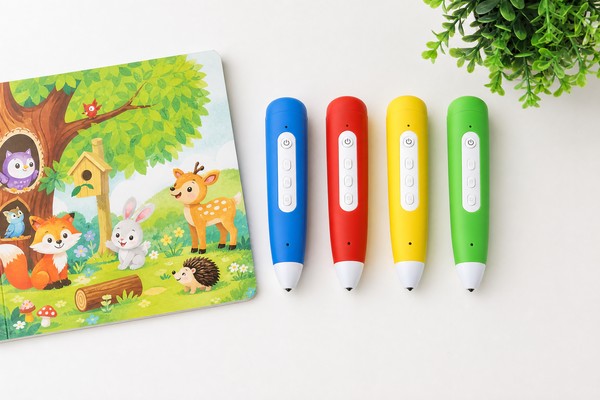
A Picture Book Reading Pen is a hand-held educational device for children. The pen contains:
– a small processor and speaker,
– optical/audio decoding or RFID/NFC reader to map pen taps to audio clips,
– a rechargeable battery and charging interface (micro-USB, USB‑C, or proprietary),
– user interface (LEDs, buttons), and
– housing sized to be handheld by children (typically 120–160 mm long).
Primary users and channels:
– End users: children age 2–10 and their caregivers.
– Buyers: educational publishers, distributors, white‑label toy brands, e‑commerce retailers, and school procurement.
– Markets: global — EU, US, China, Southeast Asia, Latin America. Each market has overlapping but distinct regulatory and transport requirements.
Battery-related product constraints:
– Product runtime expectations typically 6–24 hours play time depending on battery capacity (300–1,200 mAh).
– Size/weight constraints favor single-cell pouch (Li‑Po) 3.7 V solutions.
– Safety expectations are high due to use by children; buyers and marketplaces will demand documented safety testing.
Why Demand Is Growing
Demand for talking book pens continues to rise for three reasons relevant to battery selection and safety:
– Product proliferation: New content partners and publishers require white-label hardware. Manufacturers must scale production and standardize battery procurement to support multiple SKUs.
– Regulatory pressure and retailer policies: Major retailers and e‑commerce platforms now require robust battery safety documentation to reduce recalls and carriage denials. Buyers increasingly require IEC 62133 and UN38.3 prior to purchase.
– Logistics complexity: Cross-border distribution and air freight of battery-containing devices require compliance with transport regulations; buyers expect suppliers to handle documentation and packaging.
Consequences for buyers:
– Sourcing must include battery compliance as a line item in RFQs.
– Buyers should expect longer lead times for cells/packs with completed certification.
– Non-compliant shipments risk rejection by carriers, fines, or product seizures.
Key Technology Differences
Choosing cell chemistry and pack design requires evaluating trade-offs: energy density, safety, cost, weight, charge architecture, and certification complexity.
Common options for talking book pens:
- Lithium‑ion / Lithium‑polymer (Li‑ion / Li‑Po) pouch cells
- Nominal voltage: 3.6–3.7 V per cell.
- Typical single-cell capacities for pens: 300–1,200 mAh.
- Charge voltage (per cell): 4.20 ±0.03 V (standard CC/CV).
- Advantages: highest energy density, compact packaging, mature supply chain.
- Primary safety controls required: protection PCB (overcharge, over-discharge, short-circuit, overcurrent), thermistor (NTC) for temp cutoffs, mechanical protection.
-
Certification: UN38.3 for transport; IEC 62133-2 for safety acceptance.
-
Lithium Iron Phosphate (LiFePO4)
- Nominal voltage: ~3.2–3.3 V per cell; charge to ~3.6 V.
- Lower energy density (≈60–80% of Li‑Po), heavier but intrinsically more thermally stable and less prone to thermal runaway.
- Advantages: better abuse tolerance and cycle life.
-
Disadvantages: requires voltage architecture change or boost conversion to reach audio electronics 3.7 V targets; higher cost and size trade-offs make it uncommon for pens.
-
Nickel-based (NiMH)
- Nominal voltage per cell: 1.2 V; impractical for single-cell pen designs; lower energy density and older tech.
- Use only for very low-cost designs if avoiding lithium entirely.
Battery pack components to compare:
– Cell model and supplier (brand, cell dimensions, capacity stated).
– Protection PCB (number of MOSFETs, overcurrent threshold, balance if multi-cell).
– Thermistor placement: recommended NTC (e.g., 10 kΩ at 25°C) embedded in cell pouch close to anode.
– Charging interface and IC: must implement CC/CV for Li‑ion; typical charge current 0.5C (for 500 mAh, 250 mA charge current recommended).
– Connectors, housing adhesives and mechanical retention (prevent puncture).
Regulatory/standards differences:
– UN38.3 is a transport test sequence applied to cells and complete batteries.
– IEC 62133 covers safety and abuse tests for portable sealed secondary cells and batteries used in consumer products — it addresses design and manufacturing safety (battery-level).
– Country-level or retail requirements (GB standard GB31241 in China, UL standards in North America) may require additional evidence or tests.
Key Features and Specifications to Evaluate
When specifying or evaluating battery suppliers and packs for talking book pens, require the following minimum items in RFQs and supplier QC packages:
Essential battery specifications
– Cell chemistry, nominal voltage, rated capacity (mAh) — measured at C/5 to C/10 discharge per IEC or vendor spec.
– Physical dimensions and mass tolerance.
– Cycle life (e.g., ≥300 cycles to 80% capacity at 0.5C charge / 1C discharge) with test reports.
– Internal resistance (mΩ) and tolerance.
– Charge/discharge ratings: recommended charge current (mA), max charge current (C-rate), recommended discharge cut-off voltage, continuous and peak discharge current.
– Charge profile: CC/CV parameters, charge termination criteria.
Safety and compliance documents (must be supplied)
– UN38.3 test report for the cell and, where applicable, for the assembled battery pack.
– IEC 62133 certificate or test report for the assembled battery pack (IEC 62133-2 for Li-ion).
– MSDS (Material Safety Data Sheet) for the cells/pack.
– Certificate of Conformity/Declaration of Conformity (CE) referencing applicable directives for the device (RoHS, EMC if applicable).
– Cell manufacturer’s traceability (batch codes), origin country.
Battery pack design and protection
– Protection PCB schematic and BOM; provide overcharge cutoff (typical 4.25 V threshold per cell with hysteresis), over-discharge cutoff (typical 2.4–2.8 V), overcurrent trip (example: 3–6 A depending on design), short-circuit response time.
– Thermistor specification and placement; suggested NTC 10 kΩ at 25°C and temp cutoff thresholds (e.g., disable charging >60°C).
– Mechanical retention and insulation to prevent puncture or terminal short.
Transport and packaging
– Battery Wh calculation: Wh = Vnom * Ah. For a 3.7 V 1000 mAh cell, Wh = 3.7 * 1.0 = 3.7 Wh.
– For spare batteries and small devices, ensure compliance with IATA/ICAO watt-hour limits for carriage on passenger aircraft (≤100 Wh no airline approval; 100–160 Wh airline approval required; >160 Wh generally prohibited).
– Packaging to prevent short circuits and prevent activation: cells individually insulated; packs secured in inner packaging; limited quantities marked if eligible.
QA and production
– Incoming inspection criteria: OCV, internal resistance, capacity sampling plan (e.g., sample size per ISO 2859).
– Aging and formation: recommend 24–72 hour formation cycling, capacity test and balance, and sample destructive/abuse testing per IEC 62133 during PPAP.
– Factory audit requirements: ISO 9001, IECQC, and evidence of operator training for battery assembly and ESD control.
User-facing specs and labeling
– Battery capacity and nominal voltage on product label.
– Safety warnings in user manual: charging instructions, Do not puncture/short, storage temp, disposal/recycling instructions.
– Proper transport and handling labels for shipments: UN numbers, battery handling marks, and DGR paperwork for air shipments.
Pros and Cons
This section compares the practical pros and cons of typical battery choices and procurement strategies for talking book pens.
Li‑Po pouch single-cell (common)
– Pros: Highest energy density for small volume; lightweight; straightforward CC/CV charging; wide supplier base; cost-efficient at scale (cell cost $1–$4 per 300–1200 mAh cell depending on volume).
– Cons: Requires protection PCB; more sensitive to physical damage and swelling; requires strict QC and certification.
LiFePO4 single-cell
– Pros: Superior thermal stability and cycle life; lower risk of thermal runaway.
– Cons: Lower energy density (bigger/heavier for same runtime); higher component count if voltage step-up is needed; less common for pen designs.
Non-lithium (e.g., NiMH)
– Pros: Simpler transport rules and lower regulatory friction.
– Cons: Much lower energy density, heavier or bulkier, worse user experience (shorter runtime) — rarely used.
Sourcing strategies
– OEM direct sourcing from recognized cell brands
– Pros: Better traceability and reliable quality; easier to get UN38.3 and IEC test reports directly from manufacturer.
– Cons: Higher cost and MOQ; lead times.
– Buying unbranded cells from third-party packers
– Pros: Lower unit cost and flexible MOQ.
– Cons: Higher risk of counterfeit or substandard cells; harder to obtain valid test documentation; potential regulatory rejection.
In-house battery pack assembly
– Pros: Full control over protection PCB and assembly; easier to match form-factor.
– Cons: Requires significant process controls, destruct/abuse testing, and factory audit; increases CAPEX for assembly jigs; increases supplier liability.
Contracting certified battery pack makers
– Pros: Pre-tested packs, reduced certification overhead, faster time-to-market.
– Cons: Less control over cell source unless contract specifies cell brand.
Step-by-Step Decision Guide
This is a practical procurement and compliance checklist for buying battery packs/cells for talking book pens.
- Define product battery target
- Required runtime (hours), target capacity (mAh), size envelope (mm), target weight.
-
Example: 8 hours continuous playback → estimate 250 mA average draw → select ~800 mAh cell (3.7 V).
-
Choose chemistry and cell form factor
- Default: single-cell Li‑Po pouch 3.7 V.
-
Consider LiFePO4 only if fire-safety vs weight trade-off is acceptable.
-
Set mandatory compliance requirements in RFQ
- Ask suppliers to include: UN38.3 test report (cell), IEC 62133-2 report (pack), MSDS, cell datasheet, factory audit certificate, and sample QC reports.
-
Require traceability: cell model, batch number, date code.
-
Require protection and charging specifications
- Protection PCB specs, thermistor details, maximum continuous and peak discharge currents, recommended charge current (e.g., 0.5C), and recommended charge IC or reference design.
-
If USB charging: require USB-C or micro-USB safety compliance (overcurrent, short-circuit protection within charger IC).
-
Sample verification and testing
- Request 10–20 samples including third-party lab tests or have your own vendor send samples to a lab.
- Perform incoming testing: OCV, capacity (C/5), internal resistance, mechanical inspection.
-
Perform abuse tests on sample units (overcharge, short-circuit, crush) per IEC 62133 if not already covered.
-
Audit and capability assessment
- Factory audit: supplier must have documented process for cell handling, ESD control, assembly, bonding, and final test.
-
Verify formation and aging process, cell storage conditions, and traceability.
-
Certification and transport documentation
- Ensure UN38.3 report lists the cell model explicitly and that samples were drawn from production lot or representative lot.
- For packs, ensure test report refers to the final assembled pack.
-
Prepare transport paperwork (Dangerous Goods Declaration, packing list, UN numbers) and ensure packer knows labelling and marking requirements (UN numbers, lithium-ion handling label).
-
Contract clauses
- Insert warranty, indemnity for non-compliance, sampling rights for independent testing, and recall procedures.
-
Include MOQ, lead times, and penalties for delayed delivery or failing to provide valid compliance documents.
-
Pre-shipment checks and batch testing
- Perform random sample testing per agreed acceptance sampling plan.
-
Check packaging and labeling matches dangerous goods requirements before releasing to carriers.
-
Ongoing QA and re-certification
- Establish periodic re-testing schedule (e.g., every 12 months or when cell supplier changes).
- Consider third-party lab retest of a sample from production lots.
Pricing and Cost Analysis
Sourcing cost drivers for battery-enabled pens:
Unit-level BOM example (indicative)
– Cell (3.7 V, 800 mAh Li‑Po): $1.20–$3.00 per unit depending on brand and volume.
– Protection PCB (small 3–5 component MOSFET/IC PCB): $0.40–$1.00 per unit.
– Charger IC and passive components: $0.10–$0.50.
– Mechanical integration, adhesive, thermistor, connectors: $0.20–$0.50.
– Assembly and testing overhead (per unit amortized): $0.30–$1.00.
Typical total battery pack cost (assembled): $2.20–$6.00 per unit for volumes 10k–100k.
Certification and testing (one-time or periodic)
– UN38.3 testing (cell): $2,000–$6,000 per cell type depending on lab and region.
– UN38.3 test for assembled packs or for multiple variants increases cost; budget $3,000–$10,000.
– IEC 62133 testing / certification: $5,000–$15,000 depending on test scope and iterations.
– Third-party lab retest and CB/UL evidence: $1,500–$10,000 more if UL listing is required.
– MSDS and paperwork: minimal ($200–$500) but necessary.
– Factory audits (SGS/Intertek): $1,500–$6,000 per audit depending on scope and travel.
Logistics and shipping
– Dangerous goods surcharges: carriers often add 10–30% to freight for battery-containing shipments, and airfreight may be refused by some carriers if paperwork is incomplete.
– Special packaging and inner packaging materials will add per-shipment cost (cartons, separators, insulation).
– Insurance premiums may increase for hazardous shipments.
Forecast example for a 10k-unit run (very approximate)
– BOM battery cost: 10k units * $4.00 = $40,000.
– Certification (one-time): UN38.3 + IEC 62133 + audit = $20,000 (mid-range).
– Per-unit amortized certification overhead: $20,000 / 10,000 = $2.00.
– Effective additional per-unit battery cost: $4.00 + $2.00 = $6.00 (pack cost including certification amortization).
Negotiation levers
– Volume: cell cost drops significantly at scale (multi 10ks→$1.20 per 800 mAh cell).
– Standardization: using the same cell across SKUs reduces repeated testing.
– Supplier audits: certified pack makers with existing UN/IEC evidence reduce one-time costs.
Competitive Landscape
Supplier types and where to source:
- Tier‑1 OEM cell manufacturers
- Examples (industry-known brands): LG Chem, Samsung SDI, Panasonic/Sanyo, BYD, EVE Energy.
- Advantages: consistent quality, traceable documentation, likely to provide UN38.3 and IEC test support.
-
Disadvantages: higher price and higher MOQ; some brands restrict direct sales to certified pack makers.
-
Contract battery pack assemblers (pouch cell packers)
- Specialize in integration and protection PCB assembly with small MOQ capabilities.
- Often offer pre-certified pack families for consumer devices.
-
Choose a packer with IEC 62133 experience and a track record for UN38.3 documentation.
-
Local third-party suppliers
- Advantages: lower cost and flexibility; commonly used for low-cost toys.
-
Risks: counterfeit or re-labelled cells, missing or forged test reports, inadequate traceability.
-
Test labs and certification bodies
- Major global labs: SGS, Intertek, UL, TÜV Rheinland, Bureau Veritas.
- They provide UN38.3 testing, IEC 62133 testing, and factory audits.
Retailer and platform policies
– Major e-commerce marketplaces and retailers demand battery test documentation pre-listing. Examples:
– Amazon: strict lithium battery policies; sellers must provide UN38.3 and often supplier test reports.
– Brick‑and‑mortar distributors will require IEC 62133 or equivalent.
Market signals for buyers
– Buyers increasingly prefer suppliers who can provide ISO 14001 (environmental), ISO 9001 (quality) and documented traceability.
– Suppliers that offer pre-certified battery families (UN38.3 and IEC 62133) reduce buyer risk and speed up time-to-market.
What Buyers Say
Common recurring points from procurement teams sourcing talking book pens:
- “UN38.3 and IEC 62133 are non-negotiable.” Retailers and import customs often refuse shipments without both.
- “Price differences between certified and uncertified cells are real but not worth the risk.” Buyers report recalls and rejected shipments cost far more than certification.
- “Lead time creep is the problem.” Certification and lab re-testing, plus drawing samples for labs, add 4–12 weeks to new SKUs.
- “We need better chain-of-custody from suppliers.” Traceability (lot numbers, date codes) reduces risk of counterfeit or substituted cells and is required for warranty claims.
- “Air freight can be refused even with docs if labeling or packaging is wrong.” Buyers emphasize confirming carriers’ DGR departments before booking air cargo.
- “Local regulations vary.” EU distributors request CE and RoHS evidence; some countries (e.g., China) require GB standard compliance (GB31241) for imported mobile-powered devices.
Lessons learned from buyers:
– Standardize on one cell family across SKUs.
– Require supplier to maintain third-party testing and to notify buyers of any cell design or supply changes.
– Maintain a small buffer stock of validated, certified cells to avoid production hold-ups.
Safety, Maintenance and Compliance
Safety requirements and best practices for design, end-user instructions, and shipping.
Mandatory tests and their purpose
– UN38.3 (Manual of Tests and Criteria, Part III, Sub-section 38.3)
– Purpose: ensure safe transport behaviour.
– Test sequence (cells and batteries): altitude simulation, thermal test, vibration, shock, external short circuit, impact (cells), overcharge (batteries), forced discharge (cells).
– Result: a UN38.3 test report with sample details; must include sample traceability.
- IEC 62133 (portable sealed secondary cells and batteries)
- Purpose: safety under reasonably foreseeable conditions of use and misuse.
- Tests include: overcharge, external short-circuit, forced discharge, mechanical shock, vibration, thermal tests and thermal stability/abuse tests.
- Certificate or test report demonstrates compliance with safety design and manufacturing.
Transport regulations and designations
– UN Numbers:
– UN3480 — Lithium-ion batteries (cells or batteries, standalone).
– UN3481 — Lithium-ion batteries packed with or contained in equipment.
– Air carriage:
– IATA/ICAO Dangerous Goods Regulations apply. Spare lithium-ion batteries on passenger aircraft: ≤100 Wh allowed without airline approval; 100–160 Wh require airline approval; >160 Wh generally prohibited.
– Packaging must prevent short circuits and activation; inner packaging must fully insulate terminals.
– Documentation: Shipper’s Declaration for Dangerous Goods if required; for some limited quantities and packed with equipment consignments the declaration may not be required but the marking and documentation differ.
– Sea carriage:
– IMDG Code classifies lithium batteries as Class 9 dangerous goods and requires UN numbers, stowage instructions, and packing instructions.
– Road/rail:
– ADR/RID and 49 CFR (USA) cover road and rail transport; packaging and labelling rules apply.
Device and user safety instructions (must be in manual)
– Charging: only use the supplied or specified charger; charging current and voltage limits; avoidance of incorrect chargers.
– Temperature: charge and use within manufacturer temperature limits, typically 0°C–45°C for charging and -20°C–60°C for storage.
– Do not disassemble, puncture, crush, short-circuit, or incinerate battery.
– Storage for long term: store at 30–50% state of charge in cool, dry place (15–25°C).
– Disposal: instruct users to recycle per local regulations; provide collection information and labeling per battery directives.
Product labeling (minimum)
– Battery type and rated capacity (mAh), nominal voltage (V), and country of origin.
– Recycle symbol and disposal instructions; where applicable, crossed-out wheelie bin marking required by EU Battery Directive.
– For shipments: UN number marking and lithium battery handling label as per transport regulation.
Maintenance and QC in production
– Implement incoming inspection criteria: OCV tolerance, internal resistance limit (e.g., <300 mΩ for small pouch cells), physical integrity checks.
– Aging: formation cycles and capacity test before assembly; sample destructive testing for mechanical robustness.
– Batch retention and traceability: retain samples from each batch for at least 12 months for potential investigation.
Recall and incident handling
– Have a documented plan: stop shipments, isolate remaining stock, notify buyer/retailer, cooperate with investigation, engage lab for root-cause analysis.
– Insure for product liability and include clear recall procedures in supplier contracts.
Frequently Asked Questions
What documents must my supplier provide before I place a mass order?
– Mandatory: UN38.3 test report for the cell (and pack if shipped as UN3480/UN3481), IEC 62133 test report or certificate for the pack, MSDS, cell datasheet, production QC procedures, and evidence of factory audit. Request sample test results from recent production lots.
Is UN38.3 required for all shipments?
– Yes. Any lithium cell or battery transported by air, sea, road or rail must have UN38.3 testing performed and a test report available. Carriers may refuse shipments without it.
Does IEC 62133 replace UN38.3?
– No. IEC 62133 is a safety standard for design and manufacture; UN38.3 is a transport test sequence. Both are commonly required by buyers and carriers.
What are the Wh limits relevant to air transport?
– Spare lithium-ion batteries: ≤100 Wh allowed on passenger aircraft without airline approval; 100–160 Wh allowed with airline approval; >160 Wh generally prohibited on passenger aircraft. Devices with installed batteries are treated differently (UN3481) but may still face carrier restrictions.
If I use a branded cell (Samsung, LG, Panasonic), do I still need tests?
– You still need UN38.3 and IEC 62133 evidence specific to the cell/pack you use and to the assembled pack. Branded cell test reports help, but manufacturers may still require that the assembled battery pack and device have safety testing for the final configuration.
What are the common causes of failed UN38.3 or IEC tests?
– Poor assembly (cold welds, inadequate insulation), inconsistent cell quality, improper protection circuitry, inadequate thermistor placement, and improper sample selection (i.e., samples not representative of production).
How often should I re-test?
– Re-test whenever cell model, supplier, pack design, or production location changes. Also establish a periodic re-test schedule (e.g., annually or when receiving a new cell lot). Some retailers require fresh documentation every 1–3 years.
Are there extra EU requirements?
– In the EU, battery labelling and disposal fall under the Batteries Directive (2006/66/EC) and the new EU Battery Regulation (increasingly enforced). CE marking for the device (EMC, RoHS) and RoHS compliance for materials may also be necessary.
Contact Toyvao
For RFQs, supplier sourcing, compliance support and coordination of testing and audits, provide the following in your initial inquiry:
– Target SKU and estimated annual volumes.
– Intended markets (EU, US, China, others).
– Required battery specs: cell chemistry, nominal voltage, target capacity, max dimensions.
– Required certificates: UN38.3, IEC 62133, MSDS, any retailer-specific documents (e.g., Amazon).
– Target lead time and target unit price.
Submit RFQ and documents to: rfq@toyvao.com or use the contact form at https://toyvao.com/contact. Include “Battery RFQ – Talking Book Pen” in subject. Provide CAD drawings of pen battery compartment, BOM, and any existing test reports if available. Toyvao can coordinate supplier identification, sample testing, lab selection (UN38.3, IEC 62133), and pre-shipment QA planning.
