
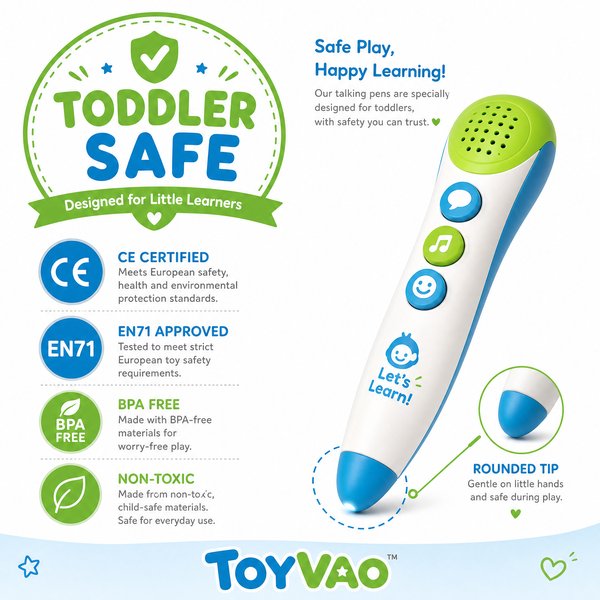
With technological advancement, talking pens have become a popular product in the children’s educational toy market. By providing interactive audio, they make learning vivid and engaging, and are especially favored by parents of preschool children. However, many parents understandably ask: are talking pens safe for toddlers? This article examines the safety, benefits, and key factors to consider when selecting a talking pen.
Safety Considerations for Talking Pens
As a type of children’s toy, safety is the primary concern for parents. The following are the main aspects to evaluate when assessing the safety of a talking pen:
1. Material Safety
High-quality talking pens are typically manufactured from durable, non-toxic, and BPA-free materials [1]. BPA is a chemical that may have negative effects on children’s health. Therefore, when selecting a talking pen, be sure to check the product specifications to ensure compliance with relevant safety standards and clear labeling as non-toxic and BPA-free [1].
2. Design and Durability
Toddlers frequently drop or chew on toys. Consequently, the talking pen’s design should be robust enough to withstand everyday drops and impacts [1]. Its shape should be easy for small hands to grip, and it should avoid sharp edges or small parts that can detach easily to prevent choking or cuts [1].
3. Battery and Charging Safety
Most talking pens use rechargeable batteries. Parents should ensure that the battery compartment and charging port are designed to be secure and not easily opened by children. Charging should be supervised by an adult, and the original or safety-compliant charging cable should be used to avoid potential electrical hazards [1].
4. Recommended Age
Although talking pens offer benefits for toddlers, most products include a recommended age range, typically 3 years and up [1] [2]. This recommendation is primarily because children under 3 may be at greater risk of ingesting small parts. Parents should carefully read product instructions and choose items appropriate for their child’s age.
Educational Benefits of Talking Pens
Beyond safety, talking pens offer notable educational benefits for child development:
1. Promote Early Literacy
Talking pens read aloud text and images, helping children form connections between sounds and written words or pictures, thereby promoting phonemic awareness, vocabulary growth, and sentence structure learning [2] [1]. This lays a solid foundation for early reading.
2. Foster Independent Learning
Talking pens allow children to independently explore book content without relying on an adult to read aloud. This self-directed learning approach helps build confidence and curiosity [2].
3. Interactivity and Engagement
Compared with traditional books, talking pens often include audio effects, songs, and games, making the learning process more engaging and stimulating children’s interest in reading [2].
4. Reduce Screen Time
Talking pens provide a screen-free interactive learning experience, which helps reduce children’s dependence on tablets or smartphones and avoids the potential harm of blue light to their eyes [2] [1].
5. Support for Multilingual Learning
Many talking pens support multiple languages, a valuable feature for bilingual families or parents who want their children to be exposed to different languages [2].
How to Choose a Safe Talking Pen
To ensure you select a safe and beneficial talking pen for your child, consider the following recommendations:
- Check materials: Prioritize products made from durable materials such as ABS plastic that are labeled non-toxic and BPA-free [1].
- Pay attention to design: Ensure the talking pen is sturdy, has no easily detachable small parts, and is easy for children to grip [1].
- Verify recommended age: Follow the manufacturer’s guidance and choose products appropriate for your child’s age [1] [2].
- Content variety: Choose products that offer a wide selection of books, flashcards, stories, and songs, and consider the expandability of available content [1] [2].
- Interactive features: Consider whether it includes recording, games, or other interactive features to enhance learning engagement [1].
Conclusion
In summary, when properly selected and used, talking pens are safe for toddlers and can serve as an important tool to support early learning and development. Parents should carefully consider a product’s materials, design, recommended age, and educational content to provide a safe and enjoyable learning experience for their children.
References
[1] Joybuy. (2026). The 2026 Parent’s Guide: Finding the Right Talking Pen for Toddlers. [https://www.joybuy.co.uk/blog/talking-pen-for-toddlers-guide/S4EcjQtN](https://www.joybuy.co.uk/blog/talking-pen-for-toddlers-guide/S4EcjQtN)
[2] Makoons. (2025). Talking Pens: A New Way for Kids to Learn Reading. [https://makoons.com/blogs/what-is-talking-pen-complete-guide-for-kids-and-parents/](https://makoons.com/blogs/what-is-talking-pen-complete-guide-for-kids-and-parents/)
