
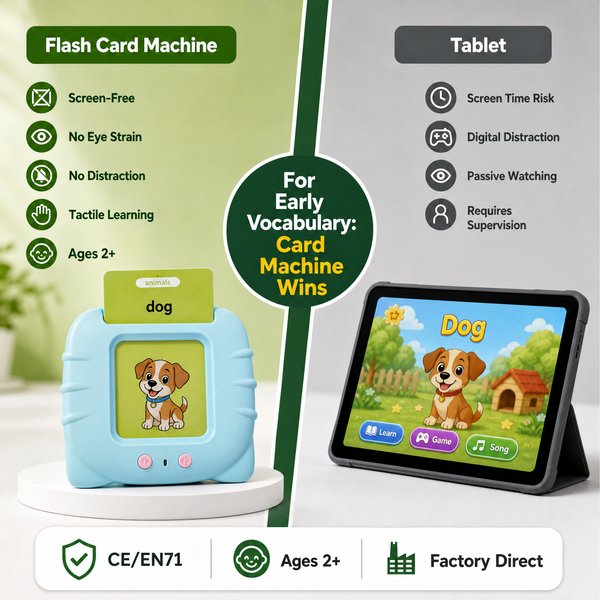
BLUF: For early vocabulary (ages 2–6), talking flash card machines are generally better than tablets when your priorities are focused, screen-free practice, durability, low-cost logistics, and native-speaker audio. Tablets win when you need multi-functional software, adaptive learning platforms, or large-screen multimedia. For most preschools, retail bundles, and ESL starter SKUs, a talking flash card machine is the smarter B2B buy.
Key decision points — “When it’s worth caring about / When you don’t need to overthink it”
1) Screen time, attention and learning focus
When it’s worth caring about: You are buying for daycare centers, Montessori classrooms, or parents who request screen-free options. Talking flash card machines remove visual distraction and protect eyesight, which research and educators favor for ages 2–6.
When you don’t need to overthink it: You are buying for older children (8+) who need interactive apps, video, or assessment dashboards. Tablets provide multi-content ecosystems that flash card machines cannot.
2) ESL quality and pronunciation
When it’s worth caring about: Your buyers are non-native speakers or you sell in ESL markets. Insist on native-speaker recorded audio (not robotic TTS) and clear enunciation. Talking flash card machines excel here because they’re dedicated audio devices — critical for phonics and pronunciation practice.
When you don’t need to overthink it: You are supplying advanced adaptive language apps with speech recognition and progress tracking — tablets and platforms handle that better.
3) Durability, classroom use and product lifecycle
When it’s worth caring about: You need rugged units for repeated use in schools. Look for drop-resistant ABS plastic housings and thick cards (typically 300g+ copperplate paper) — these survive classroom wear-and-tear better than average consumer tablets without protective cases.
When you don’t need to overthink it: You’re selling to households that expect multi-purpose devices and already plan for device replacement cycles. In that case a tablet may be acceptable.
4) Logistics, margins and e-commerce fit
When it’s worth caring about: You want light, inexpensive shipping, low storage costs, and easy SKU bundling (extra card packs). Talking flash card machines are lightweight, compact, and have high perceived value — ideal for Amazon, Shopify, and subscription box offers.
When you don’t need to overthink it: You’re bundling with apps or services requiring tablets as the anchor product.
5) Battery and maintenance
When it’s worth caring about: You want low ongoing maintenance and teacher-friendly devices. Choose units with a built-in rechargeable lithium battery (typically 300mAh), USB charging, and about 4–5 hours of continuous play—easier to manage than replaceable AAA batteries.
When you don’t need to overthink it: You have facility-level resources to handle battery replacement logistics (AAA) or enterprise tablet charging carts already in place.
Quick comparison: Talking Flash Card Machine vs Tablet
| Criteria | Talking Flash Card Machine | Tablet |
|---|---|---|
| Primary purpose | Dedicated audio-driven vocabulary & phonics practice (screen-free) | Multi-purpose: apps, video, assessment, web |
| Age suitability | 2–3 (basic words/sounds), 4–5 (phonics/math), 6+ (ESL/bilingual) | 3+ (best value for 6+) depending on apps |
| Audio quality | Native-speaker recorded audio (preferred over TTS) | Depends on app/content; TTS common |
| Screen / eye strain | Screen-free — protects eyesight | Screen-based — potential for digital distraction |
| Durability | Drop-resistant ABS plastic, thick cards (300g+ copperplate) | Fragile without cases; repair costs higher |
| Battery | Built-in rechargeable lithium ~300mAh, 4–5 hours, USB | Larger batteries, longer playtime, but chargers and carts needed |
| Logistics & cost | Lightweight, low shipping, easy to bundle (extra card packs) | Heavier, higher shipping & customs, higher unit cost |
| Certification & compliance | Ask suppliers for CE/EN71, RoHS; often easier to certify | Tablets need FCC/CE and sometimes stricter data/privacy compliance |
| Best for | Preschool classrooms, parents seeking screen-free learning, ESL starter kits | Schools needing software ecosystems, older learners, app-driven curricula |
Customer feedback synthesis (B2B buyer style)
- “Great SKU for our Amazon store — low weight, strong conversion, and we can upsell card packs. Margins are healthy.” (retailer)
- “Used in three preschools — units survive daily drops and the cards still look new after a term.” (distributor)
- “Parents appreciate the native-speaker audio; it’s noticeably better than cheap TTS tablets.” (school procurement officer)
- “We needed a bigger battery for extended daycare use; 4–5 hours is fine for short sessions but not for whole-day centers.” (early-learning buyer)
- “Some customers expected an app sync or reporting — you must set expectations that this is a single-function device.” (brand owner)
- “Packaging and instruction localization matters — one SKU sold poorly because guides weren’t translated for the local market.” (regional reseller)
Practical tips for procurement
- Specify native-speaker recordings and request sample audio files before bulk ordering (ESL markets demand this).
- Require built-in rechargeable battery (300mAh typical) and USB charging to reduce post-sales support.
- Insist on rugged ABS plastic housings and 300g+ copperplate cards for classroom durability.
- Ask suppliers for CE/EN71, RoHS and any required local safety certifications; include warranty terms in the PO (Toyvao offers a 1-year factory warranty and responsive after-sales support).
- Design SKU bundles: base unit + 2–4 themed extra card packs to increase AOV and repeat purchases on Amazon/Shopify.
FAQ
- Q: How long does the battery last and how is it charged?
A: Typical units use a built-in rechargeable lithium battery (~300mAh) that provides about 4–5 hours of continuous play and is recharged by USB (convenient for classroom or home use). - Q: Are the audio tracks native-speaker recordings or TTS?
A: For ESL effectiveness, prioritize factory models with native-speaker recorded audio. Robotic TTS is common in low-cost tablets but is less effective for phonics and pronunciation. - Q: What warranty and after-sales support should we require?
A: Request a minimum 1-year factory warranty and clear RMA procedures. Toyvao provides a 1-year factory warranty and responsive after-sales support for their talking flash card machines. - Q: Can we customize cards, languages, or branding?
A: Most manufacturers accept custom card packs, recordings, and packaging at MOQ levels. Negotiate lead times, proof approvals, and audio sample sign-off in the contract.
If you want a factory-direct talking flash card machine supplier with native-speaker audio, rechargeable battery, rugged ABS housing and 1-year warranty support, contact Toyvao for pricing, samples, and MOQ details. WhatsApp: +86 186 8106 4480 · Email: sales@toyvao.com · Website: https://toyvao.com
