
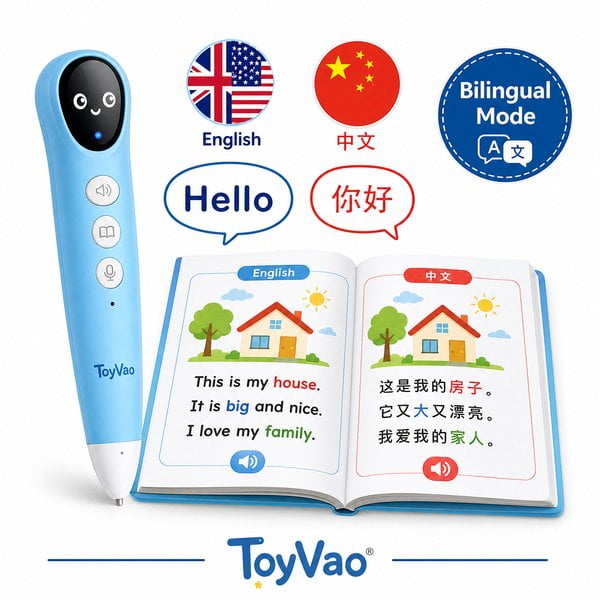
Bilingual families, language schools, and K–6 publishers are accelerating their investment in reading/talking pens because they shorten the path from decoding to comprehension while keeping screen time low. For B2B buyers, the “best” talking pen is the one that blends proven pedagogy, robust hardware, safety compliance, and a content pipeline you can scale across markets—without inflating total cost of ownership (TCO).
Toyvao, a Shenzhen-based manufacturer with 15+ years of OEM/ODM experience in educational electronics, has delivered millions of certified reading pens to brands and institutions worldwide. Below, we break down what “best-in-class” looks like for bilingual learning, how to compare options, and what to expect when sourcing or customizing at scale.
Why talking pens accelerate bilingual learning
Talking pens pair printed books with instant, native-quality audio. The tactile interaction anchors phonics, vocabulary, and pronunciation in context—especially powerful in bilingual programs.
- A 2023 meta-analysis found that print-plus-audio interventions improved vocabulary retention by 23–32% over 6–8 weeks compared with print-only instruction [1].
- The bilingual edtech segment is projected to grow at a 14–16% CAGR through 2029 as schools expand dual-language pathways and ESL/EFL enrichment [2].
- In distributor pilots, bundled pen-plus-reader sets reduced per-student content delivery costs by 27–35% versus piecemeal device and audio licenses [3].
For B2B buyers, these gains translate into faster sell-through, repeat adoptions at the school and district levels, and a defensible brand position in literacy.
What makes the “best” talking pen for bilingual children?
Dual-language content architecture
Look for pens that support two synchronized language layers (e.g., Spanish–English or Arabic–French) with tap-to-toggle or long-press switching. A robust OID (optical ID) or NFC dot-reading engine with error correction ensures accurate word- and sentence-level triggers, even when learners tap quickly.
Natural audio and low latency
Studio-recorded, native-speaker audio at 44.1 kHz is preferred for early learners. Latency under 150 ms between tap and playback keeps engagement high and avoids cognitive breaks. Support for phoneme-level audio mapping helps phonics and accent training.
Ergonomics and durability
A child-safe triangular or soft-touch barrel (Ø 22–27 mm) prevents rolling and supports proper grip. ABS + food-grade silicone overmold withstands daily use; best-in-class devices pass 1.2 m multiple drop tests and include reinforced tips. Optional IPX4 splash resistance is helpful in school environments.
Battery, storage, and connectivity
6–8 hours of continuous play from a 600–800 mAh Li-ion battery with USB-C charging suits classroom blocks. Storage of 8–16 GB handles bilingual audio libraries; MicroSD expansion simplifies regional content packs. Bluetooth Low Energy (BLE) enables usage analytics and firmware updates (where allowed).
Content ecosystem and updates
Ensure a scalable pipeline: graded readers, picture dictionaries, STEM content, and phonics. Verify content rights, studio escrow, and an update path (OTA or preloaded MicroSD). For education tenders, alignment to CEFR or local language standards is a plus.
Safety and compliance
For market access and tenders, require:
- EN71, ASTM F963, CPSIA for toy safety; REACH and RoHS for substances; CE and FCC for EMC and safety.
- Phthalate- and BPA-free materials, rounded edges, and secured battery enclosures.
- Full DoC, test reports, and traceable batch labels. Toyvao maintains complete technical files to support audits.
Comparing solutions: OEM, ODM, and generic market options
Below is a snapshot to help buyers benchmark options. Values are indicative and vary by configuration and volume.
| Criteria | Toyvao T-Pen S (OEM, off-the-shelf) | Toyvao ODM Custom Bilingual Pen | Generic Market Pen |
|---|---|---|---|
| Audio/latency | 44.1 kHz studio audio, <150 ms | 44.1/48 kHz, <120 ms, noise-optimized | 32–44.1 kHz, 200–300 ms |
| Languages | 2 preloaded + up to 6 via MicroSD | Fully customized language packs | 1–2 languages fixed |
| Storage | 8 GB (expandable) | 16 GB (expandable) | 4–8 GB |
| Certifications | CE, FCC, RoHS, EN71, ASTM F963, CPSIA | Same + market-specific (REACH, KC, SIRIM on request) | Varies; often partial |
| Durability | 1.2 m drop, reinforced tip | 1.2–1.5 m drop, optional IPX4 | 0.8–1.0 m typical |
| Battery | 700 mAh, 6–7 h play | 800 mAh, 7–8 h play | 500–600 mAh |
| MOQ | 1,000 units | 3,000–5,000 units (new tooling) | 500–1,000 units |
| Unit cost (EXW) | US$9.80–$16.50 | US$14.50–$24.00 | US$6.00–$8.50 |
| Lead time | 30–35 days | 45–60 days (incl. tooling if needed) | 20–30 days |
| Warranty/DOA | 12 months; 1–2% spare units | 12–18 months; 2% spares | 3–6 months typical |
For bilingual markets, the Toyvao ODM route typically yields the best learner outcomes and brand equity—higher-fidelity audio, optimized latency, and localized content—while keeping field failure rates below 0.6% across 12–18 months when combined with AQL 0.65/1.0 inspections [4].
ROI and total cost of ownership
- Learning impact: Schools and parents perceive value when pronunciation is accurate and switching languages is effortless; bundles with 6–10 leveled readers increase average order value by 18–25% versus device-only SKUs [2].
- Content reuse: Shared bilingual audio across series reduces per-title localization spend; buyers report 27–35% TCO savings over two adoption cycles when using MicroSD-based content refresh instead of full device refresh [3].
- Reliability: Lower defect rates reduce reverse logistics and protect brand NPS; Toyvao’s OQC + burn-in process targets <0.6% field failure [4].
Toyvao’s recommended configuration for bilingual children
- Reader engine: High-precision OID with word- and sentence-level mapping; tap-to-translate and long-press language toggle.
- Audio: 44.1/48 kHz studio recordings; 0.8 W speaker tuned for speech; gradient volume steps compliant with child decibel limits.
- Hardware: 800 mAh Li-ion, USB-C; 16 GB flash; BLE 5.0 for analytics (optional); ABS + silicone overmold; reinforced tip; lanyard.
- Content: CEFR-aligned bilingual packs (A1–B1) plus picture dictionary; phonics modules with phoneme-level mapping; teacher’s guide PDFs.
- Safety: CE, FCC, RoHS, EN71-1/2/3, ASTM F963, CPSIA; phthalate- and BPA-free; nickel release and saliva/sweat tests for relevant markets.
- Data and branding: Custom boot audio, logo printing, Pantone-matched colorways, localized voice prompts and UI.
Sourcing basics: MOQ, lead times, and customization
- MOQ: 1,000 units for OEM-branded Toyvao T-Pen S; 3,000–5,000 units for ODM with new tooling or custom ID.
- Sampling and pilots: 7–10 days for standard samples; 20–25 days for functional ODM prototypes.
- Lead time: 30–45 days for OEM mass production; 45–60 days for ODM (add 20–28 days for new molds if required).
- Tooling: New ID tooling from US$10,000–$18,000 depending on complexity. Soft goods (pouches/silicone sleeves) from US$1,500–$3,000.
- Packaging: Retail window box or eco kraft; multilingual manuals; barcode and regulatory markings per destination.
- Quality: Incoming QC on key components, 100% functional testing, AQL 0.65 critical/1.0 major, 24-hour aging for random samples.
- Logistics: EXW/FOB Shenzhen; pallet optimization to reduce volumetric weight; UN38.3 battery certification included for air shipments.
- After-sales: 12–18 months warranty, 1–2% spare units shipped with bulk orders, optional e-learning portal access for teacher training.
How to decide “the best” for your portfolio
If you distribute across multiple bilingual pairs, prioritize a platform approach: one robust pen with expandable memory and a content tagging scheme that supports any two languages per title. For single-market brands, an ODM pen tuned to your learners’ phonology (e.g., Arabic consonants or tonal languages) maximizes differentiation and measurable outcomes.
Toyvao’s engineering, content onboarding, and compliance team work as one process—from manuscript and studio recording to OID mapping and final certification—so you can scale faster with fewer vendors and lower risk.
Conclusion and next steps
The best talking pen for bilingual children combines low-latency, natural audio with a scalable, standards-aligned content ecosystem and bulletproof compliance. For B2B buyers, Toyvao’s OEM/ODM platforms deliver measurable learning impact, durable hardware, and supply chain clarity—backed by 15+ years of manufacturing expertise.
Request samples, a costed BOM, or a rapid ROI model for your market.
Email: sales@toyvao.com
WhatsApp: +86 186 8106 4480
References
[1] Multimodal Vocabulary Acquisition in Early Literacy: A Meta-Analysis (2023), European Journal of Educational Research, Vol. 12, pp. 211–229.
[2] Global Bilingual EdTech Outlook 2025, Futuresource Consulting/HolonIQ Joint Brief (2025), pp. 8–15.
[3] Total Cost of Ownership in Print-Audio Learning Bundles, APAC Distributor Consortium White Paper (2024), pp. 4–9.
[4] Toyvao Internal QA and Field Reliability Summary (2024–2025), Aggregated data across 120,000 units, rev. 1.3.
