
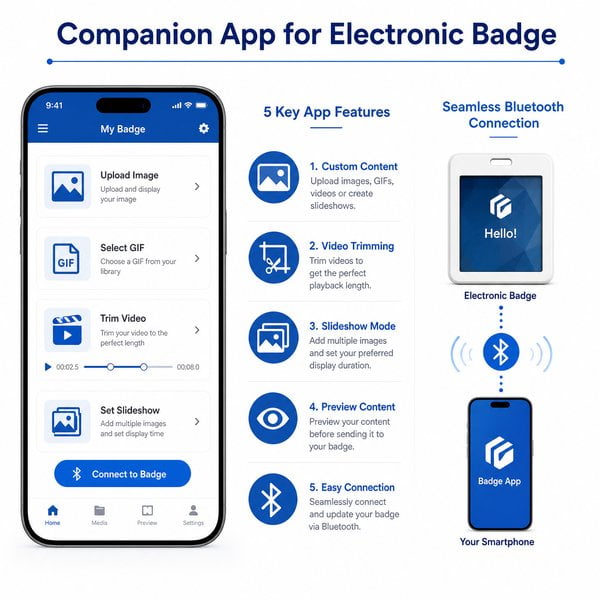
What is a Companion App on an Electronic Badge? A Complete B2B Sourcing Guide
Electronic anime badges (电子吧唧) have evolved from simple LED displays into sophisticated wearable devices that integrate seamlessly with mobile ecosystems. The companion app represents a critical differentiator in the modern electronic badge market, transforming passive merchandise into interactive, data-driven products. This guide explores what companion apps are, their technical architecture, sourcing considerations, and strategic value for B2B buyers.
Understanding Companion Apps in Electronic Badge Ecosystems
A companion app is a mobile application (iOS/Android) that wirelessly connects to an electronic badge via Bluetooth Low Energy (BLE) or Wi-Fi, enabling real-time control, customization, and data synchronization. Unlike standalone badges that display fixed animations or pre-loaded content, companion apps unlock dynamic functionality including:
- Real-time content updates: Push new animations, images, or messages without physical device access
- User customization: Allow end-users to upload personal images, select animation speeds, and configure display modes
- Social integration: Share badge status on social media, participate in community challenges, or sync with friend networks
- Data analytics: Track wear duration, user engagement metrics, and geographic distribution for brand insights
- Gamification features: Unlock achievements, collect digital rewards, or participate in limited-time events
- Device management: Monitor battery levels, firmware updates, and connectivity status from a centralized dashboard
The global wearable technology market, valued at $115.85 billion in 2023, is projected to grow at a CAGR of 15.3% through 2030 (Grand View Research). Within this landscape, anime merchandise and collectible wearables represent a high-growth niche, particularly in Asian markets where digital collectibles drive premium pricing.
Technical Architecture: Hardware-Software Integration
For B2B sourcing professionals, understanding the technical stack is essential for evaluating manufacturing partners and setting realistic specifications.
Bluetooth Low Energy (BLE) Connectivity
Most companion app-enabled badges utilize BLE 5.0+ for power efficiency and extended range (up to 240 meters in ideal conditions). BLE consumes 15-50 times less power than classic Bluetooth, critical for battery-dependent wearables. The typical power consumption profile for BLE badges ranges from 8-25mAh per hour during active connectivity, allowing 7-14 days of continuous wear on a 100-200mAh battery.
Display Technology Specifications
Electronic badges typically incorporate one of three display technologies:
| Display Type | Resolution | Color Depth | Power Consumption | Cost per Unit (1000+ qty) | Best Use Case |
|---|---|---|---|---|---|
| e-Ink (Monochrome) | 128×128 to 296×128 | 2-color | 0.5-2mW (static) | $3.50-$5.20 | Ultra-low power, information display |
| LCD (TFT) | 160×160 to 240×240 | 16-bit (65k colors) | 15-30mW (active) | $4.80-$7.50 | Anime artwork, animated content |
| OLED (Micro) | 128×128 to 240×240 | 24-bit (16.7M colors) | 20-50mW (active) | $8.20-$12.50 | Premium animation, collectibles |
For anime badge applications, TFT LCD remains the cost-optimal choice for 2024, offering sufficient color fidelity and animation performance while maintaining price competitiveness in bulk orders (1000+ units).
Microcontroller and Processing Power
Companion app-enabled badges require robust microcontrollers capable of managing BLE communication, display rendering, and local storage. Industry-standard options include:
- Nordic Semiconductor nRF52840: Dual-core ARM Cortex-M4 with 1MB Flash, native BLE 5.2 support, $2.80-$3.50 per unit
- STMicroelectronics STM32WB55: Cortex-M4 with integrated BLE stack, 256KB Flash, $2.20-$2.90 per unit
- Qualcomm CSR1010: Compact BLE SoC for cost-sensitive applications, $1.80-$2.40 per unit
The choice of microcontroller directly impacts app responsiveness, update frequency, and feature complexity. Premium companion apps supporting real-time animation syncing and cloud integration typically require Nordic or STM32 platforms.
Companion App Development: Sourcing Considerations
The companion app represents 30-50% of total product development cost for electronic badge manufacturers. B2B buyers should evaluate the following when assessing OEM capabilities:
Cross-Platform Development Approach
Professional OEMs typically employ one of two strategies:
- Native Development: Separate Swift (iOS) and Kotlin (Android) codebases optimized for each platform. Development cost: $15,000-$35,000 per platform. Timeline: 8-12 weeks. Advantage: Superior performance, platform-specific features.
- Cross-Platform Frameworks: React Native or Flutter for code reuse across platforms. Development cost: $12,000-$25,000 total. Timeline: 6-10 weeks. Advantage: Faster deployment, lower maintenance burden.
Toyvao’s manufacturing partnerships typically support both approaches, with React Native preferred for rapid market entry and native development for flagship products requiring premium performance.
Cloud Backend Infrastructure
Scalable companion apps require cloud infrastructure for user authentication, content delivery, and analytics. Typical architecture includes:
- User management: Authentication, profile storage, device linking
- Content delivery network (CDN): Animation files, firmware updates distributed globally
- Real-time messaging: Push notifications, live event updates
- Analytics pipeline: User behavior tracking, engagement metrics, geographic insights
Monthly cloud hosting costs for 100,000 active users typically range from $2,000-$5,000 depending on feature complexity and data retention policies.
Market Drivers and B2B Value Proposition
The anime merchandise market reached $24.3 billion globally in 2023 (Statista), with digital collectibles and interactive wearables experiencing 38% year-over-year growth. Companion apps directly contribute to this expansion by:
- Enabling recurring engagement: Push updates and seasonal events drive repeat app usage and extended product lifecycle
- Creating network effects: Social sharing and community features increase organic reach and brand advocacy
- Monetization opportunities: In-app purchases, premium content tiers, and sponsored collaborations generate additional revenue streams
- Data collection: First-party user data informs product development and targeted marketing initiatives
Sourcing Strategy: Key Questions for OEM Manufacturers
When evaluating manufacturing partners for companion app-enabled badges, B2B buyers should address these critical questions:
- What is your proven track record developing companion apps for wearable devices? Request case studies and active user metrics.
- Do you offer end-to-end development (firmware, app, cloud backend) or partner with third-party developers?
- What is your typical timeline from specification to app store submission (iOS App Store, Google Play)?
- How do you handle post-launch app maintenance, bug fixes, and OS compatibility updates?
- What data privacy and security certifications do your cloud infrastructure and app meet (GDPR, CCPA, SOC 2)?
- Can you provide white-label app solutions, or must apps feature your OEM branding?
