
Bottom-Line-Up-Front (BLUF)
Talking pens (specifically OID-type children’s reading pens) are a strong, cost-effective choice for early literacy engagement in classrooms, preschools, and retail bundles when you need an offline, durable, easy-to-use, tactile interactive reading aid for Ages 3+. They are not a substitute for OCR translators, general-purpose scanners, or full-feature tablets — choose an OID talking pen when you want simple point-and-play interaction with brand-matched OID-coded books, low maintenance (no apps/Wi‑Fi), 8–12 hours battery life, and minimal screen time for kids.
What a talking pen is (quick)
OID talking pens read invisible dot patterns printed on special books and play pre-recorded audio mapped to those dots. They work completely offline, require no app, Wi‑Fi, or Bluetooth, and are optimized for children’s story and activity books from the same brand. They are not OCR pens, not translation pens, and not general document scanners.
When it’s worth caring about / When you don’t need to overthink it
Compatibility (OID books)
When it’s worth caring about: You need predictable, fully synchronized audio that directly follows book content, and you plan to source OID-coded books or license content from a single supplier. Use OID pens when your product bundle or curriculum is tied to a publisher that provides compatible books.
When you don’t need to overthink it: You are stocking general-purpose assistive tools intended to read any printed text — choose OCR or scanner solutions instead.
Connectivity and Data Security
When it’s worth caring about: You require offline operation for privacy, low IT overhead, or deployments in low-connectivity schools. OID pens operate offline with no Bluetooth/Wi‑Fi/apps, minimizing network/security risk.
When you don’t need to overthink it: You want cloud features, remote content updates, or app-based classroom analytics — a Wi‑Fi/tablet-based solution is better.
Age and usability (Ages 3+)
When it’s worth caring about: You need a device that small children can hold and use independently: look for lightweight (45–85g), ergonomic grip, large audio output, one-button operation, and no screen.
When you don’t need to overthink it: Your end users are older children or adults who need advanced features like translation, OCR editing, or large-vocabulary TTS.
Budget and procurement
When it’s worth caring about: You need a lower-cost interactive device for classroom sets or retail bundles — OID pens are significantly cheaper than tablets and simpler than OCR devices. MOQ for custom OEM/ODM is typically 100–500 pcs.
When you don’t need to overthink it: You’re procuring a small number of high-end assistive tools with cloud services — tablets or OCR devices are appropriate despite higher unit cost.
Concrete product data to judge a talking pen
- Target age: Ages 3+
- Storage options: 16GB / 32GB / 64GB
- Battery life: 8–12 hours playback
- Charging: 2–3 hours via USB-C
- Audio: large clear speaker, volume control (5 levels)
- Ports/controls: 3.5mm headphone jack, volume adjustment button, simple 1-button operation
- Weight: lightweight 45–85g (child-friendly)
- Connectivity: NO Bluetooth, NO Wi‑Fi, NO app required — works offline
- Compatibility: only works with OID-coded books from the same brand
- Certifications: CE / FCC / RoHS / EN71 / ASTM / UN38.3
- MOQ for OEM/ODM custom units: 100–500 pcs
Side-by-side comparisons (winner recommendation)
Talking Pen (OID) vs Tablet
| Feature | Talking Pen (OID) | Tablet | Winner |
|---|---|---|---|
| Offline operation | Yes — fully offline | No — typically requires Wi‑Fi/apps | Talking Pen |
| Screen time | No screen — reduces eye strain | Screen — increased screen time risk | Talking Pen |
| Interactivity with physical book | Point-and-play on OID books | Limited unless special app content | Talking Pen |
| Content flexibility | Limited to OID-coded books | Highly flexible via apps/web | Tablet |
| Price / procurement for classroom sets | Lower cost per unit; suitable for MOQ 100–500 | Higher unit cost; greater support overhead | Talking Pen |
| Recommendation | Winner: Talking Pen — choose if you prioritize offline, low-cost, tactile reading tools for young children. Choose Tablet only if you need apps, analytics, and a broader content ecosystem. | ||
Talking Pen (OID) vs Audiobook
| Feature | Talking Pen (OID) | Audiobook | Winner |
|---|---|---|---|
| Interactivity | Interactive point-and-play with book pages | Passive listening only | Talking Pen |
| Physical book engagement | Direct — encourages following text and pictures | None — no direct link to a physical book | Talking Pen |
| Simplicity | Simple; single device + matching books | Very simple; no hardware beyond speaker/player | Audiobook (for simplest distribution) |
| Recommendation | Winner: Talking Pen — prefer when you want active reading engagement; Audiobooks win if you only need low-cost, passive listening experiences. | ||
OID Talking Pen vs OCR Pen
| Feature | OID Talking Pen | OCR Pen | Winner |
|---|---|---|---|
| Supported text | Only OID-coded books from same brand | Any printed text (subject to OCR limits) | OCR Pen (for flexibility) |
| Internet/app requirement | None — works offline | Often requires app or cloud processing | OID Talking Pen (for offline use) |
| Cost | Lower unit cost | Higher — specialist hardware and software | OID Talking Pen (for budget) |
| Use case | Children’s interactive reading with matched books | Translation, adult reading aids, educational scanning | Depends — OID for child literacy, OCR for broad text needs |
| Recommendation | Winner: Use OID Talking Pen for children’s reading programs and bundled book solutions; choose OCR pens when you need to read arbitrary printed text or require translation features. | ||
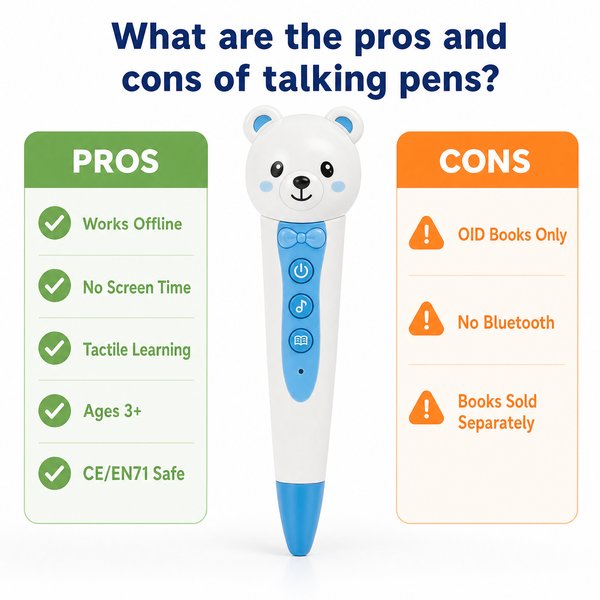
Pros and Cons (concise)
Pros
- Engaging tactile interaction: point-to-hear that links physical book and audio.
- Offline, secure operation: NO Wi‑Fi, NO Bluetooth, NO app required — works without network.
- Child-friendly design: Ages 3+, lightweight 45–85g, ergonomic grip, large audio, one-button use.
- Good battery stamina: 8–12 hours playback; 2–3 hours USB‑C charging.
- Flexible storage: 16/32/64GB for dozens to hundreds of titles.
- Accessibility features: 3.5mm headphone jack and 5-level volume control.
- Lower cost and simpler procurement for classroom or retail bundles (MOQ 100–500 for customization).
- Certifications suitable for global markets: CE, FCC, RoHS, EN71, ASTM, UN38.3.
Cons
- Content-locked: only works with OID-coded books from the same brand — limits cross-brand content flexibility.
- Not a translation or OCR tool: cannot scan or translate arbitrary printed text.
- No cloud/app management: you’ll need local processes for content updates or re-records.
- Less suitable for older students or adults who need advanced features or analytics.
Customer Feedback Synthesis
Below are representative quotes synthesized from B2B buyers evaluating OID talking pens for schools and retail.
- Positive: “Great entry-level interactive device for preschool class sets — low maintenance, long battery life, and children love pointing to pictures to hear the audio.”
- Positive: “We bundled the pens with our publisher’s storybooks and saw a measurable increase in library circulation and parent interest during open house.”
- Positive: “Factory-direct pricing from a manufacturer like Toyvao helped us hit margin targets for seasonal retail promotions and OEM packaging.”
- Negative/Concern: “Content lock-in was an issue — we had to negotiate separate book licensing instead of using our existing catalogue.”
- Negative/Concern: “Some teachers wished for simple classroom analytics or progress tracking — the offline model avoids that capability.”
- Negative/Concern: “Limited appeal for older students; we had to maintain a mixed inventory of pens and tablets for different grades.”
How to evaluate suppliers (quick checklist)
- Verify certifications: CE / FCC / RoHS / EN71 / ASTM / UN38.3.
- Check storage and battery options: confirm available 16/32/64GB and 8–12h battery spec.
- Confirm compatibility: ensure the supplier provides or licenses OID-coded book content you want to sell.
- MOQ and lead time: negotiate OEM/ODM MOQ (typically 100–500 pcs) and sample timelines.
- Ask about packaging, branding options, and content upload workflow for custom audio.
FAQ
- Q: Can the talking pen read any book I already stock?
- A: No. OID talking pens only read invisible dot patterns printed in OID-coded books from the same brand. They are not OCR pens and cannot read arbitrary printed text.
- Q: Does the pen need Wi‑Fi or an app to work?
- A: No. These OID pens work entirely offline with no Wi‑Fi, Bluetooth, or app required. Audio playback is pre-recorded and stored on the device (16/32/64GB options).
- Q: Is this suitable for preschool and kindergarten classrooms?
- A: Yes. The pen is designed for Ages 3+, with lightweight 45–85g construction, ergonomic grip, one-button operation, a 3.5mm headphone jack, and 5-level volume control. Battery life is 8–12 hours with 2–3 hours USB‑C charging, making it practical for classroom use.
- Q: Can I order customized branding or content?
- A: Yes. Many manufacturers (including factory-direct suppliers like Toyvao) offer OEM/ODM options. Typical MOQs for custom runs are 100–500 pcs—contact the supplier to discuss audio upload, packaging, and lead times.
Final takeaway
Talking pens (OID) are an excellent, low-cost, low-maintenance interactive reading tool for early childhood programs and retail bundles when your content strategy uses OID-coded books and you need offline, child-safe devices. They beat tablets for cost, simplicity, and reduced screen time; they beat audiobooks for guided, active engagement; and they are preferable to OCR when you do not need general-purpose text scanning or translation.
Contact Toyvao (factory-direct) for quotes, samples, and OEM/ODM
For factory pricing, MOQ details (100–500 pcs), certifications, or to request samples and custom content workflows, contact Toyvao:
- WhatsApp: +86 186 8106 4480
- Email: sales@toyvao.com
- Website: https://toyvao.com
Reach out with your target unit quantities, required storage/battery options, and whether you need branded packaging or content services.
