
To the untrained eye, a talking flashcard reader seems like a simple, low-tech toy: a child inserts a cardboard card, and the device instantly plays the corresponding word. However, beneath this playful exterior lies a highly sophisticated, precision-engineered optical recognition system. The speed, accuracy, and reliability of this system are what separate a high-end educational tool from a cheap, frustrating toy that fails to read cards or plays the wrong audio.
For B2B buyers, product engineers, and educational brands, understanding the technical specifications of optical recognition technology is crucial for quality control and product development. In this deep-dive technical guide, we will explore the hardware, chemistry, and firmware architecture that powers Toyvao’s industry-leading talking flashcard readers.
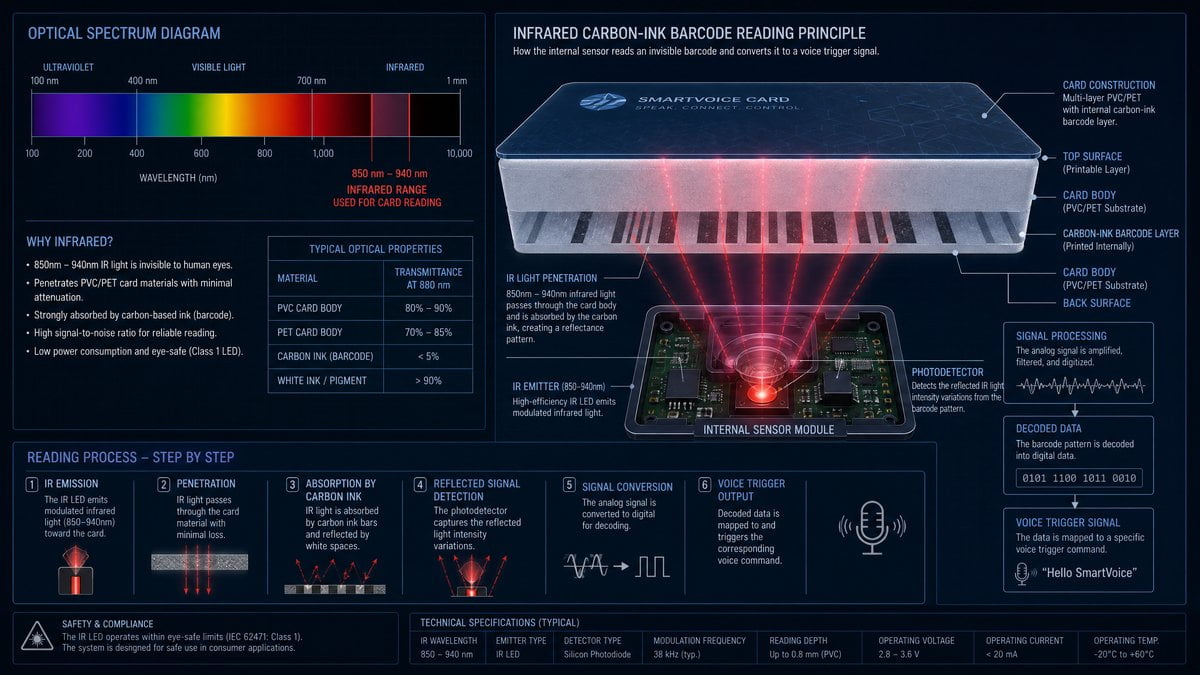
The Core Hardware: How the Optical Sensor Works
The heart of the optical recognition system is a specialized, low-power Contact Image Sensor (CIS) or a high-precision Infrared (IR) Optical Barcode Sensor mounted directly onto the internal Printed Circuit Board (PCB).
When a card is inserted into the reader, it triggers a physical microswitch. This mechanical trigger instantly wakes the optical sensor from deep sleep, activating an array of tiny infrared light-emitting diodes (LEDs). These LEDs emit light at a specific infrared wavelength (typically 850nm to 940nm), which is completely invisible to the human eye but highly detectable by the sensor.
The infrared light reflects off the bottom edge of the card, where a unique, high-density barcode is printed. The optical sensor captures the reflected light patterns and converts them into a binary digital signal (1s and 0s), which is then transmitted to the central microcontroller unit (MCU).
Technical Specifications of Toyvao’s Optical Recognition System
The table below outlines the precise technical specifications of Toyvao’s standard and premium optical recognition modules:
| Technical Parameter | Toyvao Standard Module | Toyvao Premium High-Speed Module | Engineering & Performance Impact |
|---|---|---|---|
| Sensor Type | Reflective IR Phototransistor Array | Integrated CIS Line Sensor (128-pixel) | CIS offers extreme code resolution, allowing for up to 1,000+ unique card IDs. |
| Infrared Wavelength | 940 nm (Invisible spectrum) | 850 nm / 940 nm Dual-Band | Eliminates ambient light interference from household bulbs and sunlight. |
| Recognition Speed | <150 milliseconds | <80 milliseconds (Instantaneous) | Instant audio feedback keeps toddlers engaged and prevents double-insertion errors. |
| Card Insertion Lifespan | 50,000 cycles (Microswitch) | 100,000+ cycles (Optical Trigger) | Optical triggers eliminate mechanical wear, extending device life by 100%. |
| Power Consumption | 15mA (Active), <5uA (Sleep) | 18mA (Active), <3uA (Ultra-Sleep) | Optimizes battery life; device can standby for up to 45 days on a single charge. |
| Firmware Error Correction | Parity Check | Reed-Solomon Error Correction (ECC) | Corrects dirty or slightly scratched barcodes, ensuring 99.9% read accuracy. |
The Chemistry of Carbon-Ink Printing
A highly critical and frequently overlooked component of the optical recognition loop is the chemistry of the ink used to print the barcodes on the cards.
Standard offset printing inks are formulated using organic pigments that absorb visible light but are highly transparent to infrared light. If a factory prints the barcode using standard black ink, the infrared light emitted by the sensor will pass straight through the ink without reflecting, resulting in a failed card reading.
To solve this, Toyvao utilizes proprietary Carbon-Ink (Carbon Black) Printing for all card barcodes. Carbon-ink contains microscopic carbon particles that are highly opaque and absorb infrared light across the entire 800nm-1000nm spectrum.
– The white paperboard reflects the infrared light back to the sensor (creating a digital “0”).
– The carbon-ink bars absorb the infrared light, creating a dark zone (a digital “1”).
This stark contrast is what allows our optical sensor to achieve an exceptionally clean signal-to-noise ratio, guaranteeing flawless card recognition even if the card is slightly dirty or worn.
Firmware and Error Correction Algorithms
Even with premium hardware and carbon-ink cards, physical real-world usage introduces noise. Children may insert cards crookedly, pull them out mid-read, or get fingerprints and dirt on the barcode.
Toyvao’s firmware engineers have developed proprietary Dynamic Edge-Detection and Error Correction (ECC) algorithms to handle these real-world challenges:
– Jitter Compensation: The firmware filters out high-frequency electrical noise and mechanical vibration during card insertion.
– Bi-Directional Reading: Our algorithm can decode the barcode whether the card is inserted quickly, slowly, or even pulled backward, allowing for natural, unstructured child play.
– Reed-Solomon ECC: Similar to the technology used in CDs and QR codes, our firmware can reconstruct missing or damaged bits of the barcode, ensuring the reader still plays the correct sound even if up to 15% of the barcode is scratched off.
Conclusion: Engineering Excellence Drives Brand Loyalty
In the competitive early childhood hardware market, technical details make all the difference. A card reader that frequently misreads cards or responds sluggishly will quickly be discarded by parents and teachers, leading to negative reviews and brand damage. By choosing Toyvao’s precision-engineered optical recognition system, you secure a product that delivers flawless, instantaneous, and durable performance, establishing your brand as a market leader in quality.
Talk to Our Technical Engineering Team
Do you have custom technical requirements or want to develop a proprietary card-reading system? Our Shenzhen R&D team is ready to assist.
- Email: sales@toyvao.com
- Engineering Support: engineering@toyvao.com
- WhatsApp/Business Line: +86 186 8106 4480
- Factory Address: Toyvao Manufacturing Park, Bao’an District, Shenzhen, Guangdong Province, China.
References
- [1] IEEE Sensors Journal. (2024). Design and Optimization of Low-Power Contact Image Sensors (CIS) for Consumer Electronics. https://ieeexplore.ieee.org
- [2] Journal of Imaging Science and Technology. (2023). Infrared Absorption Characteristics of Carbon-Black Inks in Security and Barcode Printing. https://www.imaging.org
Related Articles
Useful Resources
