
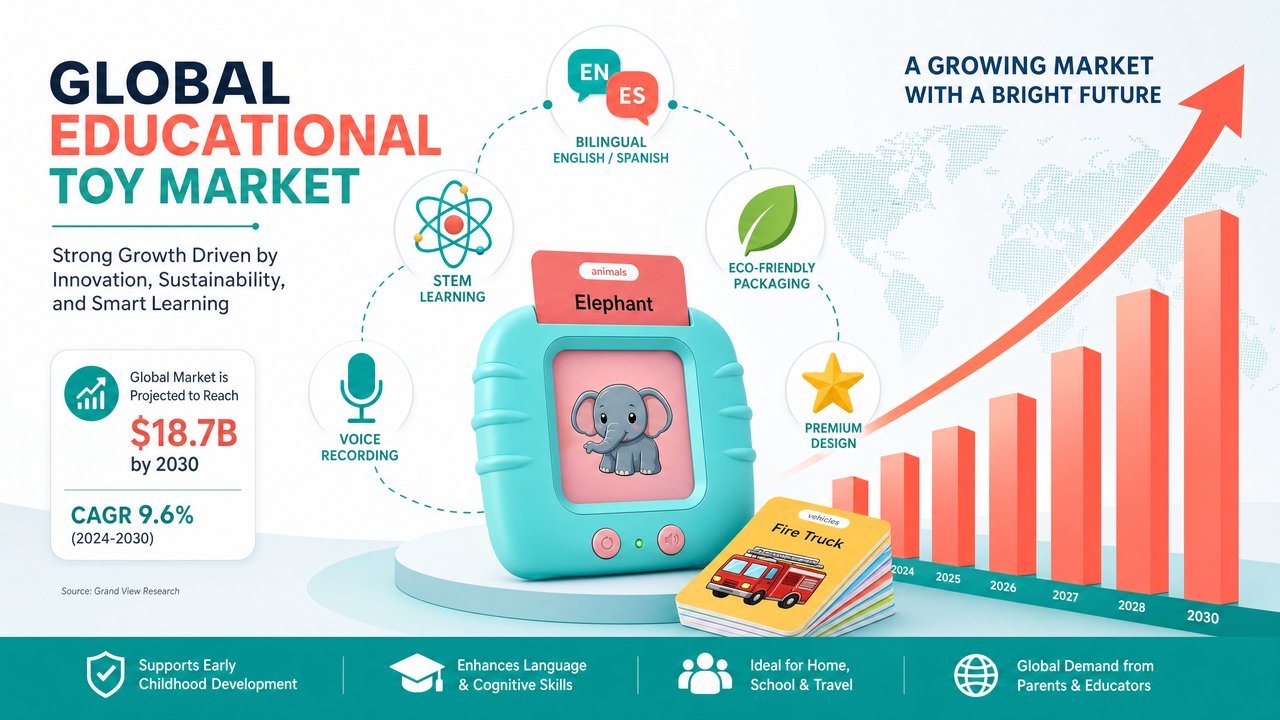
The early childhood education sector is undergoing a profound transformation. Driven by growing parental concerns over “digital strain” and screen addiction, modern parents are actively seeking physical, interactive learning alternatives [1]. In this environment, Talking Flash Cards have transitioned from a niche product into a global educational toy powerhouse.
For toy brands, distributors, and e-commerce entrepreneurs, this category offers an incredible market opportunity. However, as the market becomes more crowded, simply selling a generic, public-mold device is no longer enough to win. To build a highly profitable, sustainable brand, you must understand the underlying market drivers and learn how to effectively differentiate your product.
As a premier Shenzhen-based OEM/ODM educational toy factory, Toyvao has analyzed the latest market trends and compiled this strategic guide to help you build a best-selling talking flashcard product.
1. The Market Drivers Behind the Talking Flash Card Boom
To market and position your product successfully, you must understand why parents and educators are buying talking flash cards in record numbers:
The “Screen-Free” Parental Movement
A growing body of pediatric research highlights the negative impacts of excessive screen time on toddlers’ cognitive development and attention spans [2]. Talking flash cards offer the perfect compromise: they provide the engaging, auditory feedback of a digital tablet, but in a 100% physical, eye-safe, and screen-free format.
Alignment with Montessori & STEM Education
Modern early childhood education heavily emphasizes self-directed, sensory-based learning. Talking flash cards empower toddlers to learn independently. By physically inserting a card and hearing the corresponding sound, children engage multiple senses (sight, touch, and hearing), which drastically improves word retention and phonics development.
High Accessibility for Speech Therapy
Talking flash cards have become a vital tool in speech-language pathology, particularly for children with speech delays or those on the autism spectrum. The repetitive, clear audio feedback helps toddlers practice articulation and expand their vocabulary at their own pace.
2. 5 Strategies to Differentiate Your Product and Build a Best-Seller
If you want to stand out on Amazon, Shopify, or retail shelves, you must move beyond the basic “animal and food” card decks. Here are five high-impact product differentiation strategies that Toyvao can help you implement:
Strategy 1: Targeted Niche Content & Themes
Instead of general vocabulary, design specialized card decks targeting high-demand, underserved educational niches:
* STEM Decks: Introduce basic coding concepts, space exploration, human anatomy, or simple science experiments.
* Social-Emotional Learning (SEL): Decks focused on identifying emotions, social etiquette, and positive habits.
* Speech Therapy & Phonics: Decks specifically designed by certified speech pathologists, featuring phonics blends, mouth-movement guides, and repetitive articulation exercises.
Strategy 2: Bilingual & Multilingual Decks
Bilingual households are growing rapidly worldwide. Create dual-language decks that pronounce words in two languages sequentially (e.g., English-Spanish, English-French, or English-Mandarin). This instantly doubles your target market by appealing to immigrant families and parents eager to introduce a second language early.
Strategy 3: Advanced Hardware Features
Upgrade the standard device hardware to offer a premium user experience:
* Voice Recording Function: Add a microphone button allowing parents or teachers to record their own pronunciation or personalized encouraging messages directly onto the card.
* Interactive Quiz Mode: Add a button that challenges children to find specific cards (e.g., “Where is the apple?”), transforming passive listening into an active game.
* Bigger Battery & USB-C: Upgrade from dry AAA batteries to a long-lasting, rechargeable lithium-polymer battery with universal USB-C charging.
Strategy 4: Innovative Industrial Design
Break away from the standard “cat-shaped” or “dinosaur-shaped” plastic shells. Work with Toyvao’s industrial design team to create modern, minimalist, or highly ergonomic shapes that appeal to contemporary design-conscious parents.
Strategy 5: Sustainable & Eco-Friendly Packaging
Position your brand as environmentally conscious. Replace plastic blister trays with biodegradable sugarcane pulp trays, use FSC-certified recycled paper for the cards, and print with non-toxic, soy-based inks.
3. Product Differentiation Comparison
| Product Tier | Standard Public Mold (Low Margin) | Premium Differentiated (High Margin) |
|---|---|---|
| Card Themes | Basic Animals, Fruits, Vehicles | Phonics, STEM, Emotional Intelligence, Custom Themes |
| Languages | Single Language (English Only) | Dual-Language Bilingual (e.g., English/Spanish) |
| Hardware | Playback Only, Micro-USB | Playback + Custom Recording + Quiz Mode, USB-C |
| Packaging | Standard Color Box, Plastic Blister | Rigid Gift Box, Eco-friendly Pulp Tray, Canvas Pouch |
| Target Retail | $12.99 – $15.99 (High competition) | $29.99 – $39.99 (High brand loyalty) |
4. Leverage Shenzhen’s Supply Chain with Toyvao
Developing a differentiated, high-quality educational toy requires a manufacturing partner with strong R&D and supply chain capabilities. Located in Shenzhen, the global epicentre of electronic toy manufacturing, Toyvao provides a seamless, one-stop solution from concept design to mass production.
Our in-house R&D team consists of experienced electronic engineers, industrial designers, and early childhood content creators. We have the expertise to help you develop custom software features, design proprietary molds, and print beautiful, high-durability card decks.
Don’t compete on price—compete on value. Contact Toyvao today at sales@toyvao.com or connect on WhatsApp at +86 186 8106 4480 to schedule a video call with our product development team and start building your next best-seller.
References
- Research and Markets. (2025). Global Screen-Free Toys Market: Trends, Growth Opportunities, and Forecasts. https://www.researchandmarkets.com/reports/screen-free-toys-market
- American Academy of Pediatrics (AAP). (2024). Media and Young Minds: Cognitive Impacts of Screens vs. Physical Interactive Play. https://publications.aap.org/pediatrics/article/media-young-minds
Related Articles
Useful Resources
