
Introduction
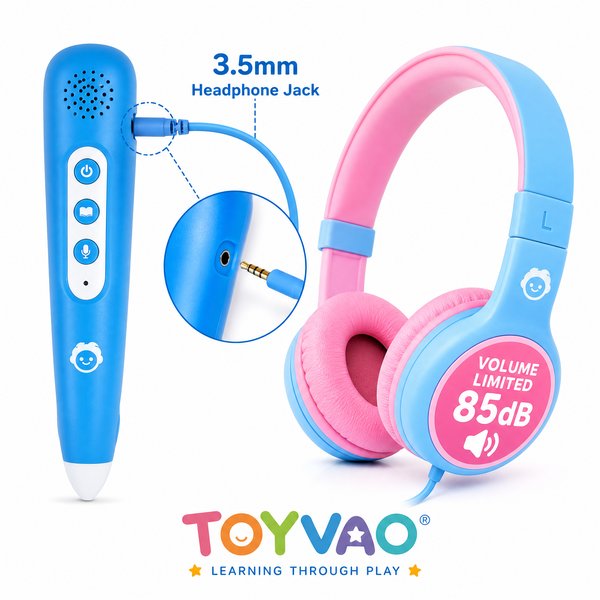
With advances in technology, digital learning tools such as reading pens have become increasingly common aids in children’s education. By providing immediate audio feedback, these tools greatly enrich the learning experience. However, a common question arises when children use a reading pen: should they wear headphones? This article examines the benefits and potential risks of children using headphones with a reading pen, and offers parents practical guidance for safe use.
Benefits of Combining Headphones with a Reading Pen
1. Improved Focus and Learning Efficiency
In noisy environments children are easily distracted. Wearing headphones can effectively block external interference and create a relatively quiet learning space, helping them concentrate on the reading pen’s content and improving learning efficiency. For example, in crowded households or public places, headphones can significantly reduce the negative impact of background noise on a child’s learning.
2. Better Audio Clarity and Listening Comprehension
Reading pens are often used for language learning, stories, or pronunciation practice. Through headphones, children can hear the sounds produced by the reading pen more clearly, including word pronunciation, intonation, and musical details. This is particularly important for language acquisition, as it helps cultivate more accurate listening comprehension and pronunciation habits.
3. Privacy Protection and Minimizing Disturbance to Others
Headphones allow children to learn without disturbing others. This is especially useful in multi-child households, libraries, or during travel, ensuring each child can have an independent learning experience while respecting the need for quiet among those nearby.
4. Personalized and Immersive Learning Experience
Headphones can provide a more immersive, personalized learning experience, allowing children to fully engage with the language environment created by the reading pen, thereby stimulating interest and improving outcomes.
Potential Risks and Concerns
Although wearing headphones offers many benefits, the potential risks cannot be ignored, particularly regarding children’s hearing health.
1. Hearing Damage: Primary Concern
Children’s auditory systems are not fully developed and are more fragile than adults’. Prolonged exposure to high volume levels—even volumes that seem moderate—can cause irreversible hearing damage [1]. The World Health Organization (WHO) recommends that daily noise exposure for children remain below 85 decibels (dBA), and for young children it is advisable to limit volume to below 70–75 dB [3]. While many headphones marketed for children claim volume limits, some products have been found in practice to exceed the manufacturers’ stated limits [4].
2. Comfort and Fit Issues
Adult headphones are typically larger and heavier and are not suitable for children. Poorly fitting headphones not only reduce comfort but can also distract children during learning. Therefore, selecting headphones specifically designed for children—lightweight and ergonomically appropriate—is essential [1].
3. Reduced Environmental Awareness
In some situations, wearing headphones can decrease a child’s awareness of their surroundings, creating safety risks. For example, outdoors or in environments where parental supervision is important, prolonged headphone use may prevent a child from noticing potential hazards in time.
4. Hygiene Concerns
If headphones are not cleaned regularly or are shared among users, they can harbor bacteria and lead to ear infections. Regular cleaning and avoiding sharing are important measures to protect children’s ear health.
How to Choose Safe Headphones for Children
When selecting headphones for children, safety should be the top consideration. The following are key purchasing guidelines:
1. Volume-Limiting Technology
Choose headphones with a hardware volume limit. Such headphones can cap the maximum output within a safe range—typically 85 dB, with a recommended 75 dB limit for toddlers [3]. Be cautious of products that rely solely on software to limit volume, as these limits can be more easily bypassed [4].
2. Comfort and Durability
Children’s headphones should be lightweight, adjustable, and equipped with soft, breathable ear pads to ensure comfort during extended use. Given children’s active nature, durability is also an important consideration [1].
3. Noise Reduction Features
In noisy environments, headphones with good passive noise reduction or active noise cancellation (ANC) can effectively reduce external noise, lowering the need for higher volumes and further protecting hearing [1].
4. Wired vs. Wireless Options
- Wired headphones: Do not require charging and provide a stable connection, but may be prone to cable tangling or damage.
- Wireless headphones (Bluetooth): Offer greater freedom of movement but require regular charging and attention to connection stability. Some wireless models also provide a wired connection option as a backup [1].
5. Built-in Microphone
For children who participate in interactive learning or online classes, headphones with a built-in microphone facilitate communication with teachers or peers.
Parental Safety Guidelines
Choosing the right headphones is not enough—parents also need to guide children in developing safe usage habits:
- Educate your child: Explain the importance of safe listening and teach them not to set the volume too high.
- Supervise use: Regularly check volume settings and limit headphone wearing time. It is recommended to take a 10–15 minute break every hour [2].
- Choose appropriate headphones: Ensure the headphones meet the safety criteria above and suit the child’s age and head size.
- Clean regularly: Keep headphones clean to prevent bacterial growth.
Conclusion
Wearing headphones while using a reading pen offers clear advantages in improving focus, audio clarity, and providing a personalized learning experience. However, parents must be fully aware of the potential risk of hearing damage and take steps to mitigate it—selecting children’s headphones with reliable volume-limiting features and teaching good usage habits will help protect children’s hearing. Balancing benefits and risks is key to ensuring healthy development for children in the digital learning era.
References
[1] The New York Times Wirecutter. (2026, March 10). The Best Kids Headphones. [https://www.nytimes.com/wirecutter/reviews/best-kids-headphones/](https://www.nytimes.com/wirecutter/reviews/best-kids-headphones/)
[2] Zhihu. (2023, July 10). Are Kids’ Headphones Really Reliable? How to Choose Bluetooth Headphones Suitable for Children — A Must-Read for Parents: Learning/Memory Tools and Gift Recommendations; Cost-Effective Over-Ear Headphones That Can Help Improve Children’s Concentration. [https://zhuanlan.zhihu.com/p/630617698](https://zhuanlan.zhihu.com/p/630617698)
[3] Headphones Addict. (2023, December 5). The Best Headphones for Toddlers in 2026 (And why avoid regular headphones). [https://headphonesaddict.com/best-headphones-for-toddlers/](https://headphonesaddict.com/best-headphones-for-toddlers/)
[4] TOM News. (2019, April 29). Thomas & Friends Children’s Headphones Launched: A Good Learning Companion for Kids. [https://news.tom.com/201904/4617238885.html)
