
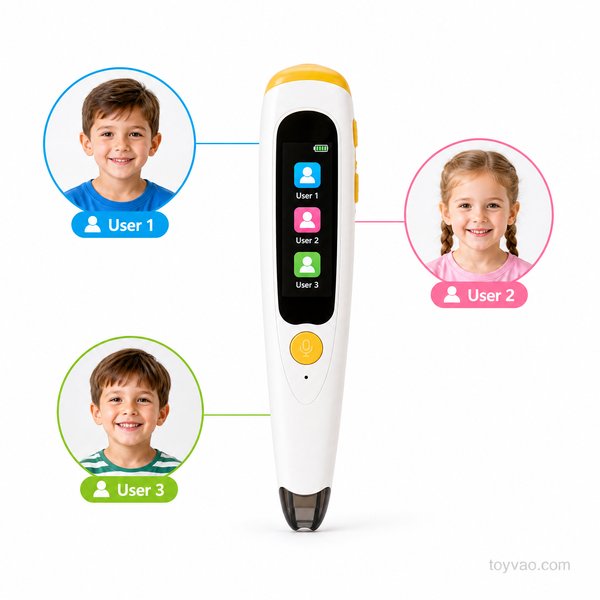
Optimizing Educational Investments: Can One Reading Pen Effectively Serve Multiple Children?
In the rapidly evolving landscape of educational technology, reading pens have emerged as powerful tools for fostering literacy and language acquisition. For B2B buyers – including importers, distributors, brand owners, and educational institutions – the question of efficiency and scalability is paramount. Specifically, can a single reading pen effectively support the learning needs of multiple children? This article delves into the technological capabilities, practical considerations, and compliance standards that address this critical inquiry, offering insights for strategic procurement.
The Core Question: Can One Reading Pen Serve Multiple Children?
The short answer is yes, with strategic implementation and consideration of specific product features. While reading pens are often perceived as personal learning devices, their design and underlying technology allow for shared usage in various educational settings. The key lies in understanding the technology and selecting pens with features that support a multi-user environment.
Understanding OID Technology and Its Implications
Toyvao’s reading pens primarily leverage **Optical Identification (OID) technology**. Unlike Optical Character Recognition (OCR) pens that scan visible text, OID pens read invisible micro-dots printed on specially prepared books and materials [1]. This technology ensures instantaneous, consistent, and fully offline audio playback, making it ideal for young learners by providing a screen-free, low-distraction experience [1, 2].
For multi-child use, the OID technology itself is inherently shareable. Any child can use the pen to interact with OID-enabled books, as the audio content is embedded within the pen and triggered by the printed material, not tied to a specific user profile on the device itself. This means that the core function of reading aloud and providing interactive feedback is readily available to all users.
Multi-User Scenarios: Practical Considerations
In classrooms, libraries, or shared home environments, reading pens can be rotated among children. Some pens even offer features like audio splitters, enabling up to five pairs of headphones to be connected to a single device for group reading activities [3]. This facilitates collaborative learning and makes the technology accessible to more students without requiring a 1:1 device ratio.
However, for optimal individualized learning and progress tracking, some advanced systems recommend or allow for individual user accounts or profiles, especially when integrated with companion apps or data management platforms [4]. While the pen’s basic function remains accessible to all, personalized learning paths or performance analytics might benefit from such configurations.
When procuring reading pens for multiple children, B2B buyers should prioritize features that enhance shared usability and educational impact.
Individualized Learning Paths and Data Tracking
While the physical pen can be shared, the learning experience can still be individualized. Modern reading pens often include features such as:
- **Multiple Language Support:** Allowing children to switch between languages for bilingual learning.
- **Built-in Dictionaries:** Providing instant word definitions to support vocabulary expansion for various users [3].
- **Audio Recording:** Enabling children to record their own voices for pronunciation practice, which can be reviewed individually [3].
For institutions requiring detailed progress monitoring, some reading pen ecosystems offer software solutions that can track individual child interactions with the pen, provided the system is designed for such data capture. This allows educators to assess comprehension and engagement on a per-child basis, even with shared hardware.
Durability and Design for Collaborative Use
Educational environments demand robust products. Reading pens designed for B2B markets typically feature durable construction (e.g., ABS plastic bodies) to withstand frequent handling and potential drops [1]. Features like long battery life (6-8 hours of continuous playback) and universal charging (USB-C or Micro-USB) are also crucial for minimizing downtime and simplifying logistics in a multi-user setting [1].
Ensuring Compliance: Essential Safety Standards for B2B Buyers
For global B2B procurement, adherence to international safety and quality standards is non-negotiable. Toyvao ensures its products meet stringent requirements to facilitate market access and guarantee child safety.
CE Marking: Accessing the European Market
The **CE Mark** is mandatory for all toys sold within the European Union. It signifies that a product complies with the EU’s harmonized health, safety, and environmental protection standards, including the Toy Safety Directive [5, 6]. For reading pens, this involves rigorous testing to ensure mechanical and physical properties, flammability, and chemical composition meet the **EN71 series of standards** [7]. B2B buyers targeting the European market must verify CE certification to ensure legal compliance and consumer trust.
For electronic educational toys destined for the United States, **FCC (Federal Communications Commission) compliance** is essential. This certification ensures that the device’s electromagnetic interference is within limits approved by the FCC, preventing interference with other electronic equipment. It’s a critical requirement for market entry and product distribution in the US [8].
EN71 and ASTM F963: Global Toy Safety Benchmarks
Beyond CE, the **EN71 standards** (e.g., EN71-1 for mechanical and physical properties, EN71-2 for flammability, EN71-3 for migration of certain elements) are globally recognized benchmarks for toy safety [7]. Similarly, **ASTM F963** is the primary toy safety standard in the United States, covering aspects from mechanical hazards to chemical content [9]. Adherence to these standards demonstrates a manufacturer’s commitment to product quality and child safety, providing B2B buyers with confidence in their procurement decisions.
Comparison of Reading Pen Features for Multi-User Environments
| Feature | Benefit for Multi-Child Use | B2B Procurement Consideration |
|---|---|---|
| OID Technology | Instant, offline audio feedback; screen-free learning. | Ensures core functionality is always available, reducing reliance on internet/apps. |
| Audio Splitter Compatibility | Enables group listening for up to 5 children. | Maximizes device utility in classroom or group settings. |
| Durable Construction (ABS Plastic) | Withstands frequent handling and drops in shared environments. | Reduces replacement costs and extends product lifespan. |
| Long Battery Life (6-8 hours) | Supports extended use throughout the school day or multiple sessions. | Minimizes charging frequency and logistical overhead. |
| Universal Charging (USB-C/Micro-USB) | Simplifies charging infrastructure; compatible with existing cables. | Streamlines maintenance and reduces proprietary accessory needs. |
| Multi-Language Support | Catters to diverse linguistic backgrounds within a group. | Expands market reach and educational inclusivity. |
| Safety Certifications (CE, FCC, EN71, ASTM F963) | Guarantees product safety and compliance with international regulations. | Essential for legal market entry and brand reputation. |
Conclusion
In conclusion, a single reading pen can indeed support multiple children effectively, particularly when the device is built with robust OID technology, designed for durability, and equipped with features that facilitate shared yet impactful learning experiences. For B2B buyers, prioritizing products that meet stringent international safety standards like CE, FCC, EN71, and ASTM F963 is crucial for ensuring compliance, market access, and the long-term success of their educational initiatives. By making informed choices, institutions can leverage reading pens to enhance literacy, promote independent learning, and optimize their educational technology investments.
Ready to source high-quality reading pens for your brand? Contact Toyvao today at sales@toyvao.com or WhatsApp us at +86 186 8106 4480 for a custom quote and free sample.
References
- Alibaba.com. (2026, April 30). OID Technology Reading Pen Guide: How to Choose Wisely. Retrieved from https://electronics.alibaba.com/buyingguides/oid-reading-pen-guide-how-it-works-what-to-choose
- Reading-Pen.com. (n.d.). What is a Talking Pen? How It Works (OID vs OCR). Retrieved from https://www.reading-pen.com/blogs/what-is-a-talking-pen-and-how-does-it-work-a-beginner-s-guide.html
- Twinkl. (n.d.). Inclusive Classrooms: 10 Top Tips for Implementing Reading Pens in your School and Classroom. Retrieved from https://www.twinkl.com/blog/inclusive-classrooms-10-top-tips-for-implementing-reading-pens-in-your-school-and-classroom
- Penpowerinc.com. (n.d.). WorldPenScan AI Reader – Reading Pen with AI Reading Buddy For … Retrieved from https://shop.penpowerinc.com/products/worldpenscan-ai-reader
- Certification-Experts.com. (2021, May 10). All you need to know about CE marking toys. Retrieved from https://certification-experts.com/all-you-need-to-know-about-ce-marking-toys/
- Alibaba.com. (n.d.). CE Certification for Toys on Alibaba.com: Your Complete … Retrieved from https://seller.alibaba.com/blogs/2026/southeast-asia/toys-hobby/ce-certification-eu-compliance-guide-alibaba-b2b
- Intertek. (n.d.). EU Toy Safety Directive | EN 71 Testing. Retrieved from https://www.intertek.com/toys-childrens-products/eu-toy-directive/
- ComplianceTesting.com. (n.d.). FCC/CE Testing & Certification for Toys & Hobby Electronics. Retrieved from https://compliancetesting.com/fcc-ce-testing-fcc-ce-certification-toys-hobby-electronics/
- CPSC.gov. (n.d.). Toy Safety Business Guidance. Retrieved from https://www.cpsc.gov/Business–Manufacturing/Business-Education/Toy-Safety
