
When importing educational toys, selecting the right manufacturing partner is the most critical decision for your brand. For B2B buyers, Amazon FBA sellers, and educational brands, a misstep in factory selection can lead to quality issues, delayed shipments, and compliance failures. According to the Toy Association, ensuring product safety and quality at the source is paramount for success in the global toy market [1]. But how do you effectively evaluate a Chinese toy factory before placing a bulk order for talking flash cards?
At Toyvao, as a leading Shenzhen-based factory specializing in children’s educational talking flash cards and walkie-talkies, we understand the intricacies of the manufacturing process. In this comprehensive guide, we will walk you through the essential criteria for evaluating a Chinese toy factory, ensuring your next bulk order is a resounding success.
1. Verify Factory Certifications and Compliance Standards
The educational toy market is heavily regulated, and non-compliance can result in severe penalties, product recalls, and brand damage. Before engaging with a factory, you must verify their certifications and adherence to international safety standards.
A reputable factory should be able to provide documentation proving compliance with standards such as ASTM F963 (US), EN71 (Europe), and ISO 9001 for quality management. The Consumer Product Safety Commission (CPSC) mandates strict testing for children’s products, including lead and phthalate limits [2].
When evaluating a factory, ask for:
– Business License and Export License: Ensure they are a legitimate manufacturing entity, not just a trading company.
– Test Reports: Request recent third-party lab test reports (e.g., SGS, Intertek) for their talking flash cards.
– Factory Audits: Look for BSCI (Business Social Compliance Initiative) or ICTI (International Council of Toy Industries) ethical manufacturing certifications.
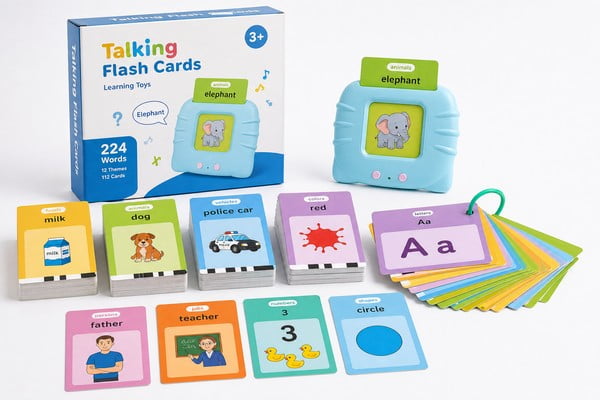
At Toyvao, we strictly adhere to these global standards, ensuring every talking flash card we produce meets the highest safety requirements.
2. Assess Production Capacity and Quality Control Processes
A factory’s ability to scale production while maintaining consistent quality is a key indicator of their reliability. You need a partner who can handle your initial bulk order and accommodate future growth.
Evaluating Production Capacity
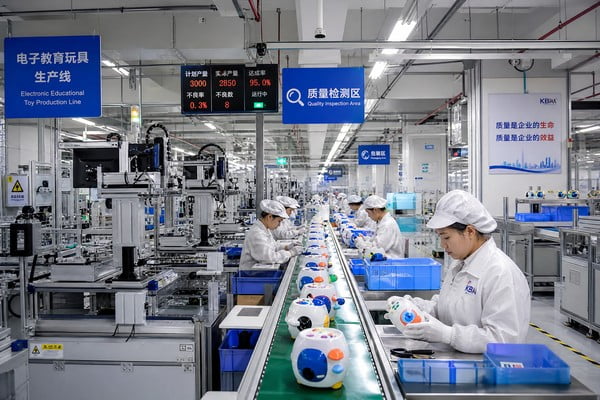
Inquire about their monthly production capacity, lead times, and peak season availability. A factory with robust infrastructure, automated assembly lines, and a skilled workforce can ensure timely delivery.
Quality Control (QC) Systems
Quality control should be integrated into every stage of production. According to a report by Grand View Research, the global educational toys market size is expected to grow significantly, making quality differentiation crucial [3].
A comprehensive QC system includes:
– IQC (Incoming Quality Control): Inspecting raw materials like ABS plastic and electronic components.
– IPQC (In-Process Quality Control): Monitoring the assembly line for defects.
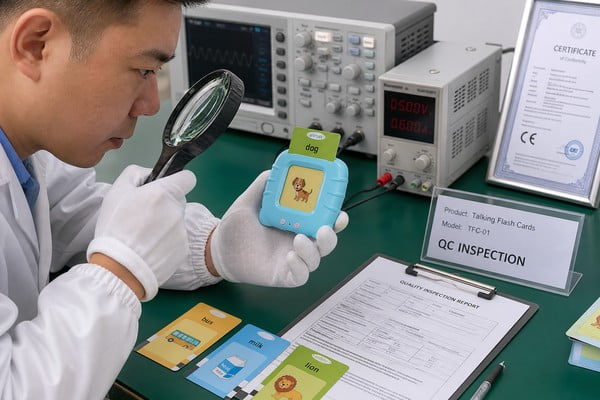
– FQC (Final Quality Control): Testing the finished talking flash cards for audio clarity, battery life, and durability.
– OQC (Outgoing Quality Control): Final inspection before shipping.
3. Analyze OEM/ODM Capabilities and Customization Options
Different buyers have different needs. Whether you are an Amazon FBA seller looking for a private label product (OEM) or an educational brand needing a completely custom design (ODM), the factory’s R&D capabilities are vital.
OEM vs. ODM Capabilities
A strong factory should offer flexible customization options, including:
– Custom Audio Content: Ability to program specific languages, accents, or educational themes into the talking flash cards.
– Packaging Design: Custom retail packaging that stands out on e-commerce platforms.
– Hardware Modifications: Adjusting the size, shape, or battery type of the flash card reader.
Cost Structure Comparison: Trading Company vs. Direct Factory
Working directly with a factory like Toyvao offers significant cost advantages compared to sourcing through a trading company. Below is a typical cost structure comparison:
| Cost Component | Sourcing via Trading Company | Sourcing Direct from Factory (Toyvao) |
|---|---|---|
| Unit Price | High (Includes middleman markup) | Low (Direct factory price) |
| Customization Fees | High (Often outsourced) | Low (In-house R&D) |
| Communication Efficiency | Low (Delayed responses) | High (Direct technical support) |
| Quality Control | Variable (Depends on the trading company) | Strict (In-house QC protocols) |
| Lead Time | Longer (Indirect coordination) | Shorter (Direct scheduling) |
4. Evaluate Communication and Long-Term Partnership Potential
Effective communication is the cornerstone of a successful manufacturing partnership. Language barriers, time zone differences, and cultural nuances can complicate the sourcing process.
When communicating with a potential factory, evaluate their responsiveness, English proficiency, and willingness to understand your business goals. A factory that asks detailed questions about your target market, compliance requirements, and product specifications is more likely to be a reliable long-term partner.
Furthermore, consider their post-sales support. Will they take responsibility for defective units? Do they offer warranties? At Toyvao, we view our clients as long-term partners, providing transparent communication and dedicated support throughout the entire production lifecycle.
Conclusion
Evaluating a Chinese toy factory requires a systematic approach, focusing on certifications, production capacity, customization capabilities, and communication. By conducting thorough due diligence, B2B buyers can mitigate risks and build a profitable, scalable business in the educational toy sector.
If you are looking for a reliable, certified, and experienced manufacturer for your next bulk order of talking flash cards, Toyvao is here to help. With our state-of-the-art facility in Shenzhen, we provide end-to-end OEM/ODM solutions tailored to your specific needs.
Ready to start your project? Contact us today!
Email: info@toyvao.com | WhatsApp: +86 186 8106 4480
References
[1] The Toy Association. “Safety & Compliance.” https://www.toyassociation.org/
[2] Consumer Product Safety Commission (CPSC). “Children’s Product Certificate (CPC).” https://www.cpsc.gov/
[3] Grand View Research. “Educational Toys Market Size, Share & Trends Analysis Report.” https://www.grandviewresearch.com/
