
BLUF — Bottom-Line-Up-Front
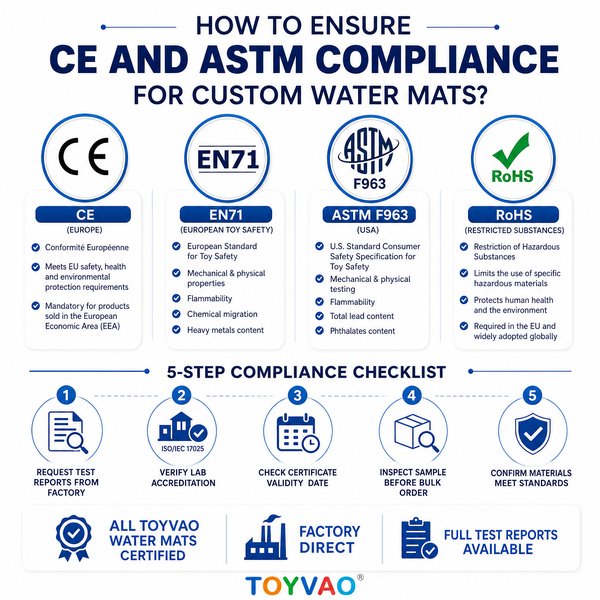
Yes — you can reliably achieve CE and ASTM compliance for custom water doodle mats by selecting certified materials (CE/EN71/ASTM compliant), embedding compliance into the OEM specification, running pre-production and type testing, and maintaining a technical file and supplier quality plan. Practical targets for planning: MOQ 1,000–2,000 pcs for OEM designs; samples in 5–7 days; mass production lead time 25–35 days. For turnkey OEM support, work with a factory-direct partner such as Toyvao to lock materials, testing labs, and labeling early in the design phase.
When it’s worth caring about / When you don’t need to overthink it
Material selection
- When it’s worth caring about: You plan to sell in the EU or US, will brand as children’s toys, use bright dyes, metal parts, or unusual adhesives, or include accessories (stamps, rollers). Use CE/EN71/ASTM compliant materials (e.g., thicker TC fabric with durable nylon borders) and request material safety data and test certificates.
- When you don’t need to overthink it: You are ordering a simple rebrand of a proven SKU with the same material spec and no added small parts—standard compliant materials and factory QA are normally sufficient.
Design customization (size, borders, packaging)
- When it’s worth caring about: Custom sizes outside the normal range (50×50 cm to 150×100 cm), custom border shapes, or printing protected IP—these can change flammability, migration, and mechanical risk profiles and trigger re-testing.
- When you don’t need to overthink it: Minor border graphics (alphabet, animals) and standard packaging swaps (color box vs window box) that do not add small detachable parts.
Accessories and bundled items
- When it’s worth caring about: Bundles that include multiple water pens, stamps, stencils, or rollers introduce choking and small-part hazard testing requirements (EN71-1/ASTM F963 mechanical tests, EN71-3 migration tests).
- When you don’t need to overthink it: Bundles with soft, large accessories already validated by the factory’s standard child safety program.
Labeling, documentation and market claims
- When it’s worth caring about: You will sell in the EU (CE marking and Declaration of Conformity required), or claim “non-toxic”/“food-grade”/“BPA-free” on packaging—these claims require supporting test reports and traceability.
- When you don’t need to overthink it: No special claims, and selling as a non-branded novelty in local markets with limited regulatory enforcement.
Practical compliance checklist (step-by-step)
- Define the final SKU: size (50×50 cm–150×100 cm), border design, packaging type, and accessories bundle.
- Specify materials in the PO: request certified TC fabric and nylon borders; demand material certificates stating CE/EN71/ASTM compliance.
- Run a prototype/sample cycle: samples ready in 5–7 days to confirm construction and accessory fit.
- Pre-test key hazards on sample: mechanical (small parts), flammability, and chemical migration (lead, phthalates) with a recognized lab.
- If tests pass, approve tooling and submit to mass production (lead time 25–35 days).
- Obtain final batch testing or a supplier declaration plus periodic third‑party testing for the first production run and after significant design changes.
- Compile the technical file: test reports, material certificates, risk assessment, User Instructions, and Declaration of Conformity (for CE).
- Label and package as required: CE mark (EU), age grading, warnings, and required language versions.
- Maintain traceability: production lot IDs, material lot numbers, and retention samples.
Comparison: compliance approach by market & business model
| Scenario | Why compliance matters | Recommended minimum actions | Typical MOQ / lead times |
|---|---|---|---|
| Small local retailer (domestic market) | Lower regulatory enforcement; reputational risk | Use factory standard CE/EN71/ASTM compliant materials; basic supplier declaration; batch inspection | MOQ 1,000 pcs; sample 5–7 days; production 25–35 days |
| Pan‑EU distribution (private label) | CE/EN71 required; legal obligations for documentation | Full EN71 testing (parts 1–3), Technical File + Declaration of Conformity, proper labeling | MOQ 1,000–2,000 pcs; sample 5–7 days; production 25–35 days |
| US mass retail (big box) | ASTM F963/ CPSIA enforcement; retail buyers require test reports | Third‑party ASTM F963 tests, lead and phthalates testing, certificate of conformity, periodic re-testing | MOQ 2,000+ recommended; sample and test time adds 2–3 weeks; production 25–35 days |
| Licensed IP / custom tooling | Higher legal and product risks (branding + small parts) | Full testing, tighter QC, retention sample program, warranty terms in contract | MOQ 1,000–2,000+; allow extra 1–2 weeks for compliance iterations |
Recommended testing matrix (minimum)
- Mechanical and Physical: EN71‑1 / ASTM F963 mechanical tests (small parts, sharp points, tensile strength of attachments).
- Chemical: EN71‑3 migration of certain elements; phthalates and heavy metals per EU and US limits.
- Flammability: EN71‑2 flammability testing for textile surfaces if the mat uses fabric layers.
- Labeling/Documentation: EU Declaration of Conformity, CE mark evidence, US Certificate of Conformity (CPC where required), and test reports from accredited labs (SGS, Intertek, TÜV, UL, etc.).
Factory QA & supply chain controls
- Lock down raw material specs and request certificates before production.
- Implement incoming material inspections and in-line QC checkpoints for seam strength, pen fit, and water retention.
- Use retention samples from each production lot for possible re-testing.
- Require the factory to provide batch-level traceability and a signed supplier declaration for compliance items.
Customer Feedback Synthesis
Below are synthesized quotes reflecting realistic B2B buyer feedback — useful when planning compliance for custom water mats.
- “Positive: The factory provided EN71 test reports and material certificates before we placed the order — it sped up our importer review.” — Regional toy distributor
- “Positive: Sample turnaround (5–7 days) let us verify the thicker TC fabric and reinforced nylon border before committing to a 1,500‑unit order.” — Private label brand
- “Positive: Bundling extra pens and stencils as OEM options helped us create a higher-margin SKU that passed ASTM testing without redesign.” — E‑commerce buyer
- “Concern: We underestimated re‑testing time when we changed border artwork — added two weeks and extra lab fees.” — School procurement officer
- “Concern: Initial shipment lacked full technical files for EU customs; we needed the supplier to send missing Declaration of Conformity.” — European distributor
- “Concern: Some accessories required separate small‑part testing which we only discovered after pre-shipment inspection — avoid surprises by clarifying accessory specs early.” — Big-box retail buyer
OEM/ODM considerations — how Toyvao can help
As a factory-direct OEM partner, Toyvao supports material specification, sample production (5–7 days), and coordinated testing plans before mass production (25–35 days). Key OEM customization options to lock in early: size (50×50 cm to 150×100 cm), border design (alphabet, animals, custom IP), packaging (color box, window box, polybag), and accessory bundles (pens, stamps, stencils, rollers). Standard OEM MOQ for custom packaging/design is typically 1,000–2,000 pcs. Use a partner that provides material certificates (CE/EN71/ASTM compliant materials) and can assist with technical file assembly.
FAQ
- Q: What tests are mandatory for CE marking of a water doodle mat?
A: For the EU, you generally need EN71-1 (mechanical/physical), EN71-2 (flammability) if applicable, and EN71-3 (migration of certain elements). You must compile a Technical File and issue a Declaration of Conformity before placing the CE mark on the product. - Q: Do I need separate ASTM testing to sell in the US?
A: Yes — US retailers commonly expect ASTM F963 compliance and CPSIA-related chemical testing (lead, phthalates). Use accredited third‑party labs for official test reports accepted by US buyers. - Q: Will changing the mat size or adding stamps require re-testing?
A: Size changes alone may not require full re-testing if materials and construction remain unchanged, but adding small detachable accessories (stamps, small pens) typically requires mechanical/small‑part testing and possibly chemical tests for those items. - Q: How long does the compliance process add to lead time?
A: Plan for sample testing to add 1–3 weeks depending on the scope and lab availability. Samples: 5–7 days; mass production: 25–35 days. Third‑party testing and certification cycles can run another 1–3 weeks.
Final recommendations
- Start compliance planning at the concept stage — lock material specs, packaging, and accessory list before tooling.
- Budget for testing early: include sample lab fees, potential re-tests for artwork/tooling changes, and documentation work.
- Require your OEM to provide CE/EN71/ASTM material evidence and help assemble the Technical File and DoC.
Contact Toyvao for factory-direct OEM support
For OEM/ODM quotes, testing coordination, and sample requests contact Toyvao — WhatsApp: +86 186 8106 4480, Email: sales@toyvao.com, Website: https://toyvao.com. Start with your target markets, final size (50×50 cm–150×100 cm), desired accessories, and packaging choice to get a customized compliance plan and lead-time estimate.
