
1. Introduction
Children’s reading pens, as an interactive electronic learning tool, play an increasingly important role in early childhood education. By combining audio with visual stimuli, they help children naturally acquire language, knowledge, and skills through interactive listening and play. However, while enjoying the convenience and fun provided by reading pens, the impact of their volume on children’s hearing health is a critical consideration that must not be overlooked.
2. Why Volume Matters
A child’s auditory system is still developing and is far more sensitive to sound than an adult’s. Prolonged exposure to excessively high volume can cause irreversible damage to a child’s hearing, leading to hearing loss or even deafness. In addition, overly loud volume can distract a child’s attention and affect learning outcomes, and may cause noise disturbances in public settings. Therefore, the volume design of reading pens is of vital importance.
3. Safe Volume Standards and Recommendations
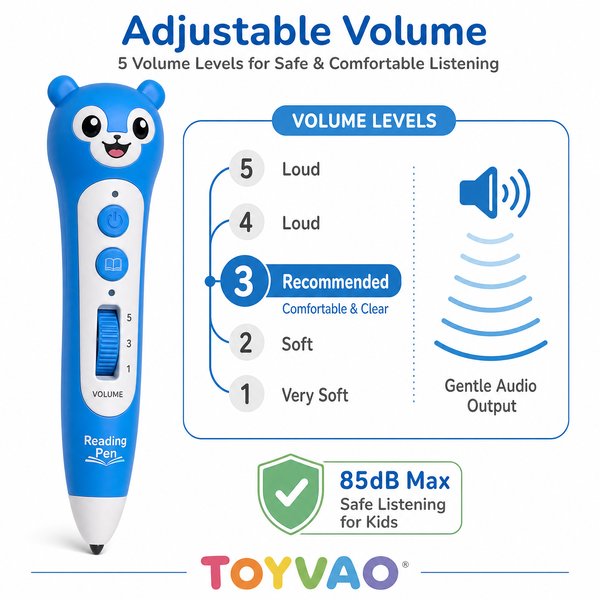
To protect children’s hearing health, many professional organizations and studies recommend that the maximum volume of electronic devices used by children should not exceed 85 decibels. This level is considered safe and unlikely to cause hearing damage even with extended listening. Therefore, when choosing a reading pen, parents should prioritize products that explicitly indicate volume safety limiting features and ensure the maximum output stays within a child-safe hearing range.
Adjustable Volume
Reading pens should provide multi-level volume adjustment so parents can set the sound appropriately based on the environment and the child’s hearing sensitivity. For example, a lower volume can be used in a quiet home, while a slightly higher level may be appropriate in noisier settings, but always within safe limits.
Headphone Support
Headphone jacks are especially important when using reading pens in public places (such as libraries or cafés) or in environments that require quiet. They not only prevent disturbing others but also help protect the child’s hearing by isolating external noise and reducing the need to increase volume.
High-quality Speakers
The speaker quality of a reading pen directly affects a child’s perception of phonemes. High-quality speakers deliver clear, natural, and non-harsh sound, reducing the need to raise volume due to poor audio quality and thereby indirectly protecting hearing. Some brands use speaker sizes ranging from 28mm to 36mm to provide better sound quality.
Default Low-volume Startup
Some reading pens are designed to start at a low default volume, which effectively prevents children from being startled by sudden high-decibel sounds when the device is powered on, demonstrating careful consideration for children’s hearing health.
5. How to Choose a Reading Pen with Appropriate Volume
When purchasing a reading pen, parents should consider volume safety as a key factor in addition to learning content and device features:
- Prioritize brands and models with volume safety limits: Carefully read product documentation to confirm whether it meets children’s hearing safety standards.
- Check for volume adjustment and headphone support: These features provide more flexible and safer hearing protection for children.
- Pay attention to speaker sound quality: Test the pen’s audio to ensure the sound is clear, gentle, and free of noise or harshness.
6. Parental Guidance and Supervision
Using reading pens is not a one-time solution; parental guidance and supervision are equally important. Parents should:
- Regularly check and adjust the volume: Ensure the pen’s volume remains within a safe range.
- Limit usage time: Avoid prolonged continuous use; recommend taking breaks every 30–60 minutes.
- Develop proper hearing protection habits: Teach children not to hold the pen close to their ears and not to rely on high volume in noisy environments.
7. Conclusion
Children’s reading pens are a powerful tool to support learning, but their volume design and usage directly affect children’s hearing health. By choosing reading pens that include volume safety limits, adjustable volume, headphone support, and high-quality speakers, and by providing proper parental guidance and supervision, we can ensure children enjoy the learning experience while maintaining healthy hearing and laying a solid foundation for their future development.
References
- [1] Mr Little Feet — One Step at a Time. What Is a Reading Pen? At What Age Can It Be Used? | Recommended Reading Pens for Young Children. https://mrlittlefeet.store/blogs/kidsread-talking-pen/readingpenguide?srsltid=AfmBOoqhWC3xWRGsmORw6YssGV2JqTAV8nkrc3wp8TvmFEPGy5qI2dcA
