
Bottom-Line-Up-Front (BLUF)
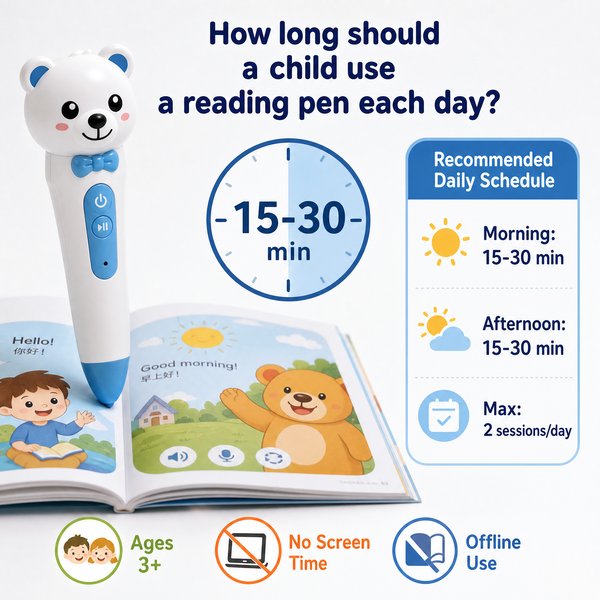
For most children using a reading pen (ages 3+), target 15–30 minutes per session and no more than 2 sessions per day (30–60 minutes total). That rhythm balances attention and retention for preschoolers, preserves battery life (8–12 hours typical), and reduces overstimulation. For classroom or targeted interventions (phonics practice, dyslexia support, speech delay reinforcement), you can schedule additional short, structured sessions—but keep individual sessions short and supervised. Toyvao offers factory-direct OID reading pens (16/32/64GB, 8–12h battery, 2–3h USB‑C charging) designed for this pattern and for offline, safe use.
When it’s worth caring about / When you don’t need to overthink it
Battery life
When it’s worth caring about: If you need full-day classroom rotation or long field trips, choose the 8–12 hour battery range and plan charging windows—multiple pens or charging docks help. Battery runtime matters more when pens will be used repeatedly across classes without access to charging.
When you don’t need to overthink it: For home use or a single reading corner (one or two short sessions per child each day), the standard 8–12h battery and 2–3h USB‑C charge time is more than adequate.
OID compatibility (special books)
When it’s worth caring about: If you plan to sell bundled solutions, curriculum packs, or school kits, you must buy OID-coded books from the same brand—OID pens only read the invisible dot patterns printed on compatible books.
When you don’t need to overthink it: If you’re purchasing pens for parent gifts or as add-ons to a single branded book set, simply match the pen to the brand’s OID titles and you’re done.
Storage (16/32/64GB)
When it’s worth caring about: If you intend to preload large libraries, bilingual audio tracks, or multiple grade levels on the device for classroom rotation, opt for 32GB or 64GB.
When you don’t need to overthink it: For single-title packs or small curated sets, 16GB is usually sufficient.
Special needs support (dyslexia, speech delay)
When it’s worth caring about: If the pen will be used as part of a multi-sensory intervention plan (audio + tactile engagement) or in collaboration with therapists, consider increased session frequency but keep sessions short (10–20 minutes) and documented.
When you don’t need to overthink it: For general classroom inclusion or screening, follow the standard 15–30 minute sessions and use the pen as a supportive, non-diagnostic tool.
Quick device facts (concrete data)
- Ages: 3+
- Recommended daily use (ages 3–6): 15–30 minutes per session, max 2 sessions/day
- Storage: 16GB / 32GB / 64GB
- Battery: 8–12 hours playback; charging 2–3 hours via USB‑C
- Audio output: 3.5mm headphone jack; volume adjustment button
- Connectivity: NO Bluetooth, NO Wi‑Fi, NO app required — works OFFLINE
- Technology: OID (invisible dot pattern) — works only with OID‑coded books from the same brand
- Certifications: CE, FCC, RoHS, EN71, ASTM, UN38.3
- MOQ for OEM/ODM customization: 100–500 pcs
Recommended daily-use comparison table
| Use case | Session length | Sessions per day | Notes |
|---|---|---|---|
| Preschool / Ages 3–6 | 15–30 minutes | Max 2 | Best for attention spans and retention; aligns with Toyvao usage guidance. |
| Early readers / Ages 6–8 | 20–30 minutes | 1–2 | Can extend practice for phonics; still break into short focused sessions. |
| Older children / 9+ | 20–45 minutes | 1–3 (with breaks) | Use for independent reading or revision; watch for screen/audio fatigue. |
| Classroom rotations / Phonics stations | 10–20 minutes per child | Multiple rotations | Short, repeated practice across the day supports skill building without overload. |
How pens support learning (practical activities)
- Point-and-read: Child touches words or pictures to hear the audio line by line.
- Repeat-after-me: Built-in model pronunciation followed by child repetition.
- Word hunting: Timed or guided searches for target words or phonemes in a book.
- Story sequencing: Play segments in order and ask the child to reorder physical cards or pages.
Special needs and targeted support (non-diagnostic, evidence-aligned)
- Dyslexia-friendly: Multi-sensory combination (audio + tactile pointing) reduces pressure, reinforces decoding, and can lower reading anxiety.
- Speech delay support: Provides clear pronunciation models and repetition opportunities to build motor planning and auditory memory.
- Note: These pens are supportive tools and not clinical diagnostic devices—use alongside specialist guidance where appropriate.
Teacher use cases
- Reading corners and independent stations—short, supervised sessions encourage practice without overtaxing attention spans.
- Phonics practice—targeted repetition for specific phonemes or word families.
- Bilingual support—preloaded audio tracks in multiple languages (if provided by the publisher) help with listening comprehension.
Limitations — what the pen is not
- Not a translation pen: It plays pre-recorded audio only for OID-coded books, not live translation.
- Not a scanner/OCR pen: It cannot read arbitrary printed text unless that text is embedded in an OID-coded book.
- Not cloud-connected: No Bluetooth/Wi‑Fi/apps; content updates require file transfers via USB or swapping preloaded units.
Production & compliance (procurement notes)
- MOQ for custom OEM/ODM: 100–500 pcs—plan lead times and sample approvals accordingly.
- Safety & transport: CE, FCC, RoHS, EN71, ASTM, and UN38.3 certifications included for most configurations.
- Factory-direct option: Toyvao offers factory-direct supply and can preload OID book packages to simplify distribution.
Customer Feedback Synthesis
Below are representative buyer-style quotes aggregated from reseller and school procurement feedback.
- Positive: “Battery life is predictable—8–12 hours easily covers a week of light classroom use. Great for our kindergarten reading corner.”
- Positive: “Offline, no‑app design simplifies deployment across many schools—no network setup or privacy headaches.”
- Positive: “Preloading multiple levels on 64GB units let us rotate materials across three grades without swapping devices.”
- Concern: “OID-only books mean we had to reorder brand-specific titles; inventory planning is more complex than generic pen solutions.”
- Concern: “Teachers requested docking/charging stations for faster turnover—single USB‑C charging is fine but slow for high-volume classrooms.”
- Concern: “Some schools wanted Bluetooth/wireless for analytics; this offline model is safer but limits remote reporting.”
FAQ
-
Q: Is it safe for a preschooler to use the pen for 30–60 minutes daily?
A: Yes—structured sessions of 15–30 minutes with a maximum of 2 sessions per day are recommended for ages 3–6. Supervision is advised for device handling and to reinforce learning. The pen is certified (CE/FCC/EN71/ASTM/RoHS).
-
Q: Can the pen read any book or scanned page?
A: No—the pen uses OID technology and only reads invisible dot patterns printed on compatible OID-coded books from the same brand. It is not an OCR or scanner pen.
-
Q: How do we update or change audio content?
A: Content updates are performed by preloading audio files via USB or by ordering units preloaded by the manufacturer. Because the device is offline (no Wi‑Fi/Bluetooth), remote updates are not supported.
-
Q: Is this suitable for dyslexia or speech delay interventions?
A: The pen supports multi-sensory learning and repetition, which can reduce reading anxiety and provide clear pronunciation models. It is a supportive educational tool and should be used alongside specialist plans when addressing diagnosed conditions.
Next steps / Call to action
If you’re specifying reading-pen solutions for retail or school procurement, contact Toyvao for factory-direct pricing, OEM/ODM options (MOQ 100–500 pcs), and sample units. WhatsApp: +86 186 8106 4480. Email: sales@toyvao.com. Website: https://toyvao.com
