
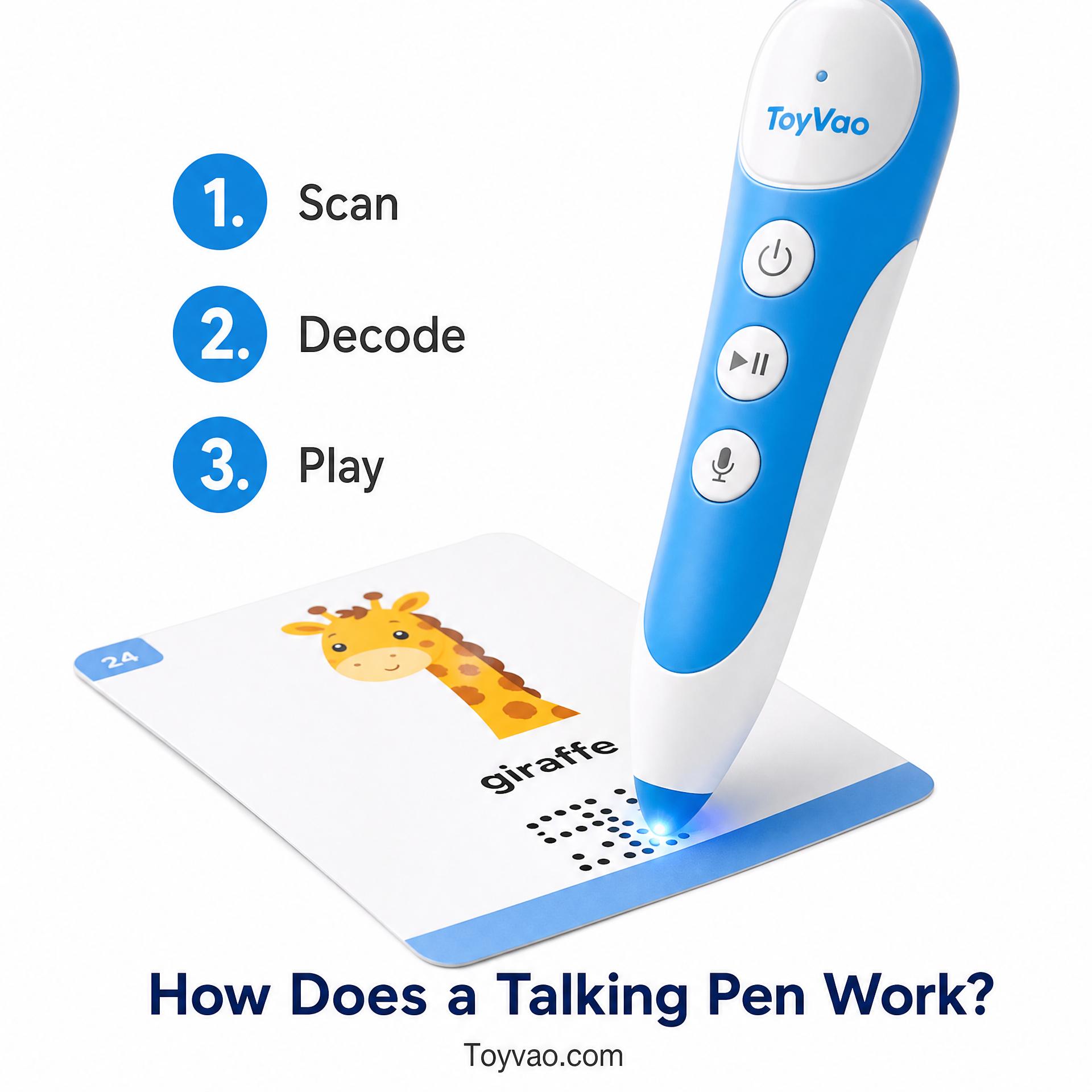
How Does a Talking Pen Work?
A talking pen, also known as a reading pen or smart pen, is an innovative electronic educational toy designed to bring printed materials to life by playing associated audio when tapped on specific areas. It works by combining advanced optical recognition technology with embedded audio playback capabilities, allowing users, especially children, to interact with books and learning cards in a dynamic and engaging way. This seamless interaction transforms traditional learning into an immersive auditory experience, significantly enhancing comprehension and retention.
The Ingenious Technology Behind Talking Pens
The magic of a talking pen lies in its sophisticated internal components and the specially prepared printed materials it interacts with. The core functionality revolves around three main technological pillars: sensing, data mapping, and audio playback.
Sensing the Printed World
At the heart of every talking pen is a tiny optical sensor or infrared (IR) camera located at its tip. This sensor is designed to read microscopic patterns or codes printed on the pages of compatible books or talking flash cards. These patterns are often invisible to the naked eye, appearing as regular print, but they contain unique identifiers for each specific spot on the page. When the pen’s tip touches a word, image, or symbol, the optical sensor captures this pattern. Some simpler designs might use physical contact detection, capacitive sensors, or barcode-like strips, but the microdot technology is prevalent for its precision and versatility.
Mapping Location to Audio
Once the optical sensor captures the unique pattern ID from the printed material, the pen’s internal processor decodes this information. This decoded ID is then cross-referenced with an internal database stored within the pen’s flash memory. This database contains a comprehensive mapping table that links each specific pattern ID (representing a page and coordinate) to a corresponding audio file or a precise timestamp within a larger audio file. For more advanced or connected talking pens, this mapping might occur via a paired app or cloud service, allowing for dynamic content updates and reducing the need for extensive on-device storage. This mapping process is instantaneous, ensuring a fluid user experience.
Bringing Sound to Life: Audio Playback
After successfully mapping the pattern ID to its associated audio, the talking pen retrieves the relevant audio segment from its internal flash memory. These audio files are typically stored in compressed formats like MP3, WAV, or AAC to balance quality and capacity. The pen then uses a digital-to-analog converter (DAC) to transform the digital audio data into an analog signal, which is then amplified and played through a miniature speaker integrated into the pen’s body. Many talking pens also include a 3.5mm jack or Bluetooth connectivity for headphone use, offering a personalized listening experience. Controls for volume, play/pause, and navigation are usually accessible directly on the pen, ensuring ease of use for children.
Enhancing Learning: Features and Benefits of Reading Pens
Talking pens are more than just gadgets; they are powerful educational tools that offer a multitude of features designed to enhance the learning process, particularly for young learners and those acquiring new languages. Manufacturers like Toyvao, specializing in electronic educational toys, leverage these features to create engaging and effective learning solutions.
Interactive Learning and Language Acquisition
One of the primary benefits of a reading pen is its ability to provide immediate audio feedback. Children can tap on words, sentences, or pictures to hear them pronounced correctly, aiding in vocabulary development, pronunciation, and reading comprehension. For ESL learners or those studying foreign languages, the multi-language support often found in these pens is invaluable. They can switch between languages, hear translations, and practice speaking with the pen’s recording function. This interactive approach makes language learning less intimidating and more enjoyable.
Recording and Personalization
Many talking pens come equipped with a built-in microphone, allowing users to record their own voices. This feature is particularly useful for practicing pronunciation, recording notes, or even creating personalized audio content for books. For instance, a child can record themselves reading a story, then play it back to compare with the pen’s pre-recorded narration. This self-assessment capability fosters independence and builds confidence in reading and speaking skills.
Accessibility and Engagement
Talking pens significantly improve accessibility for children with diverse learning needs, including those with dyslexia or visual impairments. The word-level audio playback and the ability to adjust playback speed can make reading less challenging. Furthermore, the engaging nature of these devices—turning passive reading into an active, auditory adventure—captures children’s attention and maintains their interest in learning for longer periods. This is crucial in the development of foundational literacy skills.
The Educational Toy Market and the Role of OEM/ODM
The global educational toy market is experiencing robust growth, driven by increasing parental awareness of early childhood development and the integration of technology into learning. According to Grand View Research, the global educational toys market size was estimated at USD 54.00 billion in 2023 and is projected to reach USD 118.79 billion by 2030, growing at a CAGR of 8.53% [1]. This expanding market presents significant opportunities for manufacturers and brands alike.
Market Dynamics and Growth
The demand for interactive learning tools like talking pens and talking flash cards is a key driver within this market. Parents are increasingly seeking products that offer both entertainment and educational value, preparing their children for a technology-driven future. The rise of digital learning platforms further complements the use of physical interactive toys, creating a hybrid learning environment.
OEM/ODM Partnerships in Educational Toys
For brands looking to enter or expand within this lucrative market, partnering with experienced OEM (Original Equipment Manufacturer) and ODM (Original Design Manufacturer) providers is crucial. Companies like Toyvao specialize in developing and manufacturing custom electronic educational toys. An OEM partnership allows a brand to produce its own design using the manufacturer’s facilities, while an ODM partnership offers a complete solution, from product design and development to manufacturing, based on the brand’s specifications. This enables brands to quickly bring high-quality, certified products to market without the need for extensive in-house manufacturing capabilities.
Choosing the Right Talking Pen: A Comparison
When selecting a talking pen or developing one for your brand, understanding the different types and their capabilities is essential. Here’s a comparison of common features:
| Feature | Basic Talking Pen (e.g., simple reading pen) | Advanced Talking Pen (e.g., smart reading pen) |
|---|---|---|
| Sensing Technology | Physical contact, simple barcodes | Optical/IR camera, microdot patterns |
| Audio Storage | Limited internal memory | Larger internal memory, cloud integration |
| Connectivity | USB for file transfer | USB, Bluetooth, Wi-Fi |
| Recording Function | None or basic voice recording | Advanced voice recording, playback, comparison |
| Content Updates | Manual via USB | Automatic via Wi-Fi/app, dynamic content |
| Interactive Features | Tap-to-read words/phrases | Word-by-word highlighting, games, quizzes |
| Multi-language Support | Limited or single language | Extensive multi-language options |
| Price Point | Lower | Higher |
Ready to Source Talking Pens & Reading Pens for Your Brand?
Toyvao is a Shenzhen-based OEM/ODM manufacturer specializing in electronic educational toys, including talking pens, reading pens, and talking flash cards. With 15+ years of experience and CE/FCC/EN71/ASTM certifications, we help global brands develop custom reading pen products from concept to shelf. – Email: sales@toyvao.com – WhatsApp: +86 186 8106 4480 – Website: https://toyvao.com
References
[1] Grand View Research. (2023). Educational Toys Market Size, Share & Trends Report, 2030. Retrieved from https://www.grandviewresearch.com/industry-analysis/educational-toys-market-report
