
Running a successful pre-sale or crowdfunding campaign is only half the battle. The true challenge begins the moment the campaign ends and you must fulfill your promises to your backers. Delays in manufacturing are the number one cause of backer dissatisfaction. To ensure a smooth transition from pre-sale to mass production, B2B buyers must establish a rigorous collaboration workflow with their talking flash card factory.
Why Is Pre-Sale Factory Collaboration So Difficult?
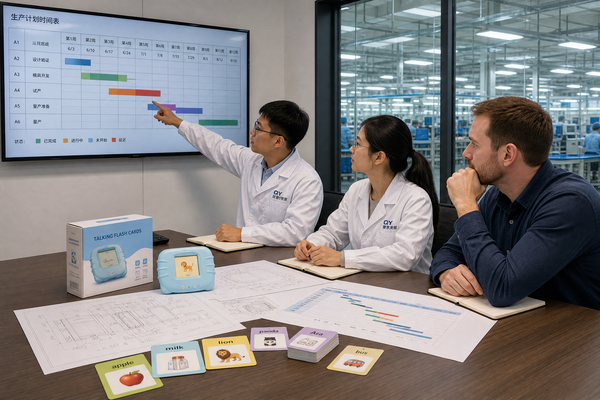
During a pre-sale, you are selling a promise. The final product specifications often evolve during the campaign based on backer feedback (e.g., unlocking a “stretch goal” for a new language pack or a silicone protective case). If the factory is not kept in the loop regarding these changes, the resulting miscommunication leads to production delays and cost overruns.
The U.S. Consumer Product Safety Commission (CPSC) notes that rushing production to meet delayed fulfillment deadlines often leads to skipped quality control steps and subsequent safety recalls [1]. A structured workflow prevents this dangerous scenario.
How to Structure the Post-Campaign Manufacturing Workflow?
A seamless transition from a funded campaign to mass production requires clear milestones and constant communication.
- The “Design Freeze” Phase: Immediately after the campaign closes, all product specifications must be finalized. If stretch goals were unlocked (e.g., adding 50 more flashcards), the factory must update the Bill of Materials (BOM) and the audio chip capacity requirements. Once agreed upon, the design is “frozen”—no more changes are allowed.
- Tooling and Golden Sample Approval: The factory begins cutting the steel injection molds for the plastic housing. Once the molds are finished, the factory produces the first batch of actual mass-production units, known as the “Golden Samples.” The buyer must rigorously test and approve these samples before full production begins.
- Component Sourcing: The factory orders the raw materials: the MCU chips, speakers, batteries, and the specific paper stock for the flashcards. Lead times for electronic components can fluctuate, so this step must be managed proactively.
- Mass Production and QC: Assembly begins. The factory should provide regular updates and allow for third-party quality control (QC) inspections during and after production.
Pre-Sale to Production Timeline Example
| Workflow Phase | Typical Duration | Key Buyer Responsibility |
|---|---|---|
| Design Freeze & BOM Finalization | 1 Week | Confirm all stretch goals and final specs |
| Mold Creation (Tooling) | 30-40 Days | Review 3D CAD files |
| Golden Sample Approval | 1-2 Weeks | Rigorous physical testing of the final sample |
| Mass Production & Assembly | 20-30 Days | Arrange third-party QC inspection |
How Toyvao Ensures On-Time Fulfillment for Pre-Sales
At Toyvao, we have helped numerous educational toy brands transition smoothly from successful Kickstarter campaigns to mass retail. We know that your backers are waiting, and your reputation is on the line.
We assign a dedicated project manager to your account the moment you begin planning your pre-sale. We help you accurately estimate production timelines so you can set realistic fulfillment dates for your backers. Our agile supply chain allows us to quickly adapt if your campaign overfunds and you suddenly need to scale your order from 1,000 units to 10,000 units. With Toyvao, you get transparent communication, strict adherence to CPSC safety standards, and on-time delivery.
References
[1] U.S. Consumer Product Safety Commission (CPSC). “Manufacturing Standard Operating Procedures.”
[2] World Health Organization (WHO). “Improving early childhood development.”
[3] The Toy Association. “Supply Chain and Manufacturing Best Practices.”
Need a reliable manufacturing partner for your upcoming pre-sale? Contact Toyvao today!
Email: sales@toyvao.com | WhatsApp: +86 186 8106 4480
Related Articles
Useful Resources
