
Does a Talking Pen Need Batteries? A Comprehensive B2B Guide
Introduction: Powering the Future of Educational Toys
In the rapidly evolving landscape of educational technology, talking pens have emerged as a pivotal tool for enhancing literacy and language acquisition. These innovative devices, leveraging Optical Identification (OID) technology, bring books to life, offering interactive learning experiences for children worldwide. For B2B buyers—importers, distributors, brand owners, and educational institutions—understanding the operational nuances, particularly regarding power sources, is crucial for strategic sourcing and product development. The fundamental question often arises: “Does a talking pen need batteries?” The answer, while seemingly straightforward, involves considerations of technology, sustainability, safety, and cost-effectiveness that are paramount in the B2B sector.
The Core of Operation: Understanding Talking Pen Power Sources
Talking pens, at their essence, are portable electronic devices. As such, they require a power source to function. Historically, many electronic toys relied on disposable alkaline batteries. However, with advancements in battery technology and a growing global emphasis on sustainability, the trend has significantly shifted towards rechargeable solutions. Today, talking pens primarily utilize one of two battery types:
Disposable Batteries: The Traditional Approach
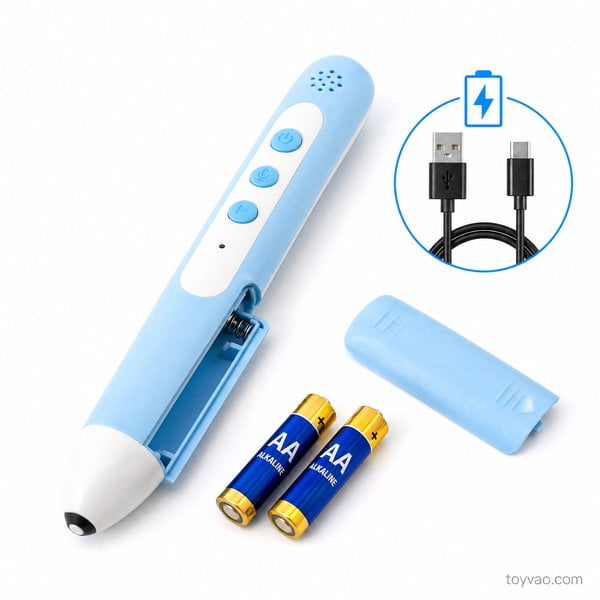
Some talking pens still operate on disposable batteries, most commonly AAA or AA types. This approach offers immediate usability out of the box, as users can simply insert readily available batteries. However, for B2B entities, this presents several long-term considerations:
- Recurring Costs: End-users face continuous expenditure on replacement batteries, which can impact customer satisfaction and perceived value.
- Environmental Impact: Disposable batteries contribute significantly to landfill waste and environmental pollution, a growing concern for eco-conscious consumers and regulatory bodies [1].
- Logistical Challenges: For large-scale deployments in educational settings, managing and replacing thousands of batteries can be a substantial operational burden.
Rechargeable Batteries: The Modern, Sustainable Solution
The vast majority of contemporary talking pens, especially those designed for sustained educational use, are equipped with built-in rechargeable lithium-ion (Li-ion) batteries. This design choice aligns with modern consumer electronics trends and offers distinct advantages for B2B buyers:
- Cost Efficiency: While the initial unit cost might be slightly higher, rechargeable pens eliminate the need for continuous battery purchases, leading to significant long-term savings for end-users and institutions.
- Environmental Responsibility: Li-ion batteries, when properly managed and recycled, have a considerably lower environmental footprint compared to disposable alternatives, enhancing a brand\’s sustainability credentials [2].
- Convenience and Performance: Rechargeable pens typically offer longer operational times per charge and can be conveniently recharged via USB, providing a seamless user experience.
- Safety: Integrated rechargeable batteries can be designed with enhanced safety features, reducing risks associated with user handling of multiple disposable cells.
OID Technology and Power Consumption
Optical Identification (OID) technology, the backbone of talking pens, involves a tiny camera that reads invisible codes printed on books or cards. This process, coupled with audio playback, requires a consistent and reliable power supply. Modern OID modules are highly energy-efficient, allowing rechargeable batteries to provide extended usage times, often several hours on a single charge. This efficiency is a key selling point for B2B buyers looking for robust and reliable educational tools.
Safety and Compliance: A B2B Imperative
For educational toys like talking pens, battery safety is not merely a feature but a critical compliance requirement. B2B buyers must ensure that their sourced products adhere to stringent international safety standards. Key standards include:
- CE Marking (Europe): Indicates conformity with health, safety, and environmental protection standards for products sold within the European Economic Area [3].
- EN71 (Europe): A set of European product safety standards for toys, covering mechanical and physical properties, flammability, chemical properties, and electrical safety [4].
- FCC (United States): Regulates electronic products to ensure they do not cause harmful interference and comply with electromagnetic compatibility standards [5].
- ASTM F963 (United States): The standard consumer safety specification for toy safety, addressing various hazards including battery compartments and electrical components [6].
Manufacturers like Toyvao prioritize embedded, secure battery compartments for rechargeable units, minimizing access by children and mitigating potential hazards, thereby ensuring compliance with these critical regulations.
Comparative Analysis: Disposable vs. Rechargeable Talking Pens
To aid B2B buyers in their decision-making, the following table provides a comparative overview of talking pens based on their power source:
| Feature | Disposable Battery Talking Pens | Rechargeable Battery Talking Pens |
|---|---|---|
| Initial Cost (Unit) | Potentially lower | Potentially higher |
| Long-term Cost (End-user) | Higher (due to battery replacements) | Lower (no replacement batteries needed) |
| Environmental Impact | Higher (more waste) [1] | Lower (less waste, reusable) [2] |
| Convenience | Requires battery replacement; immediate use | USB charging; no battery replacement; longer use per charge |
| Safety (Battery Access) | User-accessible compartments; potential for misuse | Typically sealed compartments; reduced access for children |
| Typical Battery Type | AAA, AA Alkaline | Lithium-ion (Li-ion) |
Conclusion: Strategic Sourcing for Sustainable Educational Solutions
In conclusion, while talking pens unequivocally require batteries to operate, the critical distinction for B2B buyers lies in the type of battery employed. The industry has largely moved towards rechargeable lithium-ion solutions, driven by demands for sustainability, cost-efficiency, enhanced user experience, and stringent safety compliance. For brands, distributors, and educational institutions, partnering with a manufacturer that prioritizes integrated rechargeable batteries and adheres to international safety standards like CE, EN71, FCC, and ASTM F963 is paramount. This not only ensures a superior, safer product for the end-user but also aligns with global environmental responsibility goals and provides a more attractive long-term value proposition.
References
- ResearchGate. (n.d.). The environmental impact of disposable versus rechargeable batteries for consumer use. Retrieved from https://www.researchgate.net/publication/246960845_The_environmental_impact_of_disposable_versus_rechargeable_batteries_for_consumer_use
- Pale Blue Earth. (2020). The Unsustainable Impact of Alkaline Batteries. Retrieved from https://paleblueearth.com/blogs/news/the-unsustainable-impact-of-alkaline-batteries
- European Commission. (n.d.). CE marking. Retrieved from https://ec.europa.eu/growth/single-market/ce-marking_en
- ComplianceGate. (n.d.). EN 71 Toy Safety Lab Testing: A Complete Guide. Retrieved from https://www.compliancegate.com/en-71-toy-safety-lab-testing/
- Federal Communications Commission. (n.d.). FCC.gov. Retrieved from https://www.fcc.gov/
- ASTM International. (n.d.). ASTM F963 – Standard Consumer Safety Specification for Toy Safety. Retrieved from https://www.astm.org/f0963-23.html
Ready to Partner?
Ready to source high-quality reading pens for your brand? Contact Toyvao today at sales@toyvao.com or WhatsApp us at +86 186 8106 4480 for a custom quote and free sample.
