
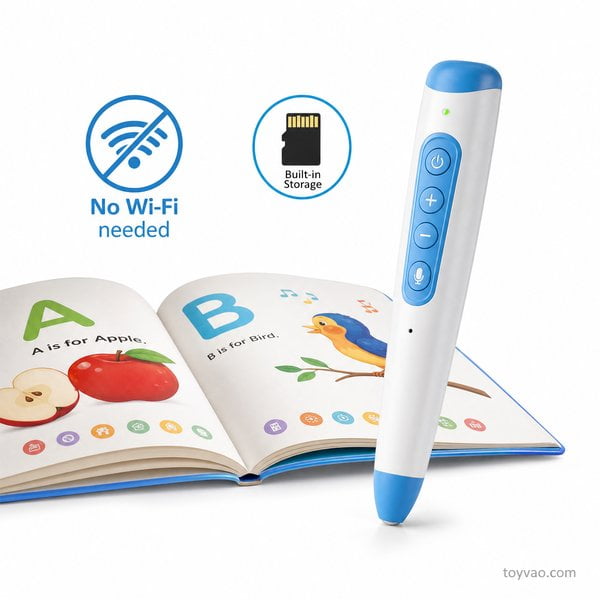
Does a Reading Pen Work Offline? Essential Insights for B2B Buyers
In the rapidly evolving landscape of educational technology, reading pens have emerged as powerful tools for enhancing literacy and language acquisition. For B2B buyers – including importers, distributors, brand owners, and educational institutions across the US, Europe, and globally – a critical question often arises: Does a reading pen work offline? Understanding the offline capabilities of these devices is paramount for ensuring seamless integration into diverse learning environments, maintaining data privacy, and guaranteeing uninterrupted educational support. This article delves into the technology behind reading pens, their offline functionality, and the significant advantages this offers to B2B partners.
Understanding Reading Pen Technology: OID vs. OCR
Reading pens primarily leverage two distinct technologies to convert printed text into audible speech: Optical Identification (OID) and Optical Character Recognition (OCR). The choice of technology significantly impacts a pen’s offline capabilities and its suitability for various B2B applications [1].
Optical Identification (OID) Pens
OID reading pens operate by detecting microscopic dot patterns pre-printed beneath text or images on specially encoded books or materials. When the pen’s optical sensor touches these patterns, it instantly triggers the playback of corresponding audio files stored locally on the device. This mechanism ensures that OID pens are inherently designed for fully offline operation. They do not require any internet connection, Bluetooth pairing, or external apps for their core function, making them ideal for screen-free, instant audio feedback in early learning and special education settings [2].
Optical Character Recognition (OCR) Pens
OCR scanning pens, such as those used for dyslexia support or translation, utilize a tiny camera to scan printed text. The built-in OCR software then converts these scanned images into digital text strings, which are subsequently read aloud by a text-to-speech (TTS) engine. For basic scanning and reading functions, many high-quality OCR pens are designed to work offline, with dictionaries and text-to-speech capabilities embedded directly on the device. However, advanced features like cloud-based translation or software updates might occasionally require an internet connection [3].
The Critical Advantage of Offline Functionality for B2B Buyers
For B2B stakeholders, the offline capability of reading pens offers a multitude of strategic advantages that directly impact product utility, market reach, and user satisfaction.
Uninterrupted Learning Environments
Offline functionality ensures that learning can occur anywhere, anytime, without dependence on Wi-Fi or cellular data. This is crucial for educational institutions in remote areas, classrooms with unreliable internet access, or for students using the pens during commutes or at home where connectivity might be limited. A stand-alone reading pen is independent of any connection, allowing students to use it in school, at home, or even on a school bus, minimizing distractions and maximizing learning continuity [1].
Data Privacy and Security
In an era of heightened data privacy concerns, offline reading pens offer a secure solution. Without an internet connection, there is no risk of sensitive user data being transmitted or stored on external servers, addressing critical compliance requirements for educational and institutional buyers. This ensures privacy and peace of mind for both institutions and parents.
Cost-Effectiveness and Scalability
Deploying offline-capable reading pens reduces the need for costly internet infrastructure or ongoing data plans, presenting a more economical solution for large-scale procurement. This makes them highly scalable for distributors and brands looking to penetrate markets with varying technological infrastructures.
Exam Compliance and Focused Learning
Many examination boards and educational settings prohibit internet-connected devices to prevent cheating. Offline reading pens, particularly those with text-to-speech but no internet access, are often approved as assistive technology in secure testing environments. Furthermore, the absence of internet connectivity eliminates digital distractions, allowing learners to maintain focus solely on the reading material [3].
Key Considerations for Sourcing Offline Reading Pens
When selecting reading pens for your B2B needs, understanding the nuances of OID and OCR technologies, especially concerning their offline operation, is vital. The following table provides a comparative overview:
| Feature/Technology | OID Reading Pens | OCR Reading Pens |
|---|---|---|
| Offline Operation | Fully offline for core functions; audio files stored on device. | Mostly offline for basic scanning/TTS; some advanced features (e.g., cloud translation) may require internet. |
| Content Dependency | Requires specially printed books/materials with invisible OID codes. | Works with almost any printed text (books, newspapers, labels). |
| Response Time | Instantaneous audio playback upon touch. | Slight delay (1-2 seconds) for scanning and processing. |
| Primary Use Cases (B2B) | Early language acquisition, interactive learning systems, special education, custom curricula with pre-encoded materials. | Dyslexia support, language learning (pronunciation, dictionary), general text scanning, exam accommodations. |
| Key Advantage | Seamless, screen-free, distraction-free learning experience. | Versatility with a wide range of printed materials. |
Toyvao’s Commitment to Offline-Capable Reading Pens
As a leading educational toy manufacturer based in Shenzhen, China, established in 2009, Toyvao specializes in OEM/ODM solutions for global brands, wholesalers, and retailers. Our commitment lies in developing high-quality reading pens that prioritize robust offline functionality, ensuring reliability, privacy, and an optimal learning experience. We understand the diverse needs of the global B2B market and engineer our products to meet stringent international standards such as CE, FCC, and EN71/ASTM, guaranteeing both safety and performance [4].
Conclusion
The question, Does a reading pen work offline? can be definitively answered with a resounding yes for the majority of core functionalities. This offline capability is not merely a feature but a fundamental advantage, offering B2B buyers unparalleled benefits in terms of uninterrupted learning, enhanced privacy, cost-effectiveness, and compliance with educational standards. By partnering with a manufacturer like Toyvao, who understands and prioritizes these critical aspects, B2B clients can confidently source reading pens that empower learners worldwide.
References
- C-Pen. (n.d.). What online and offline capabilities do you need in a reader pen? Retrieved from https://cpen.com/insights/what-online-and-offline-capabilities-do-you-need-in-a-reader-pen
- Alibaba.com. (2026, April 30). OID Technology Reading Pen Guide: How to Choose Wisely. Retrieved from https://electronics.alibaba.com/buyingguides/oid-reading-pen-guide-how-it-works-what-to-choose
- Reading-Pen.com. (n.d.). What is a Talking Pen? How It Works (OID vs OCR Technology Guide). Retrieved from https://www.reading-pen.com/blogs/what-is-a-talking-pen-and-how-does-it-work-a-beginner-s-guide.html
- Scanning Pens. (2026, February 5). How Do Reading Pens Work and Which Features Actually Matter? Retrieved from https://www.scanningpens.co.uk/blog/how-do-reading-pens-work-and-which-features-actually-matter
Ready to Elevate Your Educational Product Line?
Ready to source high-quality reading pens for your brand? Contact Toyvao today at sales@toyvao.com or WhatsApp us at +86 186 8106 4480 for a custom quote and free sample.
