
Executive Summary
This guide compares OID (Optical ID) reading pens — also known as picture book reading pens, story pens, or talking book pens — across three performance dimensions that matter for bulk B2B buyers: sensor accuracy, response time (latency), and cost per unit. It provides measurable criteria, test methods, and cost models to support procurement decisions at MOQ tiers commonly used in educational product sourcing (500 / 1,000 / 5,000+ units).
Key findings:
– OID-based pens remain the lowest-latency, highest-accuracy option for printed picture books when proper printing controls are in place. Typical real-world response times range 50–150 ms with accuracy >98% in controlled conditions.
– Camera/OCR-based pens offer broader flexibility for non-OID content but have longer latencies (200–600 ms) and require heavier processing hardware (higher BOM cost).
– RFID/NFC approaches provide near-instant response (<50 ms) but add per-book tag cost and are less precise for point reading on detailed images.
– Cost per pen (CIF, FOB) varies by feature set: low-end OID pens (basic audio, mono speaker, 8 MB flash) start at $8–$12/unit at 5,000 MOQ; mid-range OID pens (stereo audio, 64–128 MB, Bluetooth) $16–$28/unit at 1,000 MOQ; high-end models (Wi‑Fi, 16–32 GB, HD audio, rugged casing) $30–$55/unit at 500 MOQ.
– Total project cost must include printed book unit cost, OID pattern printing setup, tooling/mold amortization ($2,000–$12,000), firmware/customization fees ($1,000–$20,000 depending on scope), freight, taxes, and inspection.
This guide explains the technical trade-offs, provides test methods and acceptance criteria, outlines realistic pricing models at different volumes, and supplies a step-by-step decision and supplier-evaluation workflow for bulk buyers.
What Is Picture Book Reading Pen and Who Uses It
Definition
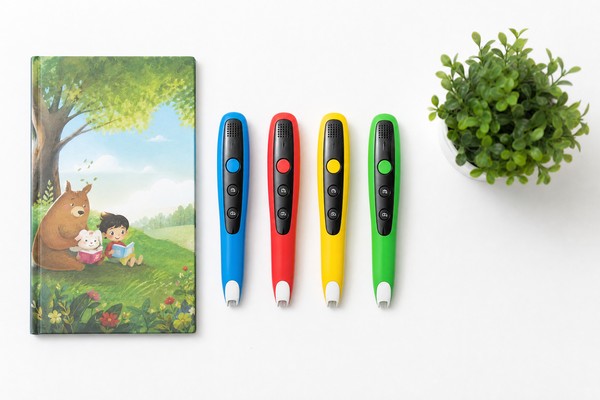
– A Picture Book Reading Pen (OID Reading Pen / Story Pen / Talking Book Pen) is a handheld electronic device that plays pre-recorded audio when its sensor is tapped on locations in a printed book that contain a machine-readable code (OID pattern) or other trigger. The pen contains a sensor, microcontroller (or SoC), audio DAC, amplifier, battery, and speaker; more advanced models include Bluetooth/Wi‑Fi, touchscreen, camera, microphone, and expandable memory.
Primary uses
– Early childhood literacy: read-along narration, phonics, vocabulary reinforcement.
– Language learning: spoken-word pronunciation, bilingual content, repetition drills.
– Special education: audio cues for visual impairments or learning difficulties.
– Library and classroom resource: low-cost audio augmentation for existing printed materials.
– Branded products: promotional storybooks or interactive manuals in toys and FMCG.
Primary buyers
– Educational publishers and content houses acquiring pens + printed materials.
– Toy manufacturers integrating pens as accessories in product SKUs.
– Distributors and retailers who resell pen-book bundles.
– NGOs and government agencies for literacy programs, often in bulk procurement with tender specifications.
Market expectations
– Pen must read encoded content reliably for children aged 3–9.
– Durable construction to withstand drops, chewing, and repeated use.
– Safe battery chemistry and compliance with children’s product standards.
– Straightforward content management workflow for audio updates and localization.
Why Demand Is Growing
Education and product drivers
– Rising demand for blended learning products that combine physical books with digital audio to increase engagement and reading fluency.
– Growth in early education spending in developing markets where low-cost interactive devices offer a scalable literacy tool.
– Brand differentiation: toy companies add interactive reading accessories as higher-margin add-ons.
Operational drivers for buyers
– Lower production costs for OID printing at scale versus embedding electronics within books.
– Reduced need for smartphones/tablets in low-connectivity environments — pens are offline-capable.
– Content re-use: same pen model supports multiple books via book-specific OID maps.
Technology maturation
– OID printing and sensor accuracy have improved; modern sensors are robust across offset and digital print methods.
– Bluetooth and wireless updates reduce logistics costs for content revisions.
– Battery and speaker tech improvements yield longer playtime and higher perceived quality without major cost increases.
Procurement trends
– Buyers increasingly specify measurable acceptance criteria (latency, misread rate, battery cycles) rather than generic “works well” statements.
– Buyers seek modular suppliers that can deliver both hardware and content/services to reduce vendor management overhead.
Key Technology Differences
Core sensing technologies
– OID (Optical ID / Invisible ID) sensor: reads a printed high-density dot or micro-pattern matrix embedded in book artwork. Advantages: small, robust to touch position; low processing need; fast response. Limitations: requires specialized printing process and exact mapping of OID codes to audio assets.
– Camera/OCR: uses a small camera and image processing to locate areas on a page. Advantages: flexible mapping, no special printing required; can support free-form recognition. Limitations: higher latency, larger SoC, higher power draw, sensitive to lighting.
– RFID/NFC tags: each page or hotspot has a passive tag read by the pen. Advantages: very fast, resistant to visual damage. Limitations: per-book tag cost, tag placement limitations, harder to achieve pinpoint location on detailed pictures.
– Capacitive touch overlays: less common; require conductive inks or overlays and are either limited to coarse zones or need specialized manufacturing.
Sensor performance metrics to compare
– Recognition accuracy: percent of correct ID reads per tap under specified conditions (target >98% for production pens).
– False positive rate: taps that trigger incorrect or unintended audio (target <0.5%).
– Response time (latency): time from pen contact to audible playback start — measure in milliseconds (ms).
– Detection area: physical diameter or hotspot size that will trigger the sensor (mm). Smaller area gives finer granularity.
Processing architectures
– Microcontroller-based (low-power MCU): typical for OID pens; low cost and low latency; limited audio codecs and storage.
– Application processor (ARM Cortex-A class): used for camera/OCR and Wi‑Fi capable pens; enables advanced codecs, streaming, and remote updates; higher BOM and cost.
– Hybrid: MCU for sensor handling and audio playback, separate BT/Wi‑Fi SoC for connectivity.
Audio subsystems
– DAC resolution and sample rate: 8 kHz/8-bit is common for speech-only, 16 kHz/16-bit preferred for better clarity, 44.1 kHz rarely used except in high-end models.
– Speaker power: 0.5–3.0 W; larger speakers give richer sound but need larger housing.
– File formats: MP3 (lossy) most common; WAV/PCM used for ultra-low-latency playback or archival. Support for AAC/OGG is variable.
– Volume control and audio equalization may be present.
Power systems
– Battery size: 200–1500 mAh; playtime varies with speaker power and use (typical 8–25 hours for 800 mAh at medium volume).
– Charging: micro-USB vs USB‑C; some models include charging docks.
– Battery safety: must meet UN38.3 for air transport, and child product battery testing per regional rules.
Mechanical and industrial design
– Material: ABS/PC plastics with child-safe finishes. Shell design affects cost and durability.
– Impact resistance: suppliers often quote drop tests (e.g., 1.2 m drop onto concrete) and anticipated failure rates.
– Buttons and stylus tip materials matter for repeated contact with paper surfaces.
Software and content management
– Offline mapping between OID codes and audio files stored on the pen.
– Content transfer methods: USB mass storage, OTG, Bluetooth file transfer, Wi‑Fi OTA updates, SD/TF card.
– CMS tools: web-based content management for mapping and packaging audio files into pen firmware or user data partitions.
Key Features and Specifications to Evaluate
Minimum acceptance specification (recommended for bulk buyers)
– Recognition accuracy: ≥98% correct reads per 1,000 random taps in intended printing and environmental conditions.
– Response time (latency): ≤150 ms from contact to audio start for OID-based pens.
– False trigger rate: ≤0.5% per 1,000 non-target touches.
– Battery life: ≥10 hours continuous play (medium volume) or ≥2,000 on/off cycles.
– Storage: 64 MB minimum for multi-book support; 256 MB–2 GB recommended for broader audio libraries.
– Speaker output: ≥1 W RMS with SNR ≥55 dB for clear in-class listening.
– Drop test: survive 1.2 m drops per ASTM/EN standards with no functional degradation.
– Connectivity: USB or USB‑C charging & mass storage; optional Bluetooth 4.2+/BLE for accessory sync.
Detailed specifications to request from suppliers
– Sensor type and part number (e.g., dedicated OID photodiode array, camera CMOS model).
– Sensor sampling rate and effective read resolution (dots/mm or code density).
– Sensor field of view and detection spot size in mm.
– Time-to-first-byte: internal processing time measured in ms.
– Firmware update method, recovery procedures, and whether bootloader is locked.
– Audio codec support list (MP3, WAV, AAC), sample rates supported, and max bitrate.
– Battery chemistry, capacity (mAh), charge cycle rating (>300 cycles typical), charging current and time.
– Memory type (NOR/NAND/eMMC) and endurance (erase/write cycles).
– Expected Mean Time Between Failures (MTBF) or projected failure rates.
– Compliance certificates: CE, RoHS, EN71/ASTM F963, FCC, and UN38.3 for lithium batteries.
– Recommended printing specs for OID patterns: dot size, ink density, plate registration tolerances, printing press types (offset vs digital), and prepress files.
Testing and QA metrics
– Tap stress: 50,000+ taps without failure for durable pens.
– Environmental limits: operating temp (-10°C to 45°C) and storage temp.
– Acoustic tests: frequency response curve, distortion at nominal output, and measured SPL at 0.5 m.
– EMI/EMC test results if sold into markets with strict standards.
Optional but differentiating features
– Stereo playback and balanced output.
– Built-in microphone for recording/playback or voice games.
– On-device language switching and UI audio prompts.
– Child-lock or parental control features.
– Multi‑book mapping with auto-detect and rapid switching (<500 ms).
Pros and Cons
OID (Optical ID) pens — Pros
– Low latency: 50–150 ms typical.
– High accuracy when books printed to spec: >98% recognition.
– Low processing requirements → lower BOM and better battery life.
– Works offline; secure (no external connectivity required).
– Economical at scale: low per-unit BOM cost.
OID pens — Cons
– Requires printing to exact specifications; print setup and quality control add cost and complexity.
– Less flexible if customer wants to use arbitrary non-OID content or scanned material.
– Upfront mapping between OID pattern and audio assets required; content pipeline must be managed.
Camera/OCR pens — Pros
– Flexibility: can work with standard print without special codes.
– Enables features like word recognition, free-form tapping, and handwriting reading.
– Better for multi-use devices where customers want to read arbitrary text.
Camera/OCR pens — Cons
– Higher latency: 200–600 ms.
– Higher BOM cost for processor, memory, and camera.
– Greater power consumption → shorter battery life.
– More sensitive to lighting and book reflectivity.
RFID/NFC-enabled pens — Pros
– Very fast reads (<50 ms) and robust to visual wear.
– Good for coarse-grained hotspots or where invisibility is unnecessary.
RFID/NFC pens — Cons
– Add per-book tag cost ($0.05–$0.40 per tag depending on volume and type).
– Harder to achieve fine-grained positional accuracy on complex images.
– Book manufacturing process must manage tag placement and lamination issues.
Overall trade-offs
– If primary use is read-along picture books with controlled production, OID is the best balance of speed, accuracy, and cost.
– For flexible content or non-standard printing, consider camera/OCR but budget for higher unit cost and longer latency.
– For interactive toys that require near-real-time response with coarse hotspots, RFID/NFC can be efficient.
Step-by-Step Decision Guide
Step 1 — Define functional requirements
– Target age range and expected environments (classroom, home, library).
– Primary use cases: read-along narration, word lookup, games, language drills.
– Required content update model: on-site USB upload vs OTA via Wi‑Fi.
– Durability expectations: drop height, water resistance, sanitation requirements.
Step 2 — Set measurable acceptance criteria
– Recognition accuracy: target ≥98% under sample conditions (define illumination, print method).
– Response time: specify max latency in ms.
– Battery life: specify minimum hours of continuous play at specified volume.
– Packaging, labeling, and safety standards required in target markets.
Step 3 — Request detailed technical RFP from suppliers
– Require part numbers for sensors and SoC, memory and speaker specs, firmware update methods, EMC and battery certifications.
– Provide sample page art file and request test prints with OID codes applied to demonstrate in-house testing.
Step 4 — Sample orders and technical evaluation
– Order 3–5 hardware prototypes and 3–5 sample printed pages from supplier’s recommended print house.
– Perform these tests:
– Latency measurement: use oscilloscope or smartphone-based high-speed audio capture to measure ms from tap to audio onset across 100 taps.
– Accuracy test: 1,000 random taps across multiple pages and operators; record misreads and false triggers.
– Environmental test: repeat accuracy in low and high ambient light and slight rotation/angle of pen.
– Battery test: continuous playback at medium volume until shutdown; measure hours.
– Durability: drop tests per spec and child abuse simulation (button mashing, chewing on tip).
– Audio quality: compare frequency response and intelligibility across sample audio files.
– Require supplier to provide factory test logs and production QA methods.
Step 5 — Negotiate commercial terms
– MOQ and price breaks at 500 / 1,000 / 5,000 units.
– Tooling amortization: clarify who pays molds, and how cost is amortized.
– Warranty and defect rate SLAs: aim for <2% DOA and <1% RMA rate annually for hardware.
– Lead times: confirm tooling (if needed) and production lead times; typical 6–10 weeks after sample approval for first production run.
– Payment terms: negotiate partial payment upon sample/production milestone and balance on shipping.
Step 6 — Production QA and inbound inspection
– Pre-production sample sign-off: updated firmware and production samples.
– During-production inspection (DPI) at 10–20% completion and final random inspection (AQL 2.5/4.0).
– Shipping sample retention for compliance and recall traceability.
– Arrange independent lab testing for safety (if required).
Step 7 — Post-delivery and support plan
– Firmware update pipeline and responsibilities for content updates.
– Spare parts and repair options: e.g., replacement speakers, charging ports.
– Local warranty claims process and stock of spare units for logistics.
Pricing and Cost Analysis
Typical BOM cost drivers
– Sensor solution: OID sensor module $0.80–$2.50; camera module $4–$12; RFID reader $0.60–$2.00.
– Processor: MCU class $1–$4; application SoC $6–$22.
– Memory: 8 MB NOR $0.50; 64–128 MB NAND/eMMC $1.50–$3.50; 8–32 GB eMMC $6–$20.
– Speaker: $0.30–$2.00.
– Battery: 200–1500 mAh Li-ion $0.90–$4.50.
– Enclosure and mold amortization: $0.60–$3.50/unit depending on MOQ and complexity.
– Assembly, firmware, testing: $0.80–$3.00/unit.
– Connectivity module (Bluetooth/Wi‑Fi): $1.50–$6.00.
Representative end-unit FOB price bands (examples)
– Basic OID pen (single speaker, 8–64 MB, no BT, micro-USB): MOQ 5,000 → FOB $8–$12/unit.
– Mid-range OID pen (stereo, 128–512 MB, BT 5.0, USB‑C): MOQ 1,000 → FOB $16–$28/unit.
– Premium pen (Wi‑Fi, 8–32 GB, HD audio, rugged casing, mic): MOQ 500 → FOB $30–$55/unit.
– Camera/OCR pen (SoC, camera, larger memory): MOQ 500 → FOB $40–$80/unit.
Book printing and OID pattern costs
– Full-color 20–32 page children’s book (offset printing, coated paper): $0.40–$1.50 per copy at 5k–10k quantities depending on size, paper, varnish.
– OID printing is typically an extra prepress step; per-book cost is minimal at scale but setup/plate costs can add $100–$800 extra upfront for each book or printing run. Estimate incremental per-book OID application $0.02–$0.15.
– For RFID/NFC solutions add $0.05–$0.40 per tag depending on antenna complexity and volume.
Other procurement costs to model
– Tooling/mold: $2,000–$12,000 depending on complexity; amortize over initial run.
– Firmware/customization: $1,000–$20,000 depending on license and change requests.
– Packaging: $0.20–$2.00 per unit depending on full retail vs bulk pack.
– Logistics: air freight vs sea freight — sea freight (20–40’ container) spreads costs; add CIF logistics $0.50–$3.50/unit depending on order size and distance.
– Duties and VAT: depends on destination country; budget 0–20% on landed cost.
– Inspection and testing labs: $500–$3,500 per run.
Example landed cost calculation (mid-range OID pen + book) — 1,000 units
– FOB pen unit price: $20
– Book per unit (20 pp): $0.90
– Packaging/box per unit: $0.70
– Tooling amortized per unit: $3,000 tooling / 1,000 = $3.00
– Firmware customization amortized: $6,000 / 1,000 = $6.00
– QC and testing per unit: $0.80
– Sea freight + insurance per unit: $1.50
– Duties/VAT estimate (10%): on FOB+book+packaging ≈ $2.66
Total landed per unit (approx): $20 + $0.90 + $0.70 + $3.00 + $6.00 + $0.80 + $1.50 + $2.66 ≈ $35.56
Note: This example highlights that customization and small MOQ tooling can dominate landed cost; optimizing these factors is critical.
Negotiation levers for buyers
– Increase MOQ to reduce per-unit tooling and component costs.
– Standardize on reference designs to avoid major firmware charges.
– Consolidate content production to a single print run and book-size standard.
– Negotiate multi-year or multi-title commitments to reduce per-book prepress fees.
Competitive Landscape
Supplier categories
– ODM hardware manufacturers (Shenzhen/Guangdong): provide complete pen hardware and optional content services; strong on cost, faster iteration cycles, broad component sourcing.
– Specialized edu-tech OEMs: focus on software-guided content authoring tools and localized support; higher per-unit cost but easier content management.
– Print shops partnered with hardware vendors: offer bundled book + OID printing services which reduce integration friction.
– System integrators and distributors: buy hardware and resell bundled solutions with white-label options.
Differentiation factors
– Hardware engineering: quality of sensor tuning, power optimization, and robust firmware.
– Content ecosystem: CMS, language packs, authoring tools, licensing agreements.
– Manufacturing quality and QA discipline: demonstrated certifications, production test coverage.
– Service and support: willingness to support localization, SLA for repairs, spare parts, and firmware patches.
Regional strengths
– China: volume manufacturing, fastest lead times, cost advantages; strong OEM ecosystem for components and assembly.
– Southeast Asia: increasing manufacturing capacity for higher-safety or higher-margin runs.
– Europe/US: smaller number of vendors focusing on premium devices with stronger compliance and service support; higher unit price.
Risk profile
– Single-supplier sourcing risk for both hardware and OID printing — consider dual-source critical components like speaker, battery, and sensor.
– IP and firmware lock-in: confirm firmware IP ownership and whether you will receive source or only binary updates.
– Supply chain disruptions: define alternative components and substitution clauses in contracts.
What Buyers Say
Common procurement feedback
– “Early pilots looked good until we scaled and print tolerances shifted.” Buyers underline that OID performance depends heavily on consistent printing and press control.
– “Battery life varied substantially between suppliers despite same mAh rating.” Buyers found that amplifier and firmware volume/idle strategies create large differences.
– “Firmware updates were a negotiation — some suppliers retain bootloader control.” Buyers insist on defined firmware update procedures and recovery options.
– “Support response time and spare part availability determined whether we’d scale another title.” Post-sale support matters as much as initial price.
– “Supplier test data must map to our test protocol.” Buyers prefer to supply a test plan rather than accept supplier’s claimed spec sheets.
Satisfaction drivers
– Reliable out-of-box performance across the first 12 months.
– Transparent defect handling and spare part supply.
– Clear content workflow and minimal manual packaging work on the buyer side.
Common complaints
– Inconsistent audio labeling and mapping errors causing misreads.
– Hidden costs: artwork conversion for OID, firmware personalization, and shipping flags.
– Poor documentation on printing tolerances and pre-press files.
Recommendations from experienced buyers
– Insist on pre-approval production prints and run pilot batches with the specific print house you will use in production.
– Lock basic features and file formats early to avoid costly rework.
– Include acceptance tests and penalties in contracts for high-volume runs.
Safety, Maintenance and Compliance
Regulatory standards to require and verify
– Electrical and RF: CE (EU), FCC (US) where applicable.
– Toy safety: EN71 (Europe), ASTM F963 (US) for toys intended for children. Confirm material compliance (phthalates, lead).
– Battery and transport: UN38.3 and ICAO/IATA guidance for lithium batteries in air freight.
– Chemical restrictions: RoHS, REACH where applicable.
– Labeling: age grade, choking hazard warnings, and language requirements for target markets.
– Privacy: if device records voice or connects online, ensure COPPA compliance and local data protection rules (GDPR in EU).
Recommended product hygiene and maintenance
– Design: smooth, food-grade plastics for easy cleaning; avoid crevices where saliva and dirt can accumulate.
– Cleaning: wipe with damp cloth and mild detergent; do not submerge unless device has IPX rating.
– Tip replacement: provide spare stylus tips and clear replacement instructions to maintain reading accuracy.
– Battery maintenance: instruct users to avoid extreme temperatures and to charge within recommended voltage ranges.
– Firmware updates: provide clear OTA or USB update procedures and fail-safe bootloader to recover bricked units.
Testing and inspection procedures
– Pre-shipment safety testing: independent lab certification for target markets.
– Random sample testing: AQL 2.5/4.0 for functional tests including sensor accuracy and audio playback.
– Battery cell batch testing: verify capacity, internal resistance, and cell heat signature during charge/discharge cycles.
Recall and incident handling
– Establish traceability: serial numbers, batch codes, and retained sample units.
– Define recall plan and responsibilities in supply contract, including cost split for logistics and refunds.
– Maintain a local support network for returns processing and repair.
Frequently Asked Questions
Q: What is the typical response time for OID reading pens?
A: Typical OID pen latency is 50–150 ms from contact to audible playback for optimized devices. Latency sources include sensor read time (~10–40 ms), internal mapping lookup (~5–30 ms), codec decoding (~5–50 ms), and amplifier wake time. Specify max allowable end-to-end latency in your RFP.
Q: How accurate are OID sensors in production conditions?
A: Under controlled printing and environmental conditions, accuracy >98% per 1,000 randomized taps is achievable. Accuracy degrades with poor printing registration, low contrast inks, or highly reflective varnishes. Always require supplier-supplied print guidelines and perform incoming print QA.
Q: How much does adding Bluetooth or Wi‑Fi increase unit price?
A: Expect an incremental BOM and integration cost of $1.50–$6.00 per unit for Bluetooth, $4–$12 for Wi‑Fi, plus firmware development time and potential hardware redesign that can add tooling and certification costs.
Q: Are firmware updates feasible at scale?
A: Yes. Options are USB mass storage updates, Bluetooth OTA (for BT-enabled pens), or Wi‑Fi for high-end models. Ensure the supplier provides a recovery bootloader and documented update procedure. Plan for firmware QA and version control.
Q: What are acceptable defect rates on large production runs?
A: Industry expectations vary, but aim for DOA <2% and annual RMA <1% for well-managed supply chains. Contractually define allowable AQLs and remedies for failed acceptance tests.
Q: Can existing print houses apply OID patterns?
A: Many modern offset/digital printers can apply OID patterns with prepress support. However, final registration tolerances must be validated. Some buyers prefer the pen supplier to control OID prepress to prevent mapping misalignment.
Q: What is the minimum order quantity for customization?
A: Hardware customization often requires MOQ 500–1,000 units due to tooling and firmware amortization. Purely white-labeling an off-the-shelf pen can be done at lower MOQ but expect lead times and unit price impacts.
Q: Are there content licensing concerns?
A: Yes. Audio content rights, translations, and music licensing must be cleared. Confirm who holds or provides licensing and include indemnity clauses in contracts.
Contact Toyvao
For procurement assistance, sample requests, testing protocols, and supplier matchmaking, contact Toyvao:
– Email: sales@toyvao.com
– Website: https://www.toyvao.com
– Inquiry details to include: required MOQ, target markets, target latency and accuracy specs, book page count and sample artwork, desired customization, and preferred delivery timeline.
Provide sample art files and a short technical brief when contacting us to accelerate supplier matching and cost estimates.
