
Introduction
As the global market for educational toys continues to expand at an unprecedented rate, reading pens (also known as talking pens) have become a staple in early childhood education. These interactive devices offer an engaging, screen-free way for children to learn languages, phonics, and storytelling. However, as parents and educators become increasingly health-conscious, a critical question frequently arises in consumer forums and retail inquiries: Can loud reading pens damage children’s hearing?
For B2B buyers, importers, brand owners, and educational institutions, addressing this concern is not just about child safety—it is a crucial factor in product compliance, brand reputation, and long-term market success. Partnering with a reliable manufacturer is essential to ensure that the products you source meet stringent international safety standards while delivering exceptional educational value. Toyvao, a leading children’s toy manufacturer based in Shenzhen, China, with over 15 years of OEM/ODM experience, specializes in producing high-quality, volume-controlled reading pens that prioritize both educational efficacy and auditory safety.
Understanding the Risks of Excessive Noise in Children’s Toys
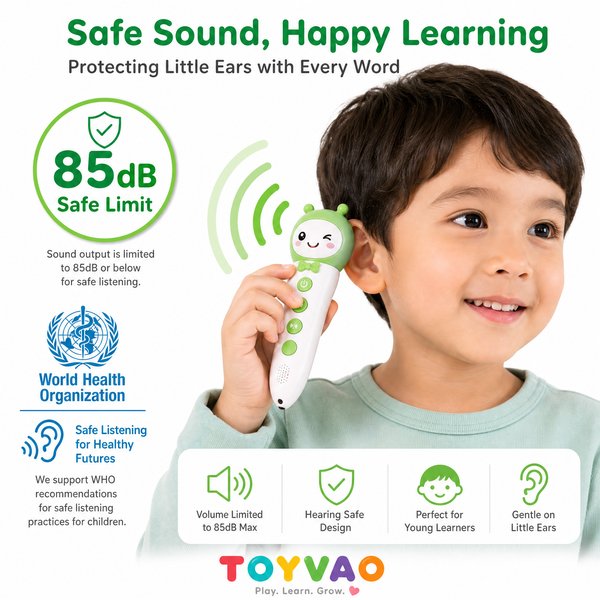
Children’s auditory systems are still developing, making them significantly more susceptible to noise-induced hearing loss (NIHL) than adults. The inner ear of a young child is highly sensitive to loud, sudden noises as well as prolonged exposure to elevated sound levels. According to the World Health Organization (WHO), exposure to sounds above 85 decibels (dB) for prolonged periods can cause permanent, irreversible hearing damage [1].
Unfortunately, many unregulated electronic toys on the market can emit sounds exceeding 90 dB. The risk is compounded by the way children interact with reading pens. Toddlers frequently hold the speaker of the pen directly against their ear to hear the audio more clearly, especially in noisy environments like classrooms or playrooms. When a device emitting 90 dB is placed directly against the ear, the sound pressure level experienced by the eardrum increases dramatically, posing a severe risk to auditory health.
For distributors and educational institutions, sourcing reading pens that lack proper volume control mechanisms poses significant liability risks and can lead to devastating product recalls. Therefore, understanding acoustic safety standards is paramount when selecting an OEM/ODM manufacturing partner.
Acoustic Safety Standards for Reading Pens
To mitigate the risks associated with loud toys, various international regulatory bodies have established strict acoustic safety standards. Compliance with these standards is non-negotiable for brands aiming to penetrate highly regulated markets in North America, Europe, and beyond.
Key International Certifications
When sourcing reading pens, B2B buyers must ensure that the products comply with the following critical certifications:
- ASTM F963 (United States): This comprehensive standard mandates that the sound pressure level for close-to-the-ear toys must not exceed 65 dB, and for handheld toys, it should remain strictly below 85 dB.
- EN 71-1 (Europe): The European standard specifies similar acoustic limits, ensuring that toys do not emit peak emission sound pressure levels that could harm a child’s hearing during foreseeable use.
- CE, FCC, and RoHS: Beyond acoustic safety, these essential certifications guarantee that the electronic components are safe, non-toxic, electromagnetically compatible, and free from hazardous substances.
Toyvao’s reading pens are rigorously tested in certified laboratories to meet and exceed these international standards, providing absolute peace of mind for importers and brand owners.
How Toyvao Ensures Auditory Safety in Reading Pens
At Toyvao, we understand that balancing clear audio quality with auditory safety is a complex technical challenge that requires extensive engineering expertise. Our dedicated R&D team has developed advanced acoustic solutions tailored specifically for children’s educational devices.
Advanced Volume Control Mechanisms
Our reading pens feature built-in, tamper-proof volume limiters that cap the maximum sound output at a safe 85 dB, regardless of how the user interacts with the device. Additionally, we utilize high-fidelity, low-distortion speakers that deliver crisp pronunciation and clear storytelling without the need for excessive volume. This ensures that children can hear the subtle nuances of language learning—such as phonics and tonal variations—without straining their ears or risking hearing damage.
Material and Acoustic Design Considerations
Beyond internal electronics, the physical design of the reading pen plays a vital role in acoustic safety. We meticulously design our speaker grilles to disperse sound evenly across a wider area, preventing concentrated sound waves from directly impacting the eardrum when the pen is held close to the face. Furthermore, the materials used in the pen casing are selected for their acoustic dampening properties, reducing harsh treble frequencies that can be particularly damaging to young ears.
Acoustic Safety Comparison
The following table illustrates the stark differences between standard unregulated reading pens and Toyvao’s safety-optimized reading pens:
| Feature | Standard Unregulated Reading Pens | Toyvao Safety-Optimized Reading Pens |
|---|---|---|
| Maximum Volume Output | Often exceeds 90 dB | Strictly capped at 85 dB (adjustable via firmware) |
| Speaker Quality | Low-cost, high distortion at high volumes | High-fidelity, low distortion for clear phonics |
| Acoustic Certification | Often lacking or unverified | Fully compliant with ASTM F963 & EN 71-1 |
| Proximity Safety | High risk when held close to the ear | Sound dispersion design minimizes direct impact |
| Customization (OEM/ODM) | Limited to basic color changes | Fully customizable volume limits, audio, and design |
The Business Impact of Sourcing Safe Reading Pens
For B2B buyers, the decision to source volume-controlled, safety-certified reading pens directly impacts the bottom line and long-term business viability.
Enhancing Brand Reputation and Consumer Trust
In today’s information age, parents are increasingly researching the safety features of the toys they purchase. Brands that actively promote the auditory safety of their reading pens can command a premium price and build long-term consumer loyalty. Market data suggests that educational toys with verified safety certifications experience a 25% higher conversion rate in retail environments compared to non-certified alternatives [2]. Furthermore, educational institutions are strictly mandated to purchase only certified safe equipment, opening up lucrative B2B sales channels for compliant brands.
Minimizing Return Rates and Liability
Sourcing non-compliant toys can lead to disastrous consequences, including costly product recalls, legal liabilities, and permanent damage to a brand’s reputation. By partnering with an experienced manufacturer like Toyvao, distributors can significantly reduce their return rates, avoid regulatory fines, and ensure smooth customs clearance across global markets.
Flexible OEM/ODM Solutions for Global Markets
Different regions may have varying acoustic requirements and language preferences. Toyvao offers highly flexible OEM/ODM customization options, allowing brand owners to adjust the default volume settings, pre-load specific educational content, and customize the exterior design to align perfectly with their brand identity. With a reasonable Minimum Order Quantity (MOQ), robust durability, and a streamlined production process, Toyvao provides a high Return on Investment (ROI) for our B2B partners.
Conclusion
So, can loud reading pens damage children’s hearing? Yes, if they are poorly designed and lack proper volume controls. However, by sourcing from a reputable manufacturer that prioritizes acoustic safety, B2B buyers can completely eliminate this risk and turn safety into a powerful selling point.
Ensuring that your educational toys comply with international safety standards like ASTM F963, EN 71-1, CE, FCC, and RoHS is essential for protecting end-users and securing your brand’s position in the highly competitive educational toy market. Toyvao’s 15 years of OEM/ODM experience make us the ideal partner for developing safe, engaging, and high-quality reading pens that parents trust and children love.
Ready to elevate your product line with safety-certified reading pens? Contact Toyvao today to discuss your OEM/ODM requirements, request samples, and explore our comprehensive manufacturing solutions.
Contact Toyvao:
- Email: sales@toyvao.com
- WhatsApp: +86 186 8106 4480
References
[1] World Health Organization (WHO). (2023). Childhood Hearing Loss: Strategies for Prevention and Care.
[2] Global Educational Toy Market Insights. (2024). Consumer Purchasing Trends and Safety Certification Impacts in Early Learning Devices.
