
Beyond the Page: Can a Reading Pen Read Any Book? A B2B Deep Dive into Compatibility and Customization
In the rapidly evolving landscape of educational technology, reading pens have emerged as powerful tools, transforming how children interact with books and learn new languages. These innovative devices promise an engaging, auditory learning experience, making reading more accessible and enjoyable. However, a common question arises among B2B buyers, distributors, and educational brands: Can a reading pen truly read any book? The answer, while nuanced, is crucial for anyone looking to source or customize these devices effectively. At Toyvao, a leading educational toy manufacturer based in Shenzhen, China, we understand the intricacies of this technology and are here to provide clarity for your sourcing needs.
How Reading Pens Work: The Technology Behind the Magic
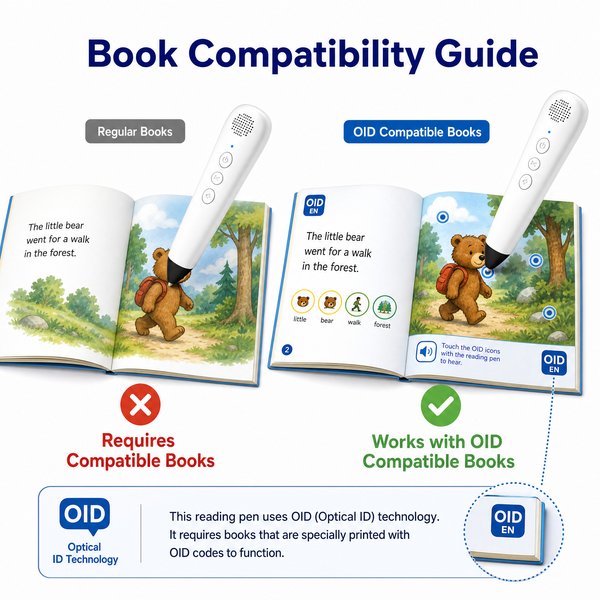
To understand compatibility, it’s essential to grasp the fundamental technology driving reading pens. These devices are not simply universal scanners. Instead, they rely on sophisticated optical recognition technology that interacts with specially encoded books. Each page, and often individual words or images, in a compatible book contains tiny, invisible codes. When the pen’s optical sensor touches these codes, it triggers the playback of corresponding audio files stored within the pen’s memory or accessible via a connected database. This means the pen must be pre-programmed with the specific audio content linked to the unique codes printed in the book. Without these embedded codes and the corresponding audio data, a reading pen cannot “read” a standard book.
Decoding Compatibility: What Makes a Book “Readable”?
The ability of a reading pen to “read” a book hinges entirely on its compatibility with the book’s encoding. This compatibility is influenced by several key factors:
- Proprietary Encoding Systems: Many reading pen manufacturers utilize their own proprietary encoding systems. This often means a pen from one brand will only work with books specifically designed and encoded by that same brand or its licensed partners.
- Content Development: The audio content (narration, sound effects, music) must be meticulously developed and synchronized with the printed codes. This is a significant investment in content creation and intellectual property.
- Firmware and Software: The pen’s internal software (firmware) must be able to interpret the specific codes found in the book and access the correct audio files. Updates are sometimes required for new book series.
- Publisher Partnerships: For a reading pen to work with a wide range of books, extensive partnerships with various publishers are necessary to encode their existing or new titles.
Toyvao excels in navigating these complexities, offering solutions that bridge the gap between technology and diverse educational content. Our expertise allows us to develop pens and content that meet specific market demands.
The Power of Customization: Tailoring Reading Pens for Your Market
While a reading pen cannot read *any* book off the shelf, the true power for B2B clients lies in customization. Toyvao specializes in OEM/ODM services, enabling partners to create reading pen solutions perfectly tailored to their target markets and educational objectives. This includes:
- Custom Content Development: We can help you develop or integrate audio content for your specific curriculum, language requirements, or proprietary book series.
- Multilingual Support: Our pens can be programmed to support multiple languages, making them ideal for diverse global markets.
- Feature Customization: From memory capacity and battery life to interactive games and recording functions, we can customize the pen’s features to your specifications.
- Branding and Design: Create a unique product with your branding, colors, and ergonomic designs.
With Toyvao, you benefit from our strict quality control processes and adherence to international standards, including CE, FCC, EN71, and RoHS certifications, ensuring a reliable and safe product for your customers.
| Compatibility Factor | Description | Implication for B2B Sourcing |
|---|---|---|
| Content Encoding | Books must contain invisible, machine-readable codes linked to audio files. | Requires sourcing pre-encoded books or developing custom encoded content. |
| Pen Technology | The pen’s optical sensor and firmware must match the book’s encoding system. | Ensures seamless interaction; proprietary systems limit cross-brand compatibility. |
| Audio Data Storage | Audio files are stored in the pen or accessed via external memory/cloud. | Affects content capacity and update mechanisms. |
| Publisher Support | Collaboration with publishers to encode their titles for pen compatibility. | Determines the breadth of available compatible books. |
| Customization (OEM/ODM) | Ability to create bespoke pens and content for specific markets. | Offers flexibility to tailor solutions for unique educational programs or brands. |
Conclusion & Call to Action
In conclusion, while the dream of a single reading pen reading every book remains a future aspiration, the current technology offers immense value through specialized, interactive learning experiences. The key for B2B buyers is to understand the importance of compatibility and to leverage the power of customization. Toyvao stands as your reliable partner in this endeavor, offering high-quality, certified reading pens and comprehensive OEM/ODM services. Whether you are looking to distribute existing solutions or develop a unique educational product, our expertise ensures your success.
Ready to enhance your educational product line with cutting-edge reading pen technology?
Contact Toyvao today for wholesale inquiries, OEM/ODM customization, and to discuss how we can bring your vision to life. Visit our contact page at https://toyvao.com/contact/ to learn more.
