
For B2B buyers sourcing talking flash cards, the relationship with the product doesn’t end when the container leaves the Shenzhen port. To build a sustainable brand, importers must establish robust systems for collecting feedback directly from the end-users: parents, teachers, and speech-language pathologists (SLPs). Relying solely on public e-commerce reviews is reactive; successful brands implement proactive feedback loops.
Why Is Proactive Feedback Collection Essential?
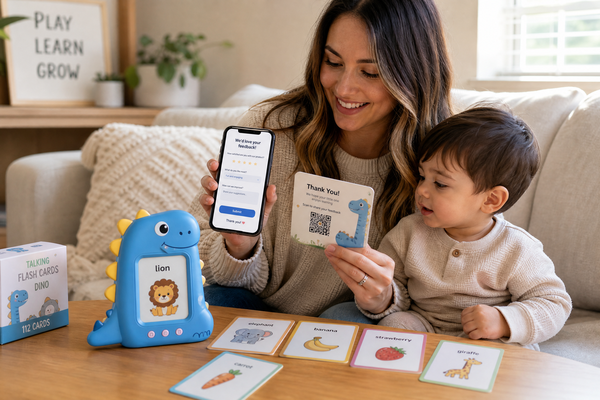
Public reviews are often polarized—customers typically only leave reviews if they are extremely happy or extremely angry. Proactive feedback collection captures the silent majority. This data is invaluable for understanding how the product is actually used in the home or classroom.
For instance, the American Academy of Pediatrics (AAP) notes that interactive toys should foster joint attention between parent and child, rather than replacing human interaction [1]. By surveying parents, a brand might discover that parents want a “quiz mode” to interact with their children, a feature that can be easily added in the next production run via a firmware update.
How Can Brands Systematically Gather Data?
Implementing a feedback loop requires integrating data collection mechanisms into the product packaging and the post-purchase customer journey.
- QR Codes on Packaging and Manuals: Include a prominent QR code on the instruction manual or a dedicated insert card. This code should link to a short, mobile-friendly survey. Incentivize completion with a digital reward, such as a free downloadable coloring book or an extended warranty.
- Post-Purchase Email Sequences: If selling through a direct-to-consumer (DTC) website or platforms that share customer emails, set up an automated email sequence. Send a “How is it working?” email 14 days after delivery, specifically asking about audio clarity and card durability.
- Beta Testing Groups: Before launching a new version of the talking flash cards, distribute samples to a closed group of beta testers. This group should include target demographics, such as parents of toddlers or special education teachers.
Proactive Feedback Channels vs. Reactive Reviews
| Feedback Channel | Timing | Type of Data Collected | Primary Benefit |
|---|---|---|---|
| Public E-commerce Reviews | Reactive (Post-issue) | Extreme satisfaction or severe defects | Highlights urgent quality control failures |
| In-Box QR Code Surveys | Proactive (Days 1-7) | Initial setup experience, perceived value | Identifies confusing instructions or missing accessories |
| Post-Purchase Emails | Proactive (Days 14-30) | Long-term durability, feature usage | Drives future product iterations and accessory ideas |
| Beta Testing Panels | Pre-Launch | Usability, educational effectiveness | Prevents costly mistakes before mass production |
How Toyvao Supports Your Feedback Loop
At Toyvao, we understand that your customer’s feedback is the key to our mutual success. We support our B2B partners’ feedback strategies by offering flexible packaging customization.
We can easily integrate your custom QR codes, survey links, and extended warranty registration cards into the final packaging during assembly. Furthermore, when you gather data indicating a desired feature—such as adding a volume control button or expanding the vocabulary set—our OEM/ODM team is ready to rapidly prototype and implement those changes for your next order. Partner with Toyvao to build a product that evolves with your customers’ needs.
References
[1] American Academy of Pediatrics (AAP). “Selecting Appropriate Toys for Young Children in the Digital Era.”
[2] World Health Organization (WHO). “Improving early childhood development.”
[3] The Toy Association. “Trends in Toys and Play.”
Need a manufacturer that supports your product iteration strategy? Contact Toyvao today!
Email: sales@toyvao.com | WhatsApp: +86 186 8106 4480
